

Don’t Be the “Ghost” of Namsan Tower: How to Say “I’m Waiting” in Korean
Phase 1: The Waiting Game (Introduction)
안녕하세요! Hello! This is your Daily Hangul Editor.
Imagine this scene: You are the main character in a K-Drama. It’s the first snow of the year. You are standing at Namsan Tower, clutching a hot pack, waiting for your date. They are late. 10 minutes pass… then 20.
Suddenly, your phone buzzes. It’s them asking, “Where are you?”
You want to say, “I’m waiting for you right here!” with all the dramatic flair of a season finale.
But if you just look up “wait” in the dictionary and shout “기다려! (Gidaryeo!)”, you might sound like you are training a puppy, not talking to your date. 🐶
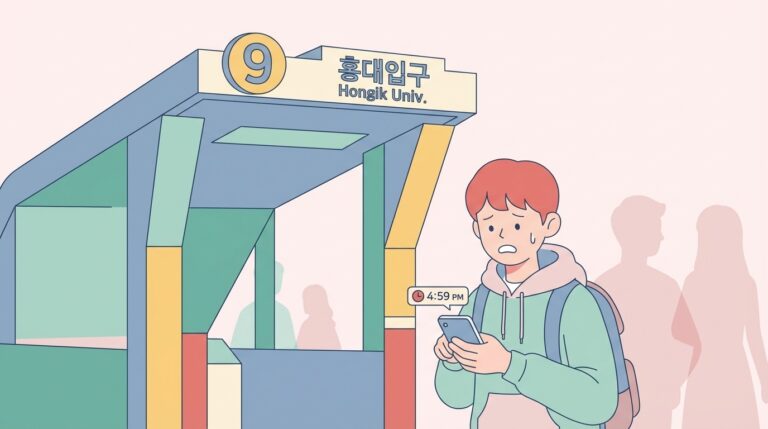
Waiting is a huge part of Korean culture—from waiting for your friends at Hongdae Station Exit 9 to waiting in a 2-hour line for that viral bagel shop in Gangnam. Today, let’s learn how to express “I’m waiting” naturally, politely, and with the perfect nuance so you don’t get lost in translation.
Phase 2: Deep Dive into “I’m Waiting”
Here are the must-know expressions for when you are the one checking the clock.
1. 기다리고 있어요 (Gidarigo isseoyo)
- Pronunciation: [Gi-da-ri-go i-sseo-yo]
- Sound Analogy: Gi (like ‘Key’) + da (like ‘Dad’) + ri (like ‘Re’ in Re-do) + go + i-sseo-yo.
- Meaning: “I am waiting.”
- K-Culture Moment: This is the standard phrase used in K-Pop lyrics when fans promise to wait for their idols to return from the military. It implies a continuous state of being—you are in the middle of waiting.
- Editor’s Insight: The ending ~고 있어요 (~go isseoyo) is the magic glue here. It turns a verb into “-ing” (present continuous). It shows you haven’t left; you are still there.
- Situation Spectrum:
[🚫 To Boss] ———— [⚠️ To Colleagues] ———— [✅ To Friends/Strangers]- Note: It is polite enough for most situations, but for a boss, you might add more honorifics (which is Level B1, so let’s stick to this safe bet for now!).
2. 어디예요? (Eodiyeyo?)
- Pronunciation: [Eo-di-ye-yo?]
- Sound Analogy: Eo (like the ‘u’ in ‘Uh-oh’) + di + ye-yo.
- Meaning: “Where are you?”
- K-Culture Moment: Every thriller movie ever. The protagonist holds the phone, looking around nervously in a dark alley. “Eodiyeyo?”
- Editor’s Insight: In Korea, asking “Where are you?” is the softest way to say “Why aren’t you here yet?” It’s less aggressive than “Why are you late?”
- Situation Spectrum:
[🚫 To Boss] ———— [⚠️ To Colleagues] ———— [✅ To Friends]
🤔 Think About It:
Korean grammar focuses heavily on the state of action (~go isseoyo). Why do you think it’s important to emphasize that you are currently waiting, rather than just saying “I wait”? Does this reflect the “Palli-palli” (Hurry up) culture where current status updates are crucial?
Phase 3: Textbook vs. Real Life
| Situation | 📖 Textbook Korean | 🗣️ Real Street Korean | 💡 Why the difference? |
|---|---|---|---|
| Waiting for a friend | 저는 기다립니다. (Jeoneun gidarimnida) |
나 기다리고 있어. (Na gidarigo isseo) |
“~nida” is too robotic for friends. Drop the “yo” and “Jeoneun” for closeness. |
| Running late | 늦어서 죄송합니다. (Neujeoseo joesonghamnida) |
거의 다 왔어! (Geoui da wasseo!) |
Koreans often say “I’m almost there!” even if they are 10 mins away to reassure you. |
| Asking status | 당신은 어디입니까? (Dangsineun eodi-imnida?) |
어디야? (Eodi-ya?) |
We rarely use the word “Dangsin” (You). It sounds like a translated script or a fight! |
Phase 4: Cultural Deep Dive — The Art of Waiting
4-1. The “Phone check” Nunchi (눈치)
When you say “기다리고 있어요,” your body language speaks louder. Standing with your arms crossed and tapping your foot signals anger. Instead, holding your phone and looking around anxiously signals, “I’m worried/eager to see you.”
4-2. K-Food Connection: The “Wei-ting” List
If you visit popular restaurants in Seoul (like the trendy bagel or donut shops), you will hear the staff say ” 웨이팅 있어요” (Weiting isseoyo). Yes, they use the English word “Waiting”!
* K-Tip: You usually need to write your phone number on a tablet at the entrance. If you don’t have a Korean number, say: “저 한국 번호 없어요. (Jeo Hanguk beonho eopseoyo.)”
Phase 5: Roleplay Scenario — The “Hongdae Exit 9” Crisis
Setting: Friday night, 7:00 PM. The legendary Hongdae Station Exit 9. It is packed with people. You are squeezed between a street performer and a couple selling flowers.
Characters:
* YOU: A hungry traveler.
* Minji: Your Korean friend who is notoriously bad with directions.
(Phone Call Starts)
Minji: 여보세요? 미안해! 길이 너무 막혀. 🚗
(Yeoboseyo? Mianhae! Giri neomu makhyeo.)
(Hello? Sorry! Traffic is so bad.)
YOU: 괜찮아요. [ 1. ______________ ]?
(Gwaenchanayo. _________?)
(It’s okay. Where are you?)
Minji: 지금 합정역이야. 너는 어디야?
(Jigeum Hapjeong-yeok-iya. Neoneun eodiya?)
(I’m at Hapjeong station. Where are you?)
YOU: 저는 홍대입구역 9번 출구에서 [ 2. ______________ ].
(Jeoneun Hongdae-ipgu-yeok 9-beon chulgu-eseo _________.)
(I am waiting at Hongdae Station Exit 9.)
🔀 Your Turn! How do you fill in the blanks?
Blank 1:
* A) 누구예요? (Who are you?)
* B) 어디예요? (Where are you?) [✅ Correct!]Blank 2:
* A) 기다려! (Wait! – Too rude!)
* B) 기다리고 있어요. (I am waiting.) [✅ Correct!]
* C) 가고 있어요. (I am going/coming.)
Phase 6: 10-Second Shadowing Drill
Let’s practice the rhythm. Repeat after the guide markings.
- 😊 Friendly: 저 / 여기서 / 기다리고 있어요.
(Jeo / yeogiseo / gidarigo isseoyo.)
(I’m waiting right here.) -
🤔 Curious: 지금 / 어디예요?
(Jigeum / eodiyeyo?)
(Where are you now?) -
😰 Anxious (Bonus): 빨리 / 와요!
(Ppalli / wayo!)
(Come quickly!)
Phase 7: K-Culture Glossary
| Korean | Romanization | English | Context |
|---|---|---|---|
| 약속 | Yaksok | Promise / Plan | Unlike English, “Yaksok” covers both serious promises and casual plans to meet. |
| 빨리빨리 | Palli-palli | Hurry-hurry | Korea’s speed culture. Waiting is often disliked unless it’s for food or idols. |
| 맛집 | Matjib | Delicious house | A trendy restaurant. Waiting in line here is considered a badge of honor. |
Phase 8: Traveler’s Survival Kit
Situation: You ordered food 20 minutes ago at a busy rest stop, and your number hasn’t been called.
🆘 Survival Phrase #1
* 🇰🇷 “얼마나 기다려야 해요?” (Eolmana gidaryeoya haeyo?)
* 🗣️ Pronunciation: [Eol-ma-na gi-da-ryeo-ya hae-yo?]
* Meaning: How long do I have to wait?
* Where to use: Restaurants, Theme Parks (Lotte World/Everland), Hospitals.📌 Editor’s Travel Note
* Map Apps: Google Maps is often outdated in Korea. Download Naver Map or KakaoMap for accurate arrival times. They even tell you which subway car is closest to the exit (so you don’t keep people waiting!).
Phase 9: Think Deeper — “Palli-Palli” vs. The Line
Why do Koreans hate waiting for elevators but wait 3 hours for a bagel?
Korea is famous for its “Palli-Palli” (Hurry-Hurry) culture. Deliveries arrive overnight, and internet speeds are blazing fast. Waiting creates anxiety because it feels inefficient. However, there is an exception: Trends. If a restaurant or pop-up store is trendy, waiting becomes a social activity. The long line proves the value of the place.
🧠 Think Deeper:
In your country, is a long line a sign of “bad service” or “good quality”? How does your culture view waiting?
Phase 10: FAQ & Troubleshooting
Q: Can I say “기다려 (Gidaryeo)” to a taxi driver if I need to run to the ATM?
A: NO! 🛑 “Gidaryeo” is Banmal (informal/blunt). It sounds like a command. To a taxi driver (who is likely older), say: “잠시만요!” (Jamsimanyo – Just a moment) or “조금만 기다려 주세요” (Please wait a little bit).
Q: What if I am the one late?
A: Don’t just say “Sorry.” Add “금방 가요!” (Geumbang gayo – I’m coming soon/right there). It shows effort.
Phase 11: Wrap-up & Mission
One-Liner: Use “기다리고 있어요” to tell someone you are currently waiting, but never use “기다려” unless you are training a dog!
🚀 Action Mission:
* 🥉 Bronze: Look at yourself in the mirror and say “어디예요?” with a worried face 3 times.
* 🥈 Silver: Next time you order coffee, while waiting for your drink, think to yourself: “커피를 기다리고 있어요.”
* 🥇 Gold: Text a friend who is late for a meeting (or pretend to): “나 OO에서 기다리고 있어!” (I’m waiting at [Place]!)
📺 K-Culture Mission: Watch a K-Drama episode this week. Find a scene where someone is waiting. Do they look at their watch? Do they call? Observe their Nunchi!
Phase 12: Quiz
- Situation: You are meeting your boss at a cafe. You arrived first. Your boss texts: “Are you there?” What do you reply?
- A) 응, 기다려. (Eung, gidaryeo.)
- B) 네, 기다리고 있어요. (Ne, gidarigo isseoyo.)
- Situation: You want to ask the restaurant staff how long the wait is.
- A) 어디예요? (Eodiyeyo?)
- B) 얼마나 기다려야 해요? (Eolmana gidaryeoya haeyo?)
(Scroll down for answers)
.
.
.
Answers:
1. B (A is too rude for a boss!)
2. B (A means “Where are you?”)
Frequently Asked Questions (FAQ)
Q: What does "기다리고 있어요 (Gidarigo isseoyo)" mean in Korean and how do you pronounce it?
A: In Korean, "기다리고 있어요 (Gidarigo isseoyo)" is pronounced [Gi-da-ri-go i-sseo-yo] and means: a key conversational Korean expression covered in this lesson.
Q: What does "어디예요? (Eodiyeyo?)" mean in Korean and how do you pronounce it?
A: In Korean, "어디예요? (Eodiyeyo?)" is pronounced [Eo-di-ye-yo?] and means: a key conversational Korean expression covered in this lesson.






