

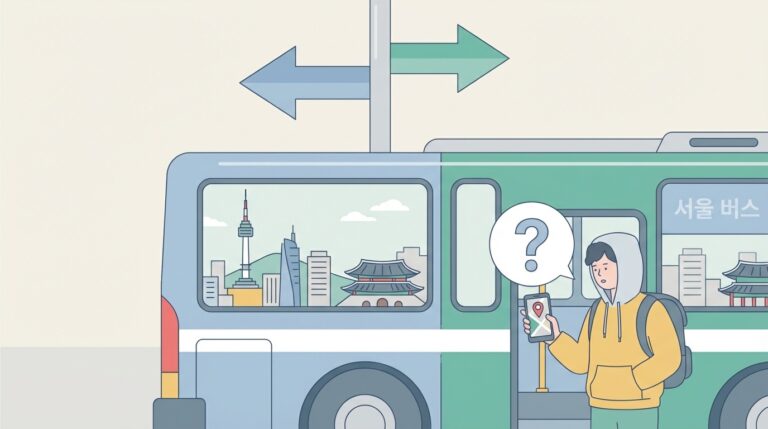
Help! I’m on the Wrong Bus! 🚌 Exploring Korea Like a Local (Even When You’re Lost)
Phase 1: The Immersive Hook
Hello! This is your Daily Hangul Editor.
Picture this: You are in Seoul. It’s evening, and the neon signs are flickering to life. You just hopped on a blue bus, feeling confident like the main character in a K-Drama looking out the window while a sentimental ballad plays in your AirPods. But then, you look at your map app… and your heart sinks.
The blue dot representing you is moving away from your destination.
Panic mode? Not today.
Getting on the bus in the opposite direction is a rite of passage for anyone living in Korea. Even locals do it! The intricate web of Seoul’s transportation system can be tricky. But knowing how to handle this situation turns a travel disaster into a funny anecdote. Today, we aren’t just learning how to say “I’m wrong”; we’re learning how to survive the fast-paced world of Korean public transport with style.
Phase 2: Deep Dive (Key Expressions)
Here are the three life-saving phrases you need when you realize you’re heading to Busan instead of Hongdae.
1. 반대 방향 (Bandae banghyang)
- Pronunciation: [ban-dae bang-hyang] Think of ‘ban’ like ‘ban’ in ‘banner’, and ‘dae’ like ‘day’.
- Meaning: Opposite direction
- K-Culture Moment: In variety shows like Running Man, when members run the wrong way during a mission, the caption often screams 반대 방향!! in giant red letters.
- Editor’s Insight: This is the core vocabulary. ‘반대’ means opposite, ‘방향’ means direction. You’ll see ‘방향’ on road signs everywhere.
- Situation Spectrum:
[🚫 Formal Speech] ———— [✅ Universal] ———— [✅ Casual]
(This is a neutral noun, safe to use anywhere.)- 🤔 Think About It: Why does Korean use Sino-Korean words (based on Chinese characters) for directions? ‘Half-Oppose’ (반대) + ‘Square-Face’ (방향). It feels more academic than native words.
2. 잘못 탔어요 (Jalmot tasseoyo)
- Pronunciation: [jal-mot ta-sseo-yo] ‘Jal’ sounds like ‘jolly’ without the ‘y’.
- Meaning: I got on the wrong one / I boarded incorrectly.
- Context: You say this to the driver or a passenger when asking for help.
- Editor’s Insight: ‘잘못’ (wrongly/mistake) is a magic word. You can use it for wrong numbers (
전화 잘못 거셨어요) or wrong orders too. It implies it was an honest mistake, not intentional.- Situation Spectrum:
[🚫 Friends only] ———— [⚠️ Semi-formal] ———— [✅ Polite/Standard]3. 건너가서 타세요 (Geonneogaseo taseyo)
- Pronunciation: [geon-neo-ga-seo ta-se-yo]
- Meaning: Cross (the street) and ride.
- Context: This is the answer you will hear 99% of the time. The driver points to the other side of the road.
- Grammar Note (B1 Level):
건너가다(to cross over) +-어서(and then/so) +타세요(please ride). It captures the sequence of actions perfectly.
Phase 3: Textbook vs. Real Life
| Situation | 📖 Textbook Korean | 🗣️ Real Korean (Street Smart) | 💡 Why the difference? |
|---|---|---|---|
| Realizing the mistake | 저는 버스를 반대 방향에서 탔습니다. (I took the bus in the opposite direction.) | 아, 반대로 탔다! (Ah, I took it the opposite way!) | Self-talk in Korea often drops the subject and object for speed. |
| Asking the Driver | 기사님, 이 버스는 강남역에 갑니까? (Driver, does this bus go to Gangnam Station?) | 기사님, 이거 강남역 가요? (Driver, does this go to Gangnam?) | ‘이거’ (this thing) is used for the bus itself. It’s faster and punchier. |
| Confirming direction | 반대편에서 타야 합니까? (Must I board from the opposite side?) | 길 건너야 돼요? (Do I have to cross the road?) | Locals focus on the action (crossing the street) rather than the abstract concept (opposite side). |
Bottom Note: In a busy bus, keep it short. Drivers are busy navigating crazy traffic!
Phase 4: Cultural Context — K-Culture Deep Dive
4-1. The Art of “Hwanseung” (Transfer)
In Korea, the “Transfer” (환승 – hwanseung) system is legendary. You get free transfers between buses and subways within 30 minutes.
* The Sound: Listen for the beep.
* “Bip!” (One beep) = Tag on/off successful.
* “Turing!” (Chime sound) = Transfer successful.
* “Bip-bip-bip-bip!” = Error or insufficient funds (The sound of shame. Everyone will look at you. Don’t panic, just try again!).
4-2. The “Palli-Palli” Driver
Have you noticed in K-Dramas that buses sometimes seem to fly? Korean bus drivers are known for their speed.
* Non-verbal Tip: If you realize you are on the wrong bus, do not approach the driver while the bus is moving. It is dangerous and they might get annoyed. Wait until the bus stops at a red light or a station.
* Nunchi (Eye-measure): If the bus is packed (rush hour), shouting from the back is useless. Use your map app. If it’s empty, you can approach the front politely.
Phase 5: Immersive Roleplay
Scenario: It’s a rainy Tuesday. You are on the green bus (No. 7011). You meant to go to Hongdae to meet friends for K-BBQ, but you see the bus crossing a bridge away from the university area.
Characters:
* YOU: A hungry traveler realizing the mistake.
* Driver (Gisanim): A middle-aged man with sunglasses (even in rain), listening to trot music.
(The bus stops at a red light. You approach the front.)
YOU: (Hesitantly) 저기요, 기사님…
(Jeogiyo, gisanim… / Excuse me, driver…)
Driver: (Turns head slightly) 네?
(Ne? / Yes?)
YOU: 혹시 이거 홍대 가나요?
(Hoksi igeo Hongdae ganayo? / By any chance, does this go to Hongdae?)
Driver: 홍대? 아이고, 반대야, 반대.
(Hongdae? Aigo, bandae-ya, bandae. / Hongdae? Oh my, it’s the opposite, opposite.)
🔀 Decision Point! How do you respond?
- A) “죄송합니다. 내릴게요.” (I’m sorry. I will get off.)
- B) “아, 진짜요? 그럼 어디서 타야 돼요?” (Ah, really? Then where should I catch it?)
- C) (Just stand there looking confused)
✅ Best Choice: B. It prompts the solution. Most drivers are helpful if you ask how to fix it.
YOU (Option B): 아, 진짜요? 그럼 어디서 타야 돼요?
(Ah jinjja-yo? Geureom eodiseo taya dwaeyo?)
Driver: 내려서 길 건너가서 타요. 다음 정거장에서 내려요.
(Naeryeoseo gil geonneogaseo tayo. Daeum jeong-geojang-eseo naeryeoyo. / Get off, cross the street, and ride. Get off at the next stop.)
YOU: 네, 감사합니다! (Beep! – Tags card)
(Ne, gamsahamnida!)
Phase 6: 10-Second Shadowing Drill
Practice this until it rolls off your tongue. It’s your lifeline!
“Driver, did I take the opposite direction?”
😢 (With a worried face):
기사님, / 제가 / 반대 방향으로 / 탔나요?
(Gisanim, / jega / bandae banghyang-euro / tannayo?)
“Ah! I have to cross the street!”
💡 (With a realization face):
아! / 길을 / 건너가야 / 돼요!
(Ah! / Gireul / geonneogaya / dwaeyo!)
Phase 7: K-Culture Glossary
| Korean | Romanization | English | Context |
|---|---|---|---|
| 하차 | Hacha | Getting off | You’ll see this written on the back door button or hear it in announcements (하차입니다). |
| 배차 간격 | Baecha gan-gyeok | Dispatch interval | The time you wait between buses. Vital info on the digital signs at stops. |
| 벨 | Bel | Bell | The red ‘Stop’ button. In Korea, you must press this before your stop, or the driver might zoom past! |
| 환승입니다 | Hwanseung-imnida | “It’s a transfer” | The holy sound you want to hear when tagging your card (meaning: $0 charged). |
Phase 8: Traveler’s Survival Kit
When you are totally lost in Seoul:
🆘 Survival Phrases
1. 🇰🇷 “이거 [Place Name] 가는 거 맞아요?” (Igeo [Place] ganeun geo majayo?)
* Meaning: Is this arguably going to [Place]?
* Tip: Show your phone screen with the destination name in big letters.
2. 🇰🇷 “여기서 얼마나 걸려요?” (Yeogiseo eolmana geollyeoyo?)
* Meaning: How long does it take from here?📌 Editor’s Travel Note:
* App is King: Never trust your intuition; trust Naver Map or KakaoMap. Google Maps is often outdated for public transport in Korea.
* Tag Out: Always tag your card when getting off the bus. If you don’t, you’ll be charged double the next time you ride, and your transfer discount will vanish!
Phase 9: Think Deeper — “Palli-Palli” vs. Safety
🧠 Think Deeper: The “Stand Up Early” Phenomenon
In many Western countries, standing up while the bus is moving is discouraged. In Korea, however, you’ll notice people queuing at the back door before the bus stops. Why? This is the embodiment of “Palli-Palli” (Hurry-Hurry) culture. It’s about efficiency and not holding up the collective group.
However, this is changing. Recent campaigns urge passengers to stay seated until the bus stops for safety. But old habits die hard.
💬 Your Turn: In your country, do you wait for the bus to fully stop, or do you get ready to jump off? How does this reflect your culture’s view on time vs. safety?
Phase 10: FAQ & Troubleshooting
- Q: Can I ask the driver questions in English?
- A: Honestly, it’s a 50/50 chance. Younger drivers might know basics, but older drivers might just wave their hands. It’s better to use Papago (translation app) or the simple Korean phrases above.
- Q: I missed my stop! Can the driver let me off in the middle of the road?
- A: NO. This is strictly illegal in Korea for safety reasons. You must wait for the next official stop. Don’t beg; it puts the driver in a difficult position.
- ❌ Common Mistake #1: Asking “Where are you going?” (
어디 가세요?) to the driver.- Why wrong: It sounds like you are asking about the driver’s personal life. Ask if the bus goes to the destination (
이거 [Place] 가요?).
- Why wrong: It sounds like you are asking about the driver’s personal life. Ask if the bus goes to the destination (
Phase 11: Wrap-up
One-Liner Summary: When you catch the wrong bus, stay calm, ask “Igeo [Destination] gayo?”, and prepare to cross the street (Geonneogaseo!).
🚀 Action Missions:
* 🥉 Bronze: Say “아, 반대로 탔다!” out loud next time you make a small mistake (even if it’s just putting your shoes on the wrong feet).
* 🥈 Silver: Download Naver Map and look up a bus route from “Gangnam Station” to “N Seoul Tower”. Check the bus numbers.
* 🥇 Gold: Next time you are in Korea, sit in the front row of a bus and listen to the interactions between passengers and the driver.
Phase 12: Quiz — Interactive Challenge
- Situation: You are on a bus, and the map shows you are going the wrong way. The bus is moving fast. What should you do?
- a) Run to the driver immediately and tap his shoulder.
- b) Press the bell, wait for the stop, and then ask or get off.
- c) Scream “Help!”
- Fill in the Blank:
- Driver: “Student, you took the wrong bus. Cross the street.”
- Driver: “학생, 잘못 탔어. 길 ______ 타.”
- True or False (K-Culture):
- In Korea, you don’t need to tag your card when you get off the bus to get a transfer discount.
(Scroll down for answers)
See Answers
- b) Safety first! Never distract a moving bus driver.
- 건너가서 (Geonneogaseo) – Cross over and…
- False. You MUST tag out (beep!) when getting off to get the transfer discount.
Frequently Asked Questions (FAQ)
Q: What does "반대 방향 (Bandae banghyang)" mean in Korean and how do you pronounce it?
A: In Korean, "반대 방향 (Bandae banghyang)" is pronounced [ban-dae bang-hyang] and means: Opposite direction
Q: What does "잘못 탔어요 (Jalmot tasseoyo)" mean in Korean and how do you pronounce it?
A: In Korean, "잘못 탔어요 (Jalmot tasseoyo)" is pronounced [jal-mot ta-sseo-yo] and means: I got on the wrong one / I boarded incorrectly.
Q: What does "건너가서 타세요 (Geonneogaseo taseyo)" mean in Korean and how do you pronounce it?
A: In Korean, "건너가서 타세요 (Geonneogaseo taseyo)" is pronounced [geon-neo-ga-seo ta-se-yo] and means: Cross (the street) and ride.







