

Phase 1: The Immersive Hook
Greeting: 안녕하세요! Welcome back to Daily Hangul. I’m your editor and local guide, helping you navigate Korea not just with words, but with sense.
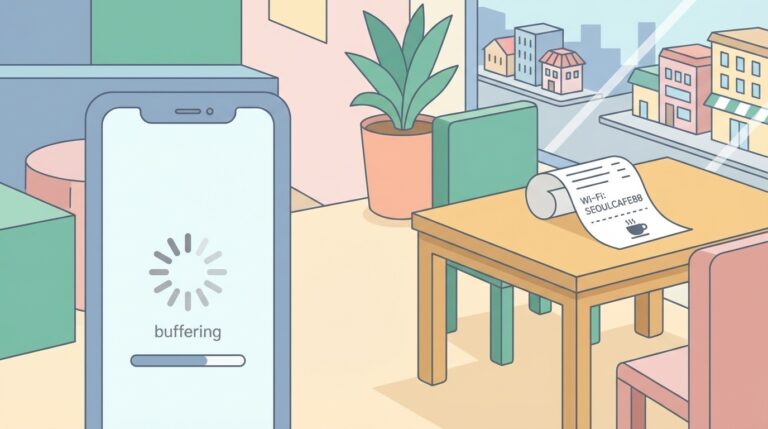
Picture this: You are in a trendy cafe in Seongsu-dong, the Brooklyn of Seoul. You’ve just taken the perfect photo of your latte art to post on Instagram. You hit ‘Upload,’ but the loading circle just spins… and spins. 😱
In K-Dramas, this is usually the moment the protagonist misses a crucial text message that leads to a misunderstanding spanning 16 episodes. In real life, it’s just frustrating. Korea is known for having the fastest internet in the world, but even here, dead zones exist, and data plans run out.
Today, we are going beyond the textbook “Is there Wi-Fi?” to help you survive the digital jungle of Seoul—from deciphering Wi-Fi passwords on receipts to asking friends for a lifeline (hotspot) without sounding rude.
Let’s get you connected. 📶
Phase 2: Deep Dive into Key Expressions
1. 비밀번호 (Bim-il-beon-ho) → 비번 (Bi-beon)
- Pronunciation: [Bi-beon] + Sounds like ‘Bee-Bun’
- Meaning: Literal: Secret Number (Password) → Real: PW / Passcode
- K-Culture Moment: In spy thrillers or crime dramas, you often hear hackers shouting, “비번이 뭐야!” (What’s the password!). In daily life, Koreans love shortening words for efficiency. Bimilbeonho is too long; Bibeon is snappy.
- Editor’s Insight: At a B2 level, you should start using abbreviations (jul-im-mal) like a local. Using the full word sounds a bit formal, like you are filling out a government form.
- Situation Spectrum:
[🚫 Formal/Elders] ———— [⚠️ Strangers/Service] ———— [✅ Friends/Casual]- (Use full word Bimilbeonho with elders or in strict formal settings. Bibeon is safe for friends and usually okay for cafe staff if you are polite.)
- 🤔 Think About It: Why does Korean culture love abbreviations (like Chimaek for Chicken+Maekju, Bibeon for Password) so much? Does it reflect the Ppalli-Ppalli (Hurry-Hurry) culture?
2. 데이터가 안 터져요 (De-i-teo-ga an teo-jyeo-yo)
- Pronunciation: [Deiteoga an teojyeoyo] + ‘Teo’ sounds like the start of ‘Touch’
- Meaning: Literal: The data isn’t bursting/exploding. → Real: The data isn’t working/I have no signal.
- K-Culture Moment: Imagine a K-Pop fan trying to stream a concert ticket purchase, but the screen freezes. They scream, “아, 왜 안 터져!” (Ah, why isn’t it working!).
- Editor’s Insight: The verb 터지다 (teojida) is incredibly versatile. Bombs explode (teojida), lucky jackpots hit (teojida), and in Korea, internet signals also “burst” forth. If you say “The internet is stopping” (멈췄어요), it’s understandable, but “An teojyeoyo” makes you sound like a native.
- Situation Spectrum:
[🚫 Formal Presentation] ———— [⚠️ Colleagues] ———— [✅ Friends/Daily Life]- (Universally used in spoken Korean to describe connection issues.)
- 🤔 Think About It: Using an explosive verb like “burst” for an invisible signal—what does this suggest about the intensity with which Koreans view internet connectivity?
3. 핫스팟 좀 켜 줄 수 있어? (Hat-seu-pat jom kyeo jul su isseo?)
- Pronunciation: [Hatseupat jom kyeo jul su isseo]
- Meaning: Literal: Can you turn on the hotspot for me a little? → Real: Can I tether off your phone?
- K-Culture Moment: In variety shows like Running Man, when members are stranded without phones, they often beg the staff: “Hotspot just for one minute, please!”
- Editor’s Insight: Notice the 좀 (jom). It literally means “a little,” but functionally, it softens a request. Without jom, the sentence sounds like a command. With jom, it sounds like a favor.
- Situation Spectrum:
[🚫 Strangers] ———— [⚠️ Close Colleagues] ———— [✅ Friends/Family]- (Asking a stranger for a hotspot is generally considered rude or weird in Korea, unlike asking for directions.)
- 🤔 Think About It: Data is money. Asking for a hotspot is like asking for a sip of someone’s expensive coffee. How does this reflect boundaries in Korean friendship?
Phase 3: Textbook vs. Real Life
| Situation | 📖 Textbook Korean | 🗣️ Real Korean | 💡 Why the difference? |
|---|---|---|---|
| Asking for Wi-Fi PW | 와이파이 비밀번호가 무엇입니까? (What is the Wi-Fi password?) | 혹시 비번 영수증에 있나요? (Is the PW on the receipt by any chance?) | Koreans avoid direct questions to staff when the info might already be provided (efficiency & nunchi). |
| Slow Internet | 인터넷 속도가 느립니다. (The internet speed is slow.) | 와, 렉 걸려. / 렉 쩐다. (Wow, it’s lagging. / The lag is intense.) | Influenced by gaming culture (Lag = Lex). ‘Jjeonda’ is B2+ slang for ‘intense/dope/bad’. |
| Data runs out | 데이터가 없습니다. (I have no data.) | 나 데이터 거지 됐어. (I became a data beggar.) | Self-deprecating humor is common among friends. |
Phase 4: Cultural Deep Dive — The “Receipt” Ritual
4-1. Non-verbal Communication: The Receipt Check
In many Western countries, you ask the barista for the Wi-Fi code while ordering. In Korea, don’t ask yet!
- Look at the wall: Often, there is a small artistic poster with the ID/PW.
- Look at the receipt (Yeongsujeung): 90% of franchises (Starbucks, Twosome Place) print the Wi-Fi info at the bottom of the receipt.
- The “Kiosk” Era: Since you often order via kiosk, you might skip the counter entirely. If you throw away your receipt, you throw away your internet access!
Nunchi Tip: If you see someone standing up, looking confused at the walls, and holding their phone up, they are looking for the Wi-Fi password. Help them out if you know it!
4-2. K-Drama Trope: The “Read Receipt” Anxiety
In messaging apps like KakaoTalk, the little yellow number ‘1’ disappears when someone reads your message. This is called “1이 없어졌다” (The 1 disappeared).
- The Scene: A character sends a confession. The data signal is weak. The message fails to send. They run around looking for Wi-Fi.
- The Reality: If you say “My data isn’t popping (an teojyeo),” your Korean friends will immediately panic for you, because they know the agony of a delayed KakaoTalk reply.
Phase 5: Immersive Roleplay
Setting: A hip, crowded cafe in Hongdae. You are with your Korean friend, Min-ji. You need to download a large file for work urgently.
Characters:
* YOU: Foreigner living in Seoul, intermediate Korean speaker.
* Min-ji: Your Korean university friend, quick-witted and tech-savvy.
(The Dialogue)
YOU: (Staring at phone frustration) 아, 진짜… 또 이러네.
(Ah, jin-jja… tto i-reo-ne.)
(Ah, seriously… it’s doing it again.)
Min-ji: 왜? 데이터 안 터져? 여기 사람 많아서 그런가 봐.
(Wae? De-i-teo an teo-jyeo? Yeo-gi sa-ram man-a-seo geu-reon-ga bwa.)
(Why? Data not working? I guess it’s because there are so many people here.)
YOU: 응, 중요한 파일 받아야 하는데… 와이파이 잡아야겠다.
(Eung, jung-yo-han pa-il ba-da-ya ha-neun-de… wa-i-pa-i ja-ba-ya-get-da.)
(Yeah, I need to receive an important file… I need to catch [connect to] the Wi-Fi.)
(🎭 Stage Direction: You look around the table, but there is no receipt.)
🔀 Decision Point: How do you ask Min-ji for help?
- Choice A: “민지야, 네 핫스팟 좀 켜 줘.” (Min-ji, turn on your hotspot.)
- Choice B: “저기 직원분한테 와이파이 비번 좀 물어봐 줄래?” (Could you ask the staff for the Wi-Fi PW?)
- Choice C: “혹시 내 영수증 버렸어?” (Did you throw away my receipt by any chance?)
✅ Best Choice: C
* Why: It shows you understand Korean cafe culture (the PW is on the receipt). Min-ji will be impressed by your local knowledge.
* Regarding A: Asking for a hotspot for a large file is risky unless she has an unlimited plan (mu-je-han).
* Regarding B: You can do this, but checking the receipt first is the smarter move.
Min-ji (If you choose C): 아! 맞다. 아까 쟁반에 있었지? 잠깐만… (Looks at the tray) 여기 있다! 비번 엄청 복잡해. ‘a1b2…’
(Ah! Right. It was on the tray earlier, right? Wait… Here it is! The PW is super complex. ‘a1b2…’)
Phase 6: 10-Second Shadowing Drill
Practice this sentence for when the connection is unstable.
- Situation: You are on a video call, and the video keeps freezing.
- Emotion: 😥 Frustrated but polite (답답하지만 정중하게)
잠시만요, / 와이파이가 / 자꾸 / 끊겨요.
(Jam-si-man-nyo, / wa-i-pa-i-ga / ja-kku / kkeun-kyeo-yo.)
“Hold on a second, the Wi-Fi keeps cutting out.”
Phase 7: K-Culture Mini Glossary
| Korean | Romanization | Meaning | Context |
|---|---|---|---|
| 무제한 요금제 | Mu-je-han Yo-geum-je | Unlimited Data Plan | The holy grail of smartphone users. If you have this, you are a ‘Hotspot Philanthropist’. |
| 에그 | E-geu | Pocket Wi-Fi | Named because the early devices looked like eggs. Essential for travelers. |
| 공공 와이파이 | Gong-gong Wa-i-pa-i | Public Wi-Fi | Free Wi-Fi found on buses and subways (e.g., SEOUL_Public). |
| QR 찍다 | QR Jjik-da | Scan QR Code | Often used now to connect to Wi-Fi without typing the password. |
Phase 8: Traveler’s Survival Kit
Module: Smartphone Life
🆘 Survival Phrases for Data Emergencies
1. 🇰🇷 “와이파이 비번 어디에 적혀 있어요?” (Where is the Wi-Fi password written?)
* Use this if you can’t find it on the receipt or wall.
2. 🇰🇷 “충전기 좀 빌릴 수 있을까요?” (Could I borrow a charger?)
* Wi-Fi is useless if your battery is dead. Korean cafes are generous with outlets (look for ‘콘센트’).
3. 🇰🇷 “여기 와이파이 잘 터져요?” (Does the Wi-Fi work well here?)
* Good to ask before you settle down to study.📌 Editor’s Travel Note: The Subway Login
When using Public Wi-Fi on the Seoul Metro (Subway), it often asks you to log in. Don’t panic! Usually, there is a “General / Visitor” button. You might need to watch a 15-second ad, but hey, it’s free!
Phase 9: Think Deeper — Connectivity as a Culture
Topic: The “Right” to Be Connected
In Korea, internet access is almost viewed as a basic human right, similar to water or electricity. You will find high-speed Wi-Fi in obscure hiking trails and deep underground subway tunnels.
Think About It: Why is this infrastructure so critical in Korea? It supports the “Ppalli-Ppalli” (Hurry) culture, but it also enforces a social expectation: You must always be reachable. In your country, is it acceptable to be “offline” for a day? In Korea, being unreachable often causes genuine worry or annoyance among friends and colleagues. The technology that connects us also binds us.
💬 Your Turn: How do you say “My phone died” (so I couldn’t reply) in your language? Is it a valid excuse?
Phase 10: FAQ & Troubleshooting
- Q: Can I ask a stranger for a hotspot if it’s an emergency?
- Editor: Strictly speaking, no. Data is considered a paid personal asset. It’s better to go into a cafe, buy the cheapest drink, and use their Wi-Fi. Or, look for an “Open” network.
- Q: The staff pointed at the kiosk when I asked for the password. Why?
- Editor: They weren’t being rude! They were indicating that the password is printed on the receipt you get from the kiosk. Don’t throw it away!
- ❌ Common Mistake: Pronouncing ‘Wi-Fi’ as ‘Wee-Fee’.
- Correction: In Korea, it is pronounced [Wa-i-pa-i]. If you say ‘Wee-Fee’ (like in some European countries), people might not understand.
Phase 11: Wrap-up & Action Mission
One-Liner: In Korea, the Wi-Fi password is usually on the receipt, and “Data not bursting” (안 터져요) is the most native way to complain about bad signals.
🚀 Action Missions:
* 🥉 Bronze: Look at your own home router. Read the password out loud using Korean numbers/letters.
* 🥈 Silver: Go to a Korean cafe (or any cafe). When you get the receipt, circle where the Wi-Fi info is (or would be). Say “비번 여기 있다” (Here is the PW).
* 🥇 Gold: Change your phone’s language setting to Korean for 1 hour. Try to navigate the “Wi-Fi” or “Settings” menu. (Warning: Memorize the icon positions first!)
K-Culture Mission: Next time you watch a K-Drama, spot a scene where a character is frustrated with their phone. Are they complaining about the battery (배터리) or the data (데이터)?
Phase 12: Interactive Quiz
- Situation: You are at a cafe. You see the text “PW: a1b2c3” on the wall. How do you tell your friend?
- A) 비번 저기 있다! (The PW is over there!)
- B) 내 핫스팟 켜 줄게. (I’ll turn on my hotspot.)
- C) 데이터가 안 터져. (The data isn’t bursting.)
- True or False (K-Culture): Most Koreans will happily share their personal Hotspot with a stranger on the subway.
- (True / False)
- Fill in the Blank: “Wait, the video call keeps disconnecting.”
- 잠시만요, 영상 통화가 자꾸 _________.
(Answers below)
.
.
.
Answers:
1. A (Use ‘Bibeon’ for password.)
2. False (Data is personal property; use public Wi-Fi instead.)
3. 끊겨요 (Kkeun-kyeo-yo)
Frequently Asked Questions (FAQ)
Q: What does "비밀번호 (Bim-il-beon-ho) → 비번 (Bi-beon)" mean in Korean and how do you pronounce it?
A: In Korean, "비밀번호 (Bim-il-beon-ho) → 비번 (Bi-beon)" is pronounced [Bi-beon] and means: Literal: Secret Number (Password) → Real: PW / Passcode
Q: What does "데이터가 안 터져요 (De-i-teo-ga an teo-jyeo-yo)" mean in Korean and how do you pronounce it?
A: In Korean, "데이터가 안 터져요 (De-i-teo-ga an teo-jyeo-yo)" is pronounced [Deiteoga an teojyeoyo] and means: Literal: The data isn't bursting/exploding. → Real: The data isn't working/I have no signal.
Q: What does "핫스팟 좀 켜 줄 수 있어? (Hat-seu-pat jom kyeo jul su isseo?)" mean in Korean and how do you pronounce it?
A: In Korean, "핫스팟 좀 켜 줄 수 있어? (Hat-seu-pat jom kyeo jul su isseo?)" is pronounced [Hatseupat jom kyeo jul su isseo] and means: Literal: Can you turn on the hotspot for me a little? → Real: Can I tether off your phone?







