

Phase 1: Immersive Hook
Greeting: Hello, advanced learners! It’s your Senior Editor from Daily Hangul.
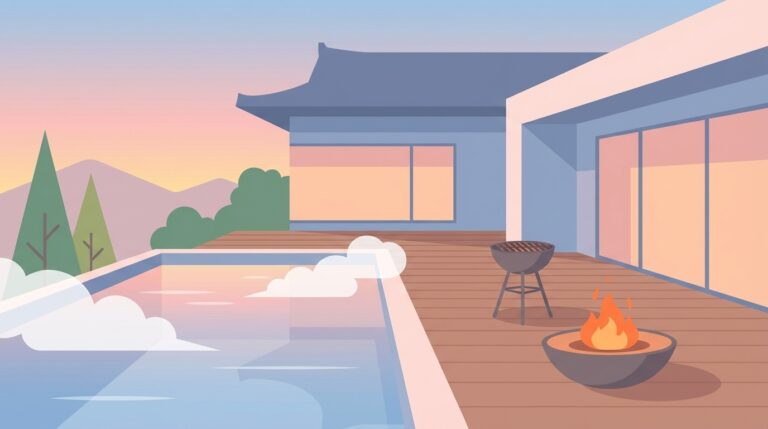
K-Culture Cold Open: Picture this: You’re watching a K-Drama like What’s Wrong with Secretary Kim or Business Proposal. The rich CEO takes the protagonist on a “spontaneous” trip. They arrive at a breathtaking, modern architectural marvel with a private infinity pool overlooking the ocean. The lighting is perfect, the barbecue is sizzling, and there isn’t another soul in sight. This isn’t a hotel; it’s what we call a “Pool Villa (풀빌라)” or a high-end “Pension (펜션).”
The ‘Why’: Here is the reality check. If you book these places using only standard textbook Korean, you might arrive to find a freezing cold pool, pay extra for the grill, or get kicked out for having one too many friends over. The Korean “Pension” system has its own unique set of unwritten rules and specific vocabulary.
Transparency: Today’s guide is based on real struggles my C1 students faced when trying to replicate those K-Drama holiday vibes. Let’s make sure you get the luxury experience you paid for.
Phase 2: Deep Dive into Key Expressions
Since you are at the C1 level, we aren’t just learning words; we are learning policy and negotiation terms.
1. 온수 추가 (Onsu chuga)
- Pronunciation: [On-su chu-ga] (Sounds like ‘Own-sue’ + ‘Chew-gum’ without the ‘m’)
- Meaning: Heating surcharge (Literal: Hot water addition)
- Context: In many Western hotels, a heated pool is standard. In Korea, especially in private pool villas, warm water is an option (옵션) that costs extra (often 50,000 KRW ~ 100,000 KRW). If you don’t say this phrase, you might be swimming in ice water.
- K-Culture Moment: Think of those aesthetic Instagram photos of influencers in bikinis in the middle of winter. That steam rising from the pool? That’s paid steam.
- Editor’s Insight: Be careful with the term ‘미온수’ (Mion-su) vs ‘온수’ (Onsu). Mion-su is lukewarm (around 30°C), while Onsu is properly hot. Ask specifically!
- Situation Spectrum:
[🚫 Formal Biz] ———— [✅ Reservation Inquiry] ———— [✅ Casual]- 🤔 Think About It: Why is heating charged separately? It reflects the Korean consumer habit of “pay for what you use” (rationality) versus the “all-inclusive” service culture. Which do you prefer?
2. 기준 인원 vs 최대 인원 (Gijun inwon vs Chaedae inwon)
- Pronunciation: [Gi-jun in-won] / [Chae-dae in-won]
- Meaning: Standard Occupancy vs Maximum Occupancy
- Context: This is the #1 cause of friction. A villa might be huge, but the Standard (기준) might be 2 people, and Max (최대) is 4. If you bring 4 people, you pay a surcharge for the extra 2 per night.
- K-Culture Moment: In variety shows like 1 Night 2 Days, you see huge groups sleeping together. But in private villas, hosts are very strict about noise and facility wear-and-tear.
- Editor’s Insight: Sneaking people in is a huge taboo (and often monitored by CCTV at the entrance). Just pay the ‘인원 추가 비용’ (Extra person charge).
- Situation Spectrum:
[⚠️ Strict Policy Terminology] ———— [✅ Essential for Booking]3. 불멍 (Bulmeong)
- Pronunciation: [Bul-meong] (Rhymes with ‘Bull’ + ‘Lung’ starting with M)
- Meaning: Spacing out while staring at the fire.
- Context: This is a cultural phenomenon. It’s not just about having a campfire; it’s a meditative activity. When booking, you ask for a “fire pit” setup specifically for Bulmeong.
- K-Culture Moment: Every healing variety show (like In the Soop with BTS) features a scene where members sit silently around a fire. It’s the peak of modern Korean relaxation.
- Editor’s Insight: You usually have to buy a “Firewood Set” (장작 세트) from the host. It’s rarely free.
- Situation Spectrum:
[🚫 Business Meeting] ———— [✅ Friends/Travel] ———— [✅ Social Media]- 🤔 Think About It: Bulmeong (Fire-spacing), Mulmeong (Water-spacing)… Why is the concept of “doing nothing” (멍 때리기) so trendy in hyper-competitive Korea?
Phase 3: Textbook vs Real Life
| Situation | 📖 Textbook Korean | 🗣️ Real Korean (C1 Level) | 💡 Why the difference? |
|---|---|---|---|
| Asking about extra costs | 추가 비용이 있어요? (Is there an extra cost?) | 이거 현장 결제인가요, 포함인가요? (Is this on-site payment or included?) | Koreans distinguish between pre-payment and paying upon arrival (현장 결제). |
| asking about BBQ | 바비큐 할 수 있어요? (Can we do BBQ?) | 그릴은 숯인가요, 전기인가요? (Is the grill charcoal or electric?) | The taste matters. Charcoal (숯) is premium; electric is convenient but less “vibey.” |
| Check-in Inquiry | 체크인하고 싶어요. (I want to check in.) | 입실 안내 문자가 아직 안 와서요. (I haven’t received the check-in text yet.) | Most pool villas are contactless. You receive a code via text, not a key at a desk. |
Phase 4: Cultural Deep Dive
4-1. The “Pension” (펜션) Concept
In Europe, a pension is a modest guest house. In Korea, a Pension (especially a Pool Villa) is often a high-tech, architectural luxury house. It sits between a hotel and an Airbnb. The key cultural difference? Garbage Disposal. Even if you pay $500 a night, you are expected to separate your recycling (분리수거) and wash your dishes before leaving. It is considered basic etiquette (매너).
4-2. K-Drama Connection: The “Meat” Hierarchy
In dramas, you’ll see characters stopping at a mart before arriving at the villa. Why? Because the highlight of a Pension trip is the Samgyeopsal & Hanwoo Party. If you are the one booking the villa, you are the “Command Center.” You need to coordinate: “Does the villa provide seasoning (쌈장/salt)? Or do we need to buy it?”
Phase 5: Immersive Roleplay
Setting: You are messaging the host of “Stay Cloud,” a popular pool villa in Gapyeong. You booked for 2 people but want to add a friend and ensure the pool is warm.
Characters:
* YOU: A meticulous traveler planning a perfect weekend.
* Host: A polite but strictly policy-driven villa owner.
Dialogue:
YOU: 안녕하세요, 이번 주말 예약한 [Your Name]입니다. 문의드릴 게 있어서요.
(Annyeonghaseyo, ibeon jumal yeyakhan [Name]imnida. Mun-ui-deuril ge isseoseoyo.)
(Translation: Hello, I’m [Name] booked for this weekend. I have an inquiry.)
Host: 네, 고객님. 어떤 점이 궁금하신가요?
(Ne, gogaengnim. Eotteon jeomi gunggeumhasingayo?)
YOU: 친구 한 명이 더 갈 것 같은데, 인원 추가 비용은 얼마인가요?
(Chingu han myeongi deo gal geot gateunde, inwon chuga biyung-eun eolmaingayo?)
(Translation: One friend might join us. How much is the extra person charge?)
Host: 1인당 3만 원입니다. 침구류는 저희가 준비해 드려요.
(Irindang 3man wonimnida. Chimgu-ryu-neun jeohuiga junbihae deuryeoyo.)
(Translation: It’s 30,000 won per person. We will provide bedding.)
🔀 Decision Point: Negotiating the Pool Temp!
A) “아, 그리고 수영장 물 따뜻하게 해주세요.”
B) “온수 풀 신청하고 싶은데, 입실할 때 바로 이용 가능한가요?”
C) “미온수 말고 온수로 해주세요. 몇 도까지 올라가나요?”
✅ Best Choice: C
* Reason: At C1 level, precision is key. Simply asking for “warm” might get you 28°C. Asking for the specific temperature (usually 32°C-35°C for winter) ensures you get what you want.
YOU (Choice C): 미온수 말고 온수로 해주세요. 혹시 수온은 몇 도까지 유지되나요?
(Mion-su malgo onsu-ro haejuseyo. Hoksi su-on-eun myeot do-kkaji yuji-doenayo?)
Host: 34도로 24시간 유지됩니다. 추가 요금 5만 원은 현장 결제 부탁드려요.
(34-do-ro 24-sigan yuji-doemnida. Chuga yogeum 5man won-eun hyeonjang gyeolje butakdeuryeoyo.)
(Translation: It’s maintained at 34 degrees for 24 hours. Please pay the 50,000 won surcharge on-site.)
Phase 6: 10-Second Shadowing Drill
Let’s practice verifying the hidden costs clearly but politely.
😤 Firm but Polite:
숯불이랑 / 온수 추가 비용은 / 현장에서 결제하면 되나요?
(Sut-bul-irang / on-su chu-ga bi-yong-eun / hyeon-jang-e-seo gyeol-je-ha-myeon doe-na-yo?)
Translation: For the charcoal fire and heated pool surcharge, can I pay on-site?
Phase 7: K-Culture Mini Glossary
| Korean | Romanization | Meaning | Context |
|---|---|---|---|
| 입실 / 퇴실 | Ipsil / Toesil | Check-in / Check-out | Used specifically for condos/pensions/dorms rather than hotels. |
| 보증금 | Bojeung-geum | Deposit | Sometimes requested for damage security. |
| 독채 | Dokchae | Private/Entire House | Meaning you don’t share the building with anyone else. |
| 픽업 서비스 | Pick-up Service | Pick-up Service | Many rural pensions offer pick-up from the nearest bus/train station. |
| 어메니티 | Amenity | Toiletries | Ask if they provide this; many eco-friendly places now don’t give toothbrushes. |
Phase 8: Traveler’s Survival Kit (Pro Tips)
Topic: Luxury Camping & Pension Locations
🆘 Survival Phrases
1. 🇰🇷 “혹시 픽업 서비스 되나요?” (Hoksi pick-up service doenayo?)
* Translation: Do you offer a pick-up service?
* Why: Many pool villas are deep in the mountains/countryside (Gapyeong, Yangpyeong) and hard to reach without a car.
2. 🇰🇷 “주변에 편의점 있나요?” (Jubyeone pyeoniejeom innayo?)
* Translation: Is there a convenience store nearby?
* Why: Once you drink, you can’t drive. If the store is far, you’re in trouble.
3. 🇰🇷 “배달되는 치킨집 있나요?” (Baedal-doeneun chicken-jip innayo?)
* Translation: Is there a chicken place that delivers here?
* Why: The ultimate late-night snack. Remote villas might be out of delivery zones.📌 Editor’s Travel Note:
Use KakaoMap or Naver Map to check the location. If the address ends in ‘ri’ (리) or ‘san’ (산), it is VERY rural. Ensure you buy all groceries (alcohol, water, snacks) before you check in.
Phase 9: Critical Thinking — “Think Deeper”
Topic: The “Option” Culture (Hidden Costs)
Unlike Western all-inclusive resorts, Korean hospitality often relies on a base price + options (Op-shyun). You pay for the room, but the grill is extra, the fire pit is extra, the pool heat is extra, and extra bedding is extra.
🧠 Think Deeper:
Why is this structure dominant? Some argue it allows rational pricing (why pay for a pool if you won’t use it?). Others see it as a marketing tactic to make the room rate look cheaper on apps. How does this compare to luxury bookings in your country?💬 Your Turn: Have you ever been surprised by a “hidden cost” in Korea? Share your story in the comments!
Phase 10: FAQ & Troubleshooting
Q: Can I invite friends just for dinner (BBQ) and send them home before sleeping?
A: Maybe, but be careful. This is called ‘잠시 방문’ (Visitor). Most high-end villas strictly forbid this or charge the full extra person fee because they use the facilities (water, toilet, dishes). Always ask the host: “잠깐 식사만 하고 갈 지인이 있는데 괜찮나요?” (Is it okay if an acquaintance joins just for the meal?)
❌ Common Mistake: Assuming “Pool Villa” means hotel service.
✅ Fix: It is a rental home. There is no 24/7 concierge. If you need water or towels at 11 PM, you might be out of luck. Check everything upon arrival (Ip-sil).
Phase 11: Wrap-up & Action Mission
One-Liner: Booking a Korean Pool Villa is less about “reservation” and more about “customizing your options”—speak up for the warmth you deserve!
Action Missions:
- 🥉 Bronze: Say “온수 추가는 얼마예요?” (How much for heating?) out loud three times.
- 🥈 Silver: Go to a Korean booking site (like Yeogi Eottae or Naver Booking), find a Pension, and look for the ‘Additional Info’ section to find the BBQ price.
- 🥇 Gold: If you are in Korea, call a Pension owner (or pretend to be one with a friend) and ask about the difference between ‘Mion-su’ and ‘Onsu’.
K-Culture Mission: Watch a clip of I Live Alone (나 혼자 산다) where a celebrity goes glamping. Notice how obsessed they are with the equipment (장비발) and the food setup.
See you in the next lesson! Happy Glamping! 🏕️✨
Frequently Asked Questions (FAQ)
Q: What does "온수 추가 (Onsu chuga)" mean in Korean and how do you pronounce it?
A: In Korean, "온수 추가 (Onsu chuga)" is pronounced [On-su chu-ga] and means: Heating surcharge (Literal: Hot water addition)
Q: What does "기준 인원 vs 최대 인원 (Gijun inwon vs Chaedae inwon)" mean in Korean and how do you pronounce it?
A: In Korean, "기준 인원 vs 최대 인원 (Gijun inwon vs Chaedae inwon)" is pronounced [Gi-jun in-won] and means: Standard Occupancy vs Maximum Occupancy
Q: What does "불멍 (Bulmeong)" mean in Korean and how do you pronounce it?
A: In Korean, "불멍 (Bulmeong)" is pronounced [Bul-meong] and means: Spacing out while staring at the fire.






