

Phase 1: The Immersive Hook
Greeting: 안녕하세요! This is your Daily Hangul editor, back with another delicious slice of Korea.
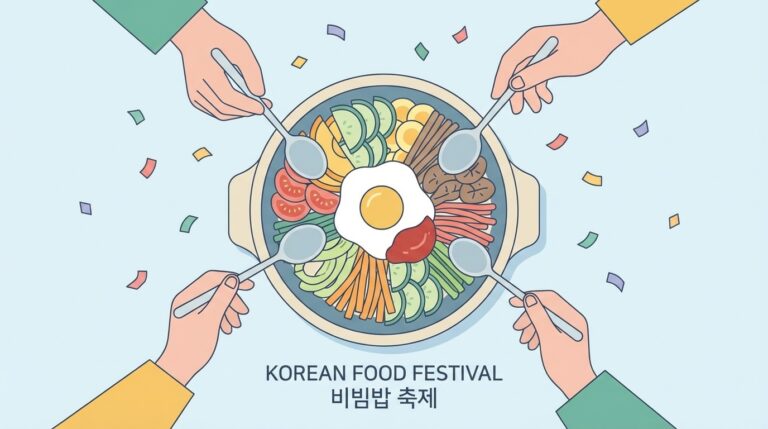
Imagine this: You are in the heart of Jeonju, the food capital of Korea. The air smells like sesame oil and grilled beef. In the center of the plaza, there is a giant bowl big enough to feed 400 people. Drums are beating, people are cheering, and chefs are mixing rice, vegetables, and gochujang with shovels. Yes, shovels.
Welcome to the Jeonju Bibimbap Festival.
You’ve seen K-Drama scenes where the protagonist, stressed out from a breakup or a bad boss, dumps all the leftover side dishes into a big silver bowl, spoons in red paste, and aggressively mixes it while crying, right? That is the soul of Bibimbap. It’s not just food; it’s emotional release.
But at a festival, if you just point and say “This please,” you are missing out on the Jeong (affection). Today, I will teach you how to order like a local foodie, customize your bowl, and express just how dangerously full you are.
Phase 2: Deep Dive into Core Expressions
Here are the three expressions that will turn you from a tourist into a “Mukbang” star.
1. 비벼 드릴까요? (Bibyeo deurilkkayo?)
- Pronunciation: [bi-byeo deu-ril-kka-yo] Think of ‘BB’ cream + ‘yo-yo’. The ‘bi’ sound is quick and light.
- Meaning: “Shall I mix it for you?” (Literal) vs. “Want me to do the hard work?” (Nuance)
- K-Culture Moment: In many traditional restaurants, especially for foreigners or elderly guests, the staff might offer to mix the Bibimbap for you because there is a technique to doing it without mashing the rice grains.
- Editor’s Insight: The verb 비비다 (to mix/rub) is iconic. In K-Pop choreography, rubbing hands together is often called the “sak-sak bibida” move. If you want to do it yourself (which is fun!), you can say “아니요, 제가 비빌게요!” (No, I’ll mix it!).
- Situation Spectrum:
[🚫 Formal Banquets] ———— [⚠️ Restaurants] ———— [✅ Casual/Festival]
(At a festival booth, the vendor is very likely to ask you this to speed up the line!)- 🤔 Think About It: Why is “mixing” so important in Korean culture? It’s not just about taste; it represents harmony (Jowha). Different ingredients coming together to make something better.
2. 육회 많이 넣어 주세요 (Yukhoe mani neo-eo juseyo)
- Pronunciation: [yu-khoe ma-ni neo-eo ju-se-yo] ‘Yuk’ sounds like ‘You’, ‘Khoe’ is like ‘Que’ in ‘Question’.
- Meaning: “Please put in a lot of raw beef.”
- K-Culture Moment: Jeonju Bibimbap is famous for using Yukhoe (seasoned raw beef) instead of cooked meat. In K-Dramas, eating Yukhoe is often portrayed as a delicacy for food connoisseurs.
- Editor’s Insight: This is a B2 level hack. Instead of just ordering “Bibimbap,” specifying the ingredient shows you know the local specialty. Don’t be shy to ask for “Mani” (lots)!
- Situation Spectrum:
[🚫 Fine Dining] ———— [⚠️ Regular Shop] ———— [✅ Market/Festival]
(At a festival, customization is half the fun!)- 🤔 Think About It: Raw beef might be strange in some cultures. How does your culture view raw food? In Korea, freshness is often equated with health.
3. 배 터질 것 같아요 (Bae teojil geot gatayo)
- Pronunciation: [bae teo-jil geot ga-ta-yo] ‘Teo’ sounds like the ‘tu’ in ‘turn’.
- Meaning: “I think my stomach is going to explode.”
- K-Culture Moment: You will hear this in almost every variety show (like Running Man or I Live Alone) after a meal. It is the highest compliment to the chef.
- Editor’s Insight: Koreans love hyperbole. We don’t just say “I’m full” (Baebulleoyo). We say we are going to explode or die (Baebulleo jukgesseoyo). Use this with a happy sigh, and the Ajumma (auntie owner) will love you.
- Situation Spectrum:
[🚫 CEO Meeting] ———— [⚠️ First Date] ———— [✅ Friends/Casual]
Phase 3: Textbook vs. Real Life
| Situation | 📖 Textbook Korean | 🗣️ Real Street Korean | 💡 Why the difference? |
|---|---|---|---|
| Receiving Food | 맛있게 드세요. (Enjoy your meal.) | 야무지게 비벼 드세요! (Mix it skillfully/smartly!) | Yamujida implies doing something thoroughly and well. It adds a cheering vibe. |
| Asking for more | 고추장 더 주실 수 있나요? (Can you give me more Gochujang?) | 이모! 여기 양념 좀 팍팍! (Auntie! Put some sauce in aggressively!) | “Pak-pak” is an onomatopoeia for generous action. Festivals love energy! |
| Tasting it | 참 맛있습니다. (It is truly delicious.) | 와, 꿀맛이다! (Wow, it tastes like honey!) | Slang like “Honey-taste” (Kkul-mat) instantly makes you sound like a native. |
💡 Editor’s Note: Using “Imo” (Auntie) is the magic key in Korean eateries, but ensure the owner is middle-aged or older. If she’s young, stick to “Sajangnim” (Boss)!
Phase 4: Cultural Deep Dive — The Art of Mixing
Non-verbal Communication:
When mixing Bibimbap, use your spoon, not chopsticks! In K-Dramas, you might see people using chopsticks to keep the rice fluffy, but at a street festival? Grab that spoon and put your elbow into it. Also, holding the bowl with one hand while mixing with the other shows enthusiasm.
K-Food Connection:
Why is Jeonju Bibimbap so famous? It represents the Universe. Five colors (O-bang-saek) represent the five elements: Green (wood), Red (fire), Yellow (earth), White (metal), and Black (water). When you mix them, your body absorbs the energy of the universe. So, you aren’t just eating lunch; you are eating cosmic harmony!
Critical Insight:
Notice how Koreans share food. At the festival, you might see a giant pot where everyone gets a scoop. This is communal eating. Unlike Western courses where “this is mine, that is yours,” Korean food culture is often “this is ours.”
Phase 5: Immersive Roleplay Scenario
Setting: Saturday, 2 PM. Jeonju Hanok Village Festival grounds. It’s crowded, loud, and festive. You are at a popular stall named “Grandma’s Hand Taste.”
Characters:
* YOU: A hungry traveler who skipped breakfast for this.
* Ajumma: The energetic owner, wearing a red apron and a plastic visor.
(Dialogue Start)
Ajumma: 어서 오세요! 전주 오면 비빔밥 먹고 가야지! 앉을 자리 없으면 포장도 돼요!
(Eoseo oseyo! Jeonju omyeon bibimbap meokgo gayaji!)
(Welcome! If you come to Jeonju, you gotta eat Bibimbap! If there are no seats, takeout is okay too!)
YOU: 냄새가 너무 좋아서 그냥 지나칠 수가 없네요! 비빔밥 하나 주세요.
(Naemsaega neomu joaseo geunyang jinachil suga eomneyo! Bibimbap hana juseyo.)
(The smell is so good I couldn’t just pass by! One Bibimbap, please.)
Ajumma: 그래요, 맛있게 해 줄게. 육회 못 먹는 거 아니죠?
(Geuraeyo, masitge hae julge. Yukhoe mon-neong-neun geo anijyo?)
(Okay, I’ll make it delicious. You can eat raw beef, right?)
🔀 Decision Point: How do you respond?
* A) 네, 괜찮아요. (Yes, it’s fine.) – Standard & Safe.
* B) 아뇨, 익혀 주세요. (No, please cook it.) – If you can’t eat raw meat.
* C) 없어서 못 먹죠! 많이 주세요! (I can’t eat it because I don’t have it! Give me lots!) – Super Local Joke.
✅ Best Choice (C): “Eopseoseo mon-meokjyo” is a classic Korean dad-joke/witty response meaning “I love it so much, the only problem is I don’t have enough of it.” The Ajumma will laugh and probably give you extra service!
(Continuing with C)
Ajumma: (Laughing loudly) 아이고, 한국 사람 다 됐네! 여기 육회 듬뿍! 자, 비벼 줄까요?
(Aigo, Hanguk saram da dwaenne! Yeogi yukhoe deumpuk! Ja, bibyeo julkkayo?)
(Oh my, you’re practically Korean! Here is heaps of beef! Now, shall I mix it for you?)
YOU: 아니요, 제가 직접 비빌게요! 그게 제 맛이죠.
(Aniyo, jega jikjeop bibilgeyo! Geuge je masijyo.)
(No, I’ll mix it myself! That’s the real taste.)
(🎭 Stage Direction: You mix vigorously with a spoon. The red color spreads perfectly.)
Phase 6: 10-Second Shadowing Drill
Let’s practice the “Compliment” phrase. Say this after your first bite.
“Wow, the sauce is really authentic!”
😊 와, / 고추장 맛이 / 진짜 / 예술이네요!
(Wa, / gochujang masi / jinjja / yesurineyo!)
- Intonation Tip: Raise your pitch on “Wa” and stretch “Yesurineyo” slightly to show admiration.
- Breakdown: Yesul (Art) + ineyo (is). Calling food “Art” is a common compliment.
Phase 7: K-Culture Mini Glossary
| Korean | Romanization | Meaning | Context |
|---|---|---|---|
| 손맛 | Son-mat | Hand taste | The belief that food tastes better when made by hand with care (often by mothers/grandmothers). |
| 서비스 | Seo-bi-seu | Service (Freebie) | Free food given by the owner as a gesture of kindness (e.g., a free soda or extra side dish). |
| 먹방 | Mukbang | Eating Broadcast | The famous internet culture of filming oneself eating large amounts of food. |
| 줄 서다 | Jul seoda | To stand in line | Essential vocabulary for any popular festival stall. |
| 포장 | Pojang | Takeout/Packing | Very common at festivals if seating is full. |
Phase 8: Traveler’s Survival Kit (Festival Edition)
Jeonju is crowded. You need to be quick and efficient.
🆘 Survival Phrases TOP 3
1. “줄이 어디예요?” (Juri eodiyeyo?) – “Where is the line?” (Don’t accidentally cut in line!)
2. “카드 결제 돼요?” (Kadeu gyeolje dwaeyo?) – “Do you take cards?” (Most festivals do, but always ask.)
3. “매운 거 잘 못 먹어요.” (Maeun geo jal mon-meogeoyo.) – “I can’t eat spicy things well.” (Ask for less Gochujang.)📌 Editor’s Travel Note:
* Jeonju Hanok Village: Wear comfortable shoes. The festival area is cobblestone.
* Restrooms: Look for “Hwajangsil” (화장실). Lines are long, so go when you see one!
Phase 9: Think Deeper — Food & Identity
“Why mix everything?”
In Western fine dining, flavors are often separated to be appreciated individually. In Korea, Bibimbap represents the philosophy of convergence. It reflects a society that values the group over the individual. The ingredients (vegetables, meat, rice) lose their individual shape to create a new, unified flavor.
🧠 Think Deeper: Does this reflect the Korean corporate culture or family structure too? Where the collective goal is more important than individual expression? How does this compare to your country’s signature dish?
💬 Your Turn: Do you prefer keeping your food separate or mixing it all up? Let me know in the comments!
Phase 10: FAQ & Troubleshooting
- Q: Can I lift the bowl to eat?
- A: Maybe. In Japan, you lift the rice bowl. In Korea, it is traditionally polite to leave the bowl on the table and use a spoon. But at a festival? Standing up? Do whatever keeps you from spilling!
- Q: Is it rude to leave food?
- A: Korean hosts love to see empty bowls. If you leave a lot, they might worry it tasted bad. If you are full, say “너무 맛있는데 배가 불러요” (It’s delicious but I’m full).
- ❌ Common Mistake: Mixing with chopsticks only.
- ✅ Fix: Use the spoon for mixing and eating rice. Use chopsticks only for picking up side dishes (Banchan).
Phase 11: Wrap-up & Action Mission
Summary: Today we learned how to offer to mix Bibimbap, ask for extra beef like a local, and express that our stomachs are exploding with happiness.
🚀 Action Missions:
* 🥉 Bronze: Say “배 터질 것 같아요” next time you finish a big meal (even if you are alone).
* 🥈 Silver: Go to a Korean restaurant, order Bibimbap, and tell the waiter “Gochujang jom deo juseyo” (More sauce please).
* 🥇 Gold: Visit the Jeonju Bibimbap Festival (or any K-Food festival) and jokingly say “Eopseoseo mon-meokjyo!” when offered something delicious.
🎬 K-Culture Mission: Watch an episode of “Street Food Fighter” (Jeonju episode) or a Mukbang video of Bibimbap. Observe how they mix it. Do they use a spoon? How does it sound?
See you in the next delicious lesson! 맛있게 드세요!
Phase 12: Interactive Quiz
1. Situation: The Ajumma asks, “Shall I mix it for you?” but you want to experience the fun of mixing it yourself. What do you say?
* A) 네, 주세요. (Yes, please.)
* B) 아니요, 맛없어요. (No, it tastes bad.)
* C) 아니요, 제가 비빌게요! (No, I will mix it!)
2. True or False: It is rude to say your stomach is going to explode (Bae teojil geot gatayo) to the chef.
* (True / False)
3. Vocabulary: What is the Korean word for “Raw Beef”?
* [ ]
🔻 Answers (Click to Reveal)
1. C. (A is polite if you want help, B is rude!)
2. False. In a casual setting, it’s a huge compliment meaning you ate well.
3. Yukhoe (육회).
Frequently Asked Questions (FAQ)
Q: What does "비벼 드릴까요? (Bibyeo deurilkkayo?)" mean in Korean and how do you pronounce it?
A: In Korean, "비벼 드릴까요? (Bibyeo deurilkkayo?)" is pronounced [bi-byeo deu-ril-kka-yo] and means: "Shall I mix it for you?" (Literal) vs. "Want me to do the hard work?" (Nuance)
Q: What does "육회 많이 넣어 주세요 (Yukhoe mani neo-eo juseyo)" mean in Korean and how do you pronounce it?
A: In Korean, "육회 많이 넣어 주세요 (Yukhoe mani neo-eo juseyo)" is pronounced [yu-khoe ma-ni neo-eo ju-se-yo] and means: "Please put in a lot of raw beef."
Q: What does "배 터질 것 같아요 (Bae teojil geot gatayo)" mean in Korean and how do you pronounce it?
A: In Korean, "배 터질 것 같아요 (Bae teojil geot gatayo)" is pronounced [bae teo-jil geot ga-ta-yo] and means: "I think my stomach is going to explode."







