

Don’t Lose Money! How to Ask for “VIP” Exchange Rates in Korea
Phase 1: Immersive Hook — The Smart Protagonist Moment
안녕하세요! Daily Hangul’s Senior Editor here.
Have you ever watched those K-Dramas where the protagonist is a savvy, smart consumer? They don’t just walk into a bank and accept the first number they see on the screen. No, they lean in slightly, give a polite smile, and drop a magic sentence that saves them money for an extra serving of Samgyeopsal later.
Traveling or living in Korea means dealing with Won (KRW). Whether you are exchanging your travel budget at Incheon Airport or sending your salary back home, the exchange rate (환율) matters.
Many foreigners assume banks have fixed rates like a restaurant menu. Wrong. In Korea, loyalty, apps, and even a polite question can get you a “Preferential Rate” (우대율). If you don’t ask, you are literally leaving money on the counter. Today, let’s learn how to claim your rights as a smart banking customer.
Phase 2: Deep Dive — Key Expressions
Here are the B1-level phrases that will make the bank teller look at you with respect.
1. 환율 우대 받을 수 있나요?
- Pronunciation: [Hwanyul odae badeul su innayo?]
- Sound Analogy: Hwan-yul (sounds like ‘Juan’ + ‘Yule’ log) + O-dae (Oh, day!) + badeul-su-innayo?
- Meaning:
- Literal: Can I receive exchange rate preferential treatment?
- Real Nuance: “Can you give me a better rate/discount on the commission fees?”
- K-Culture Moment: Think of a scene where a character pulls out a coupon at a cafe. This is the banking version of that. You aren’t begging; you are checking for available benefits.
- Editor’s Insight: We don’t usually say “discount” (할인) for money exchange. We use the word 우대 (Preferential Treatment). It sounds more professional and respectful.
- Situation Spectrum:
[🚫 Casual Friend] ———— [✅ Bank Teller/Clerk] ———— [✅ Call Center]- 🤔 Think About It: Why does Korean use the word “Treatment” (우대) instead of “Discount”? It implies a relationship. You get a better rate because you are a valued customer, not just because the price dropped.
2. 주거래 은행이에요.
- Pronunciation: [Jugeorae eunhaeng-ieyo.]
- Sound Analogy: Ju-geo-rae (Jew + Go + Ray) + eun-haeng (Un + Hang).
- Meaning:
- Literal: This is my main transaction bank.
- Real Nuance: “I bank here all the time, so please treat me nicely.”
- K-Culture Moment: In dramas, when a chaebol (rich heir) walks into a bank, everyone bows. You might not be a chaebol, but saying this phrase gives you “Regular Customer” status.
- Editor’s Insight: In Korea, loyalty is currency. If you have a bank account where your salary comes in, you are a 주거래 고객 (Main Customer). Always mention this!
- Situation Spectrum:
[🚫 Friends] ———— [✅ Bank Teller] ———— [✅ Insurance Agent]3. 수수료는 얼마예요?
- Pronunciation: [Susuryoneun eolmayeyo?]
- Meaning: How much is the commission/fee?
- Editor’s Insight: Sometimes the rate looks good, but the hidden fees (수수료) are high. Always double-check.
Phase 3: Textbook vs. Real Life
| Situation | 📖 Textbook Korean | 🗣️ Real Korean (Smart) | 💡 Why different? |
|---|---|---|---|
| Asking for a discount | 환율을 깎아 주실 수습니까? (Can you cut the rate?) | 혹시 환율 우대 쿠폰 적용되나요? (Do any coupons apply?) | “깎다” sounds like haggling in a market. Banks prefer “applying coupons/benefits.” |
| Mentioning loyalty | 저는 이 은행을 자주 이용합니다. (I use this bank often.) | 저 여기 주거래인데… (I’m a main customer here, so…) | “주거래” is the specific industry term that implies “I have rights.” |
| Checking the final amount | 총 얼마입니까? (How much is the total?) | 수수료 포함해서 얼마예요? (How much including fees?) | Koreans value transparency and hate hidden costs. |
Phase 4: Cultural Context — The Art of “Smart Banking”
4-1. Non-verbal: The Smartphone Shuffle
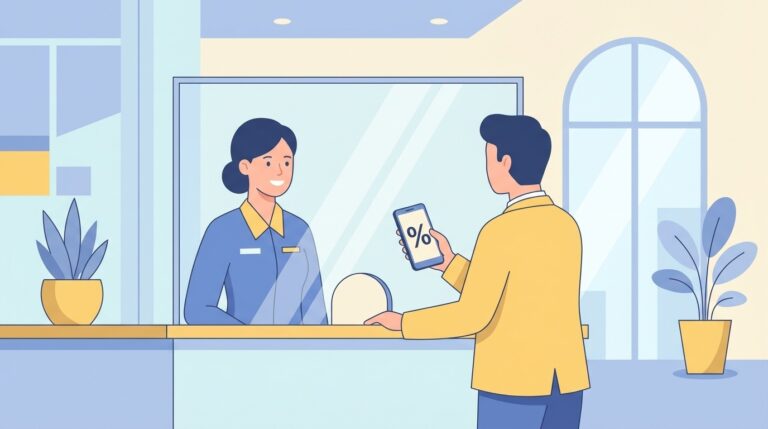
When asking for a better rate, it is very common to have your banking app open on your phone. Many Korean banks (Shinhan, KB, Hana, Woori) offer 90% preferential rates if you use their app.
* Gesture: Show your phone screen to the teller and say, “앱에서 하면 더 싼가요?” (Is it cheaper if I do it on the app?). The teller might just match that rate for you at the window to save time.
4-2. K-Culture Connection: The “Myeongdong Money Changer” vs. “Bank”
If you’ve seen travel vlogs about Korea, you know the Myeongdong Money Changers.
* Street Vibe: Fast, loud, cash-only, no ID needed sometimes. You ask, “How much?” and they type a number on a calculator.
* Bank Vibe: Quiet, take a number ticket, fill out a form, show your ARC (Alien Registration Card) or Passport.
* Critical Insight: Why go to a bank if Myeongdong is cheaper? Safety and Remittance. If you need to send rent money or tuition, you need a bank record. Street exchanges are mostly for spending money (shopping/food).
Phase 5: Immersive Roleplay
Setting: A clean, quiet branch of KB Bank in Seoul. It’s lunchtime, so it’s busy. Your number 104 dings.
Characters:
* YOU: An expat living in Korea for 6 months.
* Teller (Kim): Professional, wearing a uniform, typing fast.
(Dialogue Start)
Teller (Kim): 104번 고객님, 자리에 앉으세요. 무엇을 도와드릴까요?
(Customer 104, please sit down. How can I help you?)
YOU: 안녕하세요. 달러를 한국 돈으로 환전하고 싶어요.
(Hello. I want to exchange dollars to Korean Won.)
Teller (Kim): 네, 신분증 주시겠어요? 얼마 환전하시나요?
(Okay, ID please? How much are you exchanging?)
YOU: 1,000달러요. 여기 여권입니다.
(1,000 dollars. Here is my passport.)
Teller (Kim): (Types) 네, 오늘 환율은 1,300원입니다.
(Okay, today’s rate is 1,300 won.)
🔀 Decision Point: The rate seems a bit low. What do you do?
- A) “네, 알겠습니다. 해주세요.” (Accept it silently)
- B) “저 여기 주거래 은행인데, 환율 우대 되나요?” (Play the loyalty card)
- C) “더 깎아주세요! 비싸요!” (Haggle like at a market)
✅ Best Choice: B
* Why: Option C is rude in a bank setting. Option A loses you money. Option B is polite, logical, and often results in a 30-50% fee discount.
(Continuing with Choice B)
Teller (Kim): 아, 잠시만요. (Checks computer) 네, 급여 통장 사용 중이시네요. 50% 우대 해드릴게요.
(Ah, one moment. Yes, you use a salary account. I will give you a 50% preference.)
YOU: 와, 감사합니다!
(Wow, thank you!)
Phase 6: 10-Second Shadowing Drill
Practice this until it rolls off your tongue. The pause (/) is crucial for politeness.
😊 Slightly expectant tone (기대하는 말투)
“저 / 여기 주거래인데… / 환율 우대 / 받을 수 있나요?”
(Jeo / yeogi jugeorae-inde… / hwanyul odae / badeul su innayo?)
Phase 7: K-Culture Mini Glossary
| Korean | Romanization | Meaning | Context |
|---|---|---|---|
| 환전 | Hwanjeon | Currency Exchange | The act of changing money. |
| 우대율 | Odaeyul | Preferential Rate | The % discount on the bank’s commission fee. |
| 송금 | Songgeum | Remittance | Sending money (e.g., to your home country). |
| 주거래 | Jugeorae | Main Transaction | Your primary bank relation. |
| 번호표 | Beonhopyo | Number Ticket | You must take this from the machine when you enter a bank. |
Phase 8: Traveler’s Survival Kit (Banking Edition)
Even if you aren’t living in Korea, you might need to visit a bank or exchange booth.
🆘 Survival Phrases
1. 🇰🇷 “여권 필요해요?” (Yeogwon piryohaeyo?)
* English: Do you need my passport?
* Note: Always bring your passport for banking.
2. 🇰🇷 “작은 돈으로 주세요.” (Jageun doneuro juseyo.)
* English: Please give me small bills.
* Note: Use this if you don’t want only 50,000 won bills.
3. 🇰🇷 “달러를 원화로 바꾸고 싶어요.” (Dalleo-reul wonhwa-ro bakkugo sipeoyo.)
* English: I want to change Dollars to Won.📌 Editor’s Pro Tip
WOWPASS & NAMANE Cards: These days, many tourists skip the bank and use prepaid cards like WOWPASS. You can load foreign currency at a kiosk, and it acts like a Korean debit card. But for large amounts of cash, banks or Myeongdong are still king.
Phase 9: Think Deeper — “The Cashless Society”
🧠 Topic: Why is Korea moving away from cash?
Korea is becoming a “Cashless Society” (현금 없는 사회) faster than almost anywhere else. You can pay for a 500-won chewing gum with a credit card, and no one will blink.
However, this creates a unique paradox. While digital banking is hyper-advanced (sending money takes 10 seconds on an app), physical bank branches are closing down rapidly. For foreigners, this means learning digital banking words (Certificate, OTP, Transfer) is becoming more important than physical banking phrases.
💬 Your Turn: In your country, is it rude to pay for small items with a card? How does it compare to Korea?
Phase 10: FAQ & Troubleshooting
Q: Can I really ask for a better rate at the airport bank?
A: You can ask, but the answer is usually “No” or the discount is very small. Airport rents are expensive! It’s always better to exchange in the city or use an app to reserve money for airport pickup (Cyber Exchange).
Q: Is it rude to count the money in front of the teller?
A: Absolutely not. It is expected. The teller will usually count it in a machine, then count it again by hand in front of you. You should check it too before leaving the window.
❌ Common Mistake:
* Mistake: Using the word “바꿔주세요” (Change it) without context.
* Correction: Use “환전해주세요” (Exchange it). “바꿔주세요” can mean “exchange for a different product” (refund/return). In a bank, “Hwanjeon” is the precise term.
Phase 11: Wrap-up & Mission
One-Liner: Don’t just exchange money; exchange it smartly by mentioning you are a “Jugeorae” (Main Customer) or asking for “Odae” (Benefits).
🚀 Action Missions:
* 🥉 Bronze: Stand in front of a mirror and practice saying “환율 우대 받을 수 있나요?” smoothly.
* 🥈 Silver: Download a Korean banking app or travel card app (like WOWPASS) and find the word “환율” (Exchange Rate) in the menu.
* 🥇 Gold: Go to a bank or an official exchange booth and ask, “혹시 우대 쿠폰 적용되나요?” even if you don’t have one. See how they react!
K-Culture Mission: Next time you watch a drama, look for a scene where a character checks their bank balance on their phone and sighs. That’s the universal language of adulthood!
Phase 12: Interactive Quiz
1. Situation: You are at a bank window. The teller tells you the rate. You want to ask if there are any discounts on the fee. What do you say?
* A) 깎아주세요. (Cut the price.)
* B) 환율 우대 되나요? (Is a preferential rate possible?)
* C) 이거 너무 비싸요. (This is too expensive.)
2. True or False:
* “In Korea, it is rude to ask for a better exchange rate at a bank.”
* (True / False)
3. Vocabulary:
* Which word means “Main Transaction Bank” (Loyalty Bank)?
* [ J _ g _ o _ a _ ]
🔑 Answers:
1. B (A is for markets, C is complaining)
2. False (It is smart, not rude, as long as you are polite.)
3. Jugeorae (주거래)
Frequently Asked Questions (FAQ)
Q: What does "환율 우대 받을 수 있나요?" mean in Korean and how do you pronounce it?
A: In Korean, "환율 우대 받을 수 있나요?" is pronounced [Hwanyul odae badeul su innayo?] and means: Literal: Can I receive exchange rate preferential treatment?
Q: What does "주거래 은행이에요." mean in Korean and how do you pronounce it?
A: In Korean, "주거래 은행이에요." is pronounced [Jugeorae eunhaeng-ieyo.] and means: Literal: This is my main transaction bank.
Q: What does "수수료는 얼마예요?" mean in Korean and how do you pronounce it?
A: In Korean, "수수료는 얼마예요?" is pronounced [Susuryoneun eolmayeyo?] and means: How much is the commission/fee?







