

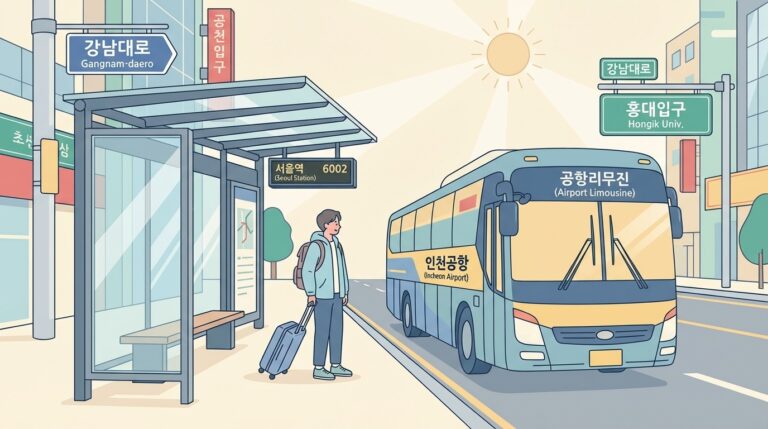
Phase 1: The Immersive Hook
Hello! This is your Daily Hangul Editor. 👋
Picture this: You’ve just finished an amazing trip to Seoul. You’ve visited the palaces, eaten way too much Samgyeopsal, and maybe even spotted a K-Pop idol’s birthday ad in the subway. Now, it’s time to go home.
You’re standing at a bus stop with two heavy suitcases. A big bus pulls up. It looks like the airport bus, but the destination sign is scrolling too fast in Korean. Panic sets in. 😱
In K-Dramas, this is the moment the main character runs after the bus in slow motion while a sad ballad plays. But in real life? You just miss your flight.
Don’t worry! Today, we’re going to master the Airport Limousine Bus. It’s not just a ride; it’s the final scene of your Korea trip. Let’s make sure it’s a happy ending.
Phase 2: Deep Dive into Core Expressions
Here are the top 3 phrases that will save your life (and your flight schedule).
1. 이 버스 인천공항 가요? (I beoseu Incheon-gonghang gayo?)
- Pronunciation: I buh-suh In-cheon-gong-hang ga-yo?
- (Tip: ‘Gayo’ sounds a bit like ‘Guy-yo’.)
- Meaning:
- Literal: Does this bus go to Incheon Airport?
- Real Nuance: “Please confirm I’m not getting on a bus to Busan by mistake!”
- K-Culture Moment: You know those variety shows like Running Man where they race to a location? Asking the driver correctly is the difference between winning and getting a penalty.
- Editor’s Insight: Even if the sign says “Airport,” asking this question is a great way to alert the driver that you are going there. He might even help you with your luggage!
- Situation Spectrum:
[🚫 Casual (Banmal)] ———— [✅ Standard Polite (Yo)] ———— [⚠️ Formal (Hamnida)]- Use the ‘Yo’ form. It’s polite enough for a stranger but not stiff like a news anchor.
- 🤔 Think About It: Why do Koreans ask even when the sign clearly says “Airport”? It’s a culture of “Double-Checking” (hwagin) to share the responsibility of the journey.
2. 얼마나 걸려요? (Eolmana geollyeoyo?)
- Pronunciation: Ol-ma-na girl-yuh-yo?
- (Sound Analogy: Think of ‘girl’ + ‘yuh’ + ‘yo’.)
- Meaning: How long does it take?
- K-Culture Moment: In K-Dramas, when the lead actor is stuck in traffic and checks his watch nervously? That is the energy of this phrase.
- Editor’s Insight: Traffic in Seoul (especially across the Han River) is unpredictable. This question manages your expectations.
- Situation Spectrum:
[🚫 To a King] ———— [✅ To a Driver] ———— [✅ To a Friend]
3. 도착하면 알려 주세요. (Dochakamyeon allyeo juseyo.)
- Pronunciation: Do-chak-ha-myun al-lyuh ju-se-yo.
- Meaning: Please let me know when we arrive.
- Editor’s Insight: This is your safety net. If you fall asleep (which you will, the seats are comfy), the driver will wake you up or shout “Airport!”
Phase 3: Textbook vs. Real Life
| Situation | 📖 Textbook Korean | 🗣️ Real Korean | 💡 Why is it different? |
|---|---|---|---|
| Checking Destination | 기사님, 이 버스는 인천공항행입니까? (Driver, is this bus bound for Incheon Airport?) | (Pointing at bus) 인천공항 가요? (Incheon-gonghang gayo?) | Real life is fast. We drop the title ‘Driver’ and ‘is this bus bound for’ to save time. |
| Asking for Ticket Price | 요금은 얼마입니까? (How much is the fare?) | 얼마예요? (Eolmayeyo?) | Simple is best. Everyone understands ‘How much?’ |
| Saying Thank You | 대단히 감사합니다. (Thank you very much.) | 감사합니다! (Gamsahamnida!) | While getting off, a quick shout is enough. Short and sweet. |
Bottom Note: You are Level A2. Stick to the “Real Korean” column. It sounds more natural and less like you are reading a script!
Phase 4: Cultural Deep Dive
4-1. Non-verbal Communication: The “Bag Dance”
When the bus arrives, don’t just stand there. The driver will likely come down to open the luggage compartment.
* The Move: Bow slightly (15 degrees) when he takes your bag.
* The Ticket: Have your ticket or T-Money card ready in your hand. Fumbling for your wallet blocks the line and stresses everyone out!
4-2. K-Travel Connection: The “Limousine” Bus
In Korea, the airport bus is often called a “Limousine Bus” (리무진 버스).
* K-Pop Context: You know those photos of idols looking chic at the airport? That’s “Airport Fashion” (Gonghang Fashion). Even if you aren’t an idol, taking the Limousine Bus feels a bit VIP. The seats are huge and recline far back.
* Wait, is it a Limo? No, it looks like a bus. But it’s a premium bus. Don’t look for a long stretch car!
Phase 5: Immersive Roleplay
Setting: It’s 6:00 AM in Hongdae. The streets are quiet. You are at the bus stop with your luggage. The Airport Limousine (Bus #6002) pulls up.
Characters:
* YOU: A traveler who doesn’t want to miss the flight.
* Driver Kim: A busy bus driver wearing gloves and sunglasses.
Start!
Driver Kim: (Opens the luggage door below the bus) 가방 넣으세요!
(Gabang neouseyo! – Put your bags in!)
YOU: (Putting bag in) 네!
(Ne! – Okay!)
Driver Kim: (Gets in the driver’s seat) 타세요.
(Taseyo. – Get on.)
YOU: (Tapping your card, but looking unsure) 저기요…
(Jeogiyo… – Excuse me…)
🔀 DECISION POINT! How do you ask if this goes to the airport?
* A) “Incheon Airport?” (Just the noun)
* B) “I beoseu Incheon-gonghang gayo?” (Full sentence)
* C) “Where are you going?” (Direct translation)✅ Best Choice: B – It’s polite and clear.
⚠️ Choice A: Okay for survival, but a bit rude without a verb or ‘yo’.
❌ Choice C: Too vague. He might say “I’m going to work!”
YOU: (Choosing B) 이 버스 인천공항 가요?
(I beoseu Incheon-gonghang gayo?)
Driver Kim: 네, 갑니다. 터미널 1이요, 2요?
(Ne, gamnida. Terminal 1-iyo, 2-yo? – Yes, it goes. Terminal 1 or 2?)
YOU: 아! 터미널 1이요!
(Ah! Terminal 1-iyo!)
Phase 6: 10-Second Shadowing Drill
Practice these until they roll off your tongue! Watch the intonation.
- 😰 Anxious/Polite:
이 버스 / 인천공항 / 가요? ⤴️
(I beoseu / Incheon-gonghang / gayo?) -
⌚ Checking Time:
공항까지 / 얼마나 / 걸려요? ⤴️
(Gonghang-kkaji / eolmana / geollyeoyo?) -
😊 Relief:
감사합니다 / 기사님! ⤵️
(Gamsahamnida / gisanim!)
Phase 7: K-Culture Mini Glossary
| Korean | Romanization | Meaning | Context |
|---|---|---|---|
| 공항패션 | Gonghang Fashion | Airport Fashion | The stylish outfit idols/actors wear at the airport. It’s a huge media event! |
| 기사님 | Gisanim | Driver (Honific) | Polite way to address a taxi or bus driver. Never say “Hey!” |
| 칼같이 | Kal-gachi | Like a knife | Used when transportation arrives exactly on time. “The bus left like a knife!” |
Phase 8: Traveler’s Survival Kit
Taking the airport bus? Keep these in your pocket.
🆘 Survival Card: The Airport Bus
* Where to buy tickets: You can pay with Cash (exact change recommended) or T-Money Card (Transportation card) inside the bus. You can also buy paper tickets at ticket booths near the bus stop.
* The Cost: Usually between 10,000 KRW ~ 17,000 KRW ($8~$14). It’s cheaper than a taxi but more expensive than the subway.
* Terminals: Incheon Airport has Terminal 1 (T1) and Terminal 2 (T2). They are far apart! Check your ticket before you tell the driver.📌 Editor’s Travel Note:
Download Naver Map or KakaoMap. Google Maps doesn’t work well for walking/transit directions in Korea. These apps will tell you exactly when the bus arrives.
Phase 9: Think Deeper – “Palli-Palli” Culture
Why is everyone rushing?
In Korea, you might hear the phrase “Palli-palli” (Hurry, hurry) often. Even the bus drivers are efficient and fast. When you ask “How long does it take?”, you aren’t just asking for time; you are participating in the cultural value of efficiency.
Public transport in Korea is incredibly punctual. If the app says the bus arrives in 3 minutes, it usually means 3 minutes. This reliability allows Koreans to plan their busy lives down to the second.
🧠 Think Deeper: In your country, is being 5 minutes late acceptable? In Korea, for a bus or meeting, 5 minutes late can be a big deal. How does your language reflect your culture’s view on time?
Phase 10: FAQ & Troubleshooting
- Q: Can I eat drinking coffee on the bus?
- NO. 🙅♀️ In Seoul, city buses ban takeaway cups with straws/open lids to prevent spills. Bottled water with a cap is usually okay, but it’s best to finish your drink before boarding.
- Q: Do I need to tip the driver for loading my bags?
- NO. 🙅♂️ Tipping is not a custom in Korea. A loud and sincere “Gamsahamnida!” (Thank you) is the best tip.
- Q: I don’t know which terminal I need!
- Show your e-ticket to the driver. He will know instantly. Airlines like Korean Air/Delta are usually T2, while Asiana and others are T1 (but always check!).
Phase 11: Wrap-up & Action Items
Summary: Today we learned how to ask if the bus goes to the airport (…gayo?), check the time (…eolmana geollyeoyo?), and handle the “Limousine Bus” like a pro.
🎬 Your Mission:
- 🥉 Bronze: Stand in front of a mirror and ask, “Does this bus go to Incheon Airport?” three times clearly.
- 🥈 Silver: Go to Naver Map, find Incheon Airport, and look at the bus route numbers. Practice reading them in Korean (Six-Zero-Zero-One: Yuk-gong-gong-il).
- 🥇 Gold: Watch a YouTube video of a “Seoul Airport Bus Ride” and shadow the announcements you hear!
💬 Comment Below: Have you ever taken the wrong bus in a foreign country? Tell me your story!
Phase 12: Interactive Quiz
1. Situation: The bus arrives. You want to ask the driver if he goes to the airport. What is the BEST thing to say?
* A) Gonghang? (Airport?)
* B) I beoseu Incheon-gonghang gayo? (Does this bus go to Incheon Airport?)
* C) Annyeonghaseyo? (Hello?)
2. True or False:
* “You should give the bus driver a 1,000 KRW tip for helping with luggage.”
3. Fill in the blank:
* “Incheon Airport has Terminal 1 and Terminal ____.”
🔑 Answer Key:
1. B (A is too short, C is just a greeting.)
2. False (No tipping in Korea! Just say thanks.)
3. 2 (Make sure you know which one!)
Frequently Asked Questions (FAQ)
Q: What does "이 버스 인천공항 가요? (I beoseu Incheon-gonghang gayo?)" mean in Korean and how do you pronounce it?
A: In Korean, "이 버스 인천공항 가요? (I beoseu Incheon-gonghang gayo?)" is pronounced [I buh-suh In-cheon-gong-hang ga-yo?] and means: a key conversational Korean expression covered in this lesson.
Q: What does "얼마나 걸려요? (Eolmana geollyeoyo?)" mean in Korean and how do you pronounce it?
A: In Korean, "얼마나 걸려요? (Eolmana geollyeoyo?)" is pronounced [Ol-ma-na girl-yuh-yo?] and means: a key conversational Korean expression covered in this lesson.
Q: What does "도착하면 알려 주세요. (Dochakamyeon allyeo juseyo.)" mean in Korean and how do you pronounce it?
A: In Korean, "도착하면 알려 주세요. (Dochakamyeon allyeo juseyo.)" is pronounced [Do-chak-ha-myun al-lyuh ju-se-yo.] and means: Please let me know when we arrive.







