

Phase 1: Immersive Hook
Hello! This is your Daily Hangul Editor. 👋
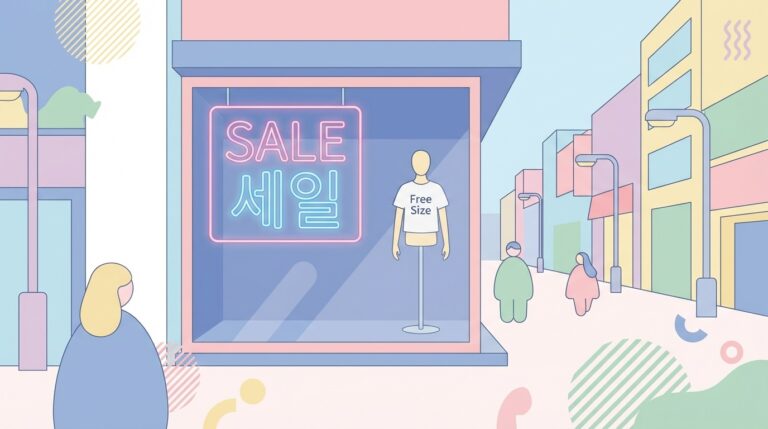
Picture this: You are walking through the bustling streets of Hongdae or Myeongdong. K-Pop is blasting from every storefront—maybe it’s the latest NewJeans or BTS track. You spot a jacket in the window. It looks exactly like the one your favorite K-Drama lead wore in that romantic confession scene. 😍
You walk in. The price tag is confusing, or maybe there isn’t one. There’s a big red sign that says something in Korean with a “%” symbol next to it. You need to know if it’s on sale, but your throat tightens. What if you ask wrong? What if it’s super expensive?
Don’t worry. I’ve seen hundreds of students freeze in this exact moment. But here’s the secret: You already know half the answer because the Korean word for “Sale” is… well, you’ll see. 😉
In this guide, we aren’t just learning words; we’re unlocking your “K-Fashion confidence.” Let’s get you that jacket!
Phase 2: Deep Dive into Core Expressions
1. 세일 하나요? (Seil hanayo?)
- Pronunciation:
Se-il ha-na-yo?- Se-il: Sounds exactly like the English word “Sale” (but say it shorter, no long dipthong).
- Ha-na-yo: Sounds like “Ha” (laugh) + “Na” (nah) + “Yo” (yo-yo).
- Meaning: “Is this on sale?” / “Are you having a sale?”
- K-Culture Moment: Think of those chaotic scenes in variety shows where idols rush into a store during a mission. They shout this to save their budget!
- Editor’s Insight: This is the easiest win for English speakers. Korean uses the English loanword “Sale” (세일). You are already fluent in 50% of this phrase!
- Situation Spectrum:
[🚫 To the King] ———— [✅ Shop Staff] ———— [✅ Friend] - 🤔 Think About It: Why do Koreans use the English word “Sale” instead of a traditional Korean word? It reflects how modern Korean retail culture was heavily influenced by Western department stores in the late 20th century.
2. 이거 얼마예요? (Igeo eolmayeyo?)
- Pronunciation:
Ee-geo ol-ma-ye-yo?- Igeo: Means “This.”
- Eolmayeyo: Sounds like asking ” Old ma (mom) yeah yo?”
- Meaning: “How much is this?”
- K-Culture Moment: Every time a character in a drama shops at a street stall (Pojangmacha) or a fancy boutique, this is the golden phrase.
- Editor’s Insight: Even if you don’t understand the number they answer with, asking this shows you are an interested buyer. Usually, they will show you the price on a calculator!
Phase 3: Textbook vs. Real Life
| Situation | 📖 Textbook Korean | 🗣️ Real Street Korean | 💡 Why is it different? |
|---|---|---|---|
| Asking about a sale | 할인 판매 중입니까? (Harin panmae jungimnikka?) | 세일해요? (Seilhaeyo?) | The textbook version is like asking, “Is a discount transaction in progress?” Too robotic! |
| Checking price | 가격이 어떻게 됩니까? (Gagyeogi eotteoke doemnikka?) | 이거 얼마예요? (Igeo eolmayeyo?) | In shopping, speed is key. Short and polite is best. |
Botton Note: For A1 beginners, sticking to “Seil hanayo?” is safer and more natural than trying to use formal business words like “Hal-in” (Discount).
Phase 4: Cultural Deep Dive
4-1. The Art of “Eye Shopping” & Nunchi
In Korea, browsing without buying is called “Eye Shopping” (아이쇼핑). Staff might follow you closely—this is considered “good service” in Korea, not stalking! If you feel pressured, just smile and use your Nunchi (situational awareness). A slight bow and a “Just looking” (or simply smiling) is enough.
4-2. The “Free Size” Trap (K-Fashion Context)
You will often see clothes labeled “Free Size.”
* Western Context: One size fits all (usually loose).
* Korean Context: One size fits… the average Korean frame (usually S or M in US sizes).
* Editor’s Tip: Don’t get discouraged if “Free Size” doesn’t fit! It’s a unique quirk of the K-Fashion industry. This is why asking “Can I try this on?” (see Survival Kit) is crucial.
Phase 5: Immersive Roleplay
Setting: A trendy clothing store in Hongdae on a Friday night. Loud K-Pop is playing. The staff member is dressed very stylishly.
Characters:
* YOU: A tourist looking for a cool T-shirt.
* Staff: A hip Korean university student working part-time.
Start Dialogue:
YOU: (Holding up a T-shirt) 저기요, 이거 세일 하나요?
(Jeogiyo, igeo seil hanayo?)
(Excuse me, is this on sale?)
Staff: 네! 지금 20% 세일해요.
(Ne! Jigeum isip-peosenteu seilhaeyo.)
(Yes! It’s 20% off right now.)
YOU: 아, 진짜요? 그럼 이거 얼마예요?
(Ah, jinjja-yo? Geureom igeo eolmayeyo?)
(Ah, really? Then how much is this?)
Staff: 만 원이에요.
(Man-won ieyo.)
(It’s 10,000 won.)
🔀 Decision Point: It’s cheap! What do you do?
- A) “깎아주세요!” (Kkaka juseyo! – Discount please!)
- B) “주세요.” (Juseyo. – Please give me / I’ll take it.)
✅ Best Choice: B
* Why? In a regular store with price tags, asking for a discount (A) is rude or awkward. Save Option A for traditional markets (Namdaemun/Dongdaemun)!
Phase 6: 10-Second Shadowing Drill
Let’s practice! Focus on the emotion in the brackets.
- (Curious 🧐) 이거 / 세일 / 하나요?
(I-geo / se-il / ha-na-yo?) - (Surprised 😲) 와! / 진짜 / 싸요!
(Wa! / jin-jja / ssa-yo!)-> Wow! It’s really cheap! - (Happy 😊) 이거 / 주세요!
(I-geo / ju-se-yo!)-> Please give me this!
Phase 7: K-Culture Mini Glossary
| Korean | Romanization | Meaning | Context |
|---|---|---|---|
| 득템 | Deuk-tem | Great catch | Slang for buying something good at a cheap price. (Item + Gain). |
| 신상 | Ssin-sang | New Arrival | Short for “Sin-sang-pum”. Koreans love the “newest” items! |
| 원쁠원 | Won-ppeul-won | 1+1 (BOGO) | “One Plus One”. Buy one, get one free. Essential for shopping! |
Phase 8: Traveler’s Survival Kit
🆘 Survival Phrase #1: Can I try this on?
* 🇰🇷 “입어봐도 돼요?” (Ibeo-bwado doeyo?)
* 🗣️ Sound-alike: “Ee-bo-bwa-do day-yo?”
* 📍 Where: Clothing stores (spas, boutiques).
* 💡 Pro Tip: In Korea, you must take off your shoes before entering the fitting room in many small boutiques! Look for a carpet or slippers.📌 Editor’s Travel Note: Makeup Guards
If you wear makeup, the staff might hand you a white face cover (mask). You must put this over your face before pulling a shirt over your head to prevent makeup stains. It’s distinctively Korean etiquette!
Phase 9: Think Deeper — “Language & Modernity”
Why do we say “Seil” (Sale) and not the Korean word?
Korea modernized rapidly. In the rush of economic growth, many English terms related to commerce (Sale, Grand Open, Event) were adopted directly because they sounded “modern” and “global” at the time. Using “Seil” instead of “Harin” (discount) often carries a nuance of a lighter, more casual, or western-style shopping event. Does your language use English words for shopping too?
Phase 10: FAQ & Troubleshooting
- Q: Can I use “Seil hanayo?” at a convenience store?
- A: You can, but they usually use “Event” (이벤트) or “1+1” (One plus one) more often. But they will understand you!
- Q: Can I bargain in a Department Store (like Hyundai, Lotte)?
- A: No. Prices are fixed. Bargaining is only for traditional markets or underground shopping malls (if you pay cash).
- ❌ Common Mistake: Asking “How much?” nicely but forgetting to add “-yo” at the end.
- Example: “Igeo eolma?” (This is rude to strangers!)
- Correction: “Igeo eolmayeyo?”
Phase 11: Wrap-up & Action Mission
Summary: Today we learned that asking for a sale in Korean is easy—just say “Seil” with a Korean accent! We also learned to avoid “Free Size” shock and how to ask for the price politely.
🚀 Action Missions:
* 🥉 Bronze: Look in the mirror and say “Igeo seil hanayo?” 3 times with a smile.
* 🥈 Silver: Watch a K-Drama or K-Pop vlog where they go shopping. Can you spot a red “SALE” or “%” sign in the background?
* 🥇 Gold: Go to a Korean mart or shop in your city and ask the staff “Seil hanayo?” (If they speak Korean!)
💬 Your Turn: Have you ever bought clothes in a foreign country and realized the size was totally different? Tell me your story in the comments!
Phase 12: Quiz — Interactive Challenge
1. You are at a fancy department store. You see a jacket you like. What is the BEST way to ask the price?
* A) 야! 얼마? (Ya! Eolma?)
* B) 이거 얼마예요? (Igeo eolmayeyo?)
* C) 깎아주세요. (Kkaka juseyo.)
2. True or False?
* “In Korea, ‘Free Size’ usually means Extra Large.” (T/F)
(Scroll down for answers)
.
.
.
Answers:
1. B (A is rude, C is not for department stores).
2. False (It usually means Small/Medium!).
Frequently Asked Questions (FAQ)
Q: What does "세일 하나요? (Seil hanayo?)" mean in Korean and how do you pronounce it?
A: In Korean, "세일 하나요? (Seil hanayo?)" is pronounced [Se-il ha-na-yo?] and means: a key conversational Korean expression covered in this lesson.
Q: What does "이거 얼마예요? (Igeo eolmayeyo?)" mean in Korean and how do you pronounce it?
A: In Korean, "이거 얼마예요? (Igeo eolmayeyo?)" is pronounced [Ee-geo ol-ma-ye-yo?] and means: a key conversational Korean expression covered in this lesson.







