

Phase 1: The Immersive Hook
안녕하세요! This is your Daily Hangul Senior Editor.
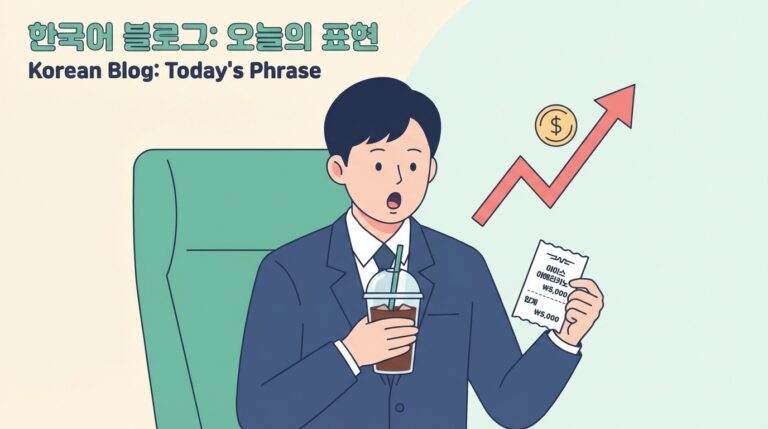
Picture this: You are watching a K-Drama. The protagonist, a hardworking office worker in Seoul, sighs deeply while looking at a café receipt. She just bought an Iced Americano (Ah-Ah), the lifeline of modern Koreans. But wait—the price isn’t what it used to be.
In Korea, coffee isn’t just a beverage; it’s survival fuel. We joke that we have “coffee blood” running through our veins. So, when the price of beans goes up, it’s not just an economic statistic—it’s a national emotional event.
Have you walked into a café in Gangnam or Hongdae recently and seen a polite but heartbreaking notice taped to the register?
“Due to the skyrocketing cost of green beans and logistics, we have no choice but to adjust our prices…”
Today, we aren’t just learning how to order coffee. We are diving into Level C2 territory: discussing economics, expressing empathy for small business owners, and lamenting the cost of living like a true Seoulite. If you can discuss inflation in Korean, you are no longer a student; you are a resident.
Phase 2: Deep Dive into Core Expressions
At the C2 level, we move beyond “It’s expensive” (bissayo). We use specific vocabulary to describe economic shifts and their impact.
1. 불가피한 가격 인상 (Bulgapihan gagyeok insang)
- Pronunciation: [bul-ga-pi-han ga-gyeok in-sang]
- Meaning: An inevitable price hike / Unavoidable price increase.
- K-Culture Moment: You will see this phrase on A4 papers taped to kiosks or café windows. It’s the standard formal apology used by business owners.
- Editor’s Insight: The word ‘불가피하다’ (inevitable) carries a nuance of “I really didn’t want to do this, but the situation forced my hand.” It appeals to the customer’s jeong (empathy).
- Situation Spectrum:
[🚫 Casual Chat] ———— [⚠️ Semi-formal] ———— [✅ Written Notices/Formal Discussion]- 🤔 Think About It: Why do Korean shop owners almost always frame price hikes as “unavoidable” rather than a business decision? It reflects the culture of shared hardship.
2. 체감 물가 (Chegam mulga)
- Pronunciation: [che-gam mul-ga]
- Meaning: Perceived cost of living / How prices feel to the consumer.
- K-Culture Moment: News anchors often say, “Statistics show inflation is 3%, but the chegam mulga for citizens is much higher.”
- Editor’s Insight: Che (body) + Gam (feeling). It’s not the numbers; it’s the visceral shock you feel when your favorite latte jumps from 4,500 KRW to 5,500 KRW.
- Situation Spectrum:
[✅ Friends] ———— [✅ Colleagues] ———— [✅ News/Debate]- 🤔 Think About It: Is there a specific word in your language that separates “official inflation” from “felt inflation”?
3. 월급 빼고 다 오른다 (Wolgeup ppaego da oreunda)
- Pronunciation: [wol-geup ppae-go da o-reun-da]
- Meaning: “Everything is going up except my salary.”
- K-Culture Moment: The universal anthem of Korean office workers (jikjangin) during lunch hour. Often heard after checking the credit card alert for coffee.
- Editor’s Insight: This is a set phrase, almost an idiom now. It’s a safe, self-deprecating joke that builds instant solidarity with anyone working in Korea.
- Situation Spectrum:
[✅ Friends] ———— [✅ Colleagues] ———— [🚫 Formal Report]
Phase 3: Textbook vs. Real Life
| Situation | 📖 Textbook Korean | 🗣️ Real Korean (Insider) | 💡 Why the difference? |
|---|---|---|---|
| Reacting to price hike | 커피 값이 비싸졌어요. (Coffee has become expensive.) |
와, 물가 미쳤다. (Wow, the price level is crazy.) |
“Crazy” (michyeotda) is the most common emotional intensifier for extreme situations. |
| Asking why | 왜 가격이 올랐나요? (Why did the price go up?) |
원두값이 많이 올랐나 봐요? (I guess green bean prices went up a lot?) |
C2 speakers don’t just ask; they deduce. Showing you understand the market context is polite. |
| Complaining about budget | 돈이 부족해요. (I lack money.) |
내 지갑 눈감아… (Close your eyes, my wallet…) |
Personifying the wallet adds wit and humor to a sad financial reality. |
Bottom Note: At C2, direct complaints can sound childish. Using wit (humor) or macroeconomic observation makes you sound sophisticated.
Phase 4: Cultural Deep Dive — Coffee & The Economy
4-1. The “Lunchflation” Phenomenon
Have you heard the term Lunchflation (Runchi-peul-rei-syeon)? It’s a Konglish portmanteau popular in Korean media. Since coffee is an essential part of the lunch ritual (Meal + Coffee), rising bean prices directly hit the office worker’s allowance.
Non-verbal Tip: When discussing high prices with a café owner you know, a slight nod of understanding and a sympathetic sigh (“휴… 사장님도 힘드시겠어요” – Sigh… it must be hard for you too, owner) is the ultimate nunchi move. It shows you aren’t blaming them.
4-2. The Polarization of Coffee
Korea’s coffee market is splitting.
– Small Luxury: Specialty cafes charging 7,000+ KRW where people pay for the vibe and brand.
– Survival Coffee: Mega-sized franchise coffee (like Mega Coffee, Paik’s Coffee) for 2,000 KRW.
The price hike conversation is most intense in the middle—the independent cafes that are struggling to survive.
Phase 5: Immersive Roleplay Scenario
Setting: A stylish independent roastery café in Yeonnam-dong. You are a regular customer. You notice a sign on the counter announcing a price adjustment starting today.
Characters:
– YOU: A long-term expat who understands the global coffee market nuances.
– Barista Kim: The owner of the café, who looks apologetic and tired.
Dialogue:
Barista Kim: 어서 오세요! 아, 저… 죄송하지만 오늘부터 음료 가격이 조금 인상되었습니다. 😔
(Eoseo oseyo! Ah, jeo… joesonghajiman oneulbuteo eumryo gagyeogi jogeum insangdoeeotseumnida.)
[Welcome! Ah, um… I’m sorry, but beverage prices have increased slightly starting today.]
YOU: 아, 안내문 봤어요. 요즘 원두 가격이랑 우유값까지 다 올랐잖아요. 어쩔 수 없죠.
(Ah, annaemun bwasseoyo. Yojeum wondu gagyeogirang uyukkapkkaji da ollatjanayo. Eojjeol su eopjyo.)
[Ah, I saw the notice. Green bean prices and even milk costs have all risen lately. It can’t be helped.]
Barista Kim: 네, 버티고 버티다가 도저히 안 돼서요. 이해해 주셔서 감사합니다.
(Ne, beotigo beotidaga dojeohi an dwaeseoyo. Ihaehae jusyeoseo gamsahamnida.)
[Yes, we held out as long as we could, but it became impossible. Thank you for understanding.]
🔀 Decision Point: How do you respond to show support?
A) “너무 비싸요. 깎아주세요.”
B) “사장님도 힘드실 텐데, 맛있는 커피 계속 팔아주세요.”
C) “다른 가게로 가야겠네요.”✅ Best Choice: B (“It must be hard for you too, please keep selling delicious coffee.”)
Why? This is the peak of Korean Empathy (Jeong). It acknowledges the owner’s struggle and encourages them. Choice A is rude in a standard café setting, and C is hurtful.
Phase 6: 10-Second Shadowing Drill
Let’s practice a sentence that makes you sound like an economics expert.
Sentence: “International logistics costs have risen, so a price hike was inevitable.”
🇰🇷 국제 물류비 상승으로 / 가격 인상은 / 불가피했던 것 같아요.
([Gukje mulryubi sangseung-euro] / [gagyeok in-sang-eun] / [bul-ga-pi-haet-deon geot gatayo])Emotion: 🧐 Analytical & Understanding (Nod slowly while saying this)
Pausing: Pause after ‘euro’ and ‘insang-eun’ to emphasize the cause and effect.
Phase 7: K-Culture Mini Glossary
| Korean | Romanization | Meaning | Context |
|---|---|---|---|
| 가성비 | Gaseongbi | Cost-effectiveness | The most important metric for Korean consumers. “Is it worth the price?” |
| 스벅 지수 | Seubeok Jisu | Starbucks Index | An informal economic indicator comparing purchasing power based on a Starbucks Latte. |
| 소확행 | Sohwakhaeng | Small but certain happiness | Buying a slightly expensive coffee is a common form of ‘Sohwakhaeng’ despite inflation. |
| 텅장 | Teongjang | Empty Account | A pun on Tongjang (Bank Account) + Teong (Empty sound). |
Phase 8: Traveler’s Survival Kit (Economy Edition)
Even if you are traveling, price hikes affect your budget. Here is how to read the room (and the signs).
🆘 Survival Expression: Reading Notices
– 🇰🇷 “가격 인상 안내” (Gagyeok Insang Annae)
– 🗣️ Meaning: “Price Increase Notice”
– 📍 Where: Taped on cashier counters, kiosks, or doors.
– 💡 Pro Tip: If you see dates (e.g., 1월 1일부터) on a notice, it usually means the price is changing from that day. Don’t be surprised if the menu price is different from an old blog post you found.📌 Editor’s Travel Note
– Refills: In the past, some Korean cafes offered cheap refills. With rising costs, most have abolished this or charge nearly full price. Always check: “Ripil doeyo?” (Is refill possible?)
Phase 9: Think Deeper — “Coffee as a Human Right?”
Economic Sensitivity & Collective Anxiety
Why does a 500 KRW (approx. $0.40) increase in coffee prices dominate the news in Korea?
In many Western cultures, coffee is a beverage. In Korea’s hyper-competitive, high-stress society, caffeine is viewed almost as a public utility essential for productivity. When coffee prices rise, it triggers a collective anxiety about the cost of sustaining one’s work life. It challenges the “Sohwakhaeng” (Small but certain happiness)—if I can’t even afford my daily latte, what joy is left?
💬 Your Turn: In your country, which item’s price hike causes the most public outrage? Gas? Bread? Internet? Let us know in the comments!
Phase 10: FAQ & Troubleshooting
Q: Can I ask the part-timer (alba) why the price went up?
A: No. The part-timer has no control over prices and is likely stressed by other customers asking the same thing. Expressing complaints to them is considered Gapjil (abuse of power). Just say “Ah, prices went up” to yourself and order.
Q: Is it rude to mention ‘Starbucks is cheaper’?
A: It can be sensitive. Independent cafe owners pride themselves on quality beans. Comparing them to a massive chain solely on price might hurt their pride regarding their bean quality.
❌ Common Mistake:
Using “비싸다” (Bissada) too aggressively directly to the staff.
Instead of saying “Why is this so expensive?” (Igeo wae ireoke bissayo?), simply ask to confirm the price: “Is this the correct price?” (I gam-aek manneungayo?).
Phase 11: Wrap-up & Action Mission
Summary: Today we learned how to discuss inflation, rising costs, and empathy using the context of coffee prices.
🚀 Action Missions:
– 🥉 Bronze: Stand in front of a mirror and practice the sigh: “Wolgeup ppaego da oreunda…”
– 🥈 Silver: Go to a Korean news site (Naver/Daum) and search for “커피 가격 인상” (Coffee price hike). Try to read the headlines.
– 🥇 Gold: Visit a local cafe. If you see a price notice, casually mention to a friend (or think to yourself): “Wondu-gapi mani ollat-na bwayo.” (Bean prices must have gone up a lot.)
K-Culture Mission: Watch a K-Drama office scene. Look for the moment they go for coffee after lunch. Observe who pays. Is it Dutch Pay or does the senior (Sunbae) pay? With rising prices, Dutch Pay is becoming more common!
Phase 12: Quiz — Interactive Challenge
1. Situation Judgment:
You see a notice saying “원자재값 폭등으로 가격을 조정합니다.” What is the most appropriate reaction to the owner?
– A) “Are you trying to become rich?”
– B) “The raw material market is volatile, I understand it’s inevitable.” (Correct)
– C) “Give me a discount then.”
2. True or False:
– “Lunchflation” refers to the phenomenon of skipping lunch to drink coffee.
Answer: False. It refers to the inflation of lunch prices (often including coffee), making the midday meal a financial burden.
3. Vocabulary:
Fill in the blank: “My salary stays the same, but the _______ (perceived inflation) is suffocating.”
Answer: 체감 물가 (Chegam mulga)
Frequently Asked Questions (FAQ)
Q: What does "불가피한 가격 인상 (Bulgapihan gagyeok insang)" mean in Korean and how do you pronounce it?
A: In Korean, "불가피한 가격 인상 (Bulgapihan gagyeok insang)" is pronounced [bul-ga-pi-han ga-gyeok in-sang] and means: An inevitable price hike / Unavoidable price increase.
Q: What does "체감 물가 (Chegam mulga)" mean in Korean and how do you pronounce it?
A: In Korean, "체감 물가 (Chegam mulga)" is pronounced [che-gam mul-ga] and means: Perceived cost of living / How prices feel to the consumer.
Q: What does "월급 빼고 다 오른다 (Wolgeup ppaego da oreunda)" mean in Korean and how do you pronounce it?
A: In Korean, "월급 빼고 다 오른다 (Wolgeup ppaego da oreunda)" is pronounced [wol-geup ppae-go da o-reun-da] and means: "Everything is going up except my salary."






