

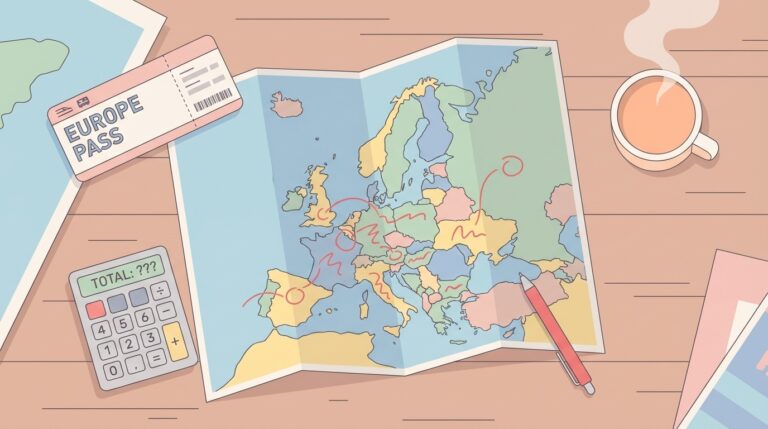
Phase 1: Immersive Hook — The “Ppali-Ppali” Eurotrip
Greeting: 안녕하세요! This is your Daily Hangul Senior Editor.
The K-Culture Cold Open: Picture this: You are watching a popular Korean travel reality show like “Traveler” or “Youth Over Flowers” (꽃보다 청춘). The cast members aren’t just lounging around. They are huddled over a map at 2 AM, calculating train transfer times down to the minute. The captions don’t just say “We need to hurry.” They say “If we miss this, our entire route collapses!”
The ‘Why’: Koreans are famous for the “European Tour in 10 Days” style of travel. We don’t just visit places; we conquer them. If you are planning a trip with Korean friends, or just want to discuss your Eurail route like a native Seoulite, you need words that convey efficiency, cost-effectiveness, and the intensity of the schedule. At C2 level, saying “I want to go to Paris” isn’t enough. You need to explain why that route is efficient.
Transparency: This guide reconstructs real debates I’ve heard in cafes across Hongdae where students and backpackers plan their “Grand Euro Tour.”
Phase 2: Deep Dive into Core Expressions
1. 뽕을 뽑다 (Ppong-eul ppop-da)
- Pronunciation: [Ppong-eul ppop-da] (Sounds like a popping sound ‘Pop’ + ‘eul’ + ‘Pop-da’)
- Meaning:
- Literal: To pull out the mulberry roots.
- Real Nuance: To get your money’s worth completely; to maximize value to the point of exhaustion.
- K-Culture Moment: When a Korean buys an unlimited Eurail Pass, they will ride trains for 10 hours a day just to make sure they “beat the system.” You’ll hear this in variety shows when someone eats a lot at a buffet.
- Editor’s Insight: This is idiomatic and slightly slangy but widely used. It reflects the Korean desire for extreme efficiency and value. If you buy a 500 Euro pass and only visit two cities, you failed to “pull the roots.”
- Situation Spectrum:
[🚫 Formal Biz] ———— [⚠️ Semi-Formal] ———— [✅ Casual] - 🤔 Think About It: Why does Korean culture value “getting more than what you paid for” so aggressively? It ties back to a history of resource scarcity and rapid economic growth.
2. 동선이 꼬이다 (Dongseon-i kkoida)
- Pronunciation: [Dong-seon-i kko-i-da]
- Meaning:
- Literal: The moving line is twisted.
- Real Nuance: The route is inefficient/tangled; we are backtracking or wasting time.
- K-Culture Moment: In K-Dramas involving office work or events, a manager might yell, “Who planned this layout? The movement path (동선) is a mess!” In travel, it means your plan to go London -> Rome -> Paris is illogical.
- Editor’s Insight: Dongseon (Movement line) is a high-level Hanja word used by architects, event planners, and smart travelers. Using this makes you sound incredibly intellectual and organized.
- Situation Spectrum:
[🚫 None] ———— [⚠️ Very Polite] ———— [✅ Standard]
(Safe to use everywhere)
3. 강행군 (Ganghaenggun)
- Pronunciation: [Gang-haeng-gun]
- Meaning:
- Literal: Forced march (military term).
- Real Nuance: A brutal, tight schedule with no rest.
- K-Culture Moment: Watching idols on tour or actors filming a drama overnight. Fans often worry, “Are they doing a ganghaenggun schedule again?”
- Editor’s Insight: Koreans often plan vacations that are more tiring than work. If your friend suggests visiting 5 countries in 7 days, you sigh and say, “Are we doing a ganghaenggun?”
- Situation Spectrum:
[🚫 None] ———— [⚠️ Formal] ———— [✅ Standard]
Phase 3: Textbook vs. Real Korean
| Situation | 📖 Textbook Korean | 🗣️ Real Korean | 💡 Why the difference? |
|---|---|---|---|
| Maximizing the pass | 이 패스를 잘 사용해야 해요. (We need to use this pass well.) | 이걸로 아주 뽕을 뽑아야지! (We gotta extract the roots with this!) | “Well” is too vague. Koreans love visceral metaphors for value. |
| Bad route planning | 계획이 안 좋아요. (The plan is bad.) | 동선이 완전 비효율적이야. (The movement path is totally inefficient.) | C2 speakers use specific logic terms (efficiency/path) over generic adjectives. |
| Too many stops | 일정이 너무 많아요. (The schedule is too much.) | 이건 완전 살인적인 스케줄인데? (This is a murderous schedule, isn’t it?) | Hyperbole is key to natural Korean expression. |
Bottom Note: At C2, stop using “good/bad” (좋다/나쁘다). Use “efficient/inefficient” (효율적이다/비효율적이다) or “murderous” (살인적이다) to describe schedules.
Phase 4: Cultural Deep Dive
4-1. The “Insaeng Shot” Factor (Non-verbal)
Even if a train route makes no logistical sense, a Korean traveler might insist on it because of a specific photo spot on Instagram. When planning, if someone shows you a photo on their phone silently, that is a non-verbal command: “We MUST go here.”
4-2. K-Travel: The Obsession with “Efficiency”
In Western culture, a “lazy holiday” is a virtue. In Korea, a lazy holiday can be seen as “wasting time.” When you hear “본전을 찾다” (to recover the principal cost), it’s the financial version of ppong-eul ppop-da.
Critical View: Why is Korean travel so rushed? Because vacation days are scarce. If you only get 5 days off a year, sleeping in feels like a crime. Understanding this helps you understand why your Korean friends wake you up at 6 AM in Switzerland.
Phase 5: Immersive Roleplay Scenario
Scenario A: The Strategy Meeting
Setting: A 24-hour cafe in Seoul, 11 PM. You and Min-ji are staring at a laptop with the Eurail map open. You have 2 weeks.
Characters:
– YOU: The Pragmatist (wants a relaxed trip).
– Min-ji: The “General” (wants to see everything).
Dialogue:
Min-ji: 야, 지도를 봐. 파리에서 바로 로마로 가면 동선이 너무 꼬이잖아. 중간에 스위스를 찍고 가야지.
(Ya, jidoreul bwa. Parieseo baro romaro gamyeon dongseoni neomu kkoijana. Junggane seuwiseureul jjikgo gayaji.)
(Hey, look at the map. If we go straight from Paris to Rome, the route gets totally twisted. We have to hit Switzerland in the middle.)
YOU: 스위스? 거기 물가가 얼마나 비싼데. 우리 예산으로는 무리야.
(Seuwiseu? Geogi mulgaga eolmana bissande. Uri yesanureoneun muriya.)
(Switzerland? Do you know how expensive it is there? It’s impossible with our budget.)
Min-ji: 유레일 패스 샀으면 기차라도 많이 타야 뽕을 뽑지! 야간열차 타면 숙박비도 아낄 수 있어.
(Yureil paeseu sasseumyeon gicharado mani taya ppongeul ppopji! Yaganyeolcha tamyeon sukbakbido akkil su isseo.)
(If we bought the Eurail pass, we need to ride trains a lot to get our money’s worth! If we take the night train, we save on hotel costs too.)
🔀 Decision Point: How do you respond to the night train idea?
A) “좋아, 그렇게 하자.” (Okay, let’s do that.)
B) “너 그러다 병나. 너무 강행군이야.” (You’ll get sick doing that. It’s too much of a forced march.)
C) “역시 민지야! 천재네.” (As expected of Minji! Genius.)
✅ Best Choice: B — At C2 level, you should be able to express concern using high-level vocabulary like ganghaenggun. It shows you understand the physical toll of her plan.
Scenario B: The K-Pop Detour (Bonus)
Situation: You realize a K-Pop group is performing in Berlin on your dates.
YOU: 잠깐, 우리 일정에 변수가 생겼어. 베를린을 반드시 넣어야 해.
(Jamkkan, uri iljeonge byeonsuga saenggyeosseo. Bereullineul bandeusi neoeoya hae.)
(Wait, a variable has appeared in our schedule. We MUST include Berlin.)
Friend: 갑자기? 동선 다 망가지는데?
(Gapjagi? Dongseon da manggajineunde?)
(Suddenly? The whole route will be ruined?)
Phase 6: 10-Second Shadowing Drill
Feel the stress of planning! Use an assertive tone.
- 😤 비싼 돈 주고 / 패스 샀는데 / 뽕을 뽑아야죠!
(Bissan don jugo / paeseu sanneunde / ppongeul ppop-ayajo!)
(We paid good money for this pass, so we have to get every penny’s worth!) -
😰 욕심부리다가 / 동선이 / 다 꼬여버렸어.
(Yoksimburidaga / dongseoni / da kkoyeo-beoryeosseo.)
(I got too greedy and now the whole route is twisted.)
Phase 7: K-Culture Mini Glossary
| Korean | Romanization | Meaning | Context |
|---|---|---|---|
| 가성비 | Gaseongbi | Cost-effectiveness | The holy grail of Korean travel planning. |
| 찍고 오다 | Jjikgo oda | Touch and go | Visiting a place extremely briefly (just to take a photo) and leaving. |
| 인생샷 | Insaeng-shot | Life Shot | The “best photo of your life.” Often dictates the travel route. |
| 변수 | Byeonsu | Variable | Used when unexpected events (strikes, weather) change plans. |
Phase 8: Traveler’s Survival Kit (For Planning)
Since this unit is about planning a trip abroad using Korean, here are the top phrases to negotiate an itinerary.
🆘 Survival Expressions
– 🇰🇷 “이건 너무 무리한 일정이에요.” (Igeon neomu murihan iljeong-ieyo.)
– Meaning: This schedule is too unreasonable/heavy.
– 🇰🇷 “여기는 뺄까요?” (Yeogineun ppaelkkayo?)
– Meaning: Should we take this place out (of the plan)?
– 🇰🇷 “최적의 경로를 찾아보자.” (Choejeog-ui gyeongro-reul chajaboja.)
– Meaning: Let’s find the optimal route. (Very C2 level academic phrase).📌 Editor’s Travel Note:
Koreans rely heavily on blogs (Naver Blog) for travel routes. If a famous blogger says “Route A is the best,” 90% of Koreans will follow Route A. Expect your friends to cite blogs as evidence!
Phase 9: Think Deeper — Efficiency vs. Experience
Topic: The Sociology of “Checking Boxes”
Korean travel language often sounds like military strategy (ganghaenggun, conquest, mission). This reflects the high-pressure, competitive society where “leisure” is also a task to be performed perfectly. If you don’t see everything, you feel like you “failed” the vacation.
🧠 Think Deeper: In your culture, is a vacation considered “successful” if you do nothing but sleep? Or do you also feel the pressure to “see everything” to justify the cost?
Phase 10: FAQ & Troubleshooting
Q: Can I use “뽕을 뽑다” with my professor or boss?
A: No! It is slang. With superiors, use “본전을 찾다” (recover the cost) or “알차게 보내다” (spend time fruitfully).
Q: Is it rude to reject a friend’s travel plan?
A: Direct rejection is tricky. Instead of saying “No, I hate that,” say “그것도 좋은데, 체력이 될까 걱정이야” (That’s good too, but I’m worried about our physical stamina). Blame your body, not their idea.
❌ Common Mistake:
Using “여행을 계획하다” (Plan a travel) constantly.
✅ Better: Use “일정을 짜다” (Weave a schedule) or “루트를 정하다” (Decide a route). It sounds much more native.
Phase 11: Wrap-up & Mission
One-Liner Summary: When planning a trip in Korean, focus on efficiency, avoid “twisted routes,” and always try to “extract the roots” of your ticket value!
Action Mission:
– 🥉 Bronze: Look at a map of Europe and say aloud: “여기서 여기로 가면 동선이 꼬이는데?” (Going from here to here twists the route?)
– 🥈 Silver: Go to a Korean travel community (like ‘Euryurang’) and read a post. Find the word ‘일정’ (schedule) or ‘예산’ (budget).
– 🥇 Gold: Open Google Maps with a friend and plan a hypothetical 3-city trip using only Korean to debate the route.
K-Culture Mission: Watch an episode of “Europe Outside Your Tent” (텐트 밖은 유럽). Notice how they discuss driving routes and camping spots!
Phase 12: Interactive Quiz
- Situational Judgment: Your friend wants to visit 4 cities in 2 days. What is the most appropriate reaction?
- A) 와, 뽕을 뽑네! (Wow, extracting the roots!)
- B) 와, 정말 여유롭다. (Wow, so relaxing.)
- C) 와, 이건 완전 강행군인데? (Wow, isn’t this a total forced march?)
- Answer: C. A is possible sarcastically, but C accurately describes the difficulty.
- Fill in the Blank: “기차가 연착되는 ______가 생겨서 호텔에 늦게 도착했어.”
- A) 눈치 (Nunchi)
- B) 변수 (Variable)
- C) 정 (Jeong)
- Answer: B. Unexpected variable.
💬 Your Turn: What is the most “Ganghaenggun” (intense) trip you’ve ever taken? Tell us in the comments!
Frequently Asked Questions (FAQ)
Q: What does "뽕을 뽑다 (Ppong-eul ppop-da)" mean in Korean and how do you pronounce it?
A: In Korean, "뽕을 뽑다 (Ppong-eul ppop-da)" is pronounced [Ppong-eul ppop-da] and means: Literal: To pull out the mulberry roots.
Q: What does "동선이 꼬이다 (Dongseon-i kkoida)" mean in Korean and how do you pronounce it?
A: In Korean, "동선이 꼬이다 (Dongseon-i kkoida)" is pronounced [Dong-seon-i kko-i-da] and means: Literal: The moving line is twisted.
Q: What does "강행군 (Ganghaenggun)" mean in Korean and how do you pronounce it?
A: In Korean, "강행군 (Ganghaenggun)" is pronounced [Gang-haeng-gun] and means: Literal: Forced march (military term).







