

Don’t Get Kicked Out! How to Ask “Can I Bring This Coffee In?” ☕️📚
Phase 1: Immersive Hook
Hello! This is your Senior Editor at Daily Hangul. 👋
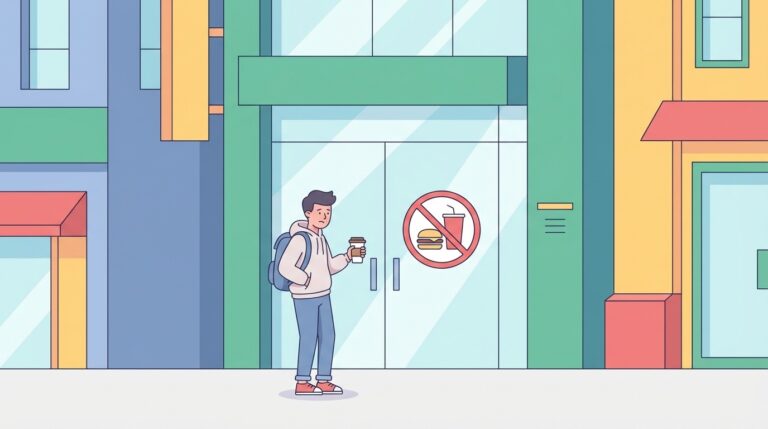
Picture this: You are the main character in a K-Drama set in a university. You’ve been studying hard (or pretending to) just like the students in Reply 1988 or Cheese in the Trap. You approach the library entrance, holding your lifeline—an ice-cold Americano (a.k.a. “Ah-Ah”).
Suddenly, the librarian stares at your cup. The air freezes. The background music stops. Is she judging your caffeine addiction? No. She’s looking at the lid.
In Korea, public etiquette regarding food and smell is huge. Whether it’s a library, a museum, or even a city bus in Seoul, knowing how to ask “Is food allowed?” is the difference between being a polite guest and being the “clueless foreigner.”
Don’t worry! Today, we’ll master the art of asking permission so you can keep your coffee and your dignity.
Phase 2: Deep Dive (Core Expressions)
Here are the top 3 expressions you need to survive the Korean “No Food” zones.
1. 음식물 반입 금지인가요? (Is food prohibited?)
- Pronunciation: [Eumsik-mul ban-ip geum-ji-in-gayo?]
- Tip: Ban-ip sounds a bit like “Barip” quickly. Geum-ji (Prohibited) sounds sharp and strict.
- Meaning:
- Literal: Is food entry prohibited?
- Real Nuance: “Is there a rule against bringing food in here?”
- K-Culture Moment: You will see the words [음식물 반입 금지] written on stickers on city buses in Seoul. If you hold a cup of tteokbokki, the driver will stop you!
- Editor’s Insight: This is a bit formal because it uses the official terms found on signs. Use this when you want to sound educated and respectful of the rules.
- Situation Spectrum:
[🚫 Casual Friends] ———— [⚠️ Semi-formal] ———— [✅ Strangers/Staff]- 🤔 Think About It: Why does Korean have a specific word for “bringing in” (ban-ip) separate from just “carrying”? It emphasizes the boundary between “outside” and “inside” space.
2. 이거 가지고 들어가도 돼요? (Can I take this inside?)
- Pronunciation: [Igeo ga-ji-go deu-reo-ga-do dwae-yo?]
- Sound-alike: Dwae-yo sounds like “Deh-yo” (rhymes with mayo).
- Meaning:
- Literal: Even if I take this and enter, is it okay?
- Real Nuance: “Can I bring this in?”
- K-Culture Moment: A fan asking security at a K-Pop concert entrance if they can bring their banner or water bottle inside.
- Editor’s Insight: This is the MVP phrase. You can use it for food, bags, pets, or even a friend! Just point at the object and say this.
- Situation Spectrum:
[✅ Casual Friends] ———— [✅ Semi-formal] ———— [✅ Strangers/Staff]3. 물은 괜찮아요? (Is water okay?)
- Pronunciation: [Mu-reun gwaen-cha-na-yo?]
- Meaning:
- Literal: As for water, is it okay?
- Real Nuance: “Okay, no food, but surely water is fine, right?”
- Editor’s Insight: This is your negotiation phrase. Often, libraries ban snacks (crumbs/smell) and open cups (spills), but allow water in a closed bottle.
- Situation Spectrum:
[✅ Casual Friends] ———— [✅ Semi-formal] ———— [✅ Strangers/Staff]
Phase 3: Textbook vs. Real Life
Let’s see how a textbook robot speaks versus a Seoul local.
| Situation | 📖 Textbook Korean | 🗣️ Real Korean | 💡 Why different? |
|---|---|---|---|
| At the library door | 음식물을 가지고 들어갈 수 있습니까? (Can I enter with food?) | 이거 돼요? (Does this work/Is this okay?) | In spoken Korean, context is king. Pointing at the coffee replaces the word “food.” |
| Checking rules | 규정이 어떻게 됩니까? (What is the regulation?) | 반입 안 돼요? (Is bringing-in not allowed?) | Focuses on the immediate action (bring in) rather than the abstract rule. |
💡 Editor’s Note: For A2 learners, “이거 돼요?” (Igeo dwaeyo?) is a magic key. It works for payments, entry, seats, and food!
Phase 4: Cultural Context — K-Culture Deep Dive
4-1. The “X” Gesture (Non-verbal)
If you ask a librarian or security guard, and they cross their arms in an “X” shape, stop immediately! This is the universal Korean sign for “Geum-ji” (Prohibited). Don’t try to argue; it’s a hard no.
4-2. The “Study Cafe” vs. “Library” Distinction
In K-Dramas, you see two types of study zones:
1. Public Library (Do-seo-gwan): Extreme silence. No typing sounds. Usually NO food/drinks except water.
2. Study Cafe (Seu-teo-di Ka-pe): Paid entry. Often provides free coffee and snacks in a designated lounge.
Critical Thinking: Why is the “smell” of food considered so rude in Korea? It links back to Nunchi (reading the room). Your garlic baguette might smell great to you, but in a collective space, forcing that smell on others is seen as a lack of consideration.
Phase 5: Immersive Roleplay
Scenario: It’s 2:00 PM on a Tuesday. You are at a public library in Mapo-gu. You have a tumbler with coffee in your hand. The stern librarian is watching you.
Characters:
* YOU: A thirsty student.
* Librarian: A strict middle-aged lady (Ajumma) who loves silence.
Start Roleplay:
Librarian: (Staring at your hand) 학생, 잠깐만요. ✋
(Hak-saeng, jam-kkan-man-yo.)
(Student, hold on a second.)
YOU: 네? 저요? 😳
(Ne? Jeo-yo?)
(Yes? Me?)
Librarian: 그거 커피예요? 열람실에 음식물 반입 금지예요. 🙅♀️
(Geu-geo keo-pi-ye-yo? Yeol-lam-si-re eum-sik-mul ban-ip geum-ji-ye-yo.)
(Is that coffee? Food/drink entry is prohibited in the reading room.)
🔀 Decision Point: How do you respond?
- A) “아, 죄송합니다. 다 마시고 들어갈게요.” (Ah, sorry. I’ll drink it all and go in.)
- B) “뚜껑 닫으면 괜찮아요?” (Is it okay if I close the lid?)
- C) “몰랐어요. 그냥 들어갈게요.” (I didn’t know. I’ll just go in.)
✅ Best Choice: B — Many libraries allow covered tumblers! It’s worth asking politely.
⚠️ Choice C Analysis: This is rude. Ignorance of the law is not an excuse in Korea!
Continued (If you chose B):
YOU: 아, 혹시 뚜껑 닫으면 괜찮아요? 🥤
(Ah, hok-si ttu-kkeong da-deu-myeon gwaen-cha-na-yo?)
Librarian: (Softening) 텀블러예요? 그럼 쏟지 않게 조심하세요. 😌
(Teom-beul-leo-ye-yo? Geu-reom ssot-ji an-ke jo-sim-ha-se-yo.)
(Is it a tumbler? Then be careful not to spill.)
Phase 6: 10-Second Shadowing Drill
Let’s practice the negotiation phrase!
- Emotion: 🥺 (Polite & slightly pleading)
- Sentence: 죄송한데 / 물은 / 가지고 들어가도 / 돼요?
- Romanization: Joe-song-han-de / mu-reun / ga-ji-go deu-reo-ga-do / dwae-yo?
- Meaning: I’m sorry, but / as for water / can I take it / inside?
Phase 7: K-Culture Mini Glossary
| Korean | Romanization | Meaning | Context |
|---|---|---|---|
| 반입 금지 | Ban-ip Geum-ji | Entry Prohibited | Used for items (food, pets, weapons). |
| 열람실 | Yeol-lam-sil | Reading Room | The quiet study area in a library. |
| 휴게실 | Hyu-ge-sil | Lounge/Rest Area | The Safe Zone! You can eat and talk here. |
| 외부 음식 | Oe-bu Eum-sik | Outside Food | Often banned in cafes/restaurants (don’t bring Starbucks into a scenic cafe!). |
Phase 8: Traveler’s Survival Kit
Even if you aren’t going to a library, you need this for Public Transport!
🆘 Survival Card: The Seoul Bus Rule
Since 2018, coffee cups/food are banned on Seoul city buses.
– If the driver stops you: Don’t argue. Finish it outside or throw it away.
– Expression: “이거 버리고 탈게요!” (I’ll throw this away and get on!)
– 💡 Pro Tip: Bottled water (with a cap) or fully sealed bags (like unopened chips) are usually OK.
Phase 9: Think Deeper — “One Step Further”
Topic: Collectivism & Public Space
In Western cultures, “freedom” often means “I can do what I want as long as I don’t hurt you.” In Korea, public etiquette is driven by “Nam-eui Si-seon” (The gaze of others) and not causing inconvenience (Min-pye).
The strict “No Food” rules in quiet places aren’t just about hygiene; they are about protecting the collective atmosphere. Eating a crunchy apple in a silent library is seen as breaking the shared agreement of silence.
💬 Your Turn: In your country, is it rude to eat on the bus or in a library? Or is it totally normal? Tell me in the comments!
Phase 10: FAQ & Troubleshooting
- Q: Can I bring a laptop to the library?
- A: Yes, but check the zone! Some rooms are “No Typing” (Book study only). Look for signs with a laptop icon 💻.
- Q: Can I whisper in the Reading Room (Yeol-lam-sil)?
- A: ❌ No. People might leave post-it notes on your desk asking you to be quiet. It’s intense!
- Q: What if I see others eating?
- A: Check if you are in the Hyu-ge-sil (Lounge). If you are in the study room and someone is eating, they are being rude (or it’s a very chill library).
❌ Common Mistake: asking “Can I eat?” (먹어도 돼요?) instead of “Can I bring this in?” (가지고 들어가도 돼요?).
* Why? You might just want to hold the coffee without drinking it. Asking about “entry” is more precise.
Phase 11: Wrap-up & Action Mission
One-Liner Summary: When in doubt, point at your item and ask “Igeo dwaeyo?” (Is this okay?) before entering!
🚀 Action Mission:
* 🥉 Bronze: Look at your water bottle or coffee cup right now and say, “Igeo gajigo deureogado dwaeyo?” 3 times.
* 🥈 Silver: Watch a K-Drama scene in a cafe or library and spot the differences in noise levels.
* 🥇 Gold: Next time you enter a shop or restricted area with a drink, ask the staff “Igeo dwaeyo?” (Even if you are not in Korea, try the sentiment!)
Phase 12: Quiz — Interactive Challenge
1. You see a sign that says [음식물 반입 금지]. What does it mean?
a) Please eat comfortably.
b) Food entry is prohibited.
c) Only water is allowed.
2. Which item is usually allowed on a Seoul Bus?
a) An open cup of hot coffee.
b) A hamburger in your hand.
c) A water bottle with a screw cap.
3. True or False?
“In a Korean ‘Reading Room’ (Yeol-lam-sil), it is okay to chat quietly with your friend.”
(True / False)
Answer Key:
1. (b) ban-ip (entry) geum-ji (prohibited).
2. (c) Sealed items are okay!
3. False. Silence is golden. Go to the Hyu-ge-sil to chat.
Frequently Asked Questions (FAQ)
Q: What does "음식물 반입 금지인가요? (Is food prohibited?)" mean in Korean and how do you pronounce it?
A: In Korean, "음식물 반입 금지인가요? (Is food prohibited?)" is pronounced [Eumsik-mul ban-ip geum-ji-in-gayo?] and means: a key conversational Korean expression covered in this lesson.
Q: What does "이거 가지고 들어가도 돼요? (Can I take this inside?)" mean in Korean and how do you pronounce it?
A: In Korean, "이거 가지고 들어가도 돼요? (Can I take this inside?)" is pronounced [Igeo ga-ji-go deu-reo-ga-do dwae-yo?] and means: a key conversational Korean expression covered in this lesson.
Q: What does "물은 괜찮아요? (Is water okay?)" mean in Korean and how do you pronounce it?
A: In Korean, "물은 괜찮아요? (Is water okay?)" is pronounced [Mu-reun gwaen-cha-na-yo?] and means: Literal: As for water, is it okay?







