

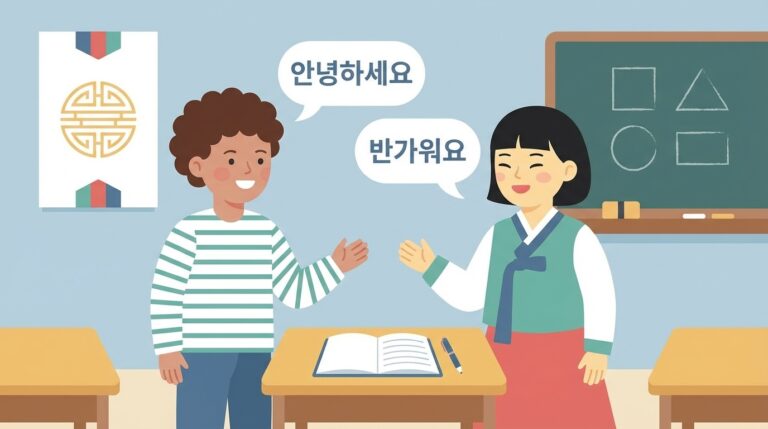
Phase 1: Immersive Hook
Greeting: Hello! This is your Daily Hangul Editor.
Imagine this scene: You’ve just walked into your new classroom in Seoul. It feels exactly like that K-Drama moment—maybe True Beauty or Weightlifting Fairy Kim Bok-joo. You slide into a desk, and the person next to you looks up. The air is filled with that polite, awkward silence.
In K-Dramas, this is usually where the male lead stares intensely, or the female lead drops her pencil. But in real life? You need to speak.
If you stay silent, you’re just the “mysterious foreigner.” But if you know the right three phrases, you’re instantly “that cool new friend.”
Today, we are skipping the robotic textbook introductions. I’m going to teach you how to actually make a friend (Chingu) in a Korean school setting, without making it weird.
Phase 2: Deep Dive into Key Phrases
1. 이름이 뭐예요? (What is your name?)
- Pronunciation: [Ireumi mwoyeyo?]
- Sound-alike: “Ear-em-ee / mwo-yay-yo?”
- Meaning:
- Literal: What is the name?
- Real Nuance: “I want to know who you are (politely).”
- K-Culture Moment: In every variety show (like Running Man), when a new guest appears, this is the first polite bridge built before the chaos starts.
- Editor’s Insight: You might hear “Seonghami eotteoke doeseyo?” in textbooks. That is SUPER formal. Unless you are talking to the school principal, stick to “Ireumi mwoyeyo?” It’s polite but friendly.
- Situation Spectrum:
[🚫 To Elders] ———— [✅ Classmates/Strangers] ———— [✅ Friendly] - 🤔 Think About It: Koreans often omit the word “You” (Dangsin). Why? Because saying “What is your name?” can sound too direct or distancing. We focus on the “Name” itself.
2. 몇 살이에요? (How old are you?)
- Pronunciation: [Myeot sar-ieyo?]
- Sound-alike: “Myut / sal / ee-yay-yo?”
- Meaning:
- Literal: How many years (old) are you?
- Real Nuance: “I need to know our hierarchy so I can choose the right grammar!”
- K-Culture Moment: You know that scene where two characters are arguing, and suddenly one yells, “Ya! How old are you?!” Age determines everything in Korea—who pours the water, who speaks casually, and who pays for lunch.
- Editor’s Insight: In Western culture, asking age is rude. In Korea, it is essential. It’s not about judging your age; it’s about finding out if we can be equal friends (Same age = Chingu).
- Situation Spectrum:
[⚠️ Elders (Use respectful form)] ———— [✅ Peers/Younger] ———— [✅ Casual] - 🤔 Think About It: If someone is one year older than you, can you call them “Friend” (Chingu)? In strict Korean culture, no. They are “Unnie/Oppa/Noona/Hyung.” Does this distinct boundary exist in your language?
3. 인스타 해요? (Do you use Instagram?)
- Pronunciation: [Insta haeyo?]
- Sound-alike: “In-sta / heh-yo?”
- Meaning:
- Literal: Do you do Instagram?
- Real Nuance: “Let’s stay in touch without the pressure of exchanging phone numbers.”
- K-Culture Moment: This is the modern version of asking for a phone number. It’s low-pressure and casual. You’ll see K-Pop idols asking fans this at fan signs, too!
- Editor’s Insight: “Phone number” feels too serious for day one. “Insta” or “KakaoTalk” is the golden ticket to friendship.
- Situation Spectrum:
[🚫 Grandparents] ———— [✅ Peers] ———— [✅ New Acquaintances]
Phase 3: Textbook vs. Real Life
| Situation | 📖 Textbook Korean | 🗣️ Real Korean (School Life) | 💡 Why is it different? |
|---|---|---|---|
| Greeting | 안녕하십니까 (Annyeonghasimnikka) | 안녕하세요 (Annyeonghaseyo) | The first one sounds like a soldier reporting for duty. The second is soft and polite. |
| Asking Major | 전공이 무엇입니까? (Jeongong-i mueosimnikka?) | 전공이 뭐예요? (Jeongongi mwoyeyo?) | “Mwoyeyo” is the magic ending for polite but friendly conversation. |
| Saying Goodbye | 안녕히 가십시오 (Annyeonghi gasipsio) | 갈게~ / 내일 봐요 (Galge / Naeil bwayo) | Friends don’t use formal farewells. They say “I’m going~” or “See you tomorrow.” |
Bottom Note: As an A1 beginner, if you use the “Textbook” version, people will think you are cute but stiff. Aim for the “Real” column to blend in!
Phase 4: Cultural Context — K-Culture Deep Dive
4-1. Non-verbal: The “Bow-Nod”
When you say “Annyeonghaseyo,” do not wave your hand immediately if it’s the first meeting. Instead, do a small head bow (nod). It shows respect. Waving is for when you become close friends.
4-2. Connection: The “Chingu” (Friend) Concept
In K-Dramas like Reply 1988, you see the squad doing everything together. But notice something? They are all born in the same year.
* In English: A 20-year-old and a 40-year-old can be “friends.”
* In Korean: strictly speaking, “Chingu” (친구) usually implies the same age.
* Critique: This creates a culture where it’s hard to be casual with someone even one year older. But don’t worry! As a foreigner, Koreans will be lenient with you. You have a “Foreigner Pass.”
Phase 5: Immersive Roleplay
Setting: Monday Morning, 9 AM. A university lecture hall. You sit next to a student who looks friendly.
Characters:
* YOU: An exchange student excited to make friends.
* Minji: A Korean student, curious about you but shy.
(Dialogue Start)
YOU: (Smiling) 안녕하세요! 여기 자리 있어요?
(Annyeonghaseyo! Yeogi jari isseoyo?)
(English: Hello! Is this seat taken?)
Minji: 아, 아니요! 앉으세요.
(Ah, aniyo! Anjeuseyo.)
(English: Ah, no! Please sit.)
YOU: 감사합니다. 저는 [Your Name]이에요.
(Gamsahamnida. Jeoneun [Name]-ieyo.)
(English: Thank you. I am [Name].)
Minji: 반가워요. 저는 민지예요.
(Bangawayo. Jeoneun Minji-yeyo.)
(English: Nice to meet you. I am Minji.)
YOU: 민지 씨, 혹시 몇 살이에요?
(Minji-ssi, hoksi myeot sar-ieyo?)
(English: Minji, by any chance, how old are you?)
Minji: 저는 스무 살이에요. (20 years old)
(Jeoneun seumu sar-ieyo.)
🔀 Decision Point! You are also 20. How do you respond?
- A) “아, 그렇습니까?” (Ah, is that so?) – Very Formal
- B) “와! 우리 동갑이네요!” (Wow! We are the same age!) – Friendly & Excited
- C) “응, 반가워.” (Yeah, nice to meet you.) – Sudden Banmal (Rude)
✅ Best Choice: B
* Why? “Donggap” means same age. This is the magic word that turns strangers into friends instantly.
* Analysis of C: Even if you are the same age, never drop to informal speech (Banmal) without asking first!
Phase 6: 10-Second Shadowing Drill
Let’s practice the magic phrase to get contact info. Repeat this 3 times!
- Emotion: 😊 Curious & Friendly
- Line: 혹시 / 인스타 / 해요?
- Romanization: Hoksi / In-sta / haeyo?
- Meaning: By any chance / do you do / Instagram?
Phase 7: K-Culture Mini Glossary
| Korean | Romanization | Meaning | Context |
|---|---|---|---|
| 선배 / 후배 | Sunbae / Hoobae | Senior / Junior | The absolute law of school hierarchy. Seniors take care of juniors (buy food), juniors show respect. |
| 동갑 | Donggap | Same age | The golden ticket to becoming instant best friends. |
| 학식 | Haksik | School Cafeteria Food | Short for “Hakgyo Sikdang.” Cheap and the center of student life. |
| 인싸 | Inssa | Insider (Popular kid) | Someone who gets along with everyone (Social Butterfly). |
| 아싸 | Assa | Outsider | Someone who prefers to be alone or doesn’t fit in (not always bad!). |
Phase 8: Traveler’s Survival Kit (Campus Edition)
Even if you aren’t a student, you might visit a university campus (like Yonsei or Ewha) because they are beautiful tourist spots.
🆘 Survival Phrases
1. “와이파이 비밀번호 뭐예요?” (Wifi bimil-beonho mwoyeyo?)
* What is the Wifi password? – Essential for survival.
2. “화장실 어디예요?” (Hwajangsil eodiyeyo?)
* Where is the bathroom? – Never gets old.
3. “편의점 어디 있어요?” (Pyeonuijeom eodi isseoyo?)
* Where is the convenience store?📌 Editor’s Note:
Korean university campuses are hilly. Like, hiking-level hilly. Wear comfortable shoes. Also, the “University District” (Daehak-ro) usually has the best and cheapest food!
Phase 9: Think Deeper — Language & Power
The “Age” Hierarchy:
In English, you can meet someone 10 years older and say, “Hey, Mike!” instantly. In Korea, that linguistic equality doesn’t exist by default. Language is a tool to map out your social position relative to others.
🧠 Think Deeper:
Does this hierarchy make Korean society stiff, or does it create a comforting structure where everyone knows their role? Some find it suffocating; others find safety in knowing exactly how to behave. How does your language handle respect for elders?
Phase 10: FAQ & Troubleshooting
Q: Can I just speak English to make friends?
A: You can, but saying just one sentence in Korean (like “Ireumi mwoyeyo?”) shows you respect their culture. It lowers the barrier massively.
Q: What if I am older than everyone else?
A: Lucky you! In Korea, the older person (Hyung/Unnie/Noona/Oppa) usually buys the food. But they also get more respect. It’s a trade-off.
❌ Common Mistake:
Calling a new friend “You” (Dangsin).
✅ Fix: Just use their name + ssii (Minji-ssi) or omit the subject entirely.
Phase 11: Wrap-up & Mission
Summary: To make friends, ask their name, check their age politely, and ask for their Instagram.
🚀 Action Mission:
* 🥉 Bronze: Look in the mirror and introduce yourself: “Annyeonghaseyo, Jeoneun [Name]-ieyo.”
* 🥈 Silver: Go to a Korean comment section on YouTube/Instagram and type: “안녕하세요! 반가워요!”
* 🥇 Gold: If you see a Korean person or visit a Korean restaurant, say “Gamsahamnida” (Thank you) clearly with a smile.
📺 K-Culture Mission:
Watch episode 1 of any “School” genre K-Drama (like All of Us Are Dead or School 2017). Count how many times they ask “How old are you?” or “Are we the same age?”
Phase 12: Interactive Quiz
1. You met someone for the first time. They are the same age as you. What do you say?
* A) “Ya!” (Hey!)
* B) “Banmal haja.” (Let’s speak casually – immediately)
* C) “Wa, uri donggap-ineyo!” (Wow, we are the same age!)
2. Which phrase is best for getting contact info casually?
* A) House address juseyo.
* B) Insta haeyo?
* C) Phone number naenwa. (Give me your number – Gangster style)
(Scroll down for answers)
.
.
.
Answers: 1 (C) – Always acknowledge the coincidence first! 2 (B) – Modern and polite.
Frequently Asked Questions (FAQ)
Q: What does "이름이 뭐예요? (What is your name?)" mean in Korean and how do you pronounce it?
A: In Korean, "이름이 뭐예요? (What is your name?)" is pronounced [Ireumi mwoyeyo?] and means: a key conversational Korean expression covered in this lesson.
Q: What does "몇 살이에요? (How old are you?)" mean in Korean and how do you pronounce it?
A: In Korean, "몇 살이에요? (How old are you?)" is pronounced [Myeot sar-ieyo?] and means: a key conversational Korean expression covered in this lesson.
Q: What does "인스타 해요? (Do you use Instagram?)" mean in Korean and how do you pronounce it?
A: In Korean, "인스타 해요? (Do you use Instagram?)" is pronounced [Insta haeyo?] and means: a key conversational Korean expression covered in this lesson.







