Phase 1: Immersive Hook
Greeting: 안녕하세요! Daily Hangul Editor here.
The K-Culture Cold Open:
You know that scene in Running Man or your favorite idol’s reality show? The games are over, the losers are chosen, and suddenly the screen flashes red with the word 벌칙 (Beolchik – Penalty). They might have to wear a funny wig or get hit with a water cannon. Everyone laughs.
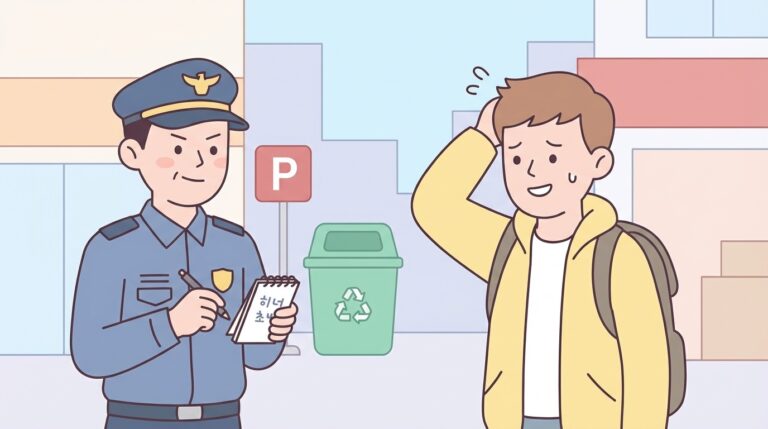
But in real life in Korea? When you see a piece of paper stuck to your car windshield or get stopped by an official in a subway station, it’s not a variety show. It’s a moment of panic. “Did I break a rule?” “How much do I have to pay?”
The ‘Why’:
Breaking a rule in Korea—whether it’s jaywalking, illegal parking, or messing up the recycling—can lead to awkward confrontations and fines. But knowing how to apologize properly can sometimes turn a strict “Pay up!” into a kind “Just be careful next time.”
Transparency:
This guide is based on real stories from students who accidentally sat in the “Pregnant Women Only” seat or threw trash in the wrong bin. Let’s learn how to navigate these sticky situations like a local.
Phase 2: Deep Dive (Core Expressions)
1. 규칙을 어기다 (Gyuchig-eul eogida)
- Pronunciation: [gyoo-chig-eul uh-gi-da]
Tip: The ‘eo’ in ‘eogida’ sounds like the ‘u’ in ‘uh-oh’ when you make a mistake.- Meaning: To break a rule / To violate a regulation.
- K-Culture Moment: Think of Squid Game. The whole premise is about what happens when you 규칙을 어기다. In news reports about celebrities, this phrase appears when they get into trouble.
- Editor’s Insight: This is a somewhat formal phrase. In casual conversation, you might hear “룰을 깨다” (break the rule), but “어기다” sounds more serious and acknowledges the weight of the action.
- Situation Spectrum:
[🚫 Casual Friends] ———— [⚠️ Semi-formal] ———— [✅ Formal/Serious]- 🤔 Think About It: Why does Korean distinguish between breaking a “promise” (yaksok) and a “rule” (gyuchik) so strictly?
2. 벌금을 내다 (Beolgeum-eul naeda)
- Pronunciation: [beol-geum-eul nae-da]
- Meaning: To pay a fine.
- K-Culture Moment: In K-Dramas, when a chaebol (rich heir) drives recklessly, they might arrogantly say, “I’ll just pay the fine.” But for us regular people, hearing this phrase makes our hearts drop!
- Editor’s Insight: “내다” means “to pay” or “to turn in.” It’s the same verb used for paying taxes or handing in homework.
- Situation Spectrum:
[✅ Casual Friends] ———— [✅ Semi-formal] ———— [✅ Formal]
(Used universally in all contexts)3. 한 번만 봐주세요 (Han beon-man bwaju-seyo)
- Pronunciation: [han bun-man bwa-ju-say-yo]
- Meaning: Please let it slide just this once / Please overlook it this time.
- K-Culture Moment: This is the ultimate survival phrase. You see this in dramas when a character gets caught speeding by a police officer. They clasp their hands and beg, “Aigo, Officer! Han beon-man bwaju-seyo!”
- Editor’s Insight: Literally, it means “Please look at me (favorably) just once.” It appeals to the Korean concept of Jeong (connection/humanity). You are asking them to see you as a human who made a mistake, not just a rule-breaker.
- Situation Spectrum:
[✅ Casual Friends] ———— [✅ Semi-formal] ———— [⚠️ Formal]
(Use with caution with very strict officials, but worth a try!)
Phase 3: Textbook vs. Real Life
| Situation | 📖 Textbook Korean | 🗣️ Real Korean | 💡 Why the difference? |
|---|---|---|---|
| Admitting a mistake | 규칙을 어겼습니다. (I broke the rule.) | 제가 잘 몰랐어요. (I didn’t know well.) | Koreans prefer to appeal to ignorance rather than direct confrontation. |
| Asking for mercy | 용서해 주십시오. (Please forgive me.) | 아, 진짜 한 번만요… (Ah, really, just this once…) | “Forgive” is too dramatic. “Just once” negotiates the situation casually. |
| Paying the fine | 벌금은 얼마입니까? (How much is the fine?) | 이거 얼마 내야 돼요? (How much do I have to pay for this?) | Shorter, more direct sentences are preferred in stressful moments. |
Bottom Note: B1 learners, don’t try to use slang with police officers. Stick to the “Real Korean” column but keep your tone polite (ending in -yo)!
Phase 4: Cultural Deep Dive
4-1. Non-verbal Communication: The “Sak-Sak” Hands
When saying “한 번만 봐주세요” (Please let it slide), your body language is 50% of the message.
– The Gesture: Put your two palms together in front of your chest and rub them slightly. This is called “Sonsi-ro saksak” (rubbing hands). It signifies deep apology and begging.
– The Eyes: Do not make defiant eye contact. Look slightly down to show shame.
4-2. K-Culture Connection: Beolchik (Penalty) Culture
In K-Pop variety shows, 벌칙 (Beolchik) is a game penalty (like a flick on the forehead). In real life, 벌금 (Beolgeum) is a legal fine.
– K-Pop Context: If you hear your idol scream “Beolchik!” they are likely playing a game.
– Real Life: If a government official says “Beolgeum,” stop laughing immediately. The playful “fighting spirit” of variety shows does not apply here!
Phase 5: Immersive Roleplay
Scenario: It is a humid Tuesday night at the Han River Park. You and your friends ordered fried chicken. You finished eating and threw the leftovers and the box into a general trash can. Suddenly, a park official wearing a green vest stops you.
Characters:
– YOU: A foreign student who truly didn’t know the recycling rules.
– Official (Ahjussi): Strict but tired. He has seen hundreds of people break rules today.
Dialogue:
Official: 잠깐만요! 거기는 일반 쓰레기 버리는 곳 아닙니다. 🛑
(Jamkkanmanyo! Geogineun ilban sseuregi beorineun got animnida.)
Wait! That’s not the place for general trash.
YOU: 네? 치킨 상자 버리면 안 돼요? 🍗
(Ne? Chikin sangja beorimyeon an dwaeyo?)
Huh? Can’t I throw away the chicken box?
Official: 음식물은 따로 버려야죠. 이거 규칙 위반이에요. 벌금 내셔야 합니다.
(Eumsigmureun ttaro beoryeoyajyo. Igeo gyuchik wibanieyo. Beolgeum naesyeoya hamnida.)
You have to separate food waste. This is a rule violation. You have to pay a fine.
Official: 신분증 주세요. (Give me your ID.)
🔀 Decision Point! How do you react?
- A) “Why? Everyone else is doing it!” (Argue logic)
- B) “Aigo… I really didn’t know. I’m a foreigner. Please let it slide just this once.” (Appeal to emotion)
- C) “Okay, here is my money.” (Accept defeat immediately)
✅ Best Choice: B
Reason: In Korea, if you show you are “sorry and ignorant” rather than “defiant,” officials often give a warning instead of a fine. Logic (A) often makes them angry.
YOU (Option B): 죄송합니다. 제가 한국 온 지 얼마 안 돼서 잘 몰랐어요. 한 번만 봐주세요. 🙏
(Joesonghamnida. Jega Hanguk on ji eolma an dwaeseo jal mollasseoyo. Han beon-man bwaju-seyo.)
Official: (Sighs) 에휴… 다음부터는 조심하세요. 이번만 봐 드립니다.
(Ehyu… Daeumbuteoneun josimhaseyo. Ibeonman bwa deurimnida.)
(Sigh) Be careful next time. I’ll let you off just this once.
Phase 6: 10-Second Shadowing Drill
Practice this magic sentence for when you get caught!
Sentence: 죄송해요, / 제가 규칙을 / 잘 몰랐어요. 😢
Romanization: Joesonghaeyo, / jega gyuchigeul / jal mollasseoyo.
Translation: I’m sorry, I didn’t know the rules well.
Emotion: 😢 (Apologetic, slightly embarrassed, soft voice)
Phase 7: K-Culture Mini Glossary
| Korean | Romanization | Meaning | Context |
|---|---|---|---|
| 딱지 | Ttakji | Ticket/Citation | A sticker placed on cars for illegal parking. Also a traditional game (Squid Game), but here it means trouble! |
| 과태료 | Gwataeryo | Fine (Administrative) | Minor fines for parking or trash. Different from criminal fines. |
| 벌칙 | Beolchik | Penalty/Punishment | Usually used in games/variety shows, not for legal fines. |
| 봐주다 | Bwajuda | To overlook/Cut slack | Essential verb for negotiation. |
Phase 8: Traveler’s Survival Kit
Situation: You rented a car in Jeju or Seoul and got a parking ticket.
🆘 Survival Phrases
– 🇰🇷 “이거 어디에 내요?” (Igeo eodie naeyo?)
– Meaning: Where do I pay this?
– 🇰🇷 “가상계좌 있나요?” (Gasang-gyejwa innayo?)
– Meaning: Is there a virtual account (for bank transfer)?
– 🇰🇷 “얼마예요?” (Eolmayeyo?)
– Meaning: How much is it?📌 Editor’s Travel Note:
– Paying Fines: Most parking tickets in Korea have a “Virtual Bank Account” (가상계좌) number printed on them. You just transfer the money via mobile banking or at an ATM.
– Rental Cars: If you get a fine in a rental car, tell the rental company immediately upon return. If you don’t, they will charge your credit card later with extra fees!
Phase 9: Think Deeper — “Strict Rules vs. Flexible People”
Culture Insight:
Korean society is famous for being “Ppalli-Ppalli” (Hurry-Hurry) and highly efficient. To maintain this speed in a densely populated country, rules (like recycling or subway etiquette) are very detailed. However, there is a counter-force called Jeong (Human Affection).
Ideally, rules are strict. But in reality, if you appeal to Jeong (by apologizing sincerely and showing humility), the strict rule can bend. This isn’t “corruption”; it’s a cultural value that prioritizes human context over cold logic.
🧠 Think Deeper:
In your country, if you break a rule and apologize, does the police officer let you go? Or is the law black and white? How does this compare to the Korean concept of “Bwajuseyo” (Let it slide)?
Phase 10: FAQ & Troubleshooting
Q: Can I offer cash to the police officer to pay the fine immediately?
A: ABSOLUTELY NOT. 🚫
Trying to hand cash to a police officer can be considered bribery. Always ask for the ticket (bill) and pay it through the bank. Never try to “settle it” on the spot with cash in hand.
Q: Is “Jeong” (Mercy) applicable everywhere?
A: No.
Safety violations (speeding in a school zone, drunk driving) have ZERO tolerance. “Bwajuseyo” only works for minor, honest mistakes like confusing trash bags or parking slightly over a line.
❌ Common Mistake:
Using “Wae?” (Why?) when caught.
Asking “Why?” sounds aggressive and challenging to authority. Start with “Sorry” first, then ask for clarification.
Phase 11: Wrap-up & Mission
Summary:
When you break a rule (규칙을 어기다), you might have to pay a fine (벌금을 내다). But if it’s a genuine mistake, try appealing to their humanity by asking them to overlook it just once (한 번만 봐주세요).
Action Mission:
– 🥉 Bronze: Stand in front of a mirror, rub your hands together, and practice saying “Han beon-man bwaju-seyo” with a sad puppy face.
– 🥈 Silver: Watch an episode of Running Man and count how many times they say “Beolchik” (Penalty).
– 🥇 Gold: Next time you are in Korea and throw away trash, double-check the labels. If you are unsure, ask a local, “Igeo yeogi beoryeodo dwaeyo?” (Can I throw this here?)
Phase 12: Interactive Quiz
1. Situation Judgment:
You are caught jaywalking (crossing the street illegally). The police officer stops you. Which response is the WORST?
– A) “Joesonghamnida. Mollasseoyo.” (Sorry. I didn’t know.)
– B) “Wae jabeun geoyeyo?” (Why did you catch me?)
– C) “Han beon-man bwaju-seyo.” (Please let it slide.)
Answer: B. Challenging the officer with “Why” will almost guarantee you get a fine. A and C give you a chance to escape with a warning.
2. True or False (K-Culture):
“Gwataeryo” (Fine) and “Beolchik” (Penalty) are the exact same thing in Korean.
Answer: False. Gwataeryo is a legal/administrative fine. Beolchik is usually a punishment in a game or variety show context.
Frequently Asked Questions (FAQ)
Q: What does "규칙을 어기다 (Gyuchig-eul eogida)" mean in Korean and how do you pronounce it?
A: In Korean, "규칙을 어기다 (Gyuchig-eul eogida)" is pronounced [gyoo-chig-eul uh-gi-da] and means: To break a rule / To violate a regulation.
Q: What does "벌금을 내다 (Beolgeum-eul naeda)" mean in Korean and how do you pronounce it?
A: In Korean, "벌금을 내다 (Beolgeum-eul naeda)" is pronounced [beol-geum-eul nae-da] and means: To pay a fine.
Q: What does "한 번만 봐주세요 (Han beon-man bwaju-seyo)" mean in Korean and how do you pronounce it?
A: In Korean, "한 번만 봐주세요 (Han beon-man bwaju-seyo)" is pronounced [han bun-man bwa-ju-say-yo] and means: Please let it slide just this once / Please overlook it this time.