

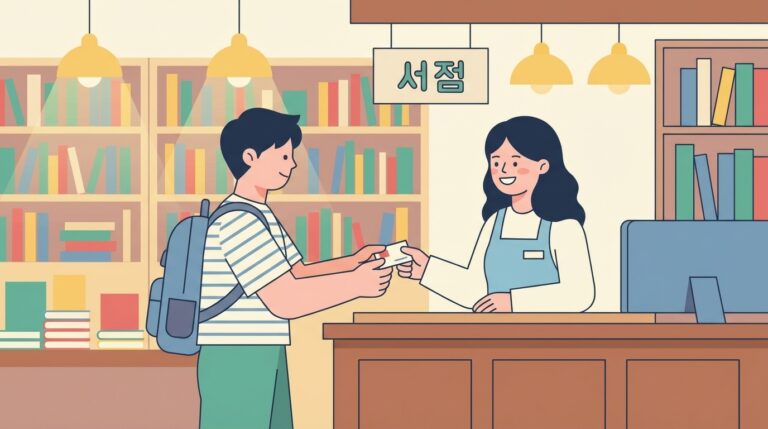
Phase 1: Immersive Hook
Hello! This is your Daily Hangul Editor. 👋
Imagine this: You are in a K-Drama scene. Specifically, that quiet, aesthetic library scene where the main characters accidentally touch hands while reaching for the same book. 📚✨ You want to borrow that book to start your own story, or maybe you’re at a huge Kyobo Bookstore wanting to collect points like a savvy local.
You walk up to the desk, confidence high. The staff looks at you and asks something fast. You freeze.
“Do I need a ticket? Money? A secret password?”
Don’t worry! Today, we are cracking the code of “Making a Membership Card” (회원증 만들기). Whether it’s for a library, a bookstore, or even your favorite K-Pop idol’s official fan club, the vocabulary here is your golden key. Let’s get you that card! 💳
Phase 2: Deep Dive (Core Expressions)
Here are the 3 magic phrases you need to survive the information desk.
1. 만들고 싶은데요 (Man-deul-go si-peun-de-yo)
- Pronunciation: [Man-deul-go] + [She-peun-day-yo]
Tip: ‘Man’ sounds like ‘Mon’ in Monday. ‘Deul’ sounds like the ‘dull’ in dull moment.- Meaning: “I would like to make [it].” (Literal: I want to make…)
- K-Culture Moment: In K-Dramas, when a character walks into a cafe or a bank, they often end their sentence with “~n-de-yo”. It softens the tone. Instead of demanding “Make this!”, it implies “I want to make this… (can you help me?)”
- Editor’s Insight: This is the most versatile phrase. You can use it for bank accounts, point cards, or even ordering custom subways sandwiches!
- Situation Spectrum:
[🚫 Formal Boss] ———— [⚠️ Polite/Standard] ———— [✅ Casual]
Note: Perfect for staff (Strangers).- 🤔 Think About It: Why do Koreans end sentences with “…but/and” (~는데요) instead of a direct period? What does this say about avoiding direct confrontation?
2. 신분증 (Sin-bun-jeung)
- Pronunciation: [Shin-bun-jeung]
Tip: ‘Shin’ like your leg’s ‘shin’. ‘Jeung’ sounds like ‘jung’ in jungle.- Meaning: ID Card / Identification
- K-Culture Moment: You know those scenes where the police stop someone, or a bouncer checks ID at a club in Hongdae? They always ask for “Sin-bun-jeung”.
- Editor’s Insight: For foreigners, this usually means your Passport or ARC (Alien Registration Card). If you hear this word, instinctively reach for your wallet!
- Situation Spectrum: Essential vocabulary for any administrative task.
- 🤔 Think About It: In Korea, your ID number (Resident Registration Number) is tied to everything—internet, gaming, banking. How does this compare to privacy in your country?
3. 번호 (Beon-ho)
- Pronunciation: [Bon-ho]
Tip: ‘Bon’ like ‘Bon’ appetit. ‘Ho’ like Santa’s ‘Ho ho ho’.- Meaning: Number (specifically Phone Number here)
- K-Culture Moment: A classic pickup line in K-Dramas: “Beon-ho jom…” (Can I have your number?). But here, the clerk just wants to register you!
- Editor’s Insight: They will likely ask for your “Hude-phone beon-ho” (Cell phone number).
- Situation Spectrum: Used everywhere.
- 🤔 Think About It: Korean phone numbers almost always start with ‘010’. It’s a cultural code!
Phase 3: Textbook vs. Real Life
| Situation | 📖 Textbook Korean | 🗣️ Real Korean | 💡 Why is it different? |
|---|---|---|---|
| Stating Purpose | 회원증을 만들러 왔습니다. (I came to make a membership card.) |
회원증 만들려구요. (I’m looking to make a membership card.) |
The textbook version sounds like a robot or a soldier. Real life prefers softer endings like ~(i)ryeoguyo. |
| Asking about ID | 신분증을 보여 주십시오. (Please show me your ID.) |
신분증 있으세요? (Do you have ID?) |
“Do you have it?” implies “Show it to me” but sounds less demanding. |
Bottom Note: For A1 beginners, sticking to “Textbook” is safer, but understanding “Real” Korean helps you not panic when you hear it!
Phase 4: Cultural Deep Dive
4-1. The “Two-Hand” Rule (Non-verbal)
When the clerk asks for your ID (Sin-bun-jeung), never pass it with one hand!
* The Move: Hold the card with your right hand, and lightly support your right elbow/wrist with your left hand.
* Why? It shows respect. Even if the clerk is younger, this is a business interaction.
4-2. K-Culture Connection: The “Point” Obsession 🎁
In Korea, “Membership” often equals “Points.”
* Bookstores (like Kyobo, YP Books): Koreans love accumulating points (po-in-teu). Even 1% back is important! If you buy K-Pop albums, these points add up fast.
* K-Pop Fanclubs: Joining an official fan club (like ARMY, BLINK, CARAT) is called “Ga-ip” (가입 – Signing up). The vocabulary you learn here (Name, ID, Phone Number) is exactly what you see on Global Interpark or Melon Ticket when joining a fan club!
Phase 5: Immersive Roleplay
Setting: A bright, busy counter at a large bookstore in Seoul. You want to make a membership card to get a discount on your K-Pop magazines.
Characters:
* YOU: A clever student who wants to save money.
* Staff: A fast-talking but efficient employee.
Staff: 어서 오세요. 찾으시는 책 있으세요?
(Eoseo oseyo. Chajeusineun chaek isseuseyo?)
(Welcome. Is there a book you are looking for?)
YOU: (You shake your head) 아니요. 회원증 만들고 싶은데요. 💳
(Aniyo. Hoewon-jeung mandeul-go sipeunde-yo.)
([No. I want to make a membership card.])
Staff: 아, 네. 신분증하고 핸드폰 보여주세요.
(Ah, ne. Sin-bun-jeung-hago hand-phone boyeo-juseyo.)
([Ah, okay. Please show me your ID and cell phone.])
🔀 Decision Point: You realize you left your Passport at the hotel!
- Option A: “Here is my Credit Card.” (Will it work?)
- Option B: “죄송해요, 없어요.” (Sorry, I don’t have it.)
- Option C: Show a photo of your passport on your phone.
✅ Best Choice: Option B or C.
A credit card is NOT an ID. Usually, for simple bookstore memberships, a photo of your passport (Option C) might work if the staff is nice, or just a phone number authentication is enough. But for libraries, you MUST have the physical ID.
YOU: (Showing your phone number) 여기요.
(Yeogi-yo.)
([Here it is.])
Staff: 네, 가입 되셨습니다.
(Ne, ga-ip doesyeot-seumnida.)
([Okay, you are signed up.])
Phase 6: 10-Second Shadowing Drill
Practice these until your tongue remembers them!
- Polite Request 😊
저 / 회원증 / 만들고 싶은데요!
(Jeo / hoewon-jeung / man-deul-go / si-peun-de-yo!) -
Confirming ID 😮
신분증 / 여기 / 있어요.
(Sin-bun-jeung / yeogi / isseo-yo.)
Phase 7: K-Culture Mini Glossary
| Korean | Romanization | Meaning | Context |
|---|---|---|---|
| 회원증 | Hoewon-jeung | Membership Card | ‘Hoewon’ = Member, ‘Jeung’ = Certificate/Card. |
| 가입 | Ga-ip | Sign-up / Join | Used for websites, fan clubs, and insurance. |
| 서명 | Seo-myeong | Signature | You will sign on a digital pad. |
| 포인트 | Po-in-teu | Points | The magical currency of Korean shopping. |
Phase 8: Traveler’s Survival Kit (Membership Edition)
Top 3 Survival Phrases for Registration:
🆘 Survival Phrase #1
* 🇰🇷 “여권도 돼요?” (Yeogwon-do dwaeyo?)
* 🗣️ Meaning: Does a passport work? (Is a passport okay?)
* 💡 Why: Many systems only accept Korean Resident Cards (ARC). Always ask this first!🆘 Survival Phrase #2
* 🇰🇷 “비밀번호 뭐예요?” (Bimil-beonho mwo-yeyo?)
* 🗣️ Meaning: What is the password?
* 💡 Why: Usually needed for Wi-Fi in the library!📌 Editor’s Travel Note
* Public Libraries: Most Korean public libraries allow foreigners to read books inside without a card. But to borrow books, you almost always need an ARC (Alien Registration Card). A passport is often not enough for borrowing.
* Bookstores: You can easily make a “Point Card” with just a phone number!
Phase 9: Think Deeper — “One Step Further”
🧠 Theme: The “Ppalli-Ppalli” (Hurry Hurry) Culture & Efficiency
Have you noticed how fast the staff types when you give them your ID? Korean service culture is built on speed. Memberships are often processed in under 30 seconds.
Think About It: Why does Korean society value this extreme speed in administration? Is it just impatience, or is it a sign of a highly digitized, connected society where “waiting” is seen as a system failure?
💬 Your Turn: In your country, how long does it take to get a library card? 5 minutes? 5 days? Let me know in the comments!
Phase 10: FAQ & Troubleshooting
- Q: Can I use a fake name or nickname for a bookstore card?
- A: No. Korean systems require “Sil-myeong” (Real Name) verification, usually tied to your phone number. Always use the name exactly as it appears on your ID.
- Q: The staff asked for “Sign”. What is that?
- A: It’s Konglish for “Signature” (Seo-myeong). Just scribble on the digital pad!
❌ Common Mistake: Writing your name in specific Korean characters when your ID is in English.
✅ Fix: If your ID is English (Passport), register with English spelling.
Phase 11: Wrap-up & Action Items
One-Liner: To get a card, just remember: “Mandeul-go sipeunde-yo” (I want to make it) + Show ID politely!
🏆 Action Mission:
* 🥉 Bronze: Look in the mirror and say “Sin-bun-jeung yeogi isseoyo” 3 times while holding your ID with two hands.
* 🥈 Silver: Go to a Korean website (like Yes24 or Kyobo) and find the button that says “회원가입” (Sign Up).
* 🥇 Gold: Visit a bookstore in Korea and ask, “Point card mandeul-go sipeunde-yo?”
Phase 12: Quiz — Interactive Challenge
- Situational Judgment: You want to tell the staff you want to make a card. Which is the most natural A1 phrase?
- A) 회원증 만들어라. (Make a card!)
- B) 회원증 만들고 싶은데요. (I’d like to make a card…)
- C) 회원증 싫어요. (I hate cards.)
- True or False (Culture):
- It is polite to hand over your ID card with one hand while looking at your phone. (T/F)
- Fill in the Blank:
- Staff: “_______ 보여주세요.” (Please show me your ID.)
- Hint: S_n-b_n-j_u_g
(Scroll down for answers)
.
.
.
Answers: 1. (B), 2. (False – Use two hands!), 3. 신분증 (Sin-bun-jeung)
Frequently Asked Questions (FAQ)
Q: What does "만들고 싶은데요 (Man-deul-go si-peun-de-yo)" mean in Korean and how do you pronounce it?
A: In Korean, "만들고 싶은데요 (Man-deul-go si-peun-de-yo)" is pronounced [Man-deul-go] and means: "I would like to make [it]." (Literal: I want to make...)
Q: What does "신분증 (Sin-bun-jeung)" mean in Korean and how do you pronounce it?
A: In Korean, "신분증 (Sin-bun-jeung)" is pronounced [Shin-bun-jeung] and means: ID Card / Identification
Q: What does "번호 (Beon-ho)" mean in Korean and how do you pronounce it?
A: In Korean, "번호 (Beon-ho)" is pronounced [Bon-ho] and means: Number (specifically Phone Number here)







