

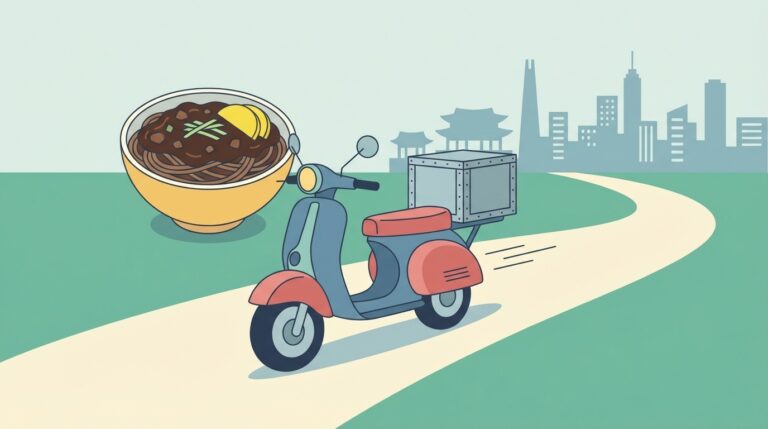
Phase 1: Immersive Hook — The “Black Noodle” Magic
Greeting: 안녕하세요! This is your Daily Hangul editor, waiting for my doorbell to ring.
The Scene: You’ve seen it in every K-Drama. The main character has moved into a rooftop apartment (Oktapbang). They are sitting on the floor, wearing comfy sweatpants. There’s a yellow metal box arriving on a scooter. They peel off the plastic wrap, snap wooden chopsticks apart, and mix those black noodles with a frantic, hungry energy. Slurp.
That is Jjajangmyeon (짜장면). It’s not just food; it is the soul of Korean delivery culture.
But here’s the problem. You open a delivery app or pick up the phone, and panic sets in. How do you say “Just leave it at the door”? What if you want extra pickled radish?
The Why: If you can order Jjajangmyeon over the phone, you have officially graduated from “Tourist” to “Survivor.” Today, we aren’t just ordering noodles; we are ordering confidence.
(Note: This guide is based on real struggles my A2 students faced when trying to feed themselves in Seoul!)
Phase 2: Deep Dive — Key Phrases for Hunger
1. 짜장면 하나 배달되나요? (Can I get one Jjajangmyeon delivered?)
- Pronunciation: [Jjajangmyeon hana baedal-dwenayo?]
- Sound Analogy:
- Jja: Like the start of ‘Ja’zz, but press your tongue harder against the roof of your mouth. It’s a strong, popping sound.
- Myeon: Sounds like “Me” + “Yawn” smashed together.
- Meaning:
- Literal: Jjajangmyeon one delivery become?
- Real Nuance: “Are you open, and can you bring food to me?”
- K-Culture Moment: In dramas, this is often the first line spoken by a detective staking out a criminal, or a student pulling an all-nighter. It signals “I am busy, but I need fuel.”
- Editor’s Insight: Most places require a minimum order amount (minimum order fee). If you are alone, you might need to order a “Set Menu” (Noodles + Tangsuyuk) to get delivery.
- Situation Spectrum:
[🚫 Boss] ———— [⚠️ Stranger/Phone] ———— [✅ Friendly]- This is standard polite language (-yo ending). Safe for everyone.
- 🤔 Think About It: Why does Korean use “Doena-yo?” (Does it become?) instead of “Can I?” It shifts the focus from your ability to the situation’s possibility. Passive and polite.
2. 단무지 많이 주세요. (Please give me lots of pickled radish.)
- Pronunciation: [Danmuji mani juseyo]
- Sound Analogy:
- Dan: Like ‘Dan’iel.
- Muji: Like a ‘Moo’ cow + ‘G’ (gee).
- Meaning: Give me extra yellow pickled radish.
- K-Culture Moment: Eating greasy black bean noodles without the crunchy, sour yellow radish is considered a crime by many Koreans. In movies, you’ll see characters crunching on this loudly to show frustration or determination.
- Editor’s Insight: Don’t be shy. Koreans love side dishes (Banchan). Asking for “mani” (lots) is seen as you enjoying the food, not being greedy.
- Situation Spectrum:
[🚫 Formal Speech] ———— [⚠️ Restaurant Staff] ———— [✅ Casual]- Perfectly acceptable to say to the owner or write in the “Request” box on an app.
3. 문 앞에 놔주세요. (Please leave it in front of the door.)
- Pronunciation: [Mun ap-e nwa-juseyo]
- Sound Analogy:
- Mun: Like ‘Moon’.
- Nwa: Like ‘Noi’ in Noir, but shorter.
- Meaning: Put it in front of the door.
- K-Culture Moment: Since the pandemic, and for single women living alone (safety), this has become the default delivery mode. You’ll see piles of packages and food boxes in apartment hallways in Korea.
- Editor’s Insight: Use this if you are too shy to speak Korean face-to-face with the rider! It’s the introvert’s magic spell.
- 🤔 Think About It: Korea has a high-trust society where packages left outside rarely get stolen. How does this compare to your home country?
Phase 3: Textbook vs. Real Life
| Situation | 📖 Textbook Korean | 🗣️ Real Korean | 💡 Why different? |
|---|---|---|---|
| Ordering | 저는 짜장면을 주문하고 싶습니다. (I would like to order…) | 여기 짜장면 하나요! (Jjajangmyeon here!) | Koreans value speed (Ppalli-ppalli). Context makes the verb unnecessary. |
| Payment | 신용카드로 계산할 수 있습니까? (Is it possible to calculate with a credit card?) | 카드 돼요? (Card okay?) | Efficiency. “Does card work?” is all you need to ask. |
| Arriving | 음식이 도착했습니다. (The food has arrived.) | 배달이요~ (Delivery~) | The rider just announces their role/action. Short and loud. |
Bottom Note: Real Korean drops particles (eul/leul) and verbs when the situation is obvious. Don’t sound like a robot!
Phase 4: Cultural Deep Dive
4-1. The Great Dilemma: Bu-meok vs. Jjik-meok
In a K-Drama or variety show, you might see people fighting over Tangsuyuk (Sweet and Sour Pork), which often comes with Jjajangmyeon.
– Bu-meok (부먹): Pouring the sauce over the meat. (Soft, flavorful)
– Jjik-meok (찍먹): Dipping the meat into the sauce. (Crispy)
Tip: If you are sharing, NEVER pour the sauce without asking. It can ruin friendships! This is a matter of respect and preference in communal eating.
4-2. The “Empty Bowl” Etiquette
Historically, Chinese food in Korea was delivered in non-disposable plastic bowls. After eating, you would put the dirty bowls outside your door. The rider would come back later to collect them.
Modern twist: Nowadays, most use disposable containers due to hygiene and cost. But if you get a real bowl, do NOT throw it away! Put it outside.
Phase 5: Immersive Roleplay — The Sunday Hangover
Setting: It is Sunday, 11:30 AM. You are hungover or just incredibly lazy. You call the local Chinese restaurant directly because the app is down.
Characters:
– YOU: Hungry foreign student.
– Boss (Ajayeon): The busy restaurant owner. Speaks fast.
Start Dialogue:
Boss: (Fast) 네, 만리장성입니다~
(Ne, Manlijangseong-imnida~)
(Yes, this is ‘Great Wall’ restaurant~)
YOU: 안녕하세요. 짜장면 배달되나요?
(Annyeonghaseyo. Jjajangmyeon baedal-dwenayo?)
(Hello. Can I get Jjajangmyeon delivered?)
Boss: 네, 주소 어디세요?
(Ne, juso eodiseyo?)
(Yes, where is your address?)
YOU: 여기 망원동 201호인데요.
(Yeogi Mangwon-dong 201-ho indeyo.)
(Here is Mangwon-dong unit 201.)
Boss: 네, 짜장면 하나요? 다른 건요?
(Ne, Jjajangmyeon hanayo? Dareun geonyo?)
(Okay, one Jjajangmyeon? Anything else?)
🔀 Decision Point: You are VERY hungry. What do you say?
Option A: “아니요, 그것만 주세요.” (No, just give me that.)
Option B: “군만두 서비스 있어요?” (Do you have fried dumpling service?)
✅ Best Choice: Option A for a single order.
Analysis: ‘Service’ (서비스) means ‘freebies’ in Korea. Usually, you only get free dumplings if you order a lot (like 3+ dishes or a set). Asking for service on one bowl of noodles is a bit cheeky! But if you ordered a Set Menu (Tangsuyuk + Noodles), Option B is valid!
YOU (Choosing A): 아니요, 그것만 주세요. 아, 단무지 많이 주세요!
(Aniyo, geugeonman juseyo. Ah, Danmuji mani juseyo!)
(No, just that please. Ah, lots of radish please!)
Boss: 알겠습니다. 15분 걸려요~
(Algetseumnida. 15-bun geollyeoyo~)
(Okay. Takes 15 mins~)
Phase 6: 10-Second Shadowing Drill
Let’s practice the sentence that gets you fed. Say it with URGENCY but POLITENESS.
😊 Bright & Clear:
사장님, / 짜장면 하나 / 배달 / 되나요?
(Sajangnim, / Jjajangmyeon hana / baedal / dwenayo?)
Boss, / Jjajangmyeon one / delivery / possible?
Phase 7: K-Culture Mini Glossary
| Korean | Romanization | Meaning | Context |
|---|---|---|---|
| 배달 | Baedal | Delivery | Korea is the “Nation of Delivery” (Baedal-ui Minjok). |
| 곱배기 | Gopbaegi | Double portion | If you are super hungry, say “Jjajangmyeon Gopbaegi.” Usually costs 1,000 won more. |
| 서비스 | Seobiseu | Service (Freebie) | Free food given by the owner to show appreciation. |
| 탕수육 | Tangsuyuk | Sweet & Sour Pork | The soulmate of Jjajangmyeon. Usually shared. |
Phase 8: Traveler’s Survival Kit
Even if you don’t call, you will use a kiosk or an app.
🆘 Survival Phrases TOP 3
1. 🇰🇷 “매운 거 못 먹어요.” (Mae-un geo mot meogeoyo.)
– Translation: I can’t eat spicy things. (Jjajangmyeon is safe, but Jjamppong is spicy!)
2. 🇰🇷 “포장 돼요?” (Pojang dwaeyo?)
– Translation: Is take-out (to-go) possible?
– Use: If you want to pick it up yourself to save delivery fees.
3. 🇰🇷 “여기요!” (Yeogiyo!)
– Translation: Over here!
– Use: To call a waiter in a restaurant or answer the door for delivery.📌 Editor’s Travel Note:
– Apps: Download ‘Baedal Minjok’ (Baemin) or ‘Yogiyo’. Some have English support now, or use ‘Shuttle Delivery’ (fully English) in Seoul.
– Address: Learn your “Road Name Address” (e.g., Sejong-daero 23-gil). Old style addresses are confusing for foreigners.
Phase 9: Think Deeper — Food & Identity
Why is Korean delivery so fast? (The ‘Ppalli-ppalli’ Culture)
Did you know you can get food delivered to a specific picnic mat by the Han River? Korean delivery culture is fueled by high population density and the cultural trait of “Ppalli-ppalli” (Hurry, hurry). It’s not just about speed; it’s about convenience as a form of care. In a society where everyone works long hours, quick delivery allows people to enjoy a warm meal without the labor of cooking.
🧠 Think Deeper: In your country, is delivery seen as a luxury or a daily necessity? How does the speed of service reflect your culture’s view on time?
Phase 10: FAQ & Troubleshooting
- Q: Do I have to tip the delivery driver?
- A: NO. Tipping is not a custom in Korea. The delivery fee is already included in the app or the price. If you try to give money, they might look confused or refuse.
- Q: Can I order just one bowl?
- A: Sometimes no. Many places have a “Minimum Order Amount” (e.g., 15,000 KRW). If you are alone, you might have to order a “Set” or pay the delivery fee extra.
- Q: The driver is wearing a helmet and walked into the building. Is that rude?
- A: No. Efficiency is key. They keep helmets on to save time. Don’t be offended!
❌ Common Mistake: Asking for a fork.
✅ Fix: Most delivery places give chopsticks (wooden disposable ones). If you absolutely cannot use chopsticks, keep a fork in your house or ask “Pokeu (Fork) isseoyo?” but don’t expect them to always have one.
Phase 11: Wrap-up & Mission
One-Liner: Ordering Jjajangmyeon is your initiation into real Korean life—loud, fast, and delicious.
🎯 Action Mission:
– 🥉 Bronze: Stand before a mirror and practice: “Danmuji mani juseyo!”
– 🥈 Silver: Watch a K-Drama eating scene (Mukbang) and listen for the “slurp” sound.
– 🥇 Gold: Order Jjajangmyeon (or go to a shop) and confidently ask for “Gopbaegi” (Double portion) or extra radish!
💬 Your Turn: Have you ever tried the “black noodles”? Are you Team Pour (Bu-meok) or Team Dip (Jjik-meok)? Fight in the comments below! 👇
Phase 12: Quiz — The “Delivery” Challenge
- Situation: The delivery rider arrives. What is the most natural thing to say?
- A) Hello, how are you today?
- B) Thank you. (Gamsahamnida)
- C) I love you.
- K-Culture True/False:
- If you order Tangsuyuk to share, you should immediately pour the sauce over the meat without asking.
- (True / False)
- Fill in the blank:
- “Please leave it in front of the door.”
- “____ ap-e nwa-juseyo.”
Answers:
1. B. Short and sweet. They are busy!
2. False. You might start a war. Always ask first!
3. Mun (문).
Frequently Asked Questions (FAQ)
Q: What does "짜장면 하나 배달되나요? (Can I get one Jjajangmyeon delivered?)" mean in Korean and how do you pronounce it?
A: In Korean, "짜장면 하나 배달되나요? (Can I get one Jjajangmyeon delivered?)" is pronounced [Jjajangmyeon hana baedal-dwenayo?] and means: a key conversational Korean expression covered in this lesson.
Q: What does "단무지 많이 주세요. (Please give me lots of pickled radish.)" mean in Korean and how do you pronounce it?
A: In Korean, "단무지 많이 주세요. (Please give me lots of pickled radish.)" is pronounced [Danmuji mani juseyo] and means: a key conversational Korean expression covered in this lesson.
Q: What does "문 앞에 놔주세요. (Please leave it in front of the door.)" mean in Korean and how do you pronounce it?
A: In Korean, "문 앞에 놔주세요. (Please leave it in front of the door.)" is pronounced [Mun ap-e nwa-juseyo] and means: a key conversational Korean expression covered in this lesson.







