

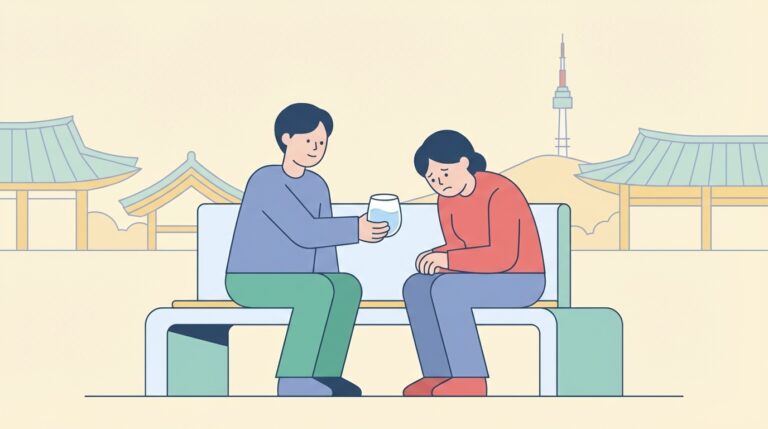
Phase 1: The “K-Drama Moment” — Don’t Panic! 😱
Annyeonghaseyo! This is your Daily Hangul Editor. 👋
Picture this: You are watching a K-Drama. The main character just found out a shocking family secret. They grab the back of their neck, stumble, and gasp for air. What happens next?
A family member rushes in with a glass of water and shouts a specific phrase while rubbing their back.
Or maybe you’re at a crowded subway station in Seoul. Someone drops their phone on the tracks and starts screaming. Everyone is looking. You want to help, but how do you tell them to breathe and relax in Korean?
Saying “Relax!” in English might not work if they are in panic mode. Today, we are learning the emergency brake words of the Korean language. These aren’t just words; they are emotional first-aid kits.
Let’s learn how to be the calm in the chaos. ✨
Phase 2: Deep Dive into Core Expressions 🤿
Here are the top 3 phrases you need to know when the heat goes up.
1. 진정하세요 (Jinjeong-haseyo)
- Pronunciation: [Jin-jeong-ha-se-yo]
- Sound Analogy: Jin (like ‘Gin’ in Ginger) + Jeong (like ‘Jung’ in Jungle) + Ha + Se (like ‘Say’) + Yo.
- Meaning:
- Literal: Please do the action of calming down.
- Real Nuance: “Please compose yourself.” This is the standard, polite way to tell someone to cool off.
- K-Culture Moment: In medical dramas like Hospital Playlist, doctors say this to panicked guardians in the ER. It’s authoritative but polite.
- Editor’s Insight: This is a “command” but a soft one. Use this when the person is acting irrational or too loud.
- Situation Spectrum:
[🚫 Boss/Elder] ———— [⚠️ Co-worker/Stranger] ———— [✅ Friend/Junior]
(Note: Generally safe for strangers, but be careful with elders. See Phase 10!) - 🤔 Think About It: Why is the word “calm” (Jinjeong) based on Chinese characters meaning “suppressing emotion”? Does Korean culture value hiding strong emotions?
2. 괜찮아요 (Gwaenchana-yo)
- Pronunciation: [Gwaen-chan-a-yo]
- Sound Analogy: Gwaen (sounds like ‘Gwen’ from Gwen Stefani) + Chan + Ah + Yo.
- Meaning:
- Literal: It is okay.
- Real Nuance: “It’s fine,” “Don’t worry,” “You’re safe.” This is the magic universal word of Korea.
- K-Culture Moment: Every K-Pop fan meeting ever. When an idol cries, fans chant “Ul-ji-ma!” (Don’t cry) followed by “Gwaenchana! Gwaenchana!”
- Editor’s Insight: While Jinjeong-haseyo is an instruction, Gwaenchana-yo is empathy. It validates their feelings while calming them down.
- Situation Spectrum:
[✅ Boss/Elder] ———— [✅ Co-worker/Stranger] ———— [✅ Friend/Junior]
3. 숨 쉬세요 (Sum swiseyo)
- Pronunciation: [Sum swi-se-yo]
- Sound Analogy: Sum (like ‘Sum’ in Summary) + Swi (sounds like ‘Swe’ in Sweet) + Se + Yo.
- Meaning: “Please breathe.”
- K-Culture Moment: High-tension thriller movies. When the victim is rescued by the detective, the detective holds their shoulders and says this.
- Editor’s Insight: Use this only in medical or high-panic physical situations (hyperventilation).
Phase 3: Textbook vs. Real Life 🥊
| Situation | 📖 Textbook Korean | 🗣️ Real Korean (Street/TV) | 💡 Why is it different? |
|---|---|---|---|
| Friend is angry | 진정해 (Jinjeong-hae) | 워~ 워~ (Woah~ Woah~) | Influenced by Western TV/Variety shows. It’s funny and lighthearted. |
| Trying to stop a fight | 그만하십시오 (Geuman-hasipsio) | 그만해! (Geuman-hae!) | In urgent fights, politeness is dropped for speed and impact. |
| Comforting a crying friend | 울지 마세요 (Ulji maseyo) | 에이, 왜 그래~ (Ey, wae geurae~) | “Don’t cry” can feel cold. “Ey, why are you being like this~” shows affection. |
💡 Editor’s Note: “Woah~ Woah~” is very casual! Do not say “Woah~” to your boss unless you want to be fired! 😅
Phase 4: Cultural Deep Dive 🧘♂️
4-1. The “Hand on Back” Technique (Skinship)
In Western culture, touching someone can be invasive. In Korea, if a friend is choking up or angry, rubbing or patting their back (deung-eul dudeurida) is almost automatic. It’s a non-verbal way of saying “I am here with you.”
4-2. The Magic Elixir: Water 💧
Have you noticed in K-Dramas? When a mother gets shocked, someone ALWAYS runs to the fridge to get water.
* K-Science: Koreans believe cold water “cools down” the heat rising in the body (Hwaseong – fire anger).
* Action: If you are in a restaurant and your friend is upset, silently pouring a cup of water and placing it in front of them is a powerful move.
Phase 5: Roleplay Scenario 🎬
📍 Setting: Hongdae Street, Friday Night
It is chaotic. Your friend, Jisoo, just realized she lost her wallet. She is starting to panic, breathing fast, and looking around wildly.
Jisoo: (Hyperventilating) 어떡해! 내 지갑! 카드랑 신분증 다 있는데!
(Eotteokhae! Nae jigap! Kadeu-rang sinbunjeung da inneunde!)
(Translation: What do I do! My wallet! My cards and ID are all in there!)
YOU: (Choose your response below!)
🔀 Decision Point: What do you say?
- A) “진정하세요! 경찰서 가요.” (Jinjeong-haseyo! Gyeongchalseo gayo.) – Formal & Logical
- B) “야! 조용히 해!” (Ya! Joyonghi hae!) – Aggressive
- C) “지수야, 숨 쉬어. 괜찮아, 찾을 수 있어.” (Jisoo-ya, sum swieo. Gwaenchana, chajeul su isseo.) – Empathetic
✅ Best Choice (C): Panic requires empathy first. Using her name + “Breathe” + “It’s okay” is the perfect combo.
⚠️ Choice A Analysis: It is grammatically correct, but “Jinjeong-haseyo” can sound a bit distant to a close friend. Drop the “-yo” (Jinjeong-hae) for friends.
🚫 Choice B Analysis: This means “Hey! Be quiet!” You might lose a friend today.
Phase 6: 10-Second Shadowing Drill 🎤
Let’s practice the empathetic tone. Don’t sound like a robot!
Emotion: Warm & Comforting 🥺
괜찮아요 / 숨 / 쉬세요.
(Gwaen-chan-a-yo / sum / swi-se-yo.)
“It’s okay. Please breathe.”
Phase 7: K-Culture Mini Glossary 📚
| Korean | Romanization | Meaning | Context |
|---|---|---|---|
| 119 | Il-il-gu | Emergency Number | Call this for Fire or Ambulance (Medical). |
| 112 | Il-il-i | Police Number | Call this for theft or fighting. |
| 응급실 | Eunggeupsil | E.R. | Where K-Drama leads end up in Episode 10. |
| 화병 | Hwabyeong | “Fire Illness” | A culture-bound syndrome in Korea. Anger/stress manifested as physical pain. |
Phase 8: Traveler’s Survival Kit 🧳
If YOU are the one in an emergency, or you need to help someone else in public.
🆘 Survival Card: Calling for Help
- 🇰🇷 “도와주세요!” (Dowajuseyo!)
- Meaning: Help me! / Please help!
- 🗣️ Pro Tip: Scream this loud. Don’t be shy.
- 🇰🇷 “여기 사람 아파요!” (Yeogi saram apayo!)
- Meaning: Someone is sick/hurt here!
- 📍 Where: Subway, Street, Restaurant.
- 🇰🇷 “천천히 말해 주세요.” (Cheoncheonhi malhae juseyo.)
- Meaning: Please speak slowly.
- 💡 Why: If a policeman or doctor is speaking too fast in an emergency.
Phase 9: Think Deeper — The Power of “Gwaenchana” 🧠
Why do Koreans say “It’s okay” even when it’s NOT okay?
In Western cultures, accuracy is key. If a leg is broken, you say “Your leg is broken.” But in Korea, you will hear “Gwaenchana” (It’s okay) first.
This reflects the Korean value of community comfort. The priority is to stabilize the group’s emotional atmosphere before tackling the cold hard facts. It’s not lying; it’s a verbal hug.
💬 Your Turn: In your culture, do you focus on fixing the problem first or comforting the person first? Share in the comments!
Phase 10: FAQ & Troubleshooting 🛠️
Q: Can I say “Relax” (릴랙스 – Rillaekseu) in Konglish?
A: Yes! Younger people use “Relax” jokingly. But don’t use it with elders; it sounds too casual.
Q: What if an older person (Ajusshi) is shouting at me? Can I say “Jinjeong-haseyo”?
A: ⚠️ Be careful. Telling an angry elder to “calm down” might make them angrier because it sounds like you are “teaching” them. Instead, bow slightly and say “죄송합니다” (Joesong-hamnida – I am sorry) first. It de-escalates faster than logic.
❌ Common Mistake: Smiling while apologizing.
✅ Fix: In many Western cultures, a nervous smile is natural. In Korea, smiling during a serious/emergency situation can be seen as mocking. Keep a serious face.
Phase 11: Wrap-up & Mission 🚀
One-Liner: When panic strikes, “Gwaenchana-yo” (It’s okay) is your superpower to restore harmony.
🎯 Action Missions:
* 🥉 Bronze: Look in the mirror, take a deep breath, and say “Sum swiseyo” to yourself 3 times.
* 🥈 Silver: Watch a K-Drama clip of an argument/accident. Try to spot if they say “Jinjeonghae” or “Gwaenchana.”
* 🥇 Gold: Next time your friend is stressed (even over a small thing), try saying “Gwaenchana-yo” instead of “Don’t worry” in English.
Phase 12: Interactive Quiz 🧩
1. Situation: Your boss is panicking because of a deadline. What is the SAFEST thing to say?
* A) 워~ 워~ (Woah~ Woah~)
* B) 진정해! (Jinjeong-hae!)
* C) 제가 하겠습니다. (Jega hagesseumnida – I will do it.)
2. True or False?
* In Korea, it is polite to maintain strong eye contact while telling someone to calm down.
3. Fill in the blank:
* “Don’t cry” in Korean is “______-ji ma.”
(Scroll down for answers)
.
.
.
.
🔑 Answers:
1. C) Giving a solution is better than telling a boss to calm down (which is rude). A and B are too casual.
2. False. Too much eye contact can be aggressive. Look slightly down or at their nose bridge to be non-threatening.
3. Ul (Ul-ji ma).
See you in the next lesson! Stay calm and study Korean! 👋
Frequently Asked Questions (FAQ)
Q: What does "진정하세요 (Jinjeong-haseyo)" mean in Korean and how do you pronounce it?
A: In Korean, "진정하세요 (Jinjeong-haseyo)" is pronounced [Jin-jeong-ha-se-yo] and means: a key conversational Korean expression covered in this lesson.
Q: What does "괜찮아요 (Gwaenchana-yo)" mean in Korean and how do you pronounce it?
A: In Korean, "괜찮아요 (Gwaenchana-yo)" is pronounced [Gwaen-chan-a-yo] and means: a key conversational Korean expression covered in this lesson.
Q: What does "숨 쉬세요 (Sum swiseyo)" mean in Korean and how do you pronounce it?
A: In Korean, "숨 쉬세요 (Sum swiseyo)" is pronounced [Sum swi-se-yo] and means: a key conversational Korean expression covered in this lesson.







