

Phase 1: The Immersive Hook
Greeting: 안녕하세요! (Hello!) It’s your Daily Hangul Editor, back with your local guide to Seoul life.
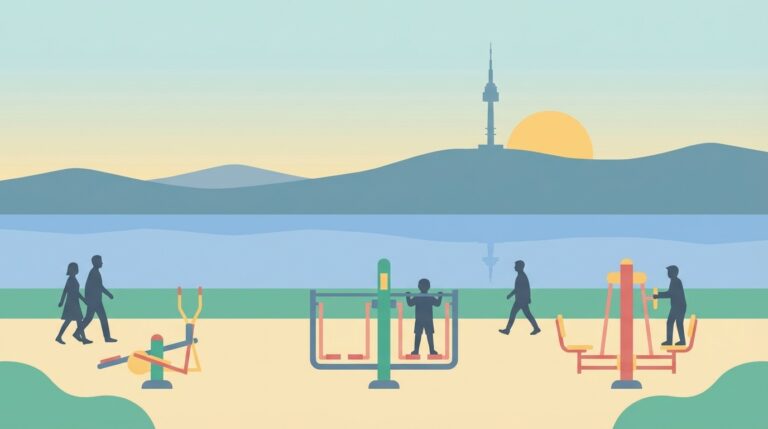
Picture this: You are walking along the Han River at sunset. To your left, a couple is walking a fluffy dog while holding hands (classic K-Drama vibe). To your right, grandmothers are vigorously using those colorful outdoor exercise machines, swinging their arms faster than a K-Pop backup dancer.
Suddenly, your Korean friend turns to you and asks, “우리 운동할래?” (Shall we exercise?).
If you just nod and smile, you might end up hiking a mountain when you only wanted a light walk! In Korea, exercise covers everything from intense “Home Training” to breathing fresh air.
Don’t worry. By the end of this guide, you’ll know exactly how to say you’re working out, just taking a stroll, or—most importantly—that you’re too tired and just want Ramyeon instead. Let’s get moving! 🏃♂️💨
Phase 2: Deep Dive (Core Expressions)
1. 운동하다 (Undong-hada)
- Pronunciation:
[Un-dong-ha-da]- Sound Analogy: Un (like ‘un’ in ‘under’) + Dong (like the ‘dong’ in ‘ding-dong’) + Ha-da.
- Meaning: To exercise / To work out.
- K-Culture Moment: You’ll see this word all over Instagram with the hashtag #오운완 (O-un-wan), which is short for “Today’s Exercise Completed.” It’s the ultimate “proof shot” culture.
- Editor’s Insight: This is the generic term. Whether you are lifting weights, doing yoga, or playing soccer, you can use this.
- Situation Spectrum:
[🚫 Formal Boss] ———— [⚠️ Colleague] ———— [✅ Friend]
(For polite situations, use 운동해요[Un-dong-hae-yo]) - 🤔 Think About It: In English, we often say “I’m going to the gym.” In Korean, we focus on the action: “I am doing exercise.” Why do you think Korean emphasizes the action over the location?
2. 산책하다 (Sanchaek-hada)
- Pronunciation:
[San-chaek-ha-da]- Sound Analogy: San (like ‘San’ Diego) + Chek (sounds like ‘check’).
- Meaning: To take a walk / To stroll.
- K-Culture Moment: Every romance drama has a nighttime walk scene. The leads walk slowly (usually near a stone wall or river), talking about deep feelings. That is Sanchaek.
- Editor’s Insight: This isn’t power walking. This is relaxing. If you want to suggest a low-stress activity to a Korean friend, suggest this!
- Situation Spectrum:
[✅ Safe for Everyone]
3. 힘들어요 (Himdeureoyo)
- Pronunciation:
[Him-deu-reo-yo]- Sound Analogy: Him (like ‘him’) + Deu (like ‘du’ in dust) + Reo-yo.
- Meaning: It’s hard / I’m tired / It’s tough.
- K-Culture Moment: Watch any variety show like Running Man. When the cast members collapse on the floor gasping for air, the caption is always “힘들어…”
- Editor’s Insight: Use this when the treadmill is too fast, or simply when life is exhausting. It’s a great way to get sympathy!
Phase 3: Textbook vs. Real Life
| Situation | 📖 Textbook Korean | 🗣️ Real Korean (Street Vibe) | 💡 Why the difference? |
|---|---|---|---|
| Going to the gym | 저는 체육관에 갑니다. (I go to the gymnasium.) |
헬스장 가요. (I go to the ‘Health-jang’.) |
“Gym” in Korea is almost always called Health-jang (Health Place). |
| Exercising at home | 집에서 운동해요. (I exercise at home.) |
홈트 해요. (I do ‘Home-T’.) |
Koreans love shortening words! Home-T = Home Training. |
| Losing weight | 체중을 감량하고 싶어요. (I want to reduce body weight.) |
다이어트 중이에요. (I am in the middle of a ‘Diet’.) |
In Korea, “Diet” means the whole process of losing weight (exercise + food), not just eating less. |
Bottom Note: If you say “Cheyuk-gwan” (Textbook gym), people might think you are going to a school PE class or a Judo stadium. Stick to Health-jang!
Phase 4: Cultural Deep Dive
4-1. Non-verbal: The “Aigo” Breath
When Koreans finish a hard set of exercises or sit down on a bench after a walk, you will hear a deep exhale often accompanied by “Aigo!” (Oh my). It’s not just a complaint; it’s a release of tension. Try sighing loudly after your workout—you’ll fit right in.
4-2. K-Culture Connection: The “Han River” Routine
In Seoul, the Han River (Hangang) is the center of the daily routine. It’s not just a river; it’s a gym, a restaurant, and a dating spot.
* The Vibe: You will see people dressed in full hiking gear just for a walk (Koreans take gear seriously!).
* The Reward: The unwritten rule of exercising at Han River is that you must eat instant Ramyeon at the convenience store afterward. There are special machines that boil it perfectly in a foil bowl.
* Thinking Point: Is exercising an excuse to eat Ramyeon? Perhaps. 😉
Phase 5: Immersive Roleplay
Setting: It’s 8:00 PM on a Tuesday. You are at the Han River Park with your Korean friend, Minji (25, energetic, loves K-Pop dances).
Minji: (Stretching her arms) 와, 날씨 진짜 좋다! 우리 뛸까?
(Wa, nalssi jinjja joda! Uri ttwilkka?)
(Wow, the weather is so good! Shall we run?)
YOU: (You are tired from work… running sounds terrible)
🔀 Your Turn! How do you reply?
- A) 네, 뛰어요! (Yes, let’s run!) [The energetic Yes]
- B) 아니요, 힘들어요. 산책해요. (No, it’s hard. Let’s take a walk.) [The honest negotiation]
- C) 배고파요. 라면 먹자. (I’m hungry. Let’s eat Ramyeon.) [The food lover]
If you chose B:
YOU: 아니요, 힘들어요. 산책해요.
(Aniyo, himdeureoyo. Sanchaek-haeyo.)
Minji: (Laughing) 그래, 좋아. 천천히 걷자.
(Geurae, joa. Cheoncheonhi geotja.)
(Okay, good. Let’s walk slowly.)
✅ Editor’s Note: Option B is perfect. You expressed your state (힘들어요) and proposed an alternative (산책해요). This is great communication!
Phase 6: 10-Second Shadowing Drill
Read this out loud. Focus on the emotion!
1. The Determined Planner 😤
매일 / 운동해요!
(Mae-il / un-dong-hae-yo!)
(I exercise / every day!)
2. The Tired Complainer 😢
아… / 너무 / 힘들어요.
(Ah… / neo-mu / him-deu-reo-yo.)
(Ah… / it’s too / hard.)
Phase 7: K-Culture Mini Glossary
| Korean | Romanization | Meaning | Context |
|---|---|---|---|
| 헬스장 | Healseu-jang | Gym | The most common word for a fitness center. |
| 홈트 | Hom-teu | Home Training | exercising at home (Youtube Yoga, etc.). |
| 몸짱 | Mom-zzang | Best Body | Slang for someone with a great physique (muscular/fit). |
| 오운완 | O-un-wan | #OOTD (Fitness ver.) | Hashtag: “Today’s Workout Completed.” |
Phase 8: Traveler’s Survival Kit
Visiting Korea? You might want to visit a gym or hike a mountain.
🆘 Survival Expression #1: The Daily Pass
* 🇰🇷 “일일권 있어요?” (Il-il-gwon isseoyo?)
* 🗣️ Pronunciation: [Il-il-gwon i-sseo-yo?]
* Meaning: Do you have a daily pass?
* Where: Any Gym (Health-jang) or Climbing Center.
* Pro Tip: Many Korean gyms require a membership, but asking for an Il-il-gwon allows you to pay for just one day (usually 15,000~20,000 KRW).📌 Editor’s Travel Note:
If you go hiking (Deung-san), strangers might say “Annyeonghaseyo” (Hello) or “Hwaiting!” (Cheer up/Go for it) to you as you pass. It’s polite to smile and say it back!
Phase 9: Think Deeper
Media vs. Reality: The “Diet” Obsession
In K-Dramas, you often see characters obsessed with “Dieting” (eating only sweet potatoes or eggs). The word 다이어트 (Da-i-e-o-teu) in Korea doesn’t just mean changing what you eat; it implies the entire lifestyle of losing weight.
Sometimes, this pressure can be intense. Korean beauty standards are high, and people openly comment on weight gain/loss as a form of greeting (“Oh, you lost weight! You look good!”).
💬 Your Turn: In your culture, is it polite or rude to comment on someone’s weight change? How does that compare to the Korean way?
Phase 10: FAQ & Troubleshooting
Q: Can I wear leggings on the street in Korea?
A: Yes, but it’s changing. A few years ago, leggings were considered “underwear” or only for the gym. Now, thanks to the “Athleisure” trend, it is very common in Hongdae or Gangnam. However, in conservative areas or with older people, you might still get a few stares.
Q: How do I ask a trainer for help?
A: Just say “도와주세요” (Do-wa-ju-se-yo / Please help me). It works for machines you don’t know how to use!
❌ Common Mistake:
Don’t say “Play sports” (스포츠를 해요). Koreans usually say “운동해요” (Exercise) for general fitness or specify the sport (e.g., 축구해요 – do soccer).
Phase 11: Wrap-up & Action Mission
One-Liner: Use 운동해요 for workouts and 산책해요 for walks, but never forget the post-workout Ramyeon.
🎯 Action Mission:
* 🥉 Bronze: Look in the mirror, flex your arm, and say “매일 운동해요!” three times.
* 🥈 Silver: Search the hashtag #오운완 on Instagram. See how Koreans document their workouts.
* 🥇 Gold: Go for a walk and post a picture with the caption: “오늘 산책해요. 안 힘들어요!” (Today I take a walk. It’s not hard!)
Phase 12: Interactive Quiz
1. Situation Check:
Your friend wants to go to the gym. What does she say?
* A) 우리 산책하러 가자. (Let’s go for a stroll.)
* B) 우리 헬스장 가자. (Let’s go to the Health-jang.)
2. True or False (K-Culture):
“Home-t” means drinking tea at home. (T/F)
3. Fill in the blank:
Running is too tiring. It is too __________.
(Hint: Him-deu-reo-yo)
Answers:
1. B (A is for a relaxing walk outdoors).
2. False (It means Home Training!).
3. 힘들어요.
See you next time! Keep moving! 💪
Frequently Asked Questions (FAQ)
Q: What does "운동하다 (Undong-hada)" mean in Korean and how do you pronounce it?
A: In Korean, "운동하다 (Undong-hada)" is pronounced [Un-dong-ha-da] and means: a key conversational Korean expression covered in this lesson.
Q: What does "산책하다 (Sanchaek-hada)" mean in Korean and how do you pronounce it?
A: In Korean, "산책하다 (Sanchaek-hada)" is pronounced [San-chaek-ha-da] and means: a key conversational Korean expression covered in this lesson.
Q: What does "힘들어요 (Himdeureoyo)" mean in Korean and how do you pronounce it?
A: In Korean, "힘들어요 (Himdeureoyo)" is pronounced [Him-deu-reo-yo] and means: a key conversational Korean expression covered in this lesson.







