

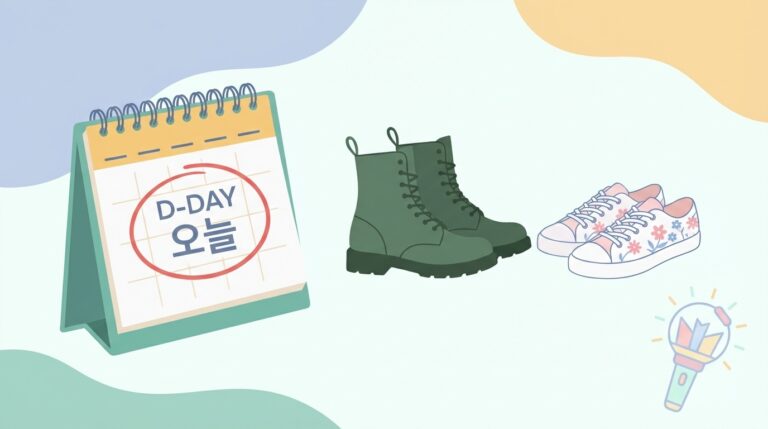
Phase 1: Immersive Hook — The “Waiting Game”
Greeting: 안녕하세요! This is your Daily Hangul Senior Editor. 👋
Imagine this: You are watching a K-Pop concert video. Suddenly, the screen goes black, and a message appears: “I will return as a better man.” The crowd cries. Your favorite idol is enlisting in the army.
Fast forward 18 months. You are checking an app on your phone every single morning. You see a number: D-10.
Or, picture a K-Drama scene where the male lead, wearing a camouflage uniform, runs toward the female lead standing outside the base. She’s crying, he’s smiling. It’s the classic Discharge Day (전역일) scene.
In Korea, mandatory military service isn’t just a government policy; it’s a massive cultural milestone. Knowing how to talk about “counting the days” isn’t just for soldiers—it’s essential for K-Pop fans waiting for their bias, or for making friends with any Korean male (it’s their favorite topic, trust me).
Today, we aren’t just learning numbers. We are learning the language of waiting and celebration. Let’s dive in! 🪖✨
Phase 2: Deep Dive — Key Expressions
1. 전역일이 언제예요? (Jeon-yeok-iri eonje-yeyo?)
- Pronunciation: [Jeon-yeok-il-i] sounds like Jun-yuck-ear-ee + [eonje-yeyo]
- Meaning:
- Literal: When is the discharge date?
- Real Nuance: “When are you finally free?” / “When does your service end?”
- K-Culture Moment: This is the #1 question fans ask their idols during live streams when they are on holiday (휴가). It’s also the first thing friends ask a soldier when he visits home.
- Editor’s Insight: While 제대 (Je-dae) is also used for “discharge,” 전역 (Jeon-yeok) is the official term for completing active duty. Using Jeon-yeok makes you sound more knowledgeable.
- Situation Spectrum:
[🚫 To a Superior Officer] ———— [⚠️ Senior Colleague] ———— [✅ Friend/Idol]- Use freely with friends! (For officers/seniors, use simpler honorifics like 언제 제대하십니까?)
- 🤔 Think About It: Why is the specific date so important? In Western armies, people often have careers. In Korea, it’s a temporary obligation with a definite finish line. The “Finish Line” mentality shapes this question.
2. 꽃신을 신다 (Kkot-sin-eul sin-da)
- Pronunciation: [Kkot-sin] (sounds like Cot-sheen) + [sin-da]
- Meaning:
- Literal: To wear flower shoes.
- Real Nuance: To successfully wait for a boyfriend (or idol) to finish his military service without breaking up.
- K-Culture Moment: In romance dramas, if a couple survives the military separation, the guy might literally gift the girl a pair of shoes with flowers on them. K-Pop fans also say, “I will wear flower shoes for you!” (meaning: I will stay in the fandom until you return).
- Editor’s Insight: The opposite is 고무신 (Gomu-sin) or “Rubber shoes,” which refers to the waiting girlfriend. If she breaks up with him while he’s serving, it’s called “wearing rubber shoes backward” (고무신을 거꾸로 신다).
- Situation Spectrum:
[🚫 Business Meeting] ———— [⚠️ Casual Chat] ———— [✅ Romantic/Fandom]
3. 말년 (Mal-nyeon)
- Pronunciation: [Mal-nyeon] (sounds like Mal-nyun)
- Meaning:
- Literal: Final years/end of a period.
- Real Nuance: The final stretch of service where the soldier has high status but zero motivation. “Short-timer’s disease.”
- K-Culture Moment: You might see a character in a sitcom lying down all day, doing nothing, telling juniors to do the work. That’s the Mal-nyeon vibe.
- Editor’s Insight: You can use this jokingly in real life too. If you are quitting your job in 2 weeks, you can say, “I’m basically a Mal-nyeon now.”
Phase 3: Textbook vs. Real Life
| Situation | 📖 Textbook Korean | 🗣️ Real Korean (Insiders) | 💡 Why the difference? |
|---|---|---|---|
| Asking time left | 제대까지 얼마나 남았습니까? (How much time is left until discharge?) |
전역 며칠 남았어? (How many days left to discharge?) |
Koreans count by “days” (D-Day), not months, for precision. |
| Counting days | 100일 남았습니다. (100 days remain.) |
나 딱 100일 깨졌어. (My 100-day mark is broken/reached.) |
“깨지다” (broken) is slang for passing a number milestone. |
| Cheering up | 힘내세요. 곧 끝납니다. (Cheer up. It ends soon.) |
시간 금방 간다! (Time flies!) |
“Time flies” is the classic (often untrue) lie civilians tell soldiers. |
Bottom Note: If you are talking to a K-Pop idol on an app like Weverse, stick to the Textbook or polite Real Korean (존댓말 polite language). Slang is for close friends only!
Phase 4: Cultural Deep Dive — The “Gun-Baek-Gi” (Military Hiatus)
4-1. Non-verbal: The Calendar App Screenshot 📱
In Korea, almost every soldier (and his girlfriend/fan) has a specific app installed: “The Day Before” or “Gun-Dol-I” (Military Boy).
* Culture Tip: If a Korean friend shows you his phone screen with a percentage bar (e.g., 85%), react immediately!
* Do this: “Wow! Almost there!” (와, 다 왔다!)
* Don’t do this: “15% is still a long time…” (He knows. Don’t remind him.)
4-2. K-Pop Connection: 군백기 (Gun-Baek-Gi)
This is a portmanteau of 군대 (Military) + 공백기 (Hiatus/Blank period).
* Context: When an idol group member enlists, the group enters Gun-Baek-Gi.
* Fan Culture: Fans create content, stream old songs, and celebrate every small holiday the idol gets. Knowing the phrase “군백기” shows you understand the K-Pop lifecycle perfectly.
* Critical View: Why do K-Pop groups sometimes release songs while in the army (recorded beforehand)? To minimize the Gun-Baek-Gi impact. In the fast-paced K-Industry, being forgotten is the biggest fear.
Phase 5: Immersive Roleplay Scenario 🎬
Setting: A pocha (tent bar) in Hongdae on a Friday night. You are with Min-ho, a Korean friend who is currently a soldier on vacation (leave). He is wearing a cap to hide his short hair.
Characters:
* YOU: International student in Korea.
* Min-ho: Soldier on leave, slightly emotional after 2 bottles of Soju.
Dialogue:
Min-ho: 아, 시간 진짜 안 간다. 부대 복귀하기 싫어 죽겠어.
(Ah, sigan jinjja an ganda. Budae bokgwihagi sireo jukgesseo.)
(Ah, time is moving so slow. I’d die rather than go back to base.)
(🎭 Min-ho puts his head on the table)
YOU: 왜? 전역일이 언제인데?
(Wae? Jeon-yeok-iri eonje-inde?)
(Why? When is your discharge date?)
Min-ho: 내년 5월… 아직도 200일이나 남았어.
(Naenyeon O-wol… ajikdo ibaek-irina namasseo.)
(Next May… I still have 200 days left.)
🔀 Your Turn! How do you respond?
A) “200일? 금방 가네! 힘내!” (200 days? That goes fast! Cheer up!)
B) “와… 진짜 많이 남았네. 술이나 마시자.” (Wow… that is a lot. Let’s just drink.)
C) “내가 기다려줄게! 꽃신 신어야지!” (I will wait for you! I’ll wear flower shoes!)
Decision Analysis:
* Option A (Risky): ⚠️ To a soldier, 200 days feels like 200 years. Saying “it goes fast” might annoy him, but it’s a common phrase.
* Option B (Best Empathy): ✅ Acknowledging his pain is the best comfort. He wants validation that it’s hard.
* Option C (Context Dependent): ❌ Only use this if you are actually dating him or joking! Otherwise, it’s very weird.
Phase 6: 10-Second Shadowing Drill 🗣️
Let’s practice the “Waiting Fan/Girlfriend” sentence. Say it with hope and affection!
😊 오빠 / 전역할 때까지 / 꼭 기다릴게요!
(Oppa / jeon-yeok-hal ttae-kkaji / kkok gidaril-geyo!)
Oppa, I will definitely wait until you discharge!
Tutor Tips:
* 오빠 (Oppa): Rise in pitch slightly to sound friendly.
* 꼭 (Kkok): Stress this word! It means “definitely” or “for sure.”
Phase 7: K-Culture Mini Glossary 📚
| Korean | Rom. | Meaning | Context |
|---|---|---|---|
| 입대 | Ip-dae | Enlistment | The day they enter the army. Usually a sad day. |
| 전역 / 제대 | Jeon-yeok / Je-dae | Discharge | The day they leave. The happiest day. |
| 곰신 | Gom-sin | Rubber Shoes | A woman waiting for her boyfriend in the army. |
| 꽃신 | Kkot-sin | Flower Shoes | A woman who waited successfully until discharge. |
| 휴가 | Hyu-ga | Vacation/Leave | When soldiers come out for a few days. |
| 군백기 | Gun-baek-gi | Military Hiatus | The break in an idol’s career due to service. |
Phase 8: Traveler’s Survival Kit 🧳
Even if you aren’t waiting for a soldier, the “D-Day Culture” is essential for traveling in Korea. Koreans love counting days for everything (travel, anniversaries, exams).
🆘 Survival Expression #1
* 🇰🇷 “한국 여행 D-며칠이에요?” (Hanguk yeohaeng Di-myeochir-ieyo?)
* 🗣️ Pronunciation: [Di-myeot-chil-ee-eh-yo?]
* Meaning: How many days until the Korea trip? (D-?)
* Use it: When planning with Korean friends or posting on Instagram.📌 Editor’s Travel Note
* App Recommendation: Download “The Day Before” (더데이비포). You will see Koreans using this widget on their home screens for everything from “Days since dating” to “Days until diet ends.” Join the culture!
Phase 9: Think Deeper — “Why We Count” 🧠
Topic: The Obsession with D-Days
Have you noticed that Koreans often ask, “How many days have you been dating?” instead of “How many years?”
Korean culture is fast-paced (Pali-Pali culture), and precision matters. The military service reinforces this. For 18 months, young men are trained to count every single day until their freedom. This habit bleeds into society. Couples celebrate the 100th day, 200th day, and 1000th day.
It’s not just about numbers; it’s about making time tangible. In a high-pressure society, ticking off a day gives a sense of accomplishment and progress.
💬 Your Turn: Does your culture celebrate specific day counts (like 100 days)? Or do you stick to years (Anniversaries)? Let me know in the comments!
Phase 10: FAQ & Troubleshooting 🛠️
Q: Can I ask a Korean guy about his army service if we just met?
* Answer: Yes, usually. For most Korean men, the army is a shared bond. It’s often an “ice-breaker.” However, if he looks very young (early 20s), he might not have gone yet. Asking “When are you going?” (언제 가요?) can be stressful for him. It’s safer to ask “Did you go to the army?” (군대 다녀오셨어요?) first.
Q: I want to send a letter to my idol in the army. Can I write in Banmal (casual speech)?
* Answer: Maybe. If the idol usually speaks to fans in Banmal (friend concept), it might be okay. But in a written letter sent to a military base, using Polite form (존댓말) is safer and shows more respect. The military is a strict environment, and polite letters look better if superiors see them.
❌ Common Mistake:
* Thinking “Soldier” = “Ahjussi” (Old man).
* Correction: Most soldiers are very young (19-22 years old). Calling a young soldier “Ahjussi” might hurt his feelings! Call him “Gun-in nim” (Mr. Soldier) or just “Jeogiyo” (Excuse me) if you need help.
Phase 11: Wrap-up & Mission 🚀
One-Liner Summary: counting discharge days isn’t just math; it’s the language of empathy and anticipation in Korea.
Action Missions:
* 🥉 Bronze: Say “전역일이 언제예요?” out loud 3 times looking at a calendar.
* 🥈 Silver: Find out the discharge date of a K-Pop idol currently serving. Calculate the D-Day!
* 🥇 Gold: If you have a Korean male friend, ask him “군대 있을 때 시간 안 갔죠?” (Time moved slow in the army, right?). Watch his reaction!
K-Culture Mission:
* Go to YouTube and search for “K-pop idol discharge event”. Watch the fans greeting them. Look at the banners. Can you spot the word “꽃신” or “전역”?
Phase 12: Quiz — Are You an Insider? 📝
1. [Situation] Your friend says he has “100 days left” until discharge. What is the BEST reaction?
* A) “Wow, only 100? That’s nothing!”
* B) “Oh no, 100 days is so long… Fighting!”
* C) “Why are you counting?”
2. [True or False] It is rude to ask a Korean man if he has finished his military service.
* (True / False)
3. [Vocabulary] What is the word for the “hiatus” period when an idol is in the army?
* [ ]
Answers:
1. B) Empathy is key! To a soldier, 100 days is forever. Acknowledge the hardship.
2. False. It’s a very common conversation topic and often builds rapport.
3. 군백기 (Gun-baek-gi)
Frequently Asked Questions (FAQ)
Q: What does "전역일이 언제예요? (Jeon-yeok-iri eonje-yeyo?)" mean in Korean and how do you pronounce it?
A: In Korean, "전역일이 언제예요? (Jeon-yeok-iri eonje-yeyo?)" is pronounced [Jeon-yeok-il-i] and means: Literal: When is the discharge date?
Q: What does "꽃신을 신다 (Kkot-sin-eul sin-da)" mean in Korean and how do you pronounce it?
A: In Korean, "꽃신을 신다 (Kkot-sin-eul sin-da)" is pronounced [Kkot-sin] and means: Literal: To wear flower shoes.
Q: What does "말년 (Mal-nyeon)" mean in Korean and how do you pronounce it?
A: In Korean, "말년 (Mal-nyeon)" is pronounced [Mal-nyeon] and means: Literal: Final years/end of a period.







