

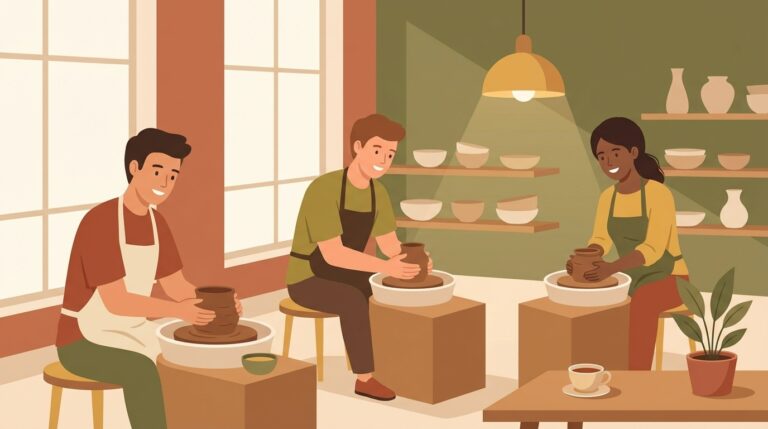
Phase 1: The “Godsaeng” Hustle — Immersive Hook
Hello! This is your Daily Hangul Chief Editor.
Picture this: You are watching a K-Drama. The protagonist, a hardworking office worker, clocks out at 6 PM. Instead of going home to crash on the sofa, where do they go? To a baking studio to learn how to make macarons. Or maybe a leather crafting workshop to make a wallet.
You might think, “Are they crazy? Aren’t they tired?”
Welcome to the world of Korean Lifelong Learning. In Korea, the “Education Fever” doesn’t end after high school or university. It transforms into a quest for ‘Godsaeng’ (갓생) — a portmanteau of “God” and “Saeng” (life), meaning a diligent, productive, and exemplary life.
Today, we aren’t just learning words; we are learning how to survive a conversation in Hongdae or Seongsu-dong when your Korean friend asks, “So, what are you learning these days?” If you say “nothing,” the conversation might get awkward. Let’s fix that.
Phase 2: Deep Dive — Keywords for the “Hobby Rich”
Here are the three expressions that will make you sound like a local who truly understands the Korean drive for self-improvement.
1. 원데이 클래스 (Wonday Kkeullaeseu)
- Pronunciation: [Won-day Kkeul-lae-seu]
- Meaning: One-day class (A short workshop completed in a single session).
- K-Culture Moment: Scroll through Instagram on a weekend. You will see K-Pop idols posting photos of ugly-but-cute pottery or handmade rings. They are all doing One-day classes.
- Editor’s Insight: This is the entry point for hobbies. Koreans love efficiency. We want to experience something cool, get a result (and a photo), without committing to a 6-month course immediately.
- Situation Spectrum:
[Casual ✅] — [Business ⚠️] — [Formal ✅](Very common word)- 🤔 Think About It: Why is “efficiency” valued even in hobbies? Does your culture prefer long-term mastery or short-term experiences?
2. 취미 부자 (Chwimi Buja)
- Pronunciation: [Chwi-mi Bu-ja] (Sounds like Chewy-me + Boo-jah)
- Meaning: Hobby Hoarder / Someone with many hobbies. (Literal: Hobby Rich).
- K-Culture Moment: Think of that character in a variety show (like I Live Alone) who buys expensive camping gear, then switches to tennis gear the next week. That’s a Chwimi Buja.
- Editor’s Insight: It’s used affectionately, but sometimes with a tiny hint of teasing about spending too much money on gear.
- Situation Spectrum:
[Casual ✅] — [Semi-formal ✅] — [Strictly Formal 🚫]3. 자기계발 (Jagigyebal)
- Pronunciation: [Ja-gi-gye-bal]
- Meaning: Self-development / Self-improvement.
- K-Culture Moment: The “Miracle Morning” trend where people wake up at 4:30 AM to read or jog before work? That is the peak of Jagigyebal.
- Editor’s Insight: This is a magic word in Korea. If you say you are busy because of Jagigyebal, everyone respects you instantly.
- Situation Spectrum:
[Casual ✅] — [Business ✅] — [Formal ✅]- 🤔 Think About It: Is self-development viewed as a personal joy or a social obligation in Korea?
Phase 3: Textbook vs. Real Life
| Situation | 📖 Textbook Korean | 🗣️ Real Korean | 💡 Why the difference? |
|---|---|---|---|
| Asking about hobbies | 취미가 무엇입니까? (What is your hobby?) | 요즘 뭐 배우는 거 있어? (Learning anything these days?) | Koreans view hobbies as active learning, not just passive distinct interests. |
| Expressing intent | 저는 요가를 배우고 싶습니다. (I want to learn yoga.) | 요가나 한번 해볼까 해. (Thinking of giving yoga a try.) | Using “-na” and “-hae bolkka hae” sounds softer and less demanding than “-go sipseumnida.” |
| After a class | 수업이 재미있었습니다. (The class was fun.) | 완전 힐링됐어. (It was total healing.) | In modern Korea, hobbies are often for mental “healing” from stress. |
Phase 4: Cultural Deep Dive — The Pressure to be Productive
4-1. The “Healing” Excuse
In Korea, simply “resting” (lying in bed) can sometimes feel like laziness due to the intense social pressure. So, people take hobby classes to “rest productively.” When you take a perfume-making class, you aren’t just playing; you are “cultivating your senses.” Use the word “힐링 (Healing)” when describing your hobby class to sound like a true local.
4-2. K-Food Connection: Baking & Coffee
Korea has a massive cafe culture. Naturally, the most popular hobby classes are Baking and Barista skills. If you meet a Korean who has a barista certificate but doesn’t work in a cafe, don’t be surprised. They likely did it just for Jagigyebal.
Phase 5: Immersive Roleplay — At a Pottery Studio in Seongsu
Setting: It is Saturday afternoon in Seongsu-dong (the Brooklyn of Seoul). You are at a trendy pottery studio wearing an apron covered in clay dust. Your friend, Minji (29, office worker, hobby enthusiast), is sitting next to you at the wheel.
Minji: 와, 너 손재주 진짜 좋다! 이거 처음 해보는 거 맞아? 🏺
(Wa, neo sonjaeju jinjja jota! Igeo cheoeum haeboneun geo maja?)
(Wow, you’re really good with your hands! Is this really your first time?)
(Minji looks at your pot with wide eyes)
YOU:
(Romanization) Soljiki… youtube-ro yeonseup jom haesseo.
(Translation) Honestly… I practiced a bit via YouTube.
Minji: 역시! 너도 완전 노력파구나. 끝나고 예쁜 카페 갈래? 내가 아는 데 있어.
(Yeoksi! Neodo wanjeon noryeokpaguna. Kkeun-nago yeppeun kape gallae? Naega aneun de isseo.)
(I knew it! You’re a hard worker too. Wanna go to a pretty cafe after this? I know a place.)
🔀 Your Turn! How do you respond?
- A) “그래! 가서 갓생 토크 좀 하자.” (Sure! Let’s talk about our ‘Godsaeng’ life.)
- B) “아니, 난 집에 가서 공부해야 해.” (No, I have to go home and study.)
- C) “카페는 무슨, 술이나 마시러 가자.” (Forget cafes, let’s go drink alcohol.)
✅ Best Choice: A — Matches the “productive/hobby” vibe of the day perfectly.
⚠️ Choice B Analysis: Too stiff. Even “Godsaeng” people need a cafe break.
⚠️ Choice C Analysis: A bit abrupt after a calming pottery class, unless Minji loves drinking!
Phase 6: 10-Second Shadowing Drill
Let’s practice saying this with the “proud but humble” vibe of a hobbyist.
😊 “요즘은 / 퇴근하고 / 꽃꽂이를 배우면서 / 힐링하고 있어요.”
(Yojeum-eun / toe-geun-ha-go / kkot-kko-ji-reul bae-u-myeon-seo / hil-ling-ha-go i-sseo-yo.)
Meaning: These days / after work / I’m learning flower arrangement / and getting healed.
Phase 7: K-Culture Mini Glossary
| Korean | Romanization | English | Context |
|---|---|---|---|
| 갓생 | Godsaeng | Living a diligent life | The ultimate compliment for someone living productively. |
| 워라밸 | Worabael | Work-Life Balance | Short for “Work Life Balance”. |
| 장비빨 | Jangbi-ppal | Gear effect | Relying on expensive equipment rather than skill (common in hobbies like golf/photography). |
| 소확행 | Sohwakhaeng | Small but certain happiness | The feeling you get from a small hobby class. |
| 금손 / 똥손 | Geumson / Ddongson | Golden Hand / Poop Hand | Being talented vs. untalented with your hands. |
Phase 8: Traveler’s Survival Kit (Class Edition)
You are in Seoul for a month and want to take a dance class like a K-Pop trainee?
🆘 Survival Phrases
– 🇰🇷 “혹시 원데이 클래스도 하시나요?” (Hoksi wonday kkeullaeseudo hasinayo?)
– Translation: Do you happen to do one-day classes?
– Use: DMing an Instagram studio or walking into a workshop.
– 🇰🇷 “몸치여도 괜찮을까요?” (Momchi-yeodo gwaenchaneulkkayo?)
– Translation: Is it okay even if I have no rhythm (body-deaf)?
– Use: Before signing up for dance classes.
– 🇰🇷 “준비물이 따로 필요한가요?” (Junbimuri ttaro piryohan-gayo?)
– Translation: Do I need to bring any supplies?📌 Editor’s Note:
Most classes are booked via Instagram DM or Naver Booking (네이버 예약). If you see a class you like on Insta, don’t be shy to DM in simple English or Korean. They are usually very welcoming!
Phase 9: Think Deeper — Productivity vs. Rest
Why must hobbies be “useful”?
In many Western cultures, a hobby is just for fun. You can be bad at it, and it’s fine. But in Korea, the “Education Fever” lingers into adulthood. There is a subconscious pressure that even your downtime should contribute to your Spec (specification/resume) or Jagigyebal (self-development).
🧠 Think Deeper:
Is this drive for perfection making Koreans more successful, or just more stressed? When you learn Korean, are you doing it for a grade, or for the joy of connecting?💬 Your Turn: In your country, is it common to take classes after work? Or do people just relax?
Phase 10: FAQ & Troubleshooting
Q: Can I go to a One-day Class alone?
A: ABSOLUTELY (Yes!).
Korea has a growing Hon-jok (Doing things alone) culture. Going to a leather workshop or baking class alone is very common. It’s actually a great way to make local friends because you have a shared topic right in front of you!
❌ Common Mistake #1: Assuming all classes provide materials.
✅ Fix: Always ask “재료비 포함인가요?” (Is the material fee included?). Some cheap classes have hidden costs!
Phase 11: Wrap-up & Action Items
One-Liner: Korean hobbies are serious business — use words like “Jagigyebal” and “Healing” to show you understand the culture.
🚀 Action Missions:
– 🥉 Bronze: Look in the mirror and ask yourself: “요즘 뭐 배워?”
– 🥈 Silver: Go to Instagram, search hashtags like #원데이클래스 or #취미, and leave a comment in Korean: “재미있어 보여요!” (Looks fun!)
– 🥇 Gold: If you are in Korea, actually book a class. If outside Korea, find a Korean cooking tutorial on YouTube and post your result with the caption “오늘의 힐링” (Today’s healing).
Phase 12: Quiz — Are you a Hobby Master?
1. Your colleague asks what you do on weekends. You want to sound like you are living a “Godsaeng”. What is the BEST answer?
– A) “그냥 잠만 잤어요.” (I just slept.)
– B) “유튜브 봤어요.” (I watched YouTube.)
– C) “도자기 공방에서 원데이 클래스 들었어요.” (I took a one-day class at a pottery studio.)
2. True or False?
– “Jagigyebal” means “wasting time.” (T/F)
3. Fill in the blank:
– “I bought too much gear for my new hobby. I guess I am a [ _______ ] Buja.”
Answers:
1. C (A and B are fine, but C screams “Godsaeng”!)
2. False (It means Self-development.)
3. 취미 (Chwimi)
Frequently Asked Questions (FAQ)
Q: What does "원데이 클래스 (Wonday Kkeullaeseu)" mean in Korean and how do you pronounce it?
A: In Korean, "원데이 클래스 (Wonday Kkeullaeseu)" is pronounced [Won-day Kkeul-lae-seu] and means: One-day class (A short workshop completed in a single session).
Q: What does "취미 부자 (Chwimi Buja)" mean in Korean and how do you pronounce it?
A: In Korean, "취미 부자 (Chwimi Buja)" is pronounced [Chwi-mi Bu-ja] and means: Hobby Hoarder / Someone with many hobbies. (Literal: Hobby Rich).
Q: What does "자기계발 (Jagigyebal)" mean in Korean and how do you pronounce it?
A: In Korean, "자기계발 (Jagigyebal)" is pronounced [Ja-gi-gye-bal] and means: Self-development / Self-improvement.







