

Phase 1: The Immersive Hook
Hello! This is your Senior Editor at Daily Hangul.
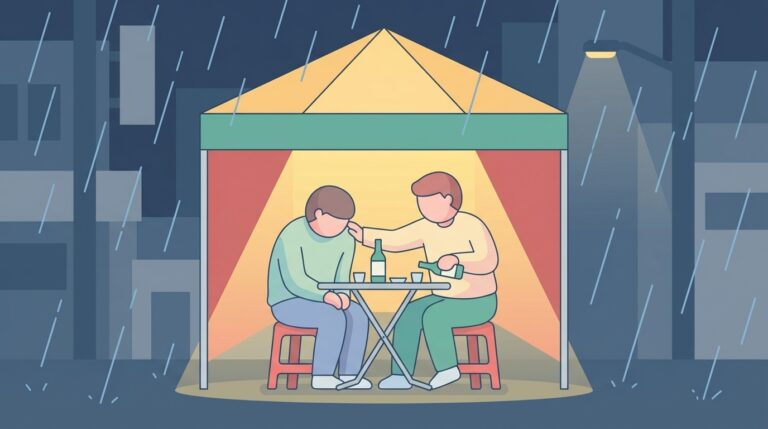
Imagine this scene: You’re watching a K-Drama. It’s episode 12, the emotional climax. The protagonist is sitting alone at a Pocha (street food tent), staring into a shot glass of Soju. It’s raining outside. Their shoulders are shaking.
A friend walks in, sits down silently, and pours a drink. They don’t give a long speech. They just say one short phrase, and the protagonist bursts into tears.
What was that magic word?
In English, we might say “I’m sorry” or “Don’t cry.” But in Korean, comforting someone is an art form deeply rooted in Jeong (정)—that invisible thread of affection that binds us. Today, we’re not just learning vocabulary; we are learning how to be a warm shoulder to lean on. Because as the Korean saying goes, “Sorrow halved is shared” (슬픔을 나누면 반이 된다).
Let’s learn how to be a real friend in Korean.
Phase 2: Deep Dive into Core Expressions
Here are the top 3 expressions you need when someone is feeling blue.
1. 속상하겠다 (Soksang-hagetta)
- Pronunciation: [Sok-sang-ha-get-ta] Sounds like ‘Soak’ + ‘Sang’ (sung) + ‘Ha’ + ‘Get’ + ‘Ta’.
- Meaning: “You must be upset/distressed.”
- Literal: Your inside (heart/stomach) must be rotting/hurt.
- Real Nuance: “I validate your feelings. I can see why you are hurt.”
- K-Culture Moment: Used constantly in variety shows when a guest tells a sad story about their trainee days. The MCs will frown deeply and say, “Aigoo, soksang-hagetta…”
- Editor’s Insight: This is the Empathy MVP. Instead of trying to fix the problem (“You should do this…”), use this first. Koreans value emotional validation over logical solutions in moments of sadness.
- Situation Spectrum:
[🚫 Formal/Boss] ———— [⚠️ Colleagues] ———— [✅ Friends]
(Note: For older people, add ‘yo’ at the end: 속상하시겠어요 / Soksang-hasigesseoyo)- 🤔 Think About It: Why does Korean focus on the “inside” (Sok) rotting? It reflects the cultural belief that suppressing emotions hurts the body (Hwabyung).
2. 힘내요 (Him-naeyo)
- Pronunciation: [Him-nae-yo] Sounds like ‘Him’ (he) + ‘Neigh’ (horse sound) + ‘Yo’.
- Meaning: “Cheer up” or “Be strong.”
- Literal: Release your strength / Generate power.
- K-Culture Moment: You’ll see this on fan placards at K-Pop concerts or written on sticky notes attached to vitamin drinks given to tired coworkers.
- Editor’s Insight: This is a classic, safe, and positive encouragement. It’s less about deep sadness and more about exhaustion or needing a boost.
- Situation Spectrum:
[✅ Formal/Boss] ———— [✅ Colleagues] ———— [✅ Friends]
(For friends, drop the ‘yo’: 힘내 / Him-nae)3. 내가 있잖아 (Naega it-jana)
- Pronunciation: [Nae-ga it-ja-na] Sounds like ‘Ne’ (net) + ‘Ga’ + ‘It’ (eat) + ‘Ja’ + ‘Na’.
- Meaning: “I’m here for you.”
- Literal: You know I exist (for you).
- K-Culture Moment: The ultimate romantic or “bestie” line. Usually said with a warm gaze, perhaps while patting the other person’s back.
- Editor’s Insight: Use this only with people you are genuinely close to. It implies a promise of loyalty and support.
- Situation Spectrum:
[🚫 Formal/Boss] ———— [⚠️ Colleagues] ———— [✅ Friends/Family]
Phase 3: Textbook vs. Real Life
Real Korean comfort is often indirect. Let’s look at the difference.
| Situation | 📖 Textbook Korean | 🗣️ Real Korean | 💡 Why different? |
|---|---|---|---|
| Friend failed a test | 슬퍼하지 마세요. (Don’t be sad.) | 술 한잔 할까? (Shall we have a drink?) | In Korea, sharing food/alcohol is the primary language of comfort. |
| Coworker made a mistake | 괜찮아요. (It’s okay.) | 아이고, 어떡해요… (Oh no, what to do…) | Sharing the worry (“We are in this together”) shows more empathy than dismissing it. |
| Someone is crying | 울지 마세요. (Don’t cry.) | (Silently handing a tissue) or 실컷 울어. (Cry it all out.) | Sometimes telling someone not to cry feels cold. Letting them cry is permission to release Han (sorrow). |
Bottom Note: If you are B1 level, try combining them: “속상하겠다… 오늘 술 한잔 할까?” (You must be upset… wanna get a drink?)
Phase 4: Cultural Deep Dive
4-1. The Art of ‘Todak-Todak’ (토닥토닥)
Words fail? Use your hands. ‘Todak-Todak’ is the onomatopoeia for gently patting someone’s back or shoulder. In Korea, physical touch like a light back pat is a powerful non-verbal comfort, even between male friends, when someone is distressed.
⚠️ Caution: Do not do this to a superior (boss/teacher) unless you have a parent-child like relationship.
4-2. Comfort Food = Soul Healing
In K-Culture, when someone is sad, we don’t just sit there. We feed them.
- Stressed/Angry? Go for Spicy Food (Tteokbokki, Fire Noodles). The pain of the spice distracts from the pain of the heart.
- Depressed/Melancholy? Go for Warm Soup or Soju.
Think About It: If a Korean friend asks, “Did you eat?” when you are sad, they aren’t hungry. They are asking, “Are you taking care of yourself despite the sadness?”
Phase 5: Immersive Roleplay Scenario
Scenario: It’s Friday night at a Chicken & Beer (Chimaek) restaurant. Your Korean friend, Min-ji, looks down. She just broke up with her boyfriend.
YOU: (Noticing her mood) 민지야, 무슨 일 있어?
(Minji-ya, museun il isseo? / Minji, is something wrong?)
Min-ji: (Sighing) 휴… 나 남자친구랑 헤어졌어.
(Hyu… na namjachingu-rang heeojyeosseo. / Sigh… I broke up with my boyfriend.)
YOU: 정말? 아이고… [ CHOOSE YOUR RESPONSE ]
🔀 Your Turn! How do you respond?
- A) “왜 헤어졌어?” (Why did you break up?)
- B) “괜찮아, 남자는 많아.” (It’s okay, there are many men.)
- C) “진짜? 너무 속상하겠다…”
✅ Best Choice: C (Really? You must be so upset…)
* Why? Option A asks for logic/reasons (too tiring right now). Option B dismisses her feelings. Option C validates her pain instantly.
Min-ji: 응, 마음이 너무 아파. (Yeah, my heart hurts so much.)
YOU: (Pouring her a drink) 이거 마시고 잊어버려. 오늘 내가 쏠게!
(Igeo masigo ijeobeoryeo. Oneul naega ssolge! / Drink this and forget it. My treat today!)
Phase 6: 10-Second Shadowing Drill
Practice saying this with a warm, lower tone. Do not speak too fast. Pause where marked.
🥺 Empathy Mode:
아이고… / 많이 힘들었겠다. / 내가 / 도와줄 거 없어?
(Aigoo… / mani himdeureot-getta. / naega / dowajul geo eopseo?)
“Oh no… that must have been really hard. Is there anything I can do to help?”
Phase 7: K-Culture Mini Glossary
| Korean | Romanization | Meaning | Context |
|---|---|---|---|
| 깡소주 | Kkang-soju | Soju without snacks | Drinking only Soju. Usually implies deep sadness or poverty. Very dramatic. |
| 기분 전환 | Gibun jeonhwan | Change of mood | Doing something (getting a haircut, traveling) to shake off sadness. |
| 푸념 | Punyeom | Grumbling/Venting | Complaining about one’s bad luck or situation. |
| 정 | Jeong | Deep affection/Bond | The feeling that makes you want to comfort even a stranger. |
Phase 8: Traveler’s Survival Kit
Even on a happy trip, things go wrong. If you lose your wallet or get hurt, you need to know how to ask for comfort/help or how to react if a local comforts you.
🆘 Survival Expression: “Uh-oh” moment
– 🇰🇷 “저, 큰일 났어요…” (Jeo, keun-il nasseoyo…)
– 🗣️ Meaning: “I have a big problem…” / “I’m in trouble…”
– 📍 Use when: You lost your passport, missed the last bus, or dropped your phone in the toilet.
– 💡 Pro Tip: If you say this with a worried face, Koreans will almost immediately stop to help because of Jeong.📌 Editor’s Travel Note
– Lost & Found: If you lose something in the subway, don’t cry yet! Visit the “Lost and Found Center” (유실물 센터). Koreans are famous for returning lost items.
– Police: Korean police stations are generally safe places to ask for help/directions if you are distressed.
Phase 9: Think Deeper — “Food and Identity”
Why do Koreans offer food when you are sad?
In many Western cultures, sadness might be met with “Do you want to talk about it?” But in Korea, the first question is often “Have you eaten?” (밥은 먹었어?). Historically, Korea went through periods of war and poverty where skipping a meal was a genuine crisis. Ensuring someone is fed is the ultimate act of care and survival.
🧠 Think Deeper:
When you say “Let’s go eat something good” to a sad friend, you are telling them: “Life goes on, and I want to sustain you so you can fight another day.” It’s a very primal, physical form of love.💬 Your Turn: How do people in your country comfort each other? Do you use food, words, or physical touch? Tell me in the comments!
Phase 10: FAQ & Troubleshooting
Q: Can I hug my Korean friend to comfort them?
A: It depends. If you are the same gender and close friends, a side-hug or back pat is fine. If you are opposite genders, a full frontal hug might be too intimate unless you are dating or very “Westernized.” Read the room (Nunchi)!
Q: Is it rude to cry in public in Korea?
A: It’s not “rude,” but it attracts attention. People might stare—not to judge, but out of concern. If you see someone crying on the subway, it’s polite to pretend you don’t see them (give them privacy) or silently offer a tissue.
❌ Common Mistake #1: Saying “다 네 잘못이야” (It’s all your fault) or being too logical.
✅ Fix: Even if it is their fault, save the logic for later. First, handle the emotion. Use “괜찮아, 누구나 실수해” (It’s okay, everyone makes mistakes).
Phase 11: Wrap-up & Action Mission
Summary: Today we learned that Korean comfort is about Validation (속상하겠다), Presence (내가 있잖아), and Sharing (Food/Drink).
🚀 Action Mission:
– 🥉 Bronze: Look in the mirror and practice the “Empathy Face” while saying “속상하겠다…” (Don’t smile! Look concerned).
– 🥈 Silver: Watch a K-Drama scene where someone is crying. Can you hear “Gwaenchana” or “Himnae”?
– 🥇 Gold: Next time a friend (even a non-Korean one) is sad, try offering them their favorite food before asking for details. See how the vibe changes!
Phase 12: Interactive Quiz
1. Situation Judgment: Your boss is sighing because the project failed. What do you say?
* A) 속상하겠다… (You must be upset…)
* B) 힘내세요, 부장님! (Cheer up, Boss!)
* C) 술 마시러 가요! (Let’s go drink!)
Answer: B) is the safest. A is too casual/intimate for a boss (unless you add honorifics perfectly), and C is too bold unless the boss suggests it first.
2. True or False?
* “In Korea, it is considered polite to leave a sad person completely alone and never ask them what is wrong.”
Answer: False. While you shouldn’t pry, showing concern with “Is something wrong?” (무슨 일 있으세요?) is considered caring. Ignoring them completely can seem cold.
Great job today! You are now ready to be a ‘Warm-hearted’ friend in Korean. See you in the next lesson!
Frequently Asked Questions (FAQ)
Q: What does "속상하겠다 (Soksang-hagetta)" mean in Korean and how do you pronounce it?
A: In Korean, "속상하겠다 (Soksang-hagetta)" is pronounced [Sok-sang-ha-get-ta] and means: "You must be upset/distressed."
Q: What does "힘내요 (Him-naeyo)" mean in Korean and how do you pronounce it?
A: In Korean, "힘내요 (Him-naeyo)" is pronounced [Him-nae-yo] and means: "Cheer up" or "Be strong."
Q: What does "내가 있잖아 (Naega it-jana)" mean in Korean and how do you pronounce it?
A: In Korean, "내가 있잖아 (Naega it-jana)" is pronounced [Nae-ga it-ja-na] and means: "I'm here for you."







