

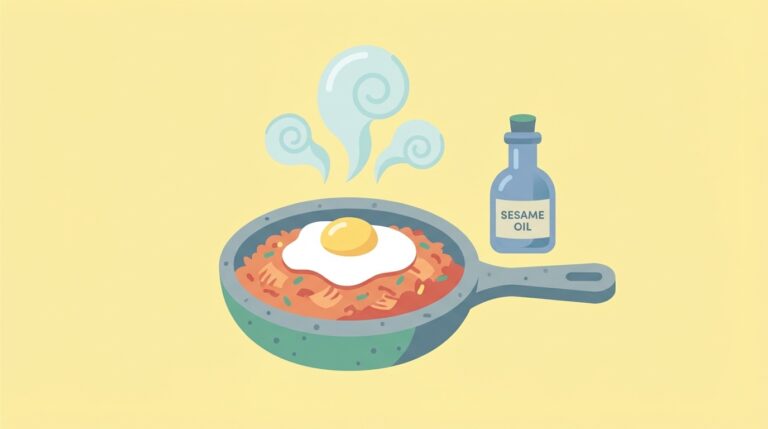
Secrets of Stir-frying Kimchi: Cook Like a K-Drama Star 🍳
Phase 1: The Sizzle of Seoul (Immersive Hook)
Greeting: Hello! This is your Daily Hangul Editor.
K-Culture Cold Open: Picture this. It’s 11 PM in a K-Drama. The main character just got their heart broken (or maybe they just lost a job). They walk into their small rooftop apartment, open the fridge, and take out a container of old, sour Kimchi. They throw it into a frying pan with some rice. Sizzle. 🔥
That sound? That smell? It’s the ultimate comfort food. But have you ever watched a Korean cooking show or a Mukbang and heard the chef say, “Kill the breath of the Kimchi”? 😱 Wait, kill what?
The ‘Why’: Cooking terms in Korean are very different from English. If you translate literally, you might end up “burning” the food instead of “stir-frying” it. Today, we are going to master the art of Kimchi-bokkeumbap (Kimchi Fried Rice) and the language that goes with it. You’ll not only learn to cook but also how to talk like a local chef.
Transparency: This guide is based on real questions from students who tried to follow Korean recipes on YouTube and got confused by the “feeling” words!
Phase 2: Deep Dive into Flavor (Key Expressions)
1. 달달 볶다 (Dal-dal bokda)
- Pronunciation: [Dal-dal bok-da] + Sounds like a rhythmic drum beat.
- Meaning: Literal: Stir-fry sweetly? Real Nuance: Stir-fry thoroughly and gently until it’s perfect.
- K-Culture Moment: In cooking vlogs, you’ll hear the YouTuber say, “Kimchi-reul dal-dal bokkaseyo.” It emphasizes the process and the effort to bring out the flavor.
- Editor’s Insight: “Bokda” means to stir-fry. But adding “Dal-dal” makes it sound delicious and emphasizes that you shouldn’t stop stirring. It’s an onomatopoeia for the sound of the spatula hitting the pan.
- Situation Spectrum:
[🚫 Formal Speech] ———— [⚠️ Cooking Shows] ———— [✅ Casual/Kitchen]🤔 Think About It: English uses adverbs like “thoroughly.” Korean uses sound-words (mimetic words) like “dal-dal” to describe actions. Why do you think Korean relies so much on sound to describe feelings?
2. 숨이 죽다 (Sumi jukda)
- Pronunciation: [Su-mi juk-da] + Sounds like “Sue me, Jook-da”
- Meaning: Literal: The breath dies. Real Nuance: The vegetables (Kimchi) have wilted and become soft.
- K-Culture Moment: A mom teaching her son to cook in a family drama: “Not yet! The breath hasn’t died yet!” (Meaning: The Kimchi is still too crunchy).
- Editor’s Insight: This isn’t violent! It’s a very common cooking term. When cabbage or kimchi gets heated, it loses water and becomes soft. That is “breath dying.”
Situation Spectrum:
[🚫 Business Meeting] ———— [⚠️ General] ———— [✅ Cooking/Gardening]🤔 Think About It: Describing vegetables as having “breath” implies they are alive. Does this reflect a cultural respect for nature and food ingredients?
3. 간을 보다 (Ganeul boda)
- Pronunciation: [Ga-neul bo-da] + “Ganeul” sounds like “Khan” (Genghis)
- Meaning: Literal: To see the saltiness. Real Nuance: To taste the food to check the seasoning.
- K-Culture Moment: Every variety show where members cook together. One person holds a spoon up to another person’s mouth. The caption says: “Gan-bogi” (Tasting time).
- Editor’s Insight: You don’t “eat” (meokda) to check flavor; you “see” (boda) the seasoning (gan). It implies a quick check, not a full meal!
- Situation Spectrum:
[🚫 Formal Presentation] ———— [⚠️ Semi-formal] ———— [✅ Kitchen/Casual]
Phase 3: Textbook vs. Real Life (Korean Kitchen Edition)
| Situation | 📖 Textbook Korean | 🗣️ Real Korean (In the Kitchen) | 💡 Why different? |
|---|---|---|---|
| Starting to cook | 김치를 볶으세요. (Stir-fry the kimchi.) | 김치 먼저 달달 볶아! (Fry the kimchi dal-dal!) | Koreans love sound words (mimetic) to show how to do it. |
| Checking status | 김치가 부드러워졌나요? (Is the kimchi soft?) | 숨 죽었어? (Is the breath dead?) | Idioms are faster and more visual than descriptions. |
| Tasting | 맛을 확인해 보세요. (Check the taste.) | 간 좀 봐봐. (Check the seasoning a bit.) | “Gan” refers specifically to saltiness/seasoning balance, which is key to Korean food. |
Bottom Note: In a casual kitchen setting, drop the “yo” at the end if you are with close friends! (e.g., “Gan bwa!” instead of “Gan boseyo.”)
Phase 4: Cultural Deep Dive — The Art of “Son-mat”
4-1. Non-verbal: The Spoon Feed (Jeong)
In Western culture, double-dipping or feeding someone with your spoon might be rude. In Korea, while cooking, if someone offers you a spoon of soup or fried rice to taste (Gan bwa), accept it! It’s an act of Jeong (affection). Open your mouth slightly and let them feed you the sample. It shows you trust their cooking.
4-2. K-Food Connection: Why Stir-fry “Sour” Kimchi?
Have you noticed in K-Dramas, they always use Shin-Kimchi (Sour/Old Kimchi) for frying? Fresh kimchi is for eating as a side dish. Old, fermented kimchi is too sour to eat alone, but when you stir-fry it (Bokda) with sugar and oil, it transforms into a savory masterpiece. This is the wisdom of Korean cooking: Nothing goes to waste.
Critical View: Why is everything “to taste”? Korean recipes often lack precise measurements, saying “add sesame oil appropriately.” This relies on Son-mat (Hand taste)—the idea that the cook’s instinct and love matter more than the scale.
Phase 5: Immersive Roleplay (Cooking Party) 🍳
Setting: Saturday afternoon. You are at your Korean friend Minji’s apartment. You are making Kimchi-bokkeumbap (Fried Rice) for lunch. The pan is hot.
Characters:
– YOU: A beginner cook, eager to learn.
– Minji (27): Your close friend, loves home cooking, talks fast when excited.
Dialogue:
Minji: 자, 이제 김치 넣을게! 기름 튀니까 조심해.
(Ja, ije gimchi neoulge! Gireum twinikka josimhae.)
(Okay, I’m putting the kimchi in now! Watch out for the splashing oil.)
(🎭 Stage Direction: Minji throws the chopped kimchi into the sizzling pan.)
YOU: 우와, 소리 대박이다! 얼마나 볶아야 해?
(Uwa, sori daebagida! Eolmana bokkayahae?)
(Wow, the sound is amazing! How long do I have to stir-fry it?)
Minji: 음… 김치 숨이 죽을 때까지 달달 볶으면 돼.
(Eum… Gimchi sumi jugeul ttaekkaji dal-dal bokkeumyeon dwae.)
(Hmm… Just stir-fry it thoroughly until the kimchi’s breath dies.)
🔀 Decision Point: Minji passes you a spoon. What do you say?
A) “아, 괜찮아요. 나중에 먹을게요.” (Ah, it’s okay. I’ll eat later.)
B) “(Accepting the spoon) 음~! 간이 딱 맞는데?” (Mmm! The seasoning is perfect?)
C) “숨이 죽었어!” (The breath is dead!)✅ Best Choice: B — Accepting the taste test is polite and fun. “Gani ttak manneunde?” is a huge compliment!
⚠️ Choice C Analysis: Grammatically correct, but weird to shout suddenly. You usually use that phrase to describe the food, not as a reaction to tasting.
Minji: 그치? 역시 김치볶음밥은 참기름이 필수야.
(Geuchi? Yeoksi gimchibokkeumbabeun chamgireumi pilsuya.)
(Right? As expected, sesame oil is essential for Kimchi Fried Rice.)
Phase 6: 10-Second Shadowing Drill 🎤
Repeat after the guide. Focus on the emotion!
- 😤 determinedly (Cooking instruction):
김치를 / 달달 / 볶아주세요!
(Gimchi-reul / dal-dal / bokka-juseyo!)
Please stir-fry the kimchi thoroughly! -
😋 Happily (Tasting food):
와 / 간이 / 딱 맞아요!
(Wa / gani / ttak majayo!)
Wow, the seasoning is perfect!
Phase 7: K-Culture Mini Glossary 📙
| Korean | Romanization | Meaning | Context |
|---|---|---|---|
| 손맛 | Son-mat | Hand taste | The unique flavor that comes from a cook’s experience and touch. |
| 묵은지 | Mugeunji | Aged Kimchi | Very old, sour kimchi. The BEST for stir-frying. |
| 참기름 | Chamgireum | Sesame Oil | The magical finishing oil used in 90% of Korean dishes. Never cook with it on high heat (it burns)! |
| 볶음밥 | Bokkeumbap | Fried Rice | The universal ending to any Korean meal (BBQ, Dakgalbi, etc.). |
Phase 8: Traveler’s Survival Kit (Food Edition) 🎒
Even if you aren’t cooking, you will order this!
🆘 Survival Expression #1: Ordering at a Restaurant
– 🇰🇷 “여기 김치볶음밥 하나 주세요.”
– Pronunciation: [Yeogi gimchi-bokkeumbap hana juseyo]
– Meaning: Please give me one Kimchi Fried Rice here.
– 💡 Pro Tip: If it’s too spicy, ask for “Less spicy” -> “Deol mep-ge hae-juseyo.”📌 Editor’s Travel Note
– Self-Service: In many casual joints (Kimbap Cheonguk), water and side dishes (Kimchi/Danmuji) are often self-service. Look for the sign “물은 셀프” (Water is Self).
Phase 9: Think Deeper — “A Little Bit” of Logic 🧠
Topic: Measurements and the “Feel” of Cooking
In Western recipes, you get exact numbers: “1 teaspoon of salt.” In Korea, especially in home cooking, you often hear “Jeokdanghi” (appropriately) or “Ganeul bogo” (after tasting).
This reflects a High-Context Culture. It assumes you already share a common knowledge of what “good kimchi” tastes like. It values intuition and experience over rigid rules.
💬 Your Turn: Does your culture’s cooking rely on exact recipes or “grandma’s feeling”? Tell us in the comments!
Phase 10: FAQ & Troubleshooting 🚧
Q: Can I say “Sum jukeosseo?” (Is the breath dead?) to a person who is tired?
A: No! 🙅♂️ That would imply they look like wilted cabbage (or dead). For people, say “Pigonhae boyeo” (You look tired). Keep “breath dying” for vegetables only!
Q: Is “Bokda” (Stir-fry) used for anything else?
A: Yes! It’s slang. “Deul-deul bokda” means to nag someone relentlessly (like you are frying them in a pan). E.g., “My boss is frying me!”
❌ Common Mistake:
– Saying “I will see the liver” (taking ‘Gan’ literally as body organ liver).
– Correction: In the kitchen context, Gan always means seasoning/saltiness.
Phase 11: Wrap-up & Action Missions 🎬
One-Liner: To cook great Korean food, you must “kill the breath” of the veggies and “fry them sweetly”! 🍳
🚀 Action Missions:
– 🥉 Bronze: Stand in your kitchen, pretend to hold a pan, and say “Dal-dal bokkaja!” (Let’s fry it dal-dal!) 3 times.
– 🥈 Silver: Next time you eat something salty/bland, practice saying “Gani majayo” (Seasoning is right) or “Gani an majayo” (Seasoning is wrong).
– 🥇 Gold: Go to a Korean restaurant (or Asian mart), buy Kimchi, and try making Kimchi Fried Rice while narrating your steps in Korean!
Phase 12: Interactive Quiz 📝
1. Which phrase best completes the sentence?
“Wait! Don’t eat it yet. The kimchi is still crunchy. It needs to _______.”
– A) 간을 봐야 해 (Taste the seasoning)
– B) 숨이 죽어야 해 (Have its breath die)
– C) 참기름을 발라야 해 (Apply sesame oil)
2. True or False?
“Dal-dal” describes the taste of the kimchi being sweet.
– (T / F)
3. Situation Check:
Your friend asks you to check the soup. You taste it and it’s perfect. You say:
– “Gani ttak majayo!”
– “Sumi jukeosseoyo!”
🔑 Answers:
1. B (It needs to wilt/soften).
2. False (It describes the sound/action of frying, not the sugar content).
3. “Gani ttak majayo!”
Frequently Asked Questions (FAQ)
Q: What does "달달 볶다 (Dal-dal bokda)" mean in Korean and how do you pronounce it?
A: In Korean, "달달 볶다 (Dal-dal bokda)" is pronounced [Dal-dal bok-da] and means: Literal: Stir-fry sweetly? Real Nuance: Stir-fry thoroughly and gently until it's perfect.
Q: What does "숨이 죽다 (Sumi jukda)" mean in Korean and how do you pronounce it?
A: In Korean, "숨이 죽다 (Sumi jukda)" is pronounced [Su-mi juk-da] and means: Literal: The breath dies. Real Nuance: The vegetables (Kimchi) have wilted and become soft.
Q: What does "간을 보다 (Ganeul boda)" mean in Korean and how do you pronounce it?
A: In Korean, "간을 보다 (Ganeul boda)" is pronounced [Ga-neul bo-da] and means: Literal: To see the saltiness. Real Nuance: To taste the food to check the seasoning.







