

Phase 1: The Immersive Hook
안녕하세요! This is your Daily Hangul Editor.
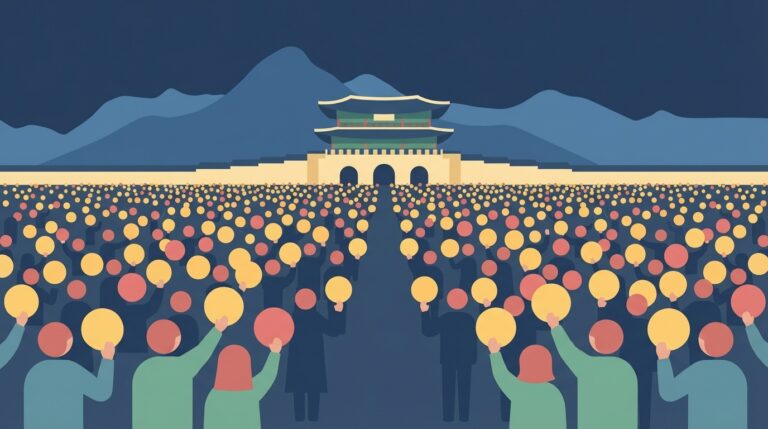
Imagine you are standing in the middle of Gwanghwamun Square in Seoul. It’s freezing cold, but the air is warm—heated by the breath of a million people. You look around, expecting chaos, but what you see is an ocean of LED candles swaying in perfect unison. Someone starts singing a song you recognize—not a protest chant, but a popular song about hope.
This isn’t a K-Pop concert. This is a 촛불 집회 (Candlelight Vigil).
K-Dramas often romanticize Korea, but if you really want to understand the soul of modern Korea—the fierce democracy, the dynamic energy, and the collective power—you need to understand this moment. It’s where history is made, not by kings, but by ordinary citizens.
Today, we are diving deep into C1-level Korean: the language of civic consciousness (시민 의식). These are the words you’ll hear on the news, in serious debates over Soju, and see in the history books. Ready to look beyond the neon lights?
Phase 2: Deep Dive into Key Expressions
1. 성숙한 시민 의식 (Seongsukan simin uisik)
- Pronunciation: [Seong-sook-han she-min ui-shik]
Tip: ‘Seong’ sounds like ‘Sung’ in Samsung. ‘Uisik’ implies a mindset or consciousness. - Meaning: Mature civic consciousness.
- K-Culture Moment: You know those viral photos of Korean streets after a massive gathering, where not a single piece of trash is left behind? That is the definition of 성숙한 시민 의식. It’s the pride Koreans take in being orderly even when they are angry.
- Editor’s Insight: This phrase is the ultimate compliment in Korean society. It means the people (simin) know their rights but also their responsibilities. It’s not just about voting; it’s about cleaning up your own mess.
- Situation Spectrum:
[🚫 Casual Chat] ———— [⚠️ Semi-Formal] ———— [✅ News/Debate]
(Use this when discussing social issues or praising collective behavior.) - 🤔 Think About It: Why is “maturity” (성숙) emphasized so much in Korean democracy? How does this contrast with the concept of “freedom” in your culture?
2. 목소리를 높이다 (Moksorireul nopida)
- Pronunciation: [Mok-so-ri-reul no-pi-da]
Tip: Imagine you are literally lifting (nopida) your voice (moksori) up to a stage. - Meaning: To raise one’s voice (Literal) / To speak out/advocate for a cause (Real nuance).
- K-Culture Moment: In dramas like Itaewon Class, when the underdog finally stands up to the conglomerate chairman, they are “raising their voice.” It’s not about shouting volume; it’s about social presence.
- Editor’s Insight: At a C1 level, don’t just say “말하다” (to speak). Use this to show you understand active participation. It implies courage and a demand for change.
- Situation Spectrum:
[🚫 Dating] ———— [✅ Work Meeting] ———— [✅ Social Discussion] - 🤔 Think About It: In Korea, silence is often a virtue. So, when someone decides to “raise their voice,” it carries immense weight. What makes you raise your voice?
3. 평화 시위 (Pyeonghwa siwi)
- Pronunciation: [Pyung-hwa see-we]
Tip: ‘Siwi’ sounds a bit like ‘Sea-weed’ without the ‘d’. - Meaning: Peaceful demonstration/protest.
- K-Culture Moment: Remember the scenes from 2016? Families with strollers, students in uniforms, and elderly couples holding candles. No violence, just persistent presence. That imagery is now iconic in Korean modern history.
- Editor’s Insight: The word ‘평화’ (Peace) is crucial here. It differentiates the modern candlelight vigils from the violent struggles of the 1980s. It represents an evolution in Korean society.
- Situation Spectrum:
[✅ News Analysis] ———— [✅ Academic Writing] ———— [⚠️ Daily Chat] - 🤔 Think About It: The candle is weak alone but powerful together. Why did Koreans choose a candle as their symbol of protest, rather than a fist or a flag?
Phase 3: Textbook vs. Real Life
| Situation | 📖 Textbook Korean | 🗣️ Real Korean (In the Square) | 💡 Why the difference? |
|---|---|---|---|
| Going to a protest | 시위에 참가하러 갑니다. (I am going to participate in a demonstration.) |
촛불 들러 가자. (Let’s go hold a candle.) |
“Holding a candle” is a poetic metonymy for protesting. It sounds softer and more voluntary. |
| Asking for change | 정부의 변화를 요구합니다. (We request a change in government.) |
이게 나라냐! (Is this even a country?!) |
This was a famous slogan. It captures the raw frustration and emotional Han (resentment) of the people. |
| Encouraging others | 힘을 내서 함께 합시다. (Let’s cheer up and do it together.) |
뭉칩시다! / 모입시다! (Let’s bunch up! / Let’s gather!) |
Korean collective culture favors verbs that imply physical closeness and solidarity. |
Phase 4: Cultural Deep Dive — The ‘Jeong’ of the Crowd
4-1. Non-verbal: The Order within Chaos
Even in a crowd of a million, there is an unwritten rule: Do not block the flow. If you are at a large gathering (concert, festival, or rally), you will notice people naturally forming lanes. Also, the “Trash Bag Ritual” is essential. At the end of any event, people will voluntarily pick up trash. Doing this gets you instant respect (and maybe a free drink from a nearby elder).
4-2. K-Pop Connection: Fan Activism
The organizational skills seen in candlelight vigils often overlap with K-Pop Fandom Culture.
– Fan Rice Wreaths (쌀화환): Just as fans donate rice in their idol’s name, citizens donate resources for protests.
– Light Sticks: The evolution of using LED candles comes directly from the concert culture where fans wave light sticks to show unity with the artist. In a vigil, the “artist” is democracy.
Phase 5: Immersive Roleplay
Setting: A trendy cafe in Jongno, overlooking the street. It is the anniversary of a major historical event. You are talking to Min-jun (34, Journalist, passionate about history).
Min-jun: (looking out the window) 와, 벌써 시간이 이렇게 흘렀네요. 그날 광화문 기억나요?
(Wa, beolsseo sigani ireoke heulleonneyo. Geunal Gwanghwamun gieongnayo?)
(Wow, time has flown by already. Do you remember Gwanghwamun on that day?)
YOU:
(Choose your response)
🔀 Decision Point:
– A) “네, 사람들이 정말 많았죠. 무서웠어요.” (Honest, but misses the cultural point)
– B) “그럼요. 성숙한 시민 의식에 정말 감동받았어요.” (Deep cultural empathy – Recommended)
– C) “아니요, 저는 정치에 관심 없어요.” (A bit dismissive in this context)
If you chose B:
YOU: 그럼요. 성숙한 시민 의식에 정말 감동받았어요. 그렇게 평화로울 줄 몰랐거든요.
(Geureomyo. Seongsukan simin uisige jeongmal gamdongbadasseoyo. Geureoke pyeonghwaroul jul mollatgeodeunyo.)
(Of course. I was deeply moved by the mature civic consciousness. I didn’t know it would be so peaceful.)
Min-jun: 맞아요. 다들 한마음으로 목소리를 높였기 때문에 세상이 바뀐 거죠.
(Majayo. Dadeul hanmaeumeuro moksorireul nopyeotgi ttaemune sesangi bakkwin geojyo.)
(Right. The world changed because everyone raised their voices with one heart.)
Phase 6: 10-Second Shadowing Drill
Feel the pride and seriousness. Do not rush.
🇰🇷 작은 촛불이 모여서 / 큰 변화를 / 만들었습니다.
(Jageun chotburi moyeoseo / keun byeonhwareul / mandeureotseumnida.)
😊 Emotion: Proud & Reflective
💡 Meaning: Small candles gathered together / to make / a big change.
Phase 7: K-Culture Mini Glossary
| Korean | Romanization | English | Context |
|---|---|---|---|
| 탄핵 | Tan-haek | Impeachment | The ultimate constitutional process often demanded in vigils. |
| 광장 | Gwang-jang | Square/Plaza | Not just a physical space, but a symbol of public debate (e.g., Gwanghwamun Square). |
| 연대 | Yeon-dae | Solidarity | A key concept in Korean social movements; standing together with others. |
| 떼창 | Tte-chang | Sing-along | Originally for concerts, but also refers to crowds singing protest songs together. |
Phase 8: Traveler’s Survival Kit (Gwanghwamun Edition)
If you visit Gwanghwamun or City Hall, you are standing on historical ground. Occasionally, large gatherings still happen.
🆘 Survival Phrases
– 🇰🇷 “지금 무슨 행사 하는 거예요?” (Jigeum museun haengsa haneun geoyeyo?)
– “What event is happening right now?” (Use this to distinguish between a festival and a protest.)
– 🇰🇷 “통행 가능해요?” (Tonghaeng ganeunghaeyo?)
– “Can I pass through?” (Ask police or volunteers if the road is blocked.)
– 🇰🇷 “화장실 어디예요?” (Hwajangsil eodiyeyo?)
– “Where is the restroom?” (Critical in large crowds!)📌 Editor’s Travel Note:
– Safety: Korean protests are generally very safe and family-friendly. However, stick to the edges if you want to observe comfortably.
– Subway: During major events, Gwanghwamun Station might be skipped by trains. Use nearby stations like Jonggak or Euljiro.
Phase 9: Think Deeper — “We” over “I”
Topic: Collectivism in Action
In English, we say “my country” or “my house.” In Korean, it is almost always “우리 나라” (our country) and “우리 집” (our house). The Candlelight Revolution was the ultimate expression of this “Uri” (Us) concept. It wasn’t about individual rights as much as it was about rectifying the path of “our” community.
🧠 Critical Question:
Does your language emphasize the individual (“I”) or the collective (“We”)? How does that shape the way your country handles political crises?
Phase 10: FAQ & Troubleshooting
Q: Is it okay for a foreigner to join a candle vigil?
A: Absolutely. Koreans generally appreciate when foreigners take an interest in their democracy. Just be respectful, observe the atmosphere, and maybe don’t lead the chants if you don’t know the context!
Q: Can I use the word ‘데모 (Demo)’?
A: You can, but it sounds a bit old-fashioned (80s vibe) and slightly aggressive. ‘시위’ (Siwi) or ‘집회’ (Jiphoe – assembly) is more neutral and modern.
❌ Common Mistake:
Don’t confuse 진보 (Progressive) and 보수 (Conservative) colors.
– Blue usually represents the liberal/democratic party.
– Red usually represents the conservative party.
(Be aware of which color flag or balloon you are holding!)
Phase 11: Wrap-up
One-Liner: Understanding ‘성숙한 시민 의식’ is your key to respecting the pride Koreans have in their modern democracy.
🚀 Action Missions:
– 🥉 Bronze: Practice saying “평화 시위” (Peaceful protest) three times.
– 🥈 Silver: Watch a YouTube video of “Gwanghwamun Candlelight Vigil 2016” to feel the atmosphere.
– 🥇 Gold: Next time you see a news report about Korea, try to identify if they use the word “시민” (Citizen) or “국민” (People/National).
Phase 12: Quiz
- Situation: You see someone picking up trash after a festival. What is the best compliment?
- A) 당신은 부자군요. (You are rich.)
- B) 성숙한 시민 의식이네요. (That’s mature civic consciousness.)
- C) 목소리가 크네요. (You have a loud voice.)
- Culture: Why do Koreans use LED candles instead of real fire often?
- A) Because real fire is illegal everywhere.
- B) For safety and to keep the event peaceful and clean.
- C) Because they ran out of matches.
- True or False: “촛불 들러 가자” literally means “Let’s go buy some candles for a birthday party.”
- (True / False)
(Answers: 1-B, 2-B, 3-False [It implies going to a protest])
Frequently Asked Questions (FAQ)
Q: What does "성숙한 시민 의식 (Seongsukan simin uisik)" mean in Korean and how do you pronounce it?
A: In Korean, "성숙한 시민 의식 (Seongsukan simin uisik)" is pronounced [Seong-sook-han she-min ui-shik] and means: Mature civic consciousness.
Q: What does "목소리를 높이다 (Moksorireul nopida)" mean in Korean and how do you pronounce it?
A: In Korean, "목소리를 높이다 (Moksorireul nopida)" is pronounced [Mok-so-ri-reul no-pi-da] and means: To raise one’s voice (Literal) / To speak out/advocate for a cause (Real nuance).
Q: What does "평화 시위 (Pyeonghwa siwi)" mean in Korean and how do you pronounce it?
A: In Korean, "평화 시위 (Pyeonghwa siwi)" is pronounced [Pyung-hwa see-we] and means: Peaceful demonstration/protest.







