

Phase 1: Immersive Hook
👋 안녕하세요! (Hello!) I’m your Daily Hangul Editor.
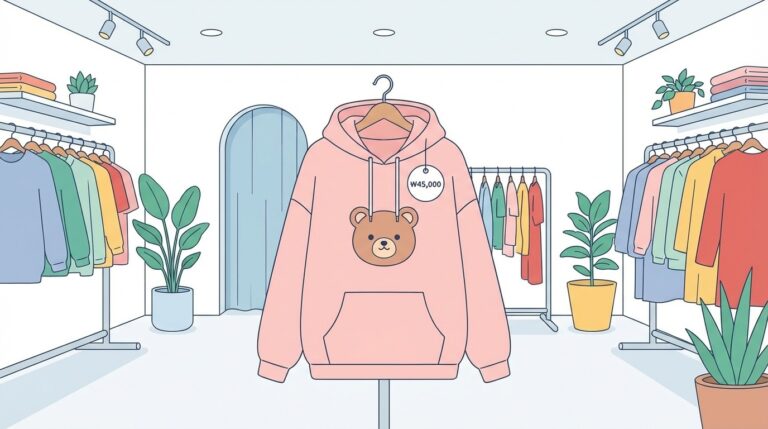
Imagine this: You are in the maze-like underground shopping mall at Gangnam Station. K-Pop hits are blasting from every store—NewJeans, IVE, BTS. To your left, you see the perfect oversized hoodie that looks exactly like something your favorite K-Drama actor wore in Start-Up.
Your heart races. You want it. But there’s no price tag.
The shop owner (we call her Sajang-nim or Imo) is looking at you. You freeze. Do you just hand over your card? Do you walk away?
Don’t panic. Asking for a price in Korea is more than just a transaction; it’s the start of a relationship. In K-Dramas, this is the moment the protagonist shows their charm. Today, I’ll teach you how to ask “How much?” without sounding like a confused tourist, so you can shop with confidence!
Phase 2: Deep Dive into Core Expressions
1. 이거 얼마예요? (How much is this?)
- Pronunciation: [I-geo eol-ma-ye-yo?]
- I-geo sounds like “Ego” without the ‘o’ stress.
- Eol sounds like “Earl” in “Earl Grey tea.”
- Ma is like “Ma” in “Mama.”
- Meaning:
- Literal: This how much is?
- Real Nuance: The universal key to shopping. It works for clothes, street food, and taxi rides.
- K-Culture Moment: Think of any scene in a variety show like Running Man where members are in a traditional market. They point and shout, “Imo! Igeo eolmayeyo?”
- Editor’s Insight: You can drop the “Igeo” (this) if you are holding the item or pointing at it. Just saying “Eolmayeyo?” is perfectly natural.
- Situation Spectrum:
[🚫 Formal Meeting] ———— [✅ Market/Store/Street] ———— [✅ Friends]
🤔 Think About It: Why is the verb “to be” (iyeyo/yeyo) so flexible in Korean? It connects the subject and the question word seamlessly. Does your language have a fixed word order for questions, or can you move words around like in Korean?
2. 좀 깎아 주세요 (Please give me a discount)
- Pronunciation: [Jom kka-kka-ju-se-yo]
- Kka-kka sounds like a crow’s sound “Caw caw,” but with a tighter throat.
- Meaning:
- Literal: Please cut (the price) a little.
- Real Nuance: “Come on, give me a deal!” This is the magic spell for markets.
- K-Culture Moment: In the drama True Beauty, high school students often shop at Dongdaemun. They use Aegyo (acting cute) while saying this phrase to save money for tteokbokki later.
- Editor’s Insight: Use this with a smile! If you say it with a straight face, it sounds rude. It’s a playful negotiation, not a demand.
- Situation Spectrum:
[🚫 Department Store/Brand Shop] ———— [⚠️ Small Boutiques] ———— [✅ Open Markets]
Phase 3: Textbook vs. Real Life
| Situation | 📖 Textbook Korean | 🗣️ Real Street Korean | 💡 Why the difference? |
|---|---|---|---|
| Asking Price | 이 옷의 가격은 얼마입니까? (I os-ui ga-gyeo-geun eol-ma-im-ni-kka?) | 이거 얼마예요? (Igeo eolmayeyo?) | The textbook version is too robotic. No one speaks like a news anchor while buying socks! |
| Thinking it’s expensive | 가격이 너무 비쌉니다. (Ga-gyeo-gi neo-mu bi-ssam-ni-da.) | 아… 좀 비싸요. (Ah… jom bissayo.) | Koreans soften the blow. “A little expensive” is more polite than “Too expensive.” |
| Just Looking | 저는 그냥 구경하고 있습니다. (Jeo-neun geu-nyang gu-gyeong-ha-go is-seum-ni-da.) | 그냥 보는 거예요~ (Geunyang boneun geoyeyo~) | Using “~yeyo” adds a softer, friendly vibe compared to the stiff “~nida.” |
Note: As an A2 learner, stick to the “Real Street Korean.” It makes you sound approachable!
Phase 4: Cultural Deep Dive — K-Culture Connection
👀 Non-verbal: The “Thinking Face”
In Korea, if a price is too high, we don’t usually say “No, I won’t buy it” immediately. That’s too direct and might hurt the owner’s feelings (remember Nunchi?). Instead, we make a “Thinking Face,” tilt our head, and say “Ah…” (slowly).
This signal tells the shop owner: “I like it, but the price is the problem.” Often, the owner will catch this signal and offer a discount before you even ask!
🎥 K-Drama Connection: The “Dongdaemun” Scene
Have you seen scenes where characters shop at Dongdaemun Night Market at 2 AM? The vibe is chaotic and energetic.
* The Trope: The rich Chaebol (heir) buys the whole store without asking the price.
* The Reality: Ordinary people (and smart tourists) compare prices at three different stalls before buying.
🧠 Critical View: Why do K-Dramas obsess over luxury brands vs. market clothes? It reflects the intense social pressure in Korea regarding appearance and status. But remember, “Fast Fashion” and “Street Fashion” in Hongdae are just as trendy!
Phase 5: Immersive Roleplay Scenario
Setting: It’s Friday night at a trendy clothing stall in Hongdae. Loud K-Pop is playing. The stall is piled high with colorful sweaters.
Characters:
* YOU: A stylish tourist looking for a souvenir.
* Imo (Auntie): The energetic shop owner (50s, wearing a visor).
🎬 Action!
Imo: 어서 오세요! 입어 보세요~
(Eoseo oseyo! Ibeo boseyo~)
“Welcome! Try it on!”
YOU: (Picking up a nice sweater)
안녕하세요. 이거 얼마예요?
(Annyeonghaseyo. Igeo eolmayeyo?)
“Hello. How much is this?”
Imo: 아, 그거 신상이에요! 5만 원!
(Ah, geugeo sinsang-iyeyo! O-man won!)
“Ah, that’s a new arrival! 50,000 won!”
🗰 Decision Point: It’s a bit pricey. What do you say?
- A) “네, 여기요.” (Okay, here you go.) – The rich tourist move.
- B) “아… 좀 비싸요… 좀 깎아 주세요!” (Ah… a bit expensive… please give me a discount!) – The brave local move.
- C) “No money.” (English) – The panic move.
✅ Best Choice: B
YOU: 아… 좀 비싸요… 좀 깎아 주세요!
(Ah… jom bissayo… jom kka-kka-ju-se-yo!)
Imo: (Laughing) 아이구, 알았어. 4만 5천 원!
(Aigu, arasseo. Sa-man o-cheon won!)
“Oh my, okay. 45,000 won!”
Phase 6: 10-Second Shadowing Drill
Let’s practice the emotion! Don’t just read it, act it.
Emotion: 😢 A little sad/disappointed (Cute begging mode)
이모~ / 이거 / 너무 / 비싸요... (Imo~ / igeo / neomu / bissayo...)
- Tip: Stretch the “mo” in Imo~ and the “sa” in bissayo to sound softer.
- Meaning: Auntie~ This is too expensive…
Phase 7: K-Culture Glossary (Shopping Edition)
| Korean | Romanization | Meaning | Context |
|---|---|---|---|
| 득템 | Deuk-tem | Great catch | Slang combining “Deuk” (gain) + “Item”. Used when you find something amazing and cheap. |
| 아이쇼핑 | Eye-shopping | Window shopping | Looking without buying. Koreans use the English word “Eye” + “Shopping.” |
| 신상 | Sinsang | New Arrival | Short for Sin-sang-pum. Shop owners love shouting this. |
| 현금 | Hyeongeum | Cash | Prices are often cheaper if you pay with this! |
Phase 8: Traveler’s Survival Kit (Shopping)
Going to Myeongdong, Dongdaemun, or Gangnam Underground? Save this card!
🆘 Shopping Survival Expressions
1. “입어 봐도 돼요?” (Ibeo bwado dwaeyo?)
* Can I try this on?
* 🚨 Warning: Many shops don’t allow trying on white clothes or T-shirts (makeup stains!).
2. “다른 색깔 있어요?” (Dareun saek-kkal isseoyo?)
* Do you have other colors?
3. “영수증 주세요.” (Yeong-su-jeung juseyo.)
* Please give me a receipt.📌 Editor’s Travel Note:
* Sizes: Korean “Free Size” is usually a Small/Medium in US/EU sizes. Don’t be surprised if it’s tight!
* Cash vs. Card: Underground malls and markets prefer Cash (Hyeongeum). They might give you a discount or “Service” (free socks) if you pay cash!
Phase 9: Think Deeper — “Jeong” in Business
Topic: Why do Koreans haggle? (Language & Culture)
In many Western countries, the price on the tag is the final price. But in Korean traditional markets, price negotiation is a form of communication. It’s connected to Jeong (정)—the feeling of connection and affection.
When an Imo gives you a discount or throws in a free pair of socks, she isn’t just losing profit; she is building a relationship with you. She wants you to leave happy and come back. However, this culture is changing. In modern Department Stores or franchises (like Olive Young), haggling is not done.
💬 Your Turn: In your country, is it rude to ask for a discount, or is it expected? Tell us in the comments!
Phase 10: FAQ & Troubleshooting
- Q: Can I use “좀 깎아 주세요” at Lotte Department Store?
- A: NO! 🙅♂️ Prices at department stores and brand shops are fixed. You will only make the clerk confused. Use it only at street stalls, underground malls, or traditional markets.
- Q: What if I don’t know Korean numbers?
- A: No problem! Most shop owners have a calculator ready. Just punch in the number you want to pay. It’s the international language of shopping.
- ❌ Common Mistake: Saying “You are expensive” instead of “It is expensive.”
- Don’t say: 당신은 비싸요 (Dangsin-eun bissayo) → You (the person) are expensive.
- Do say: 이거 비싸요 (Igeo bissayo) → This (item) is expensive.
Phase 11: Wrap-up & Action Mission
One-Liner Summary: To survive Korean shopping, smile confidently and ask “Igeo eolmayeyo?” and know when to use cash!
🏆 Your Mission:
* 🥉 Bronze: Say “Igeo eolmayeyo?” aloud 3 times while pointing at things in your room.
* 🥈 Silver: Watch a “Dongdaemun Shopping Haul” video on YouTube and listen for the word “Sinsang” (New Arrival).
* 🥇 Gold: Go to a local market (or even a Korean grocery store) and try to read the prices in Korean Won!
Phase 12: Interactive Quiz
- Situation: You are at a fancy Gucci store in Seoul. Is it okay to say “Jom kka-kka-ju-se-yo”?
- [ ] Yes, always haggle!
- [ ] No, fixed prices only.
- Fill in the Blank:
- You want to say “How much is this?”
- “_______ eolmayeyo?”
- (Hint: starts with ‘I’)
- True or False (K-Culture):
- “Eye-shopping” in Korea means buying glasses. (T/F)
Answers:
1. No (Unless you want awkward silence).
2. Igeo.
3. False (It means window shopping).
Keep practicing, and happy shopping! See you in the next lesson! 🛍️✨
Frequently Asked Questions (FAQ)
Q: What does "이거 얼마예요? (How much is this?)" mean in Korean and how do you pronounce it?
A: In Korean, "이거 얼마예요? (How much is this?)" is pronounced [I-geo eol-ma-ye-yo?] and means: a key conversational Korean expression covered in this lesson.
Q: What does "좀 깎아 주세요 (Please give me a discount)" mean in Korean and how do you pronounce it?
A: In Korean, "좀 깎아 주세요 (Please give me a discount)" is pronounced [Jom kka-kka-ju-se-yo] and means: a key conversational Korean expression covered in this lesson.







