

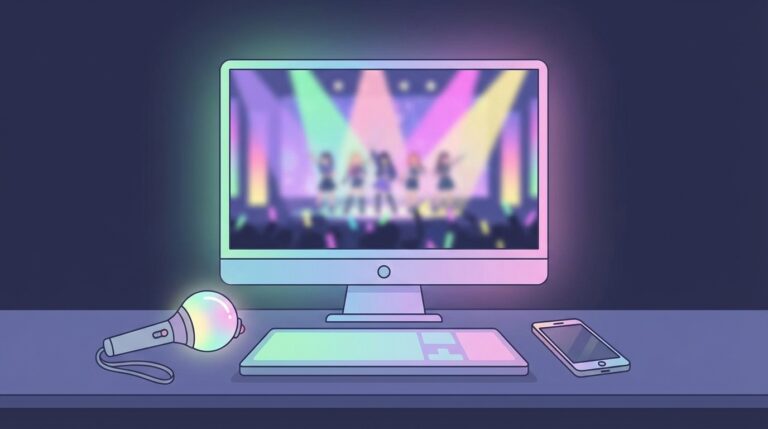
Don’t Just Watch, Protect It! The Art of “Bonbang Sasu” for K-Pop Fans
Phase 1: The Hook — Are You Ready for the Drop?
Hello! This is your Senior Editor at Daily Hangul.
Picture this: It’s 5:55 PM KST. You have three alarms set. Your laptop is open to a streaming site, your phone is refreshing Twitter, and your heart is pounding. Why? Because your favorite group (your bias group) is about to drop their first performance for their new album.
In the chatroom, a Korean fan types: “다들 본방 사수 준비 됐어?” (Dadeul bonbang sasu junbi dwaesseo?)
You know they are asking if you are ready to watch, but… Sasu? Doesn’t that sound like a military term?
If you just say “I’m watching TV,” you are missing the intense passion of K-Pop culture. Today, we are going to learn how to not just watch a performance, but how to defend the live broadcast like a true fan. This isn’t just about language; it’s about loyalty.
Phase 2: Deep Dive into Key Expressions
Here are the top 3 expressions you need to survive a Comeback Day.
1. 본방 사수 (Bonbang Sasu)
- Pronunciation: [bon-bang sa-su] (Sounds like: Bone-bang Sa-sue)
- Meaning:
- Literal: Defending/Guarding the original broadcast.
- Real Nuance: Watching a show live on TV (or stream) as it airs, to boost ratings.
- K-Culture Moment: In K-Dramas, when a famous actor has a new drama, they post on Instagram: “Today at 9 PM! Please do Bonbang Sasu!” It’s a plea for support.
- Editor’s Insight: The word 사수 (sasu) means “deadly defense” (defending to the death). It shows that for Korean fans, watching live isn’t a hobby; it’s a mission to help their idols win #1.
- Situation Spectrum:
[🚫 Formal Biz] ———— [⚠️ Semi-Formal] ———— [✅ Casual/Fandom] - 🤔 Think About It: Why do you think Korean fans use a military term like “defend” for watching TV? What does this say about the collective power of fandoms in Korea?
2. 컴백 무대 (Keombaek Mudae)
- Pronunciation: [keom-baek mu-dae] (Sounds like: Come-back Moo-day)
- Meaning: Comeback Stage / Performance.
- K-Culture Moment: Every Thursday (M Countdown), Friday (Music Bank), Saturday (Music Core), and Sunday (Inkigayo). This cycle is the heartbeat of K-Pop.
- Editor’s Insight: “Comeback” in Korea doesn’t mean returning from retirement. It just means releasing a new song/album. Even if they released a song 3 months ago, the next one is still a “comeback.”
- Situation Spectrum:
[✅ All Situations]
3. 미쳤다 (Michyeotda)
- Pronunciation: [mi-chyeot-da]
- Meaning:
- Literal: Crazy / Insane.
- Real Nuance: “This is unbelievably good!” / “Their visuals are insane!”
- K-Culture Moment: When the Ending Fairy (the member shown in close-up at the very end) winks, the entire comment section explodes with “와 미쳤다…” (Wa, michyeotda…)
- Editor’s Insight: This is the most common reaction. Use it when words fail you.
- Situation Spectrum:
[🚫 Boss/Elders] ———— [⚠️ Close Colleagues] ———— [✅ Friends/Internet]
Phase 3: Textbook Korean vs. Real Fandom Korean
| Situation | 📖 Textbook Korean | 🗣️ Real Fandom Korean | 💡 Why the difference? |
|---|---|---|---|
| Promising to watch live | 저는 생방송을 볼 거예요. (I will watch the live broadcast.) |
무조건 본방 사수지! (Unconditionally defending the live broadcast!) |
Shows passion and commitment to the group’s success. |
| Praising the performance | 공연이 정말 훌륭했어요. (The performance was excellent.) |
와, 무대 찢었다. (Wow, they tore the stage apart.) |
“Tore the stage” (찢었다) is slang for a powerful performance. |
| Asking when it starts | 언제 시작해요? (When does it start?) |
몇 시 방송이야? (What time is the broadcast?) |
Fans value efficiency; they need the exact time immediately. |
Bottom Note: If you use “생방송을 봅니다” on Twitter, people will know you are a foreigner or a very polite muggle (non-fan). Use 본방 사수 to blend in!
Phase 4: Cultural Context — The “Nunchi” of Music Shows
4-1. The Art of Timing
Watching a comeback stage isn’t solitary; it’s a synchronized event. You need Nunchi (eye-measure).
– Don’t just watch; Stream. Korean fans often run the broadcast on TV while streaming the song on a music app (Melon, Genie) on their phone.
– The Chatroom Vibe: During the broadcast, the chat moves at light speed. If the idols make a mistake, Nunchi dictates you ignore it or say “They are cute!” Do not criticize the vocals during a comeback celebration party!
4-2. Connection: K-Pop Music Shows
Did you know? The “Comeback Stage” is a trope in K-Dramas about idols (like Imitation or Lovely Runner). The nervousness backstage, the red light on the camera, and the Ending Fairy pose are iconic.
– Critical View: Idols speak in a very specific “Idol Tone” (higher pitch, overly energetic) on these shows. It’s different from how they talk in casual Vlogs. Be careful not to copy the “MC tone” in real life!
Phase 5: Immersive Roleplay — The Waiting Room Chat
Setting: Friday, 4:55 PM. You are in a KakaoTalk group chat with your Korean friend, Minji (24, hardcore fan). The show Music Bank starts in 5 minutes.
Characters:
– YOU: An international fan who wants to support the group.
– Minji: Your K-Pop mentor.
(💬 Chat Notification Sounds)
Minji: 야! 5분 남았어. 준비됐지? 🔥
(Ya! 5-bun namasseo. Junbidwaetji?)
(Hey! 5 minutes left. You ready, right?)
YOU: (Typing…) 당연하죠! 오늘 컴백 무대 기대돼요.
(Dangyeonhajo! Oneul keombaek mudae gidaedwaeyo.)
(Of course! I’m looking forward to today’s comeback stage.)
Minji: 이번 의상 진짜 예쁘대. 우리 꼭 본방 사수해야 돼.
(Ibeon uisang jinjja yeppeudae. Uri kkok bonbang sasuhaeya dwae.)
(They say the outfits are really pretty this time. We must defend the live broadcast.)
🔀 Decision Point! How do you respond to show your enthusiasm?
Option A: “네, 알겠어요. 텔레비전을 켤게요.” (Okay, I understand. I will turn on the TV.)
Option B: “무조건이죠! 치킨도 시켰어요.” (Unconditionally! I even ordered chicken.)
Option C: “응, 안 봐.” (No, I won’t watch.)
✅ Best Choice: Option B.
– Why? “무조건” (Unconditionally) matches Minji’s energy. Ordering food (Chicken/Snacks) is a common way to enjoy Bonbang Sasu.
– Critique on A: Too formal and robotic. Sounds like you are talking to a boss.
– Critique on C: Immediate friendship breakup!
(Roleplay Continues with Option B)
Minji: 대박 ㅋㅋㅋ 나도! 야, 나왔다! 시작한다!!
(Daebak kekeke Nado! Ya, nawatda! Sijakhanda!!)
(Awesome lol Me too! Hey, they’re out! It’s starting!!)
(🎭 Stage Direction: The intro music starts playing on the screen)
YOU: 와… 비주얼 미쳤다…
(Wa… bijueol michyeotda…)
(Wow… the visuals are crazy…)
Phase 6: 10-Second Shadowing Drill
Let’s practice the sentence you will tweet or say to your friend right before the show starts.
Emotion: 😤 Determined & Excited (Like you are about to win a game)
오늘 밤은 / 무조건 / 본방 사수!
(o-neul ba-meun / mu-jo-kkeon / bon-bang sa-su!)
Tonight / unconditionally / I watch the live broadcast!
💡 Tips:
– Stress the “mu-jo-kkeon” (unconditionally) to sound emphatic.
– “Bon-bang” is spoken quickly, “Sa-su” is spoken firmly.
Phase 7: K-Culture Mini Glossary
| Korean | Romanization | English | Context |
|---|---|---|---|
| 최애 | Choe-ae | Ultimate Bias | Your #1 favorite member/group. (Lit: Most Loved) |
| 입덕 | Ip-deok | Joining the fandom | The moment you become a fan. |
| 엔딩 요정 | Ending Yojeong | Ending Fairy | The member who gets the final close-up shot and poses. |
| 스밍 | Seuming | Streaming | Playing songs on loop to help chart rankings. |
| 떼창 | Ttechang | Sing-along | Fans singing loudly together during the chorus. |
Phase 8: Traveler’s Survival Kit (Fandom Edition)
If you are visiting Korea to see a Comeback Stage (e.g., at SBS Prism Tower or CJ ENM Center), you need these survival phrases.
🆘 Survival Expression #1: Finding the Line
– 🇰🇷 “여기가 줄이에요?” (Yeogiga jurieyo?)
– 🗣️ Sound-alike: [Yuh-gi-ga Jool-e-eh-yo?]
– Meaning: Is this the line/queue?
– Context: Music show lines are chaotic. Always ask before standing.🆘 Survival Expression #2: WiFi (Vital for international fans)
– 🇰🇷 “와이파이 비밀번호 좀 알려주세요.” (Waipai bimilbeonho jom allyeojuseyo.)
– Meaning: Please let me know the WiFi password.
– Pro Tip: PC Bangs (Internet Cafes) are the best places to do ticketing or streaming if you don’t have a ticket to the live show.📌 Editor’s Travel Note
– Music Show Admission: It is extremely competitive. Most shows require you to bring the physical album and an official lightstick to get in. Without these, you might be denied entry even if you won the raffle!
Phase 9: Think Deeper — “Why so serious?”
Topic: Language & Collective Action
Have you noticed that K-Pop fandom language is very militant?
– Sasu (Deadly defense)
– Ttechang (Crowd singing/chanting)
– Chong-gong (Total offensive/mass action)
🧠 Think Deeper:
This reflects the unique “Jeong” (bonding) culture of Korea, combined with a highly competitive society. Fans feel a sense of responsibility for their idol’s success. It’s not just entertainment; it’s a team sport where fans are the players.💬 Your Turn: Does your country’s music culture have organized fan activities? Or is it more individualistic? How would you say “Bonbang Sasu” in your language?
Phase 10: FAQ & Troubleshooting
Q: Can I say “본방 사수하세요” (Please do Bonbang Sasu) to my boss?
A: No! Unless your boss is a fellow K-Pop fan and you are very close. It’s a bit casual and demanding. To a superior, just say “방송을 꼭 시청하겠습니다” (I will definitely watch the broadcast).
Q: Can I use “미쳤다” (Crazy) to an idol at a fan signing?
A: Yes! If you say “오빠, 얼굴 미쳤어요!” (Oppa, your face/visuals are crazy!), they will take it as a huge compliment. But avoid using it with older people or in formal settings.
❌ Common Mistake #1
– Mistake: Saying “Comeback” (컴백) when you just mean “returning home.”
– Fix: In Korean, “Comeback” is almost exclusively used for artists releasing new material. For returning home, use “돌아오다” (doraoda).
Phase 11: Wrap-up & Action Items
Summary: Today we learned that watching a K-Pop stage live is not just viewing—it’s Bonbang Sasu (defending the broadcast)!
🚀 Action Missions:
– 🥉 Bronze (Solo): Look in the mirror and practice your “Ending Fairy” pose while saying “오늘 무대 찢었다!”
– 🥈 Silver (Online): Go to your favorite group’s latest MV on YouTube and comment in Korean: “이번 컴백 무대 본방 사수 할게요!” (I will watch this comeback stage live!)
– 🥇 Gold (Real World): The next time a K-Drama or Show airs, post a photo of your screen on Instagram Stories with the hashtag #본방사수.
Phase 12: Quiz — Are You a True Fan?
1. Which phrase is the MOST appropriate reaction when your bias performs an amazing dance break?
– A) 안녕하시렵니까? (How are you?)
– B) 무대 찢었다! (Tore the stage!)
– C) 식사하셨어요? (Have you eaten?)
2. True or False?
– “Bonbang Sasu” is a term originally used by the military to mean guarding a post. ( T / F )
3. Situation Check:
– Your Korean friend asks: “Do you want to watch Music Bank together?”
– You want to sound like a local. How do you answer?
– A) “Yes, I desire to view the television.”
– B) “Ok, let’s do Bonbang Sasu!”
Answers:
1. B (A is a greeting, C is polite small talk).
2. True (It was adapted from military/police terms to TV culture).
3. B (This is the natural way!).
Frequently Asked Questions (FAQ)
Q: What does "본방 사수 (Bonbang Sasu)" mean in Korean and how do you pronounce it?
A: In Korean, "본방 사수 (Bonbang Sasu)" is pronounced [bon-bang sa-su] and means: Literal: Defending/Guarding the original broadcast.
Q: What does "컴백 무대 (Keombaek Mudae)" mean in Korean and how do you pronounce it?
A: In Korean, "컴백 무대 (Keombaek Mudae)" is pronounced [keom-baek mu-dae] and means: Comeback Stage / Performance.
Q: What does "미쳤다 (Michyeotda)" mean in Korean and how do you pronounce it?
A: In Korean, "미쳤다 (Michyeotda)" is pronounced [mi-chyeot-da] and means: Literal: Crazy / Insane.







