

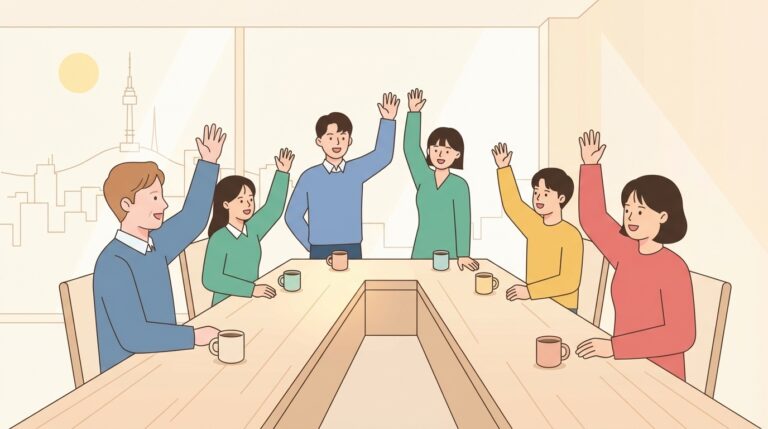
How to Be the Boss Everyone Loves in Korea: Mastering Office Leadership & Team Morale 💼
Hello! I’m the lead editor of Daily Hangul.
Picture this: It’s 10 PM in a high-rise office building in Yeouido. The team has been running on iced Americanos and sheer willpower for a week to prepare for a major pitch. The tension is palpable. In a K-Drama like Misaeng (Incomplete Life) or My Mister, this is the exact moment the team leader steps up. Do they just say “Good job” and leave? No. They say a specific phrase, maybe tap someone on the shoulder, or suggest something that instantly melts the exhaustion away.
At the C1 level, you aren’t just memorizing vocabulary to survive; you are actively leading, collaborating, and shaping the atmosphere in a Korean professional setting. Navigating 조직 몰입도 (Organizational Commitment) in Korea isn’t about rigid corporate seminars; it’s about mastering the delicate art of Jeong (정, emotional connection), Nunchi (눈치, reading the room), and understanding the massive generational shift between the traditional ‘Kkondae’ (꼰대) management style and the modern MZ generation workforce.
Let’s dive into the real, unspoken language of Korean leadership.
🔍 Phase 2: Deep Dive into Leadership Expressions
Here are the top phrases that separate a ‘boss’ from a ‘leader’ in Korea.
1. “이번 프로젝트, 다들 고생 많으셨습니다.”
- Pronunciation: [ibeon peurojekteu, dadeul gosaeng maneusyeotseumnida]
- Sound-alike guide: ‘Go-sang’ sounds like a long drawn-out ‘sang’, and ‘man-eu’ flows smoothly like ‘ma-noo’.
- Meaning: (Literal) Everyone, you have suffered a lot for this project. / (Real nuance) I deeply acknowledge your hard work and the sacrifices you made for this project.
- K-Culture Moment: The project is finally submitted. The team leader stands up, looks around the exhausted room, and says this with a warm, empathetic tone. It’s the ultimate validation.
- Editor’s Insight: This isn’t just “good job.” The word 고생 (hardship/suffering) is key here. Korean culture highly values the effort and sweat put into something, sometimes even more than the result. Acknowledging their ‘suffering’ builds immense loyalty.
- Situation Spectrum:
[🚫 절대 금지] ———— [⚠️ 주의] ———— [✅ 자유롭게]
- Close Coworkers/Subordinates: ✅
- Casual (Dropping the honorifics -> 고생했어!): ✅
- To your CEO/Top Boss: 🚫 (See FAQ!)
- 🤔 Think About It: Why does the Korean workplace emphasize acknowledging “hardship” rather than just celebrating “success”? Does your native language have a phrase that validates someone’s physical or mental exhaustion after a task?
2. “편하게 의견 내주세요. 정답은 없습니다.”
- Pronunciation: [pyeonhage uigyeon naejuseyo. jeongdabeun eopseumnida.]
- Sound-alike guide: ‘Pyeon-ha-ge’ sounds like ‘pyeon’ (rhymes with yawn) + ‘ha’ + ‘ge’ (get without the t).
- Meaning: (Literal) Please give your opinions comfortably. There is no correct answer. / (Real nuance) I want an open discussion, and I won’t judge your ideas.
- K-Culture Moment: A brainstorming session in a modern tech startup in Pangyo. The leader wants to break the traditional top-down hierarchy where junior staff are afraid to speak up.
- Editor’s Insight: Korean junior employees are often culturally conditioned to listen and follow (Nunchi). If you want real engagement, you have to actively and repeatedly give them permission to speak freely. Adding “정답은 없습니다” lowers the stakes and reduces the fear of making a mistake.
- Situation Spectrum:
[🚫 절대 금지] ———— [⚠️ 주의] ———— [✅ 자유롭게]
- Leading a team meeting: ✅
- Talking to your boss: ⚠️ (Better: “이 부분에 대해 어떻게 생각하시는지 고견을 듣고 싶습니다”)
3. “우리가 또 해내지 않았습니까!”
- Pronunciation: [uriga tto haenaeji anatsseumnikka!]
- Sound-alike guide: ‘Uri-ga’ (oo-ree-gah). Emphasize the ‘tto’ (double consonant, tight ‘t’ sound).
- Meaning: (Literal) Didn’t we pull it off again! / (Real nuance) We did it! Look at what our teamwork accomplished!
- K-Culture Moment: The team dinner (회식) after a successful sales quarter. The team lead raises a glass of Soju and shouts this before everyone cheers.
- Editor’s Insight: The magic word here is 우리 (We). Korean teams thrive on collective identity. By saying “We did it” instead of “You did well” or “I led well,” you cement the organizational commitment.
- Situation Spectrum:
[🚫 절대 금지] ———— [⚠️ 주의] ———— [✅ 자유롭게]
- Team celebrations: ✅
- Formal board meetings: ⚠️
📖 Phase 3: Textbook vs Real Life
To truly engage a Korean team, you need to sound like a native insider, not a textbook.
| 상황 (Situation) | 📖 교과서 한국어 (Textbook) | 🗣️ 진짜 한국어 (Real Korean) | 💡 왜 다를까? (Why the difference?) |
|---|---|---|---|
| Motivating the team | 열심히 일합시다. (Let’s work hard.) | 으쌰으쌰 해봅시다! 또는 가보자고! (Let’s hype it up! / Let’s go!) | “열심히” sounds like an order from the 1980s. “가보자고” is MZ generation slang that brings energetic, modern vibes. |
| Disagreeing gently | 제 생각은 다릅니다. (My thought is different.) | 아, 그 부분도 좋은데, 제 생각에는… (Ah, that part is good too, but I think…) | Preserving harmony. Direct disagreement can damage the other person’s Kibun (mood/face). |
| Team bonding | 오늘 회식에 참석하세요. (Attend the company dinner today.) | 오늘 가볍게 저녁이나 같이 할까요? (Shall we grab a light dinner together tonight?) | Modern employees value work-life balance. Framing it as a “light dinner” removes the heavy pressure of a forced traditional Hoesik. |
Bottom Note for C1 Learners: You don’t need to use heavy slang to be a good leader, but using expressions like “으쌰으쌰” shows you understand the emotional rhythm of the Korean workplace.
🧠 Phase 4: Cultural Deep Dive
4-1. Non-verbal Communication: The Art of the “Active Nod”
In a Western context, maintaining strong, unbroken eye contact shows confidence and engagement. In a Korean office, glaring into a junior employee’s eyes while they speak can feel intimidating. Instead, practice the ‘Listening Nod’. Look at their eyes, then their nose, and give a gentle, slow nod accompanied by a soft “네…” (Yes…) or “아…” (Ah…). This non-verbal cue signals psychological safety, which is the bedrock of organizational commitment.
4-2. K-Culture Connection: The Evolution of the “Hoesik” (회식)
If you’ve watched any office K-Drama, you know the Hoesik (company dinner) scene. Historically, this was where organizational commitment was forged—over endless rounds of Soju and pork belly. It was the “We are one” (우리가 남이가) mentality.
However, the reality has shifted dramatically. The MZ generation (Millennials and Gen Z) often views mandatory after-hours drinking as an extension of unpaid labor.
Modern Leadership Tip: Today’s “cool” leaders boost morale by replacing night-time drinking with a “점심 회식” (Lunch Hoesik at a nice restaurant) or buying high-quality coffee for the team during the afternoon slump using the ‘Bob-ka’ (법카 – Corporate Card). Saying, “오늘 커피는 제가 쏩니다!” (I’m treating everyone to coffee today!) is a surefire way to boost afternoon engagement.
🎭 Phase 5: Immersive Roleplay Scenario
Setting: Friday, 4:30 PM. The team just finished a grueling one-month project. You are the Team Lead (팀장). The office is quiet, and everyone looks completely drained. You need to boost morale and wrap up the week on a high note.
Characters:
– YOU (독자): The foreign Team Lead who wants to build a strong, modern team culture.
– Min-ji (28): MZ generation junior designer. Brilliant but currently running on fumes.
– Manager Kim (40): Traditional, hard-working middle manager.
Dialogue:
YOU: 다들 이번 주 정말 고생 많으셨습니다. 프로젝트가 무사히 끝났네요. 😊
(dadeul ibeon ju jeongmal gosaeng maneusyeotseumnida. peurojekteuga musahi kkeunnatneyo.)
[Everyone, you really worked hard this week. The project has wrapped up safely.]
Manager Kim: 팀장님도 고생하셨습니다. 주말에 푹 쉬셔야 할 텐데요.
(timjangnimdo gosaenghasyeotseumnida. jumare puk swisyeoya hal tendeyo.)
[You worked hard too, Team Lead. You should rest well this weekend.]
Min-ji: (Stretching her arms) 아… 드디어 끝났네요. 영혼이 나간 것 같아요.
(a… deudieo kkeunnatneyo. yeonghoni nagan geot gatayo.)
[Ah… it’s finally over. I feel like my soul has left my body.]
YOU: 민지 씨, 이번에 디자인 디테일 잡느라 야근 많이 했잖아요. 최고였어요.
(minji ssi, ibeone dijain diteil jamneura yageun mani haetjanayo. choegoyeosseoyo.)
[Min-ji, you worked a lot of overtime catching those design details. It was the best.]
Min-ji: (Smiling brightly) 앗, 감사합니다 팀장님! 알아주셔서 감동이에요.
(at, gamsahamnida timjangnim! arajusyeoseo gamdongieyo.)
[Ah, thank you, Team Lead! I’m touched that you noticed.]
Manager Kim: 자, 프로젝트도 끝났는데… 팀장님, 오늘 저녁에 삼겹살에 소주 한잔 어떠십니까? 제가 식당 예약하겠습니다!
(ja, peurojekteudo kkeutnatneunde… timjangnim, oneul jeonyeoge samgyeopsare soju hanjan eotteosimnikka? jaega sikdang yeyakhagetseumnida!)
[Well, the project is over… Team Lead, how about pork belly and Soju tonight? I’ll book a restaurant!]
(🎭 Stage Direction: Min-ji’s smile subtly freezes. She clearly wants to go home, but she is reading the room – Nunchi)
🔀 당신의 차례! 어떻게 대답할까요? (Your Turn!)
– A) “좋습니다! 오늘 제가 쏘겠습니다. 다들 갑시다!” (Great! I’m treating tonight. Let’s all go!)
– B) “아유, 김 과장님. 다들 피곤한데 오늘은 일찍 퇴근합시다. 회식은 다음 주 점심에 맛있는 거 먹으러 가죠!”
– C) “저는 피곤해서 먼저 가보겠습니다. 두 분이서 드세요.”✅ Best Choice: B — You acknowledge Manager Kim’s enthusiasm but protect Min-ji’s work-life balance. Proposing a “lunch Hoesik” next week satisfies both the traditional desire for team bonding and the modern desire for personal time. This is C1-level leadership!
⚠️ Choice A & C Analysis: ‘A’ is the classic Kkondae move that kills MZ morale. ‘C’ is too individualistic and destroys the “Uri” (We) vibe.
🗣️ Phase 6: 10-Second Shadowing Drill
Practice this sentence to sound like an empathetic, seasoned Korean team leader. Pay attention to the pauses (/) and the emotional tags.
😊 이번 프로젝트는 / 여러분 덕분에 / 무사히 끝났습니다. / 🥺 정말 / 고생 많으셨습니다.
(ibeon peurojekteuneun / yeoreobun deokbune / musahi kkeunnatseumnida. / jeongmal / gosaeng maneusyeotseumnida.)
Tip: Elongate the “정~말” (jeong~mal) slightly to show genuine sincerity.
📖 Phase 7: K-Culture Glossary (Business Edition)
| 한국어 (Korean) | Romanization | Meaning | Context & Culture |
|---|---|---|---|
| 눈치 | nunchi | Situational awareness / Reading the room | The core social sense in Korea. A good leader has “눈치가 빠르다” (quick Nunchi) to notice when employees are burnt out. |
| 회식 | hoesik | Company dinner | Traditionally mandatory drinking sessions; now evolving into lunch gatherings or cultural outings. |
| 워라밸 | worabae-l | Work-life balance | A portmanteau of Work-Life-Balance. Crucial for the MZ generation’s job satisfaction. |
| 꼰대 | kkondae | Condescending older person/boss | Someone who forces old-school values on younger staff. Avoid being this at all costs! |
| 소속감 | sosokgam | Sense of belonging | The ultimate goal of team-building in Korea. Fostering the feeling of “We.” |
🧳 Phase 8: Traveler’s Survival Kit (Corporate Visitor Edition)
Even if you aren’t leading a team full-time in Seoul, visiting a Korean office for a business trip requires a survival toolkit to build immediate rapport.
🆘 Survival Phrases for the Korean Office
– 🇰🇷 “잘 부탁드립니다.” (jal butakdeurimnida)
– 🗣️ Meaning: I look forward to working with you. (Literally: Please take good care of me).
– 📍 When to use: First introductions, before starting a meeting, or joining a new project team.
- 🇰🇷 “명함 한 장 주시겠습니까?” (myeongham han jang jusigetseumnikka?)
- 🗣️ Meaning: Could I please have a business card?
- 📍 When to use: Sitting down at the conference table.
📌 Editor’s Travel/Business Note
– The Business Card Ritual: In Korea, the exchange of business cards (명함) is sacred. Always present and receive it with both hands. Take a moment to read the title and name before putting it carefully on the table in front of you. Never shove it directly into your back pocket!
🌌 Phase 9: Think Deeper — “Language & Power”
🧠 Think Deeper: Titles as a Tool of Belonging
In English, you might call your coworker “Sarah” or your boss “David.” In Korea, using someone’s first name in a professional setting without their title is a massive faux pas. Korean language relies heavily on titles (과장님 – Manager, 팀장님 – Team Lead, 프로님 – Professional).At first glance, this seems strictly hierarchical and distant. However, functionally, these titles grant a clear Sense of Belonging (소속감). By calling someone “Manager Kim” instead of just “Kim,” you are constantly validating their hard-earned place within the organization. Recently, companies like Samsung and Kakao have tried flattening the hierarchy by having everyone call each other “~님” (Nim) or English names, sparking a massive debate between preserving the warmth of traditional roles versus pursuing Silicon Valley-style horizontal communication.
💬 Your Turn: Does your culture use titles in the workplace, or is it strictly first-name basis? Do you think calling a boss by their first name naturally makes the culture more innovative? Share your thoughts in the comments!
🛠️ Phase 10: FAQ & Troubleshooting
Foreign professionals often make critical mistakes when trying to show empathy in Korean. Let’s fix them.
Q: Can I say “수고하셨습니다” (You worked hard) to my boss or CEO?
A: 🚫 NO! This is one of the most common pitfalls. While “수고하셨습니다” is great for peers and subordinates, saying it to a superior sounds like you are evaluating their work.
✅ Instead say: “감사합니다” (Thank you) or “고생 많으셨습니다” (You went through a lot of trouble/hardship – acceptable to immediate superiors if you have a good bond, but still use with caution).
Q: How do I say “You” when praising a specific team member?
A: 🚫 Never use “당신” (Dangsin) or “너” (Neo) in the office.
✅ Instead say: Their Name + Title (e.g., “민지 대리님” – Assistant Manager Min-ji) or just Name + 님 (e.g., “민지 님”).
❌ Common Mistake #1: Trying to be the “cool boss” by immediately using Banmal (반말 – informal language) with junior staff to show closeness.
✅ Do this instead: Keep using 존댓말 (honorifics). Modern Korean professionals respect leaders who maintain polite language, as it shows mutual respect regardless of age or rank.
🎯 Phase 11: Wrap-up & Action Items
One-Liner Summary: True organizational commitment in Korea isn’t built on rigid authority, but on empathetic communication, acknowledging hard work, and fostering a strong “Uri” (We) mentality.
Action Mission:
– 🥉 Bronze (Solo): Stand in front of a mirror and practice saying “다들 고생 많으셨습니다” with a warm, empathetic smile 3 times.
– 🥈 Silver (Online): Leave a comment below using “~님, 고생 많으셨습니다” to thank someone who helped you recently.
– 🥇 Gold (Real Life): Next time you finish a group project, a language exchange session, or a meeting with Korean colleagues, use the phrase “우리가 해냈네요!” (We did it!).
🎬 K-Culture Mission: Watch episode 1 of the K-Drama Start-Up or Misaeng. Pay close attention to the team dinners or late-night office scenes. Can you spot when the characters use “고생하셨습니다” or the corporate card (법카) to boost morale?
📝 Phase 12: Interactive Challenge (Quiz)
Test your Korean corporate survival skills!
1. Situational Judgment: Your team has been working on a pitch until 11 PM. You are the leader. Everyone is packing their bags to leave. What is the BEST phrase to shout out?
– A) “내일 일찍 오세요!” (Come early tomorrow!)
– B) “다들 고생 많으셨습니다. 조심히 들어가세요.”
– C) “수고해라!”
2. True or False – K-Culture Edition:
“To show that you are a modern, approachable leader, you should insist on calling your Korean subordinates ‘너’ (You) and use informal language immediately.”
– True or False?
(Toggle for Answers)
Answers:
1. B is perfect. It acknowledges their hard work and warmly sends them off. (A is a nightmare, C is condescending).
2. False! Maintaining polite honorifics (존댓말) even with subordinates is the hallmark of a respectful, modern leader in Korea.
Editor’s closing thought: Leadership in any language is about making people feel seen. In Korean, you now have the exact words to do just that. 파이팅! (Fighting!) 💪
Frequently Asked Questions (FAQ)
Q: What does ""이번 프로젝트, 다들 고생 많으셨습니다."" mean in Korean and how do you pronounce it?
A: In Korean, ""이번 프로젝트, 다들 고생 많으셨습니다."" is pronounced [ibeon peurojekteu, dadeul gosaeng maneusyeotseumnida] and means: (Literal) Everyone, you have suffered a lot for this project. / (Real nuance) I deeply acknowledge your hard work and the sacrifices you made for this project.
Q: What does ""편하게 의견 내주세요. 정답은 없습니다."" mean in Korean and how do you pronounce it?
A: In Korean, ""편하게 의견 내주세요. 정답은 없습니다."" is pronounced [pyeonhage uigyeon naejuseyo. jeongdabeun eopseumnida.] and means: (Literal) Please give your opinions comfortably. There is no correct answer. / (Real nuance) I want an open discussion, and I won't judge your ideas.
Q: What does ""우리가 또 해내지 않았습니까!"" mean in Korean and how do you pronounce it?
A: In Korean, ""우리가 또 해내지 않았습니까!"" is pronounced [uriga tto haenaeji anatsseumnikka!] and means: (Literal) Didn't we pull it off again! / (Real nuance) We did it! Look at what our teamwork accomplished!







