

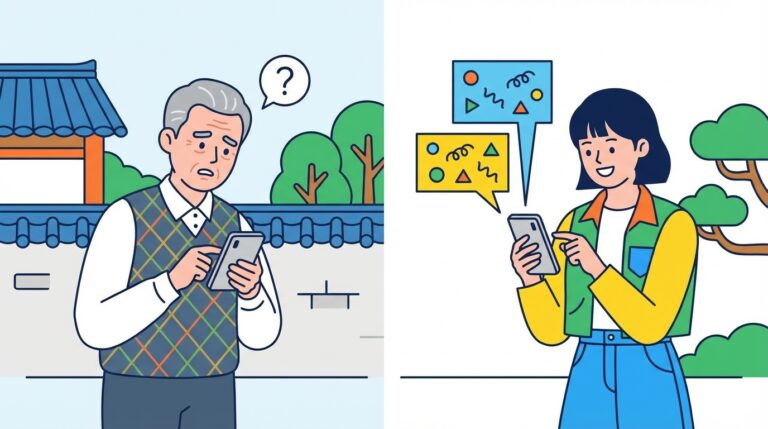
Phase 1: The Immersive Hook
Hello, learners! I’m your Daily Hangul Editor.
Picture this: You are watching a popular Korean variety show like Earth Arcade or Running Man. The PD suddenly shouts, “Time for the Neologism Quiz!” The older cast members start sweating, their eyes darting around in panic, while the younger Gen Z members laugh with absolute confidence. The screen flashes a three-letter word, and the older actors yell out hilarious, completely wrong guesses.
Or maybe you’re scrolling through your favorite K-Pop idol’s Weverse or Instagram comments, and despite knowing intermediate Korean, you feel completely lost. The dictionary is no help. Why? Because you’ve just hit the Korean Generation Gap (세대 차이)—specifically, the wild world of Neologisms and Abbreviations (신조어/줄임말).
In Korea, the language evolves at the speed of light. Knowing standard grammar is fantastic, but if you want to truly connect with native speakers, understand K-Drama humor, or leave a witty comment for your bias, you need to understand how and why Koreans shorten everything.
This guide is based on real moments my students experienced—from looking confused at a cafe to accidentally using slang with a strict boss. Let’s dive into the real, unfiltered Korean!
Phase 2: Deep Dive into Core Expressions
Let’s break down the trendiest expressions that act as a litmus test for the generation gap in Korea.
1. 완내스 (wan-nae-seu)
- Pronunciation: [wan-nae-seu] Sounds like ‘wan-ness’ (like the end of ‘wellness’)
- Meaning:
- Literal: Completely my style. (완전 내 스타일)
- Real Nuance: “This is exactly what I like!” / “Right up my alley!”
- K-Culture Moment: You walk into a beautifully decorated Hanok cafe in Bukchon. Your Korean friend snaps a photo of the interior and says, “와, 여기 진짜 완내스!” (Wow, this place is totally my vibe!)
- Editor’s Insight: This is highly positive and casually enthusiastic. It’s the ultimate compliment for music, fashion, cafes, or even a person’s personality.
- Situation Spectrum:
[🚫 절대 금지] ———— [⚠️ 주의] ———— [✅ 자유롭게]
- Friends (Casual): ✅
- Coworkers (Semi-formal): ⚠️ (Okay with close colleagues of the same age)
- Boss/Elders (Formal): 🚫
- 🤔 Think About It: Koreans love to abbreviate four-syllable or longer phrases into tight three-syllable blocks (완.내.스). How does your native language shorten phrases to express excitement?
2. 폼 미쳤다 (pom mi-chyeot-da)
- Pronunciation: [pom mi-chyot-da] ‘pom’ sounds like ‘pom-pom’, ‘mi-chyeot-da’ sounds like a sharp sneeze ‘me-chut-da’
- Meaning:
- Literal: The form is crazy.
- Real Nuance: “You/They tore that up!” / “Absolutely killing it!” / “Peak performance!”
- K-Culture Moment: During a World Cup match, Son Heung-min scores a spectacular goal. The entire pub erupts, and someone yells, “손흥민 오늘 폼 미쳤다!” You can also see this everywhere in K-Pop live stream comments after a flawless high note.
- Editor’s Insight: ‘Form’ here comes from sports, referring to a player’s physical condition. But now, Gen Z uses it for anything—even if someone just told a really funny joke or dressed well.
- Situation Spectrum:
[🚫 절대 금지] ———— [⚠️ 주의] ———— [✅ 자유롭게]
- Friends (Casual): ✅
- Coworkers (Semi-formal): ⚠️
- Boss/Elders (Formal): 🚫
- 🤔 Think About It: Why do you think sports terminology seamlessly transitions into everyday slang in modern societies?
3. 킹받네 (king-bat-ne)
- Pronunciation: [king-bat-ne] ‘king’ (English) + ‘bat-ne’ (sounds like ‘bot-neh’)
- Meaning:
- Literal: Getting king-angry. (King + 열받네)
- Real Nuance: “This is so annoying (but kind of funny).” / “I’m jokingly pissed off.”
- K-Culture Moment: Your friend keeps using a terrible pun (아재개그 – dad joke) over and over. You roll your eyes, laugh a little, and sigh, “아, 진짜 킹받네.”
- Editor’s Insight: It replaces the standard “열받네” (I’m annoyed/angry) but adds a layer of internet irony. You wouldn’t use this if you were genuinely furious. It’s for mild, often humorous annoyance.
- Situation Spectrum:
[🚫 절대 금지] ———— [⚠️ 주의] ———— [✅ 자유롭게]
- Friends (Casual): ✅
- Coworkers (Semi-formal): 🚫 (Too informal and internet-slangy)
- Boss/Elders (Formal): 🚫
- 🤔 Think About It: The use of English prefixes like ‘King-‘ or ‘God-‘ (갓) to emphasize Korean words is very common now. Is code-switching common in your internet culture?
Phase 3: Textbook vs Real Life
When standard Korean meets the fast-paced Korean internet, things change dramatically.
| Situation | 📖 Textbook Korean | 🗣️ Real Korean (Slang/Abbreviations) | 💡 Why the difference? |
|---|---|---|---|
| Agreeing | 네, 맞아요. (Yes, that’s right.) | 완전 인정 (Totally agree) or ㅇㅈ | Faster typing on mobile; ㅇㅈ is just the initial consonants of 인정. |
| Laughing | 하하하. 재미있네요. (Haha. It’s funny.) | ㅋㅋㅋㅋㅋ 꿀잼 (Honey-fun) | ‘꿀’ (honey) is used as a prefix meaning ‘very/awesome’. |
| Ordering Food | 아이스 아메리카노 한 잔 주세요. | 아아 한 잔이요. | Efficiency! “Ah-Ah” has become universally accepted, even by elders. |
| Complimenting | 정말 훌륭합니다! (Truly excellent!) | 찢었다! (Tore it!) / 폼 미쳤다 | Slang relies heavily on vivid, exaggerated imagery to express emotion. |
Bottom Note: For B2 learners, using abbreviations like ‘아아’ (Ah-Ah) or saying ‘완내스’ to a friend shows high cultural fluency. But avoid overusing extreme internet slang in real life, or you might sound like a walking meme!
Phase 4: Cultural Deep Dive
4-1. Non-verbal Communication: The Art of Nuance
When using slang like “킹받네” (so annoying), your facial expression does 80% of the work. If you look genuinely furious, people will panic. You need to employ Nunchi (눈치)—read the room! Keep a slight smirk or an exasperated laugh. Also, when texting Gen Z slang, punctuation is often dropped. A period at the end of a slang text (e.g., “완내스.”) actually feels cold and passive-aggressive!
4-2. K-Culture Connection: K-Pop & The Weverse Universe
If you are a K-Pop fan, you’ve probably seen idols doing “Neologism Tests” during fan meetings. Fans love testing their idols to see if they are trendy (인싸 – Insider) or out of touch (아싸 – Outsider).
Idols frequently use words like “폼 미쳤다” on live broadcasts to praise fans or fellow members. It breaks down the formal barrier of broadcast Korean, making the idol feel like a close friend.
Critical View: However, there’s a strict boundary. An idol might say “폼 미쳤다” to fans, but they will instantly switch to highly polite, formal Korean (존댓말) when addressing a senior artist or speaking at an award show. The ability to switch between trendy slang and perfectly polite Korean is the true mark of fluency.
Phase 5: Immersive Roleplay Scenario
Scenario A: The Company Dinner (회식)
Setting: Friday night, 7 PM. A smoky Samgyeopsal (pork belly) restaurant in Gangnam. Green soju bottles line the table. You are sitting with your Korean team, including your Gen Z coworker Minsu and your 50-year-old boss, Manager Kim (김부장님).
Characters:
– YOU: A foreign employee who surprisingly knows a lot of trendy Korean.
– Minsu (28): Friendly coworker, chronically online.
– Manager Kim (53): A classic ‘boomer’ boss who tries hard to relate to the younger staff.
Dialogue:
Minsu: 부장님, 오늘 고기 맛이 진짜 폼 미쳤는데요? 🥩
(Romanization) Bujangnim, oneul gogi masi jinjja pom michyeonneundeyo?
(Translation) Manager, the taste of the meat today is seriously crazy (in a good way)!
Manager Kim: 응? 폼이 미쳐? 고기가 무슨 폼이 있어? 내가 취했나?
(Romanization) Eung? Pomi michyeo? Gogiga museun pomi isseo? Naega chwihaenna?
(Translation) Huh? Form is crazy? What kind of form does meat have? Am I drunk?
(🎭 Stage Direction: Manager Kim looks at his soju glass, visibly confused.)
Minsu: 아, 부장님! 요즘 애들이 쓰는 말이에요. 엄청 좋다는 뜻이죠.
(Romanization) Ah, bujangnim! Yojeum aedeuri sseuneun marieyo. Eomcheong jotaneun tteusijyo.
(Translation) Ah, Manager! It’s a word kids use these days. It means it’s really good.
Manager Kim: (Turning to you) 아니, 우리 [Your Name] 씨도 이 말 알아요? 폼 미쳤다?
(Romanization) Ani, uri [Your Name] ssido i mal arayo? Pom michyeotda?
(Translation) Wait, does [Your Name] know this word too? Pom mi-chyeot-da?
🔀 Your Turn! How do you respond?
– A) “네, 알아요. 부장님은 세대 차이가 나네요!” (Yes, I know. You really show the generation gap, Manager!)
– B) “하하, 네! 인터넷에서 자주 봤어요. 오늘 부장님 회식 쏘시는 폼 미쳤다!” (Haha, yes! I’ve seen it online often. Manager, your form in treating us to dinner today is crazy!)
– C) “아니요, 저도 몰랐어요. 킹받네요.” (No, I didn’t know either. I’m king-angry.)✅ Best Choice: B — You acknowledge the slang respectfully, and humorously apply it to praise the boss! Manager Kim will definitely laugh and feel good.
⚠️ Choice A & C Analysis: A is way too direct and might offend him (saying he’s old). C uses “킹받네” entirely in the wrong context and to a superior, which is a major red flag! 🚫
Scenario B: The Cafe Survival
(A quick bonus!) You are at a busy mega-coffee chain in Hongdae. The line is huge, and the Gen Z barista is talking incredibly fast.
Barista: 손님, 주문하시겠어요?
(Translation) Are you ready to order?
You: 네, 아아 한 잔이랑 뜨아 한 잔 주세요.
(Translation) Yes, one “Ah-Ah” (Iced Americano) and one “Tteu-Ah” (Hot Americano), please.
Barista: (Smiling widely) 네, 드시고 가시나요?
(Translation) Yes, is it for here?
(You just used natural abbreviations, skipping the clunky standard ordering!)
Phase 6: 10-Second Shadowing Drill
Practice these natural rhythms. Pay attention to the pauses (/) and emotions!
- 😊 Playful Praise:
와 / 오늘 패션 / 진짜 완내스!
(wa / oneul paesyeon / jinjja wannaseu!)
Wow, your fashion today is completely my style! - 🤩 Hype mode:
야 / 방금 그 노래 / 폼 미쳤다!
(ya / banggeum geu norae / pom michyeotda!)
Hey, that song just now… absolutely tore it up! - 😤 Jokingly Annoyed:
아 진짜 / 그만해 / 킹받네.
(a jinjja / geumanhae / kingbatne.)
Ah seriously, stop it, that’s so annoying.
Phase 7: K-Culture Glossary
| 한국어 (Korean) | Romanization | English Meaning | Cultural Context |
|---|---|---|---|
| 줄임말 | jul-im-mal | Abbreviation / Acronym | The core of modern Korean slang. Koreans shorten almost everything for quick texting. |
| 신조어 | sin-jo-eo | Neologism / Newly coined word | Words created reflecting new societal trends or internet memes. |
| MZ세대 | M-Z se-dae | MZ Generation | A uniquely Korean grouping of Millennials and Gen Z (roughly born 1980-2005) used mostly by older media. |
| 꼰대 | kkon-dae | Boomer / Condescending older person | Someone who forces their outdated views on younger people. “Latte is horse…” (나 때는 말이야). |
| 인싸 / 아싸 | in-ssa / a-ssa | Insider / Outsider | Someone who is socially active and knows the trends (Insider), vs someone who prefers staying out of the mainstream (Outsider). |
| 눈치 | nun-chi | Social awareness / Tact | The silent art of reading the room. Crucial when deciding if you should use slang or formal language! |
Phase 8: Traveler’s Survival Kit
Even if you are just visiting Korea, you’ll encounter the fast-paced culture everywhere, especially in cafes and restaurants.
🆘 Survival Expressions for the Cafe/Restaurant
– 🇰🇷 “아아 한 잔 테이크아웃이요.” (a-a han jan teikeuausiyo.)
– 🗣️ Meaning: One Iced Americano to go, please.
– 📍 Where to use: Any cafe in Korea.
– 💡 Pro Tip: Koreans drink “Ah-Ah” even in the freezing winter. It’s called “얼죽아” (Eol-juk-ah: Freezing to death but still Iced Americano).📌 Editor’s Travel Note: The Kiosk Era
– Fast-paced language matches fast-paced tech. Most Korean cafes and fast food joints now use touch-screen Kiosks.
– You might see abbreviations even on menus! Look out for “강추” (Gang-chu: Strongly recommended – 강력 추천).
– No tipping! Never leave a tip on the table; it will just cause confusion and panic for the staff.
Phase 9: Think Deeper — “한 발 더 깊이”
🧠 Language and the “Pali-Pali” (Hurry Hurry) Culture
Why does the Korean language have so many abbreviations (줄임말)? It is deeply intertwined with Korea’s famous “빨리빨리” (Pali-Pali / Hurry up) culture and its hyper-advanced digital infrastructure. When Korea transitioned rapidly to the smartphone era, texting fast became a survival skill. Shortening “완전 내 스타일” to “완내스” isn’t just about being cool; it’s about efficiency. This constant craving for speed means that a slang word might be created, go viral, and die out entirely within a span of 6 months!
💬 Your Turn:
Do you feel like the internet has sped up how your native language changes? What is a slang word in your culture that older generations completely misunderstand? Let us know in the comments!
Phase 10: Troubleshooting (FAQ & Common Mistakes)
Q: “Can I use ‘완내스’ or ‘폼 미쳤다’ in my TOPIK writing exam?”
Absolutely NOT! 🚫 TOPIK is an academic test. Using internet slang will result in massive point deductions. Stick to standard vocabulary (e.g., 정말 훌륭합니다, 제 취향입니다).
Q: “If I meet a Korean my age for the first time, can I use these words?”
Maybe, but read the room (눈치!). In Korea, even people of the exact same age use polite speech (존댓말) when first meeting. You can mix slang into polite speech: “와, 이 카페 진짜 완내스네요!” (Wow, this cafe is totally my vibe-yo!).
❌ Common Mistake #1: Using outdated slang.
Many learners proudly use words like “헐” (Heol – Oh my god) or “대박” (Dae-bak – Awesome). While “대박” is still used like standard vocabulary now, it no longer makes you sound “trendy.” Using words like “캡짱” (super best) will make Gen Z Koreans stare at you like you just stepped out of a time machine from 1998!✅ Do this instead: Observe what words your favorite K-Pop idols or younger Korean friends are currently using on social media and mirror them.
Phase 11: Wrap-up & Action Items
🎯 One-Liner Summary: To survive the Korean generation gap, master the art of abbreviations (줄임말) but always remember to use your Nunchi when deciding who to say them to!
Action Mission:
– 🥉 Bronze (Solo): Stand in front of a mirror, roll your eyes playfully, and say “아, 진짜 킹받네” three times.
– 🥈 Silver (Online): Go to a K-Pop or K-Drama YouTube video and leave a comment saying “[Actor/Idol Name] 폼 미쳤다!”
– 🥇 Gold (Real Life): Next time you order coffee at a Korean cafe (or a Korean-owned cafe in your country), confidently order an “아아” (Ah-Ah).
📺 K-Culture Mission:
Watch a clip of the Korean variety show Earth Arcade (뿅뿅 지구오락실) on YouTube. Look out for how the younger cast members speak compared to the staff or older actors. You’ll see the generation gap in real-time!
Phase 12: Interactive Quiz 🏆
Test your Insider (인싸) knowledge!
1. Situational Judgment: Your friend shows you a picture of a really cool jacket they just bought. You love it. What is the most natural trendy response?
– A) 아주 아름다운 옷입니다.
– B) 오, 완전 완내스!
– C) 킹받네.
2. Fill in the Blank:
(At a cafe during the freezing winter)
“아무리 추워도 저는 무조건 ____(아이스 아메리카노) 마실 거예요!”
– A) 뜨아
– B) 아아
– C) 라떼
3. True or False – K-Culture Edition:
“It is culturally acceptable to use words like ‘폼 미쳤다’ to a senior manager at work if you want to compliment them.”
(Scroll down for answers!)
.
.
.
Answers:
1. B (A is too robotic and formal. C means annoyed).
2. B (아아 = Ah-Ah = Iced Americano. Remember the ‘Eol-juk-ah’ culture!).
3. False. Slang should be avoided with senior management to maintain professional boundaries. Stick to polite compliments like “대단하십니다” (You are amazing)!
See you in the next lesson, and keep practicing your Daily Hangul! 🇰🇷✨
Frequently Asked Questions (FAQ)
Q: What does "완내스 (wan-nae-seu)" mean in Korean and how do you pronounce it?
A: In Korean, "완내스 (wan-nae-seu)" is pronounced [wan-nae-seu] and means: Literal: Completely my style. (완전 내 스타일)
Q: What does "폼 미쳤다 (pom mi-chyeot-da)" mean in Korean and how do you pronounce it?
A: In Korean, "폼 미쳤다 (pom mi-chyeot-da)" is pronounced [pom mi-chyot-da] and means: Literal: The form is crazy.
Q: What does "킹받네 (king-bat-ne)" mean in Korean and how do you pronounce it?
A: In Korean, "킹받네 (king-bat-ne)" is pronounced [king-bat-ne] and means: Literal: Getting king-angry. (King + 열받네)







