

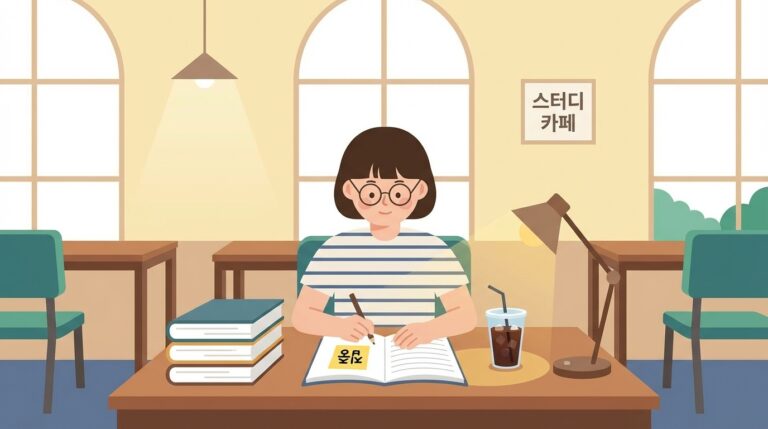
Welcome to the Silent Zone: Mastering Korean Study Cafes
Hello! I’m your lead editor at Daily Hangul.
Picture this: You are watching a K-Drama like SKY Castle or Reply 1988. You see students walking into a dimly lit room, plugging in their earphones, and studying in absolute, pin-drop silence. Fast forward to your life in Korea. You walk into a modern ‘Study Cafe’ (스터디카페) to prepare for your TOPIK exam. The vibe is immaculate—soft jazz in the lounge, free coffee, aesthetic lighting. But then… the person next to you starts clicking their four-color ballpoint pen. Click. Clack. Click. Clack.
In your home country, you might just tap their shoulder and say, “Hey, do you mind?” But in Korea? Doing that in a silent reading room might make you the villain!
Today, we are going to dive into the unique ecosystem of Korean libraries and study cafes. We will learn how to navigate these hyper-focused spaces, use the ultimate superpower of Nunchi (눈치), and speak the unspoken language of the Korean study room. Let’s get started!
Deep Dive: Essential Phrases for the Reading Room
Let’s look at the absolute must-know phrases to survive and thrive in a Korean study space.
1. 여기 자리 있어요?
- Pronunciation: [yeogi jari isseoyo?] (yo-gee jah-ree ee-sso-yo?)
- Meaning: Is this seat taken? (Literal: Does a seat exist here?)
- K-Culture Moment: You’re in a crowded university library during midterms. You spot an empty chair next to someone, but there’s a jacket draped over it. Before you sit, you lean in and whisper this phrase.
- Editor’s Insight: This isn’t just for libraries; you can use this at food courts, cafes, and subway trains. It’s soft, non-confrontational, and perfectly polite.
- Situation Spectrum:
[🚫] ———— [⚠️] ———— [✅ 자유롭게]- Friends (Casual): ✅ (Say: 여기 자리 있어?)
- Strangers/Older people (Formal): ✅ (Use the -요 form)
- 🤔 Think About It: Why do Koreans often leave their laptops and phones unattended to save a seat? Does this happen in your country?
2. 조금만 조용히 해 주시겠어요?
- Pronunciation: [jogeumman joyonghi hae jusigesseoyo?] (jo-geum-man jo-yong-hee hae joo-shee-ge-sso-yo?)
- Meaning: Could you please keep it down a little?
- K-Culture Moment: Someone is breathing heavily, whispering on the phone, or aggressively turning textbook pages. You finally gather the courage to ask them to be quiet.
- Editor’s Insight: Notice the word 조금만 (jogeumman – just a little bit). Even if they are being very loud, Koreans add “a little bit” to soften the blow and save the other person’s face. Using “-아/어 주시겠어요?” is a highly polite request form.
- Situation Spectrum:
[🚫] ———— [⚠️ 주의] ———— [✅]- Strangers: ⚠️ (Even with polite words, direct confrontation in a study room is risky. Read on to find out the real Korean way to handle this!)
3. 제 자리 좀 맡아 주실 수 있나요?
- Pronunciation: [je jari jom mata jusil su innayo?] (je jah-ree jom mah-tah joo-shil soo in-nah-yo?)
- Meaning: Could you save my seat?
- K-Culture Moment: You’ve been studying for 3 hours. You desperately need an iced Americano from the first floor, but you don’t want to lose your prime corner desk.
- Editor’s Insight: The verb 맡다 (matda) means to take charge of or keep. In casual speech with your study buddy, you just whisper: “내 자리 좀 맡아줘” (nae jari jom matajwo).
Textbook vs Real Life Korean
| Situation | 📖 Textbook Korean | 🗣️ Real Korean | 💡 Why the difference? |
|---|---|---|---|
| Telling someone to be quiet | 저기요, 조용히 하세요. (Excuse me, be quiet.) | (Leaves a Post-it note with a small candy) 🍬📝 | Direct confrontation is avoided to maintain harmony (기분 – gibun) and save face. |
| Asking if a seat is free | 이 자리는 비어 있습니까? (Is this seat empty?) | 여기 자리 있어요? (Is there a seat here?) | “있어요?” is universally used and sounds much more natural and friendly. |
| Saying “I’m going to the cafe to study” | 저는 카페에서 공부할 거예요. | 나 카공하러 가. (I’m going for Ka-gong.) | ‘카공’ (Ka-gong) is a popular abbreviation for 카페 공부 (Cafe Study). |
Bottom Note: As a B1 learner, try using “조금만 ~해 주시겠어요?” instead of imperative forms like “~하세요”. It elevates your Korean from “foreigner reading a book” to “polite local”!
Cultural Deep Dive
4-1. The Post-it Note Culture (포스트잇 문화)
Let’s talk about non-verbal communication. In Korean reading rooms, silence is sacred. If someone is tapping their foot or clicking their pen, directly telling them to stop is considered quite abrasive. Instead, Koreans use the legendary “Post-it Method”.
You write a highly polite note: “Hello, I’m sorry, but could you please be a little careful with the pen-clicking noise? Good luck with your studies! :)” You stick it on a small canned coffee or a piece of candy, and quietly place it on their desk. This smooths over any bad feelings and shows high-level Nunchi!
4-2. The Evolution of K-Study Spaces
If you watch older dramas, you’ll see 독서실 (Dokseosil)—dark, isolating reading rooms with tiny cubicles. Today, the trend is 스터디카페 (Study Cafe). These are unmanned spaces you enter via a digital kiosk. They are divided into zones:
– Lounge/Cafe Zone: Light typing allowed, soft music playing.
– Focus/Reading Zone (열람실): Absolute silence. No mouse clicking, no keyboard typing, sometimes not even aggressive erasing!
Understanding this spatial division is crucial. If you pull out your laptop and start typing an essay in the Focus Zone, you will feel the intense, silent glares of 20 Korean students piercing your soul!
Immersive Roleplay: The Pen Clicker
Setting: It’s 8:00 PM on a rainy Tuesday. You are inside a premium Study Cafe in Sinchon. The room is so quiet you can hear the hum of the air purifier. You are deep into studying Korean grammar.
Characters:
– YOU: An international student prepping for the TOPIK II exam.
– Minji (22): A university student sitting at the next desk, intensely studying for her CPA exam.
(Dialogue)
Minji: (Sighs heavily) 아… 진짜 안 외워지네.
(a… jinjja an oewojine.)
[Ah… I really can’t memorize this.]
(🎭 Stage Direction: Minji starts aggressively clicking her ballpoint pen while staring at her book. Click. Click. Click.)
YOU: (Internal thought: Oh no… I can’t focus. I need to say something, but nicely.)
저기요… 죄송한데요.
(jeogiyo… joesonghandeyo.)
[Excuse me… I’m sorry, but.]
Minji: (Looks up, startled) 네? 아, 네.
(ne? a, ne.)
[Yes? Ah, yes.]
YOU: 혹시, 펜 소리 조금만 조심해 주실 수 있나요?
(hoksi, pen sori jogeumman josimhae jusil su innayo?)
[By any chance, could you be a little careful with the pen noise?]
Minji: 헉, 죄송합니다! 제가 무의식중에…
(heok, joesonghamnida! jega mueuisikjunge…)
[Gasp, I’m so sorry! I did it unconsciously…]
YOU: 아, 괜찮습니다. 열공하세요!
(a, gwaenchanseumnida. yeolgonghaseyo!)
[Ah, it’s okay. Study hard!]
🔀 Your Turn! How would you have handled the pen-clicking?
– A) “저기요, 시끄러워요.” (Excuse me, it’s noisy.)
– B) Quietly pass her a Post-it note with a smiley face and a piece of chocolate.
– C) Glare at her until she notices.✅ Best Choice: B — This is the ultimate Korean local move. It completely avoids confrontation while effectively solving the problem. Minji will probably feel extremely grateful (and apologetic) for your kindness!
⚠️ Choice A Analysis: Too direct. It might cause her to feel deeply embarrassed or defensive.
10-Second Shadowing Drill
Practice these sentences with the right emotion and pauses. Remember, in a study cafe, you must whisper!
- 🤫 저기요, / 여기에 / 자리 있어요? (jeogiyo, / yeogie / jari isseoyo?)
- 🥺 죄송하지만, / 조금만 / 조용히 해 주시겠어요? (joesonghajiman, / jogeumman / joyonghi hae jusigesseoyo?)
- 😊 저 / 화장실 좀 다녀올게요. / 제 자리 좀 / 맡아주세요! (jeo / hwajangsil jom danyeoolgeyo. / je jari jom / matajuseyo!)
K-Culture Glossary
| Korean | Romanization | English | Contextual Meaning |
|---|---|---|---|
| 눈치 | nunchi | Social sense/Tact | The ability to read the room. Knowing not to type on a laptop in a quiet zone is good Nunchi. |
| 스터디카페 | seuteodikape | Study Cafe | Premium, quiet study spaces popular among students and job seekers. |
| 카공족 | kagong-jok | Cafe study tribe | People who study at regular cafes (like Starbucks) for long hours. |
| 열공 | yeolgong | Study hard | Abbreviation for 열심히 공부하다 (Study passionately). A great cheering word! |
| 백색소음 | baeksaek soeum | White noise | Many Korean study spaces play artificial rain or cafe sounds to boost concentration. |
Traveler’s Survival Kit
Even if you aren’t a student, you might want to visit beautiful public libraries in Korea (like the famous Starfield Library in COEX) or use a study cafe to get some remote work done.
🆘 Survival Phrases for Kiosks & Libraries
– 🇰🇷 “당일권 하나 결제할게요.” (dang-ilgwon hana gyeoljehalgeyo.)
– 🗣️ Meaning: I’d like to pay for a one-day pass.
– 🇰🇷 “와이파이 비밀번호가 어디에 있나요?” (waipai bimilbeonhoga eodie innayo?)
– 🗣️ Meaning: Where is the Wi-Fi password?
– 🇰🇷 “노트북 쓸 수 있는 자리가 어디예요?” (noteubuk sseul su inneun jariga eodiyeyo?)
– 🗣️ Meaning: Where are the seats where I can use a laptop?
📌 Editor’s Travel Note:
Almost all modern Study Cafes operate via self-service Kiosks at the entrance. You select your seat, choose your hours, and pay by card. Warning: Many kiosks require a Korean phone number to send you the entry barcode via KakaoTalk! If you only have a tourist SIM without a number, look for traditional cafes or ask the manager (if present) for help.
Think Deeper: Space & Community Respect
🧠 The Weight of Silence
Why is absolute silence so strictly enforced in Korean reading rooms? It reflects Korea’s highly competitive education and employment culture. From the Suneung (college entrance exam) to civil service exams, a single test can determine a young person’s future. Therefore, maintaining silence isn’t just a rule; it is a profound gesture of respect for someone else’s desperate hard work and dreams. When you are quiet in these spaces, you are silently cheering them on.💬 Your Turn: Does your country have specific places where absolute silence is a social law? How do people prepare for big exams in your culture? Share in the comments!
FAQ & Troubleshooting
Q: Is it okay to eat snacks in the reading room?
A: In the main reading room (열람실), absolutely NO crispy or smelly snacks. No potato chips, no cup noodles! You can quietly drink coffee or water. If you need to eat, go to the designated lounge area (휴게실).
Q: My phone is on vibrate. Is that okay?
A: Actually, no! In ultra-quiet reading rooms, even the buzzing sound of a vibrating phone on a wooden desk sounds like an earthquake. Put your phone on completely silent mode (무음 모드).
❌ Common Mistake: Answering a phone call by whispering at your desk.
✅ Do this instead: Grab your phone immediately, quickly stand up, and walk completely outside the study area (to the staircase or hallway) before saying “Hello?” (여보세요?).
Wrap-up & Missions
One-Liner Summary: Mastering the polite whispers and Nunchi of Korean study spaces will make you look like a true local!
Your Action Missions:
– 🥉 Bronze: Whisper “조금만 조용히 해 주시겠어요?” to yourself 3 times, focusing on an apologetic, soft tone.
– 🥈 Silver: Write a short “Post-it note” in Korean that you would give to someone tapping their foot loudly.
– 🥇 Gold: Next time you are in Korea, visit a real ‘스터디카페’ (Study Cafe), buy a 2-hour pass from the kiosk, and experience the culture firsthand!
🎬 K-Culture Mission:
Watch an episode of Crash Course in Romance (일타 스캔들) or SKY Castle. Notice how the students interact in their study spaces. Can you spot anyone using a Post-it note to communicate?
Did you enjoy today’s lesson? Have you ever experienced the intense silence of a Korean library? Let me know below! 👇
Interactive Quiz 🧠
1. You are in the ‘Focus Zone’ of a Study Cafe. You need to write a 10-page essay on your laptop. What should you do?
A) Type very slowly and softly.
B) Just type normally; it’s a cafe!
C) Pack up and move to the ‘Laptop Zone’ or Lounge.
2. Fill in the blank to politely ask someone to save your seat:
“제 자리 좀 ________ 주실 수 있나요?”
3. True or False: If someone is loud in a Korean library, the most culturally natural thing to do is to loudly say “Shh!” to teach them a lesson.
(Answers: 1. C – Keyboards are strictly banned in Focus Zones! / 2. 맡아 (mata) / 3. False – Direct confrontation is avoided. Use the Post-it method!)
Frequently Asked Questions (FAQ)
Q: What does "여기 자리 있어요?" mean in Korean and how do you pronounce it?
A: In Korean, "여기 자리 있어요?" is pronounced [yeogi jari isseoyo?] and means: Is this seat taken? (Literal: Does a seat exist here?)
Q: What does "조금만 조용히 해 주시겠어요?" mean in Korean and how do you pronounce it?
A: In Korean, "조금만 조용히 해 주시겠어요?" is pronounced [jogeumman joyonghi hae jusigesseoyo?] and means: Could you please keep it down a little?
Q: What does "제 자리 좀 맡아 주실 수 있나요?" mean in Korean and how do you pronounce it?
A: In Korean, "제 자리 좀 맡아 주실 수 있나요?" is pronounced [je jari jom mata jusil su innayo?] and means: Could you save my seat?







