

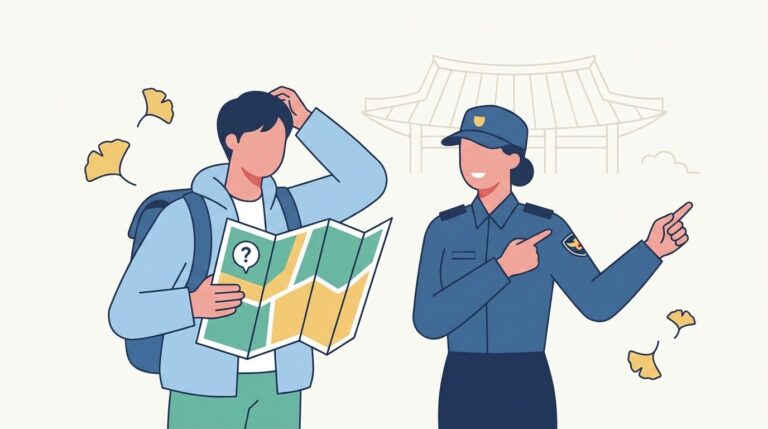
Phase 1: Empathy — Immersive Hook
Hello there! I’m your Daily Hangul Editor.
We’ve all seen it in K-Dramas: the main character is traveling abroad, accidentally bumps into someone, their bags get swapped, and suddenly they are stranded without a passport. It usually leads to a romantic comedy plot. But let’s be real—if you are standing in the middle of a bustling Seoul subway station, patting your pockets and realizing your passport is missing, it’s not a rom-com. It’s pure panic.
When a real emergency hits in a foreign country, your brain often forgets all the vocabulary you’ve studied. You just need to get to your embassy (대사관) fast. Today, we are going to learn exactly how to ask for your embassy’s contact info and location in Korean.
Don’t worry, this guide is based on real experiences from our students who survived the “lost passport” scare. By the end of this post, you’ll know exactly what to say to get the help you need, K-Drama style (but with less drama and more efficiency!).
Phase 2: Deep Dive into Core Expressions
Let’s break down the 3 ultimate survival sentences you need when looking for your embassy.
1. [Country] 대사관이 어디에 있어요?
- Pronunciation: [dae-sa-gwan-i eo-di-e is-seo-yo?] (Think of eo-di-e sounding like “uh-dee-eh”)
- Meaning: Where is the [Country] embassy?
- K-Culture Moment: If you watch police procedural dramas like Signal or Live, you’ll hear “어디에 있어요?” (Where is it?) shouted into walkie-talkies constantly. It’s the most fundamental way to ask for a location in Korean.
- Editor’s Insight: Just plug your country’s name in Korean at the beginning! For example: 미국 (US), 영국 (UK), 호주 (Australia), 캐나다 (Canada), 인도 (India). If you don’t know your country’s Korean name, just saying your country in English followed by “대사관” (dae-sa-gwan) will usually be understood!
- Situation Spectrum:
[🚫 절대 금지] ———— [⚠️ 주의] ———— [✅ 자유롭게]- Close Friends (Casual): ⚠️ (You’d drop the ‘요’ and say ‘어디에 있어?’)
- Strangers/Police (Semi-formal/Polite): ✅ (Perfect!)
- Formal/Official: ✅
- 🤔 Think About It: In English, we say “Where is the embassy?” In Korean, the verb 있다 (to exist) is used. You are literally asking, “Where does the embassy exist?” How does your native language handle location verbs?
2. 대사관 전화번호 좀 알려주세요.
- Pronunciation: [dae-sa-gwan jeon-hwa-beon-ho jom al-lyeo-ju-se-yo.]
- Meaning: Please let me know the embassy’s phone number.
- K-Culture Moment: Notice the little word “좀” (jom)? In K-Dramas, when someone is begging for a favor, they might clasp their hands and whine “Joooom~!”. It literally means “a little,” but here it acts as a magic politeness softener.
- Editor’s Insight: Without “좀”, the sentence sounds like a robot demanding information. Adding “좀” makes you sound like a human asking for a favor. It’s the Korean equivalent of adding “please” to soften a request.
- Situation Spectrum:
[🚫 절대 금지] ———— [⚠️ 주의] ———— [✅ 자유롭게]- Strangers/Police/Hotel Staff: ✅
3. 도와주세요. 여권을 잃어버렸어요.
- Pronunciation: [do-wa-ju-se-yo. yeo-gwon-eul il-eo-beo-ryeos-seo-yo.] (The il-eo part sounds like “eel-uh”.)
- Meaning: Please help me. I lost my passport.
- K-Culture Moment: “도와주세요” (Help me) is your universal SOS. Whether you lost your passport or ate a spicy Tteokbokki (떡볶이) that is literally melting your tongue, “도와주세요” works.
- Editor’s Insight: “잃어버렸어요” means you lost something accidentally. It has a slightly sad, helpless nuance to it, which instantly triggers the sympathetic “Jeong” (정 – Korean concept of care/affection) in the person you are talking to.
Phase 3: Textbook vs Real Life
| Situation | 📖 Textbook Korean | 🗣️ Real Korean | 💡 Why is it different? |
|---|---|---|---|
| Asking for the number | 대사관의 연락처를 가르쳐 주시겠습니까? (Would you please teach me the contact info of the embassy?) | 대사관 전화번호 좀 알려주세요. (Please let me know the embassy phone number.) | ‘가르치다’ usually means ‘to teach a subject’. ‘알려주다’ is used for giving information like numbers. |
| Reporting a lost item | 저는 여권을 분실하였습니다. (I have misplaced my passport.) | 여권을 잃어버렸어요! (I lost my passport!) | ‘분실하다’ is formal vocabulary used on official police forms, not usually in urgent spoken conversation. |
Bottom Note: Stick to the “Real Korean” column. It’s polite enough for A2 learners and much easier to remember when you are panicking!
Phase 4: Cultural Deep Dive
4-1. Non-verbal Communication in Emergencies
When approaching a police officer (경찰관) or a hotel receptionist in Korea, don’t just shout the sentence from afar. Walk up to them, make a slight bow with your head to show respect, and look genuinely distressed.
In Korea, “Nunchi” (눈치 – the ability to read the room) is huge. If you look completely relaxed while saying you lost your passport, they might not treat it as an urgent emergency. Let your face show your worry!
4-2. The K-Drama Police Station Trope
If you ever end up in a Korean “Pachulso” (파출소 – local police substation) like the characters in Itaewon Class or When the Camellia Blooms, you’ll notice something heartwarming. Despite being a place of law and order, it often feels like a neighborhood living room.
If you go in looking panicked because you need your embassy, don’t be surprised if an officer hands you a little paper cup of sweet instant coffee (Maxim) or a yogurt drink while you wait. That is the Korean “Jeong” (정) culture in action—comforting a guest in distress.
Phase 5: Immersive Roleplay
Main Scenario: The Hongdae Incident
Setting: Saturday night, 9 PM. The busy streets of Hongdae. You were just enjoying some street busking when you realized your sling bag—containing your passport and wallet—is gone. You spot a small local police station (파출소) and rush inside.
Characters:
– YOU: A slightly panicked traveler.
– Officer Kim (김 순경): A friendly local police officer who knows a little English but appreciates your Korean.
Dialogue:
(🎭 Stage Direction: You walk into the station looking extremely worried.)
YOU: 저기요… 도와주세요! 🚨
(jeogiyo… dowajuseyo!)
[Excuse me… please help me!]
Officer Kim: 네? 무슨 일이세요? 침착하세요.
(ne? museun iriseyo? chimchakaseyo.)
[Yes? What’s the matter? Please calm down.]
YOU: 제 여권을 잃어버렸어요.
(je yeogwoneul ileobeoryeosseoyo.)
[I lost my passport.]
Officer Kim: 아이고, 큰일이네요! 어디서 잃어버리셨어요?
(aigo, keunirineyo! eodiseo ileobeorisyeosseoyo?)
[Oh my, that’s terrible! Where did you lose it?]
YOU: 홍대 거리에서요. 미국 대사관에 전화해야 돼요.
(hongdae georieseoyo. miguk daesagwane jeonhwahaeya dwaeyo.)
[On Hongdae street. I have to call the US embassy.]
🔀 Your Turn! How should you ask for the phone number?
– A) “미국 대사관 번호가 뭐예요?” (What is the US embassy number?)
– B) “대사관 전화번호 좀 알려주세요.” (Please let me know the embassy phone number.)
– C) “빨리 전화번호 주세요!” (Give me the phone number quickly!)✅ Best Choice: B — Reason: It is polite, uses the magic softener ‘좀’, and clearly asks for the information.
⚠️ Choice C Analysis: Even in an emergency, demanding “Give it to me quickly!” sounds rude and aggressive in Korean culture.
Officer Kim: 네, 잠시만요. 제가 찾아볼게요.
(ne, jamsimanyo. jaega chajabolgeyo.)
[Yes, just a moment. I’ll look it up for you.]
Phase 6: 10-Second Shadowing Drill
Time to practice out loud! Imagine you are approaching a hotel desk. Read the slashes (/) as short pauses.
🥺 도와주세요! / 제 여권을 / 잃어버렸어요.
(do-wa-ju-se-yo! / je yeo-gwon-eul / il-eo-beo-ryeos-seo-yo.)
🙏 대사관 / 전화번호 좀 / 알려주세요.
(dae-sa-gwan / jeon-hwa-beon-ho jom / al-lyeo-ju-se-yo.)
Phase 7: K-Culture Glossary
| Korean | Romanization | English | Context |
|---|---|---|---|
| 대사관 | daesagwan | Embassy | Usually located in the central areas of Seoul (like Gwanghwamun or Itaewon). |
| 파출소 | pachulso | Local Police Box | Small neighborhood police stations you see on every major street. |
| 여권 | yeogwon | Passport | Your most important ID. Keep it safe! |
| 신분증 | sinbunjeung | ID Card | An umbrella term for any identification (passport, ARC, driver’s license). |
| 정 | jeong | Jeong | The Korean cultural concept of warmth, community bonding, and caring for others. |
Phase 8: Traveler’s Survival Kit
🆘 Survival Contacts TOP 3 for Travelers
- 📞 112 (Police): The universal police number. They have translators available!
- 📞 119 (Fire & Medical): Call this for ambulances or fire emergencies.
- 📞 1330 (Korea Travel Helpline): [⭐ PRO TIP] If you are lost, confused, or can’t communicate with a taxi driver or police officer, call 1330! It’s a free, 24/7 tourist helpline with fluent English, Japanese, and Chinese speakers. They can translate for you on the spot!
📌 Editor’s Travel Note:
Most embassies in Korea are clustered around the Jongno-gu (Gwanghwamun area) and Yongsan-gu (Itaewon area) in Seoul. If you lose your passport, you will likely need to visit Seoul, even if you lost it in Busan or Jeju.
Phase 9: Think Deeper — “One Step Further”
🧠 Think Deeper: Community Help vs. Individual Independence
If you ask a Korean person for directions to the police station or embassy, don’t be shocked if they don’t just point the way, but actually start walking with you to make sure you get there safely. In many Western cultures, giving clear instructions so the person can handle it independently is the norm. But in Korea, the collective mindset and “Jeong” (정) often mean people take personal responsibility to help a stranded guest. Even in an emergency, you’ll feel the warmth of the community backing you up.
💬 Your Turn:
If a tourist lost their passport in your home city, how would the locals react? Would they walk them to the police station? Let me know in the comments!
Phase 10: FAQ & Troubleshooting
Q: Can I just say “여권 없어요” (I don’t have a passport) instead of “잃어버렸어요” (I lost it)?
No! This is a very common mistake. If you tell a police officer “여권 없어요,” they might think you are an undocumented traveler who never had one, or you simply left it at the hotel. “잃어버렸어요” clearly communicates that it is a missing item requiring action.
Q: Will the local police speak English?
It depends on the area. In Itaewon or Myeongdong, yes, usually a bit! In rural areas, maybe not. That’s why having the Korean phrase “대사관 전화번호 좀 알려주세요” is your best safety net.
❌ Common Mistake: Yelling “대사관!!!” (Embassy!!!) loudly at people.
✅ Do this instead: Approach calmly, say “도와주세요” (Help me), and then use the phrases we learned today.
Phase 11: Wrap-up & Action Items
One-Liner Summary: When an emergency strikes, use “대사관 전화번호 좀 알려주세요” to smoothly get the contact info you need to fix the situation!
Your Action Missions for Today:
– 🥉 Bronze (Solo): Read the Shadowing Drill out loud 3 times with a worried face.
– 🥈 Silver (Online): Look up your home country’s embassy in Korea on Naver Maps. What neighborhood is it in?
– 🥇 Gold (Action): Save the 1330 Travel Helpline number in your phone right now. You’ll thank me later!
K-Culture Mission:
Next time you watch a K-Drama and someone loses their bag or visits a police station, listen closely! Can you catch them saying “잃어버렸어요” (I lost it)?
Phase 12: Interactive Quiz
Let’s test your emergency survival skills!
Q1. You need to ask a hotel staff member where your embassy is. What is the most natural A2 Korean phrase?
1) 미국 대사관이 어디에 있어요?
2) 미국 대사관의 위치를 가르쳐 주십시오.
3) 미국 대사관 번호 내놔요.
Q2. True or False?
If you lose your passport, saying “여권 없어요” is the best way to explain the situation to the police.
Q3. Fill in the blank:
대사관 전화번호 (_____) 알려주세요. (Please let me know the embassy phone number. Hint: the magic politeness softener)
(Check your answers by highlighting the invisible text below!)
[Answers: Q1 -> 1 (It’s natural and polite), Q2 -> False (Say 잃어버렸어요), Q3 -> 좀]
Stay safe on your travels, and see you in the next Daily Hangul lesson! 😊
Frequently Asked Questions (FAQ)
Q: What does "[Country] 대사관이 어디에 있어요?" mean in Korean and how do you pronounce it?
A: In Korean, "[Country] 대사관이 어디에 있어요?" is pronounced [dae-sa-gwan-i eo-di-e is-seo-yo?] and means: Where is the [Country] embassy?
Q: What does "대사관 전화번호 좀 알려주세요." mean in Korean and how do you pronounce it?
A: In Korean, "대사관 전화번호 좀 알려주세요." is pronounced [dae-sa-gwan jeon-hwa-beon-ho jom al-lyeo-ju-se-yo.] and means: Please let me know the embassy's phone number.
Q: What does "도와주세요. 여권을 잃어버렸어요." mean in Korean and how do you pronounce it?
A: In Korean, "도와주세요. 여권을 잃어버렸어요." is pronounced [do-wa-ju-se-yo. yeo-gwon-eul il-eo-beo-ryeos-seo-yo.] and means: Please help me. I lost my passport.







