

Hello! I’m the Lead Editor at Daily Hangul, your premium Korean tutoring brand. I’ve spent years teaching Korean to students from all over the world, and let me tell you—I know exactly where you feel stuck, and where the language finally ‘clicks’ for you.
Picture this: You are watching a K-Drama. The main character accidentally knocks over their boss’s expensive laptop, or maybe drops a friend’s limited-edition K-Pop photo card. Crack. Time freezes. The subtitle simply says, “I’m sorry.”
But if you listen closely, they aren’t just saying a simple “sorry.” They are using specific words to show deep remorse, take responsibility, and offer a fix.
Breaking something you borrowed is a universal nightmare. But in Korea, apologizing isn’t just about the word itself; it’s about nunchi (눈치)—reading the room—and showing that you are actively trying to make things right. If you only use textbook Korean in this situation, you might sound like a robot instead of a sincere friend.
Don’t panic! Today, we are going to learn exactly how to handle this awkward situation like a true local.
🔎 Phase 2: Deep Dive into Key Expressions
When you break something, “미안해 (mianhae)” just isn’t enough. Here are the three lifesavers you need.
1. 진짜 미안해. 내가 실수로 망가뜨렸어.
- Pronunciation: jinjja mianhae. naega silsuro manggatteuryeosseo. [jin-jja mee-ahn-hae. nae-gah shil-soo-ro mahng-gah-teu-ryuh-sso]
- Meaning: I’m really sorry. I broke it by mistake.
- K-Culture Moment: Imagine you borrowed your bestie’s official lightstick for a concert and accidentally snapped the handle in your excitement. This is the exact phrase you drop immediately.
- Editor’s Insight: The key here is 실수로 (by mistake). It softens the blow by clarifying it wasn’t intentional. It shows you are owning up to it right away without making weird excuses.
- Situation Spectrum:
[🚫 Never] ———— [⚠️ Caution] ———— [✅ Freely]
- Close Friends (Casual): ✅
- Co-workers (Semi-formal): 🚫 (Use formal language instead)
- Boss/Elders (Formal): 🚫
- 🤔 Think About It: Why do Koreans often specify how they broke it (“by mistake”) before just saying sorry? Does your culture focus more on the apology or the explanation first?
2. 정말 죄송합니다. 제가 똑같은 걸로 새로 사 드릴게요.
- Pronunciation: jeongmal joesonghamnida. jega ttokgateun geollo saero sa deurilgeyo.
- Meaning: I am truly sorry. I will buy you a new identical one.
- K-Culture Moment: This is the ultimate workplace K-Drama trope! You spilled an iced Americano on your senior colleague’s keyboard. You must offer a replacement immediately to show respect and responsibility.
- Editor’s Insight: This is an action-oriented apology. 똑같은 걸로 (with an identical one) and 사 드릴게요 (I will buy and give to you – honorific) show that you are ready to take full financial responsibility. It is extremely polite and professional.
- Situation Spectrum:
[🚫 Never] ———— [⚠️ Caution] ———— [✅ Freely]
- Close Friends (Casual): 🚫 (Too stiff, see phrase 3)
- Co-workers (Semi-formal): ✅
- Boss/Elders (Formal): ✅
- 🤔 Think About It: Offering a solution right away changes the dynamic of an apology. How does this reflect the fast-paced “Pali-pali (빨리빨리)” culture of Korea where practical solutions are highly valued?
3. 아, 어떡하지? 이거 수리비는 내가 다 낼게.
- Pronunciation: ah, eotteokhaji? igeo suribineun naega da naelge.
- Meaning: Ah, what should I do? I’ll pay for all the repair costs.
- K-Culture Moment: You borrowed your roommate’s expensive hair straightener before a big date in Hongdae, and it suddenly stopped working.
- Editor’s Insight: 어떡하지? (What should I do?) is a fantastic phrase. It shows genuine distress and proves you feel terrible about the situation. Offering to pay the 수리비 (repair cost) is the natural next step for expensive electronics.
- Situation Spectrum:
[🚫 Never] ———— [⚠️ Caution] ———— [✅ Freely]
- Close Friends (Casual): ✅
- Co-workers (Semi-formal): ⚠️ (Needs to be changed to formal: 어떡하죠? 제가 다 낼게요)
- Boss/Elders (Formal): 🚫
📖 Phase 3: Textbook vs Real Life Korean
Let’s see how real people talk compared to what you learn in language apps.
| Situation | 📖 Textbook Korean | 🗣️ Real Life Korean | 💡 Why the difference? |
|---|---|---|---|
| Apologizing to a friend | 미안합니다. 내 잘못입니다. (I am sorry. It is my fault.) | 헐 미친, 진짜 미안해! (Omg crazy, I’m so sorry!) | Younger generations use exaggerated reactions like ‘헐’ (omg) to show they are equally shocked. |
| Offering compensation to a friend | 제가 보상하겠습니다. (I will compensate you.) | 당근에서라도 똑같은 거 구해올게! (I’ll find the exact same one, even if I have to use Danggeun Market!) | Referencing ‘Danggeun’ (Korea’s top used-goods app) shows a desperate, genuine effort to fix it. |
| Asking for forgiveness | 용서해 주세요. (Please forgive me.) | 아 진짜 한 번만 봐주라ㅠㅠ (Ah seriously, please let it slide just this once ㅠㅠ) | Used among close friends to casually beg for mercy with a bit of cute whining (aegyo). |
🎭 Phase 4: Cultural Deep Dive
4-1. Non-verbal Communication: The Art of the Apology
In Korea, words are only 50% of the apology. The rest is body language and Nunchi (눈치).
– The Eyes: Do not stare aggressively into their eyes while apologizing. It can seem confrontational. Look slightly downward to show humility and remorse.
– The Hands: If you are handing back the broken item, always use two hands. It shows respect and care, even if the item is already in pieces.
4-2. K-Culture Connection: The K-Drama Cliché vs Reality
We’ve all seen it: The female lead breaks the wealthy CEO’s antique vase. They lock eyes, dramatic music plays, and suddenly she has to work as his personal assistant to pay off the debt. Sparks fly, and romance blooms!
Reality Check: In real-life Korea, breaking someone’s stuff does not lead to romance. It leads to incredible awkwardness. Don’t stare longingly; just bow slightly, use the honorifics we learned (사 드릴게요), and transfer the money via KakaoPay!
🎬 Phase 5: Immersive Roleplay Scenario
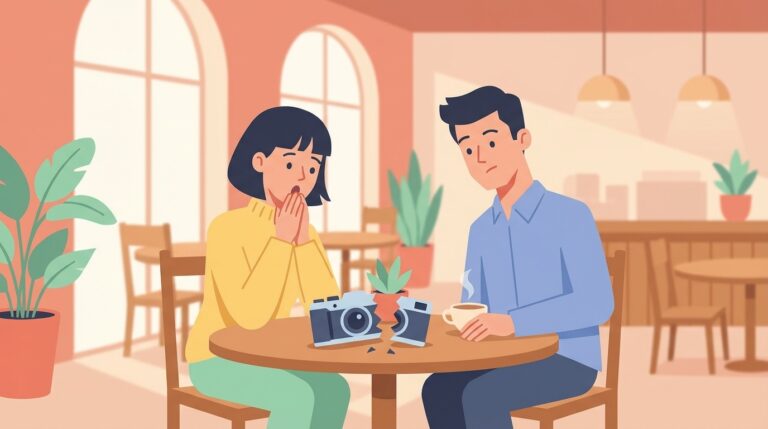
Setting: A trendy cafe in Yeonnam-dong. Friday afternoon. You borrowed your Korean friend Minji’s expensive vintage film camera (super trendy in Korea right now) for your trip to Jeju Island. You accidentally dropped it, and the lens cracked. You are meeting her to return it.
Characters:
– YOU: A foreigner living in Seoul, feeling terribly guilty.
– Minji (28): Your trendy, usually sweet Korean friend.
Dialogue:
YOU: 민지야, 진짜 미안해… (Minji-ya, jinjja mianhae… / Minji, I’m really sorry…)
(🎭 You slowly push the camera across the table with both hands.)
Minji: 어? 카메라 왜 그래? 렌즈 깨졌어?! (Eo? kamera wae geurae? renjeu kkaejyeosseo?! / Huh? What’s wrong with the camera? Is the lens broken?!)
YOU: 응… 내가 제주도에서 실수로 떨어뜨렸어. (Eung… naega jejudo-eseo silsuro tteoreotteuryeosseo. / Yeah… I accidentally dropped it in Jeju.)
Minji: 헐… 이거 구하기 진짜 힘든 건데. (Heol… igeo guhagi jinjja himdeun geonde. / OMG… This is really hard to find.)
(🎭 Minji looks upset and sighs.)
🔀 Your Turn! How should you respond?
– A) “괜찮아, 고칠 수 있을 거야.” (It’s okay, it can be fixed.)
– B) “아, 어떡하지? 수리비는 내가 다 낼게. 진짜 미안!” (Ah, what should I do? I’ll pay for all the repair costs. So sorry!)
– C) “미안. 내일 밥 살게!” (Sorry. I’ll buy you food tomorrow!)✅ Best Choice: B — Acknowledge her feelings, show distress (어떡하지?), and offer an immediate financial solution (수리비).
⚠️ Why A is terrible: Never say “It’s okay (괜찮아)” when you are the one who broke it! Only the victim gets to say it’s okay.
YOU: (Choosing B) 아, 어떡하지? 수리비는 내가 다 낼게. 진짜 미안!
Minji: 하아… 알았어. 일단 수리 센터 알아볼게. (Haa… arasseo. ildan suri senteo arabolge. / Sigh… Alright. I’ll look into a repair center first.)
YOU: 수리 안 되면 당근에서라도 똑같은 거 무조건 구해올게. (Suri an doemyeon danggeun-eseorado ttokgateun geo mujogeon guhaeolge. / If it can’t be fixed, I’ll absolutely find the exact same one, even on Danggeun Market.)
Minji: 알았어. 너무 걱정하지 마. 밥이나 먹으러 가자. (Arasseo. neomu geokjeonghaji ma. babina meogeureo gaja. / I get it. Don’t worry too much. Let’s just go eat.)
🗣️ Phase 6: 10-Second Shadowing Drill
Practice these out loud to get the rhythm and emotion right!
- 🥺 Distressed: 아, 어떡하지? / 내가 / 실수로 / 망가뜨렸어.
(ah, eotteokhaji? / naega / silsuro / manggatteuryeosseo) - 😤 Determined: 수리비는 / 내가 / 다 / 낼게!
(suribineun / naega / da / naelge!) - 🙇 Professional/Polite: 정말 / 죄송합니다. / 똑같은 걸로 / 새로 사 드릴게요.
(jeongmal / joesonghamnida. / ttokgateun geollo / saero sa deurilgeyo)
📚 Phase 7: K-Culture Mini Glossary
| Korean Word | Romanization | English Meaning | Cultural Context |
|---|---|---|---|
| 눈치 | nunchi | Social sense/tact | The core of Korean social interaction. Reading the room and knowing how to act gracefully. |
| 변상 | byeonsang | Compensation | Reimbursing someone for damage. Used heavily in formal or legal contexts. |
| 수리비 | suribi | Repair cost | ‘수리’ (repair) + ‘비’ (fee/cost). Essential word when dealing with broken electronics or cars. |
| 당근마켓 | Danggeun Market | Karrot Market | Korea’s #1 neighborhood used-goods app. A lifesaver for finding discontinued items. |
| 헐 | heol | OMG / No way | A very common slang exclamation used to express shock, dismay, or surprise. |
🧳 Phase 8: Traveler’s Survival Kit
What if you break something at an Airbnb, a hotel, or a souvenir shop in Korea? You need to handle it quickly before it becomes a bigger issue.
🆘 Survival Expression #1: When you break something in a store
– 🇰🇷 “죄송합니다. 이거 제가 깬 것 같아요. 변상하겠습니다.”
– 🗣️ (joesonghamnida. igeo jega kkaen geot gatayo. byeonsanghagetseumnida.)
– 🇬🇧 “I’m sorry. I think I broke this. I will compensate you.”🆘 Survival Expression #2: When you ruin an Airbnb item (e.g., spilled wine)
– 🇰🇷 “호스트님, 죄송한데 침대 시트에 얼룩이 묻었어요. 세탁비 보내드릴게요.”
– 🗣️ (hoseuteunim, joesonghande chimdae siteue eollugi mudeosseoyo. setakbi bonaedeurilgeyo.)
– 🇬🇧 “Host, I’m sorry but there is a stain on the bedsheet. I’ll send you the laundry fee.”📌 Editor’s Travel Note
– Take Pictures: When checking into an Airbnb in Korea, take photos of everything before you unpack. If something is already broken, send it to the host immediately so you aren’t blamed later.
– Insurance: If you accidentally break something very expensive in a store, check if your travel insurance covers personal liability (일상생활배상책임) before paying out of pocket!
🧠 Phase 9: Think Deeper — “Language & Power”
Did you notice how differently we apologize to a friend versus a colleague? In Korean, apologizing isn’t just about expressing regret; it’s a mirror reflecting social hierarchy and power dynamics.
When offering to buy a replacement for a friend, we say “사 줄게” (I’ll buy it for you). But for an older person or a boss, we must shift the entire verb to “사 드릴게요” (I will humbly offer a purchase for you). The language forces the speaker to physically lower their social stance through vocabulary. It shows that in Korean culture, respect and age/rank dictate not just how we speak, but what actions we are allowed to take.
💬 Your Turn: In your culture, do you use entirely different vocabulary when apologizing to a boss compared to a friend? Let us know in the comments!
🚨 Phase 10: FAQ & Troubleshooting
Q: Can I just say “미안 (Mian)” if I break a stranger’s item?
NO! “미안” is informal (banmal). If you use it with a stranger, they might get angry at your lack of respect, making a bad situation worse. Always use “죄송합니다 (Joesonghamnida)” with strangers.
Q: What if they say “괜찮아요 (It’s okay)”? Do they mean it?
Maybe. In Korea, it is polite to refuse compensation once or twice (this is called Geot-chire, or polite formality). You must insist on paying at least one more time. If they refuse three times, you can buy them a nice meal or a coffee giftcard instead.
❌ Common Mistake #1: Saying “괜찮아요 (It’s okay)” to comfort the victim.
✅ Do this instead: Say “어떡하죠? (What should I do?)”. Remember, only the person whose item was broken has the right to say “it’s okay”!
🎯 Phase 11: Wrap-up & Missions
One-Liner Summary: When you break something in Korea, combine a sincere apology with a concrete offer to replace or repair it!
Your Action Missions for Today:
– 🥉 Bronze (Solo): Stand in front of a mirror, bow slightly, and say “정말 죄송합니다. 제가 다 변상하겠습니다” three times.
– 🥈 Silver (Online): Leave a comment below with: “If I broke my friend’s [Item], I would say: [Korean Expression]!”
– 🥇 Gold (Real World): Next time you bump into someone or make a small mistake, practice saying “죄송합니다 (Joesonghamnida)” with a slight bow.
🇰🇷 K-Culture Mission:
Open Netflix and watch an episode of a K-Drama set in an office (like Business Proposal or Misaeng). Listen closely for the word “죄송합니다” and watch their body language. How deep do they bow?
📝 Phase 12: Interactive Quiz
Test your Nunchi before you go!
1. You accidentally stepped on your boss’s glasses. What is the BEST response?
– A) 헐 대박! 미안해요! (Omg wow! Sorry!)
– B) 아, 어떡하지? 내가 새거 사줄게. (Ah, what should I do? I’ll buy you a new one.)
– C) 정말 죄송합니다. 똑같은 걸로 새로 사 드릴게요. (I am truly sorry. I will buy you a new identical one.)
2. True or False: If you break your friend’s item and they say “It’s okay, don’t worry about it,” you should immediately say “Okay, thanks!” and forget about it.
– True / False
(Scroll down for answers!)
Click to see answers
1. Answer: C. Options A and B use informal language (banmal) and casual slang, which will probably get you fired! Always use formal language (C) with your boss.
2. Answer: False. Due to Korean politeness culture, they might just be acting nice. You should insist on compensating them at least one more time. If they still refuse, buy them a nice meal or a coffee!
Thanks for studying with Daily Hangul today! Have you ever broken something awkward? Share your story in the comments!
Frequently Asked Questions (FAQ)
Q: What does "진짜 미안해. 내가 실수로 망가뜨렸어." mean in Korean and how do you pronounce it?
A: In Korean, "진짜 미안해. 내가 실수로 망가뜨렸어." is pronounced [jinjja mianhae. naega silsuro manggatteuryeosseo. [jin-jja mee-ahn-hae. nae-gah shil-soo-ro mahng-gah-teu-ryuh-sso] and means: I'm really sorry. I broke it by mistake.
Q: What does "정말 죄송합니다. 제가 똑같은 걸로 새로 사 드릴게요." mean in Korean and how do you pronounce it?
A: In Korean, "정말 죄송합니다. 제가 똑같은 걸로 새로 사 드릴게요." is pronounced [jeongmal joesonghamnida. jega ttokgateun geollo saero sa deurilgeyo.] and means: I am truly sorry. I will buy you a new identical one.
Q: What does "아, 어떡하지? 이거 수리비는 내가 다 낼게." mean in Korean and how do you pronounce it?
A: In Korean, "아, 어떡하지? 이거 수리비는 내가 다 낼게." is pronounced [ah, eotteokhaji? igeo suribineun naega da naelge.] and means: Ah, what should I do? I'll pay for all the repair costs.







