

Surviving the K-Drama Reality: Korean Holiday Syndrome & Family Conflicts
Phase 1: Immersive Hook — Welcome to the ‘Real’ Korean Holiday
Hello! I’m your lead editor and veteran tutor at Daily Hangul.
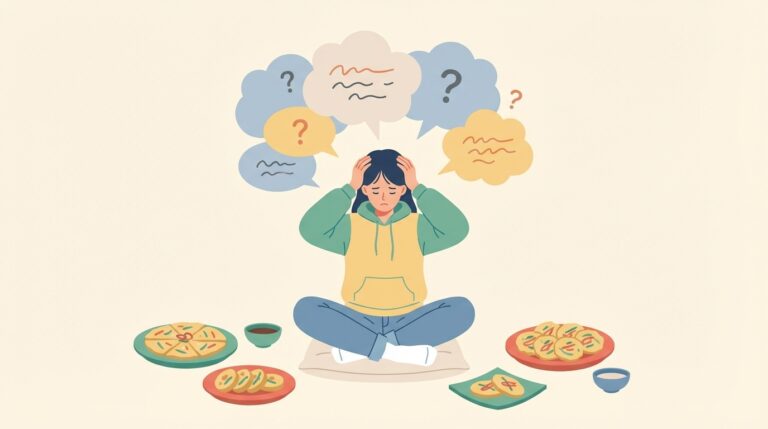
Picture this: You are watching a classic K-Drama. It’s Chuseok (Korean Thanksgiving). The living room is loud, the TV is blaring a holiday special, and the protagonist is sitting on the floor, flipping an endless mountain of jeon (savory pancakes) in a frying pan. Suddenly, an aunt leans in and asks, “So… when are you getting married?” The protagonist forces a smile, but you can practically see her soul leaving her body.
Textbooks often paint Korean traditional holidays (명절) as perfectly harmonious times where families gather in beautiful hanbok to eat rice cakes. But if you talk to your Korean friends in their 20s and 30s right before a holiday, you’ll hear a lot of deep sighs. Why? Because of the infamous barrage of uncomfortable questions and the heavy weight of family expectations.
Today, we are taking off the textbook filter. We’ll dive into the real, raw vocabulary surrounding 명절 증후군 (Holiday Syndrome) and family dynamics. Knowing these expressions won’t just improve your B2-level Korean—it will give you the ultimate “insider” empathy when your Korean friends complain about their holiday weekends. Let’s dive in!
Phase 2: Deep Dive into Core Expressions
Here are the top 3 expressions Koreans actually use when discussing holiday stress.
1. 명절 증후군 (Holiday Syndrome)
- Pronunciation: myeong-jeol jeung-hu-gun (The ‘eu’ sounds like the disgusted sound you make when stepping in gum!)
- Meaning: (Literal) Holiday Syndrome / (Real nuance) The extreme physical and mental stress experienced before, during, and after traditional holidays.
- K-Culture Moment: On the day after Seollal (Lunar New Year), every Korean news channel features doctors giving tips on how to stretch your back and relieve stress after driving for 10 hours or cooking for 20 people.
- Editor’s Insight: This isn’t just a slang term; it’s practically a recognized medical condition in Korea. Women historically suffered from the physical labor of cooking, while men stressed over massive traffic jams and financial burdens.
- Situation Spectrum:
[🚫 Never] ———— [⚠️ Be Careful] ———— [✅ Freely Use]
- Close friends: ✅
- Co-workers (small talk after holidays): ✅
- Your conservative Korean grandparents: 🚫
- 🤔 Think About It: Why does a holiday of “rest” have a “syndrome” attached to it? How do gender roles in traditional Korean society contribute to this specific vocabulary word?
2. 잔소리 (Nagging / Unsolicited Advice)
- Pronunciation: jan-so-ri (Say it sharply, like a little mosquito buzzing in your ear!)
- Meaning: (Literal) Small/Petty sound / (Real nuance) Nagging, lecturing, or intrusive questions from elders (about jobs, marriage, weight, etc.).
- K-Culture Moment: K-Pop idols often joke about this on live streams. Fans might tell them to go to sleep, and the idol will pout and say, “아~ 잔소리하지 마세요!” (Ah, stop nagging me!).
- Editor’s Insight: During holidays, relatives call this “advice out of love,” but younger people call it jansori. It perfectly captures the generational clash in modern Korea.
- Situation Spectrum:
- Complaining to friends: ✅
- Telling an elder “잔소리하지 마세요” (Stop nagging): 🚫 (Extremely rude!)
- 🤔 Think About It: In many Western cultures, asking an adult about their salary or marriage plans is a strict boundary violation. In Korea, it has historically been seen as a sign of Jeong (정, affection/caring). Where is the line between caring and nagging drawn in your culture?
3. 눈치(를) 보다 (To walk on eggshells / To read the room)
- Pronunciation: nun-chi-reul bo-da
- Meaning: (Literal) To look at eye-measure / (Real nuance) To be hyper-aware of others’ moods and adjust your behavior accordingly to avoid offending them.
- K-Culture Moment: You bring your non-Korean partner to a Korean family gathering. The atmosphere gets tense because an uncle makes an awkward joke. You are nunchi-reul boda, sweating and trying to change the subject smoothly.
- Editor’s Insight: Nunchi is the superpower of Korean social survival. During holidays, younger family members are constantly “looking at nunchi”—waiting for the elders to eat first, laughing at unfunny jokes, and trying not to look “lazy.”
- Situation Spectrum:
- Explaining your feelings to a friend: ✅ (“나 어제 친척들 눈치 엄청 봤잖아.”)
Phase 3: Textbook vs. Real Life Korean
Let’s see how textbook phrases evolve into real-life survival Korean during the holidays.
| Situation | 📖 Textbook Korean | 🗣️ Real Life Korean | 💡 Why the difference? |
|---|---|---|---|
| How was the holiday? | 가족들과 즐거운 시간을 보냈어요. (I had a good time with family.) | 아휴, 명절 증후군 때문에 죽겠어요. (Ugh, I’m dying from holiday syndrome.) | Young adults bond over shared suffering rather than forced positivity. |
| Relatives asking questions | 친척들이 질문을 많이 하셨어요. (Relatives asked many questions.) | 친척들 잔소리 폭탄 맞았어요. (I got hit by a bomb of relatives’ nagging.) | “Bomb” (폭탄) dramatically expresses the overwhelming nature of the questions. |
| I want to avoid family | 이번 명절에는 집에 안 갈 거예요. (I won’t go home this holiday.) | 저 이번 연휴에 호캉스/해외여행 가려고요. (I’m going on a staycation/overseas trip this holiday.) | Escaping to a hotel (호캉스) or abroad during holidays is a massive modern trend to avoid stress. |
Phase 4: Cultural Deep Dive
4-1. Non-verbal Communication: The Art of the “Silent Sigh”
When a Korean elder asks, “So, how much do you weigh now?” or “Did you get promoted?”, you cannot roll your eyes or yell. The culturally acceptable non-verbal response is a polite, slightly awkward smile, avoiding direct eye contact, and offering a vague “하하… 네, 뭐… 열심히 하고 있습니다” (Haha… yes, well… I’m working hard). The frustration is strictly internalized!
4-2. K-Culture Connection: The Drama Trope vs. Reality
If you watch a family K-Drama like Reply 1988, holidays are bustling, loud, and full of deep family love despite the bickering. However, if you look at modern Korean society, airports are packed during Chuseok and Seollal. Why? Because the younger generation (MZ generation) is breaking tradition. Instead of cooking jeon and enduring jansori, families are now opting to travel abroad together, or young people are spending the holidays alone (혼명족 – “solo holiday tribe”) eating convenience store bento boxes and binge-watching Netflix.
Phase 5: Immersive Roleplay Scenario
Setting: Friday afternoon, the first day of the Chuseok holiday. You are a foreign professional working in Seoul. Your Korean friend, Minji, kindly invited you to her family’s home in the countryside so you wouldn’t be lonely. You are sitting on the living room floor. Her older uncle (큰아빠) has just had a little bit too much Soju.
Characters:
– YOU: A B2-level Korean learner, trying to be polite but caught in the crossfire.
– Uncle (큰아빠): 60s, loud, traditional, means well but lacks a filter.
– Minji: 30s, your friend, currently sweating with nunchi.
Dialogue:
큰아빠 (Uncle): 오~ 우리 민지 외국인 친구! 한국말 잘하네? 그런데 나이가 몇이지? 결혼은 했어?
(O~ uri Minji oegugin chingu! Hangungmal jalhane? Geureonde naiga myeochiji? Gyeolhoneun haesseo?)
[Oh~ Minji’s foreign friend! You speak Korean well. By the way, how old are you? Are you married?]
YOU: 아, 저는 서른 살이고, 아직 결혼 안 했습니다.
(Ah, jeoneun seoreun sarigo, ajik gyeolhon an haetseumnida.)
[Ah, I am thirty, and I am not married yet.]
큰아빠 (Uncle): 에이! 서른이면 빨리 해야지! 혼자 살면 외로워서 안 돼. 한국 남자 어때? 내가 좋은 사람 소개시켜 줄까?
(Ei! Seoreunimyeon ppalli haeyaji! Honja salmyeon oerowoseo an dwae. Hanguk namja eottae? Naega joeun saram sogaesikyeo julkka?)
[Hey! If you’re thirty, you need to hurry! You can’t live alone, it’s too lonely. How about a Korean man? Shall I set you up with a good guy?]
(🎭 Stage Direction: Minji looks horrified and kicks your foot gently under the table, signaling you to just laugh it off.)
🔀 YOUR TURN! How do you respond?
– A) “아닙니다. 제 사생활이니까 신경 쓰지 마세요.” (No. It’s my private life, so please mind your own business.)
– B) “하하, 감사합니다. 좋은 사람 있으면 언제든지 환영이죠!” (Haha, thank you. If there’s a good person, I’m always welcome to it!)
– C) “큰아빠, 민지나 먼저 시집보내세요!” (Uncle, marry Minji off first!)✅ Best Choice: B — Why? It’s the ultimate “smooth deflection.” You accept the affection (Jeong) behind his intrusive question without actually committing to anything. It keeps the mood light.
⚠️ Choice A Analysis: Grammatically perfect, but culturally a disaster. Telling an elder “신경 쓰지 마세요” (mind your own business) will immediately ruin the holiday atmosphere and cause a massive family drama.
⚠️ Choice C Analysis: Hilarious, but highly risky! Only use this if you have top-tier comedic timing and are very close to the family.
Phase 6: 10-Second Shadowing Drill
Let’s practice how to complain to your friend after surviving the family dinner. Pay attention to the pauses (/) and intonation!
😤 아휴, / 이번 명절에도 / 완전 잔소리 폭탄이었어!
(Ahyu, / ibeon myeongjeoredo / wanjeon jansori poktanieosseo!)
[Ugh, / this holiday too / was a total nagging bomb!]
Pro-tip: Put extra emphasis on “완전” (completely/totally) to express your sheer exhaustion!
Phase 7: K-Culture Glossary (Mini Dictionary)
| Korean | Romanization | English | Contextual Meaning |
|---|---|---|---|
| 잔소리 | jansori | Nagging | Unsolicited life advice from elders, especially regarding major life milestones. |
| 명절 증후군 | myeongjeol jeunghugun | Holiday Syndrome | The mental and physical fatigue post-holidays. |
| 시월드 | si-world | In-law World | Slang used by married women to describe the stressful universe of their husband’s family (starts with ‘시’ for in-laws). |
| 눈치 | nunchi | Social awareness | The crucial skill of reading the room to avoid conflict. |
| 호캉스 | hokangseu | Hotel Vacance | Staycation at a nice hotel—a popular way to escape holiday stress. |
Phase 8: Traveler’s Survival Kit
Even if you aren’t attending a family gathering, navigating Korea during Chuseok or Seollal is a massive challenge for tourists. Seoul turns into a ghost town, and then suddenly, traffic is paralyzed!
🆘 Survival Expression #1: Finding Open Places
– 🇰🇷 “오늘 영업하나요?” (Oneul yeongeophaneunyo?)
– 🗣️ Pronunciation: [o-neul yeong-eop-ha-na-yo?]
– 📍 Where to use: Calling restaurants or cafes, or asking at the door.
– 💡 Pro Tip: Never trust Google Maps during Korean holidays! Always use Naver Map or KakaoMap, and look for the red text that says “명절 당일 휴무” (Closed on the day of the holiday).📌 Editor’s Travel Note
– KTX (Bullet Trains): Train tickets for major holidays sell out months in advance in a massive online ticketing war (티켓팅). Do not expect to buy a ticket at the station on the day of travel!
– Convenience Stores: They are your best friends. They never close, and during holidays, they even sell special “Holiday Bento Boxes” (명절 도시락) featuring traditional foods like jeon and japchae.
Phase 9: Think Deeper — “One Step Further”
Language & Power: The Motivation Behind the Nagging
Why do Korean elders ask such personal questions? In traditional agrarian Korean society, the village was one large extended family. Your business was everyone’s business. Asking “Have you eaten?” or “When will you have a baby?” was the ultimate expression of 정 (Jeong – deep connection and affection). The elders aren’t necessarily trying to make you feel bad; in their linguistic framework, showing curiosity about your life milestones is how they say, “I care about you.” However, as modern Korea has rapidly adopted individualistic values, this traditional display of affection clashes violently with the younger generation’s desire for personal boundaries, resulting in the dreaded “Holiday Syndrome.”
💬 Your Turn: Does your culture have a concept similar to Jeong, where intrusive questions are actually a sign of love? How do young people in your country handle nagging relatives? Let me know in the comments!
Phase 10: FAQ & Troubleshooting
Q: If an elder keeps pressuring me to eat more food, can I say “배불러요. 그만 주세요” (I’m full. Stop giving it to me)?
Editor’s Answer: Yes and No. “배불러요” is fine, but “그만 주세요” sounds a bit too direct and harsh to an elder. Instead, use the magic phrase: “아이고, 너무 맛있는데 진짜 배가 터질 것 같아요!” (Oh my, it’s so delicious but I feel like my stomach is going to burst!). It praises their cooking while firmly declining.
❌ Common Mistake #1: Translating “Mind your own business” or “I’ll handle it” directly to an elder as “제가 알아서 할게요” (I will take care of it myself).
✅ Do this instead: While “제가 알아서 할게요” is grammatically correct, it sounds rebellious and rude to older relatives. A softer, B2-level way to deflect is: “걱정해 주셔서 감사합니다. 열심히 준비하고 있습니다!” (Thank you for worrying about me. I am preparing/working hard on it!).
Phase 11: Wrap-up & Action Items
One-Liner Summary: Surviving Korean holidays requires mastering the art of nunchi, respectfully deflecting jansori, and maybe escaping for a hokance!
Action Mission:
– 🥉 Bronze (Solo): Stand in front of a mirror, sigh dramatically, and say, “아휴, 명절 증후군…” (Ahyu, myeongjeol jeunghugun…) 3 times with real emotion.
– 🥈 Silver (Online): Leave a comment on this blog using the word “잔소리” to describe a time someone nagged you.
– 🥇 Gold (Real Life): Next time your Korean friend comes back from a long holiday weekend, ask them sympathetically, “명절에 친척들 잔소리 때문에 힘들었지?” (It was hard because of relatives’ nagging during the holiday, right?). Watch their eyes light up because you truly understand them!
🎬 K-Culture Mission:
Go to YouTube and search “명절 잔소리 대처법” (How to deal with holiday nagging). You will find hilarious comedy sketches of Koreans roleplaying witty comebacks to their relatives. Try to catch the vocabulary we learned today!
Phase 12: Interactive Quiz
1. Situational Judgment: Your Korean coworker returns to the office after a 4-day Lunar New Year holiday. They look exhausted. What is the most culturally empathetic thing to say?
– A) 연휴 동안 푹 쉬셨나요? (Did you rest well during the holidays?)
– B) 부모님이 용돈 많이 주셨어요? (Did your parents give you a lot of allowance?)
– C) 명절 증후군 때문에 피곤하시죠? 커피 한잔할까요? (You must be tired from holiday syndrome, right? Shall we get a coffee?)
2. True or False: If you visit Seoul during Chuseok, all the famous restaurants and underground shopping malls will be open as usual because it’s peak tourist season. (T/F)
(Toggle for Answers)
– 1. Answer: C. By acknowledging “Holiday Syndrome,” you show deep cultural empathy. (A) is too textbook and might sound ironic to someone who cooked all weekend.
– 2. Answer: False. Major holidays mean mass migration out of Seoul. Many family-owned shops and famous local restaurants close for at least 2-3 days. Always check Naver Maps for holiday hours!
Frequently Asked Questions (FAQ)
Q: What does "명절 증후군 (Holiday Syndrome)" mean in Korean and how do you pronounce it?
A: In Korean, "명절 증후군 (Holiday Syndrome)" is pronounced [myeong-jeol jeung-hu-gun (The 'eu' sounds like the disgusted sound you make when stepping in gum!] and means: (Literal) Holiday Syndrome / (Real nuance) The extreme physical and mental stress experienced before, during, and after traditional holidays.
Q: What does "잔소리 (Nagging / Unsolicited Advice)" mean in Korean and how do you pronounce it?
A: In Korean, "잔소리 (Nagging / Unsolicited Advice)" is pronounced [jan-so-ri (Say it sharply, like a little mosquito buzzing in your ear!] and means: (Literal) Small/Petty sound / (Real nuance) Nagging, lecturing, or intrusive questions from elders (about jobs, marriage, weight, etc.).
Q: What does "눈치(를) 보다 (To walk on eggshells / To read the room)" mean in Korean and how do you pronounce it?
A: In Korean, "눈치(를) 보다 (To walk on eggshells / To read the room)" is pronounced [nun-chi-reul bo-da] and means: (Literal) To look at eye-measure / (Real nuance) To be hyper-aware of others' moods and adjust your behavior accordingly to avoid offending them.







