

Hello there! I’m the Lead Editor at Daily Hangul.
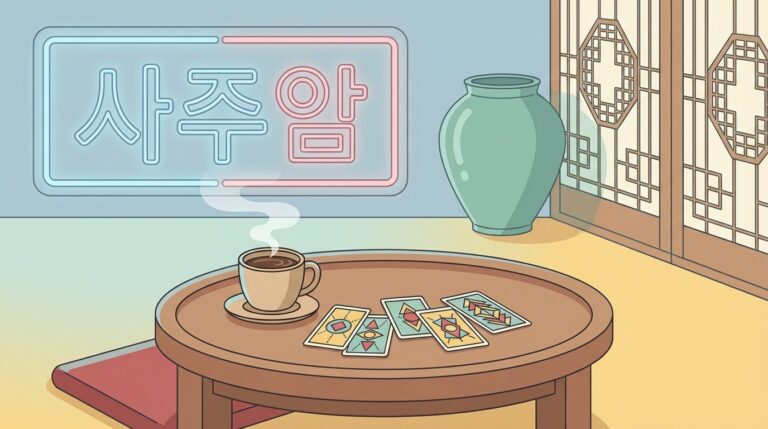
Have you ever walked down the vibrant streets of Hongdae or Myeongdong at night? Amidst the glowing neon signs of cosmetics shops and restaurants, you’ve probably noticed tiny tents or cozy cafes with signs flashing ‘사주’ (Saju) or ‘타로’ (Tarot). Or perhaps you’ve seen that classic K-Drama scene: a wealthy chaebol mother visits a mysterious shaman in a dim, incense-filled room to see if the female lead is a ‘good match’ for her son.
In Western cultures, fortune-telling might be seen as purely mystical or even taboo. But in Korea? It’s practically a national pastime! Whether it’s the start of a new year, before a big job interview, or on a first date, Koreans love getting their fortunes read. Today, we’re diving deep into Korea’s fascinating fortune-telling culture. Knowing these expressions won’t just help you navigate a Saju cafe—it will give you a profound glimpse into the Korean psyche.
This guide is packed with real questions and experiences from my B2-level students. Let’s unlock your Korean future! 🔮
Phase 2: Deep Dive into Core Expressions
Let’s learn the absolute must-know phrases before you step into a fortune-telling tent.
1. 사주 보러 갈래? (Do you want to go get our Saju read?)
- Pronunciation: Saju boreo gallae? [Sah-joo boh-ruh gahl-lae?]
- Meaning: Literal: Do you want to go see Four Pillars? / Real nuance: Wanna go get our fortune told?
- K-Culture Moment: It’s Friday night in Hongdae. You and your friends just finished eating K-BBQ, and you have some time before the last train. Someone points to a brightly lit cafe and says, ‘사주 보러 갈래?’ It’s a very common bonding activity among friends!
- Editor’s Insight: ‘사주’ (Saju) translates to ‘Four Pillars of Destiny,’ a traditional astrological concept based on your birth year, month, day, and exact time. Unlike Western horoscopes, it’s highly specific. Asking someone to go read Saju together is a sign that you are close friends!
- Situation Spectrum:
[🚫 Never] ———— [⚠️ Caution] ———— [✅ Freely]- Close Friends (Casual): ✅ (Use ‘갈래?’)
- Coworkers (Semi-formal): ⚠️ (Use ‘사주 보러 가실래요?’)
- Boss/Elders (Formal): 🚫 (Too personal!)
- 🤔 Think About It: Why is fortune-telling such a popular social activity in modern, high-tech Korea? Could it be a way for young people to vent their anxieties about the future in a highly competitive society?
2. 우리 궁합이 좋대요! (They said our compatibility is good!)
- Pronunciation: Uri gunghabi jotaeyo! [Oo-ree goong-hah-bee joh-tae-yo!]
- Meaning: Literal: Our marital harmony is good. / Real nuance: We are a great match!
- K-Culture Moment: You’ll see this everywhere in K-Dramas and K-Pop. Idol group members often check their ‘궁합’ (Gunghap) on YouTube variety shows to see who has the best team chemistry. In dramas, a bad Gunghap reading can literally drive the plot for three episodes!
- Editor’s Insight: Originally used strictly for marriage prospects, ‘궁합’ is now used casually for any type of compatibility—even between you and your favorite Korean food (e.g., ‘치킨과 맥주의 궁합’ – the chemistry of chicken and beer).
- Situation Spectrum:
[🚫 Never] ———— [⚠️ Caution] ———— [✅ Freely]- Partner/Friends: ✅
- Coworkers: ⚠️ (Only if you are joking about working well together)
- Business Meeting: 🚫
- 🤔 Think About It: Does your language have a specific word for the ‘mystical compatibility’ between two people, or do you just say ‘we get along well’?
3. 그냥 재미로 보는 거예요. (I’m just reading it for fun.)
- Pronunciation: Geunyang jaemiro boneun geoyeyo. [Geu-nyang jae-mee-roh boh-neun guh-yeh-yo.]
- Meaning: I’m just doing this for entertainment.
- K-Culture Moment: When a Korean friend suggests getting a Tarot reading, but you look a bit worried or hesitant because of your religious beliefs. Your friend will likely wave their hands and say this to reassure you.
- Editor’s Insight: This is the ultimate ‘shield’ phrase. Most Koreans don’t take Saju or Tarot as absolute gospel. It’s treated more like an MBTI personality test or a fun counseling session.
Phase 3: Textbook vs Real Life Korean
Let’s see how the textbook phrases compare to what you’ll actually hear in the neon-lit streets of Seoul.
| Situation | 📖 Textbook Korean | 🗣️ Real Korean | 💡 Why is it different? |
|---|---|---|---|
| Suggesting a visit | 당신의 운세를 알고 싶습니까? (Do you want to know your fortune?) | 우리 사주나 볼까? (Wanna just go see our Saju?) | ‘나’ implies ‘something like’ or ‘casually’. It lowers the pressure of the activity. |
| Hearing bad news | 나의 미래가 어둡습니다. (My future is dark.) | 아, 올해 삼재래 ㅠㅠ (Ah, they say it’s my Samjae year T_T) | ‘삼재’ (Samjae) refers to a 3-year period of bad luck. Koreans use this as a witty excuse when things go wrong! |
| Asking about love | 저의 연애 운명을 알려주세요. (Please tell me my romantic destiny.) | 연애운 봐주세요. (Please look at my love luck.) | Koreans love adding ‘-운’ (Luck) to everything: 연애운 (Love luck), 금전운 (Money luck), 취업운 (Job luck). |
Bottom Note: At a B2 level, start using the ‘-운’ (Luck) suffix! It makes your Korean sound incredibly natural. ‘요즘 금전운이 없어요’ (I have no money luck these days).
Phase 4: Cultural Deep Dive — K-Culture Connection
4-1. Non-verbal Communication: The ‘Bokchae’ (복채)
When you pay the fortune teller, it’s called ‘복채’ (Bokchae – fortune-telling fee). Culturally, it’s considered better luck to pay this in cash, and often handed over with two hands as a sign of respect to the elder reading your fortune. While many places accept bank transfers (계좌이체) now, handing over crisp cash still holds that traditional, mystical vibe.
4-2. K-Culture Connection: K-Drama Tropes vs. Reality
If you’ve watched Goblin or The Glory, you might think Korean shamans (무당 – Mudang) are terrifying figures jumping on sharp blades in traditional Hanbok.
The Reality: While traditional ‘Sinjeom’ (신점 – spirit reading) still exists and can be intense, the places you’ll likely visit as a traveler are Saju Cafes (사주카페). These look just like regular trendy coffee shops! You sip an iced Americano while a friendly person in normal clothes calculates your destiny on an iPad or a traditional notebook. It’s essentially a blend of astrology and modern psychological counseling.
Phase 5: Immersive Roleplay — Your Destiny in Hongdae
Setting: It’s 8:00 PM on a Saturday. You are wandering the bustling streets of Hongdae with your Korean language exchange partner, Min-su. You spot a brightly lit tent with purple curtains reading ‘타로 & 사주’ (Tarot & Saju).
Characters:
* YOU: An adventurous foreigner who wants to try everything in Korea, but your Korean is still at the B2 level.
* Min-su (28): Your friendly Korean buddy who loves to joke around.
* The Saju Reader (50s): An eccentric but warm lady with a stack of old books and an iPad.
Dialogue:
Min-su: 저기 타로집 있다! 우리 사주 보러 갈래?
(Jeogi tarojip itda! Uri saju boreo gallae?)
[Look, there’s a Tarot place! Wanna go get our Saju read?]
YOU: 오, 좋아요! 저 한 번도 안 해봤어요.
(O, joayo! Jeo han beondo an haebwatseoyo.)
[Oh, sounds good! I’ve never done it before.]
(🎭 Stage Direction: You both enter the cozy tent. It smells like sweet vanilla incense.)
Saju Reader: 어서 와요~ 뭐 보러 왔어? 연애운? 취업운?
(Eoseo wayo~ Mwo boreo watseo? Yeonae-un? Chwieobun?)
[Welcome~ What did you come to see? Love luck? Job luck?]
Min-su: 얘 연애운 좀 봐주세요! 올해 애인 생길까요?
(Yae yeonae-un jom bwajuseyo! Olhae aein saenggilkkayo?)
[Please read their love luck! Will they get a partner this year?]
Saju Reader: (Tapping on her iPad to calculate your birth time) 음… 사주에 불(Fire)이 너무 많네. 고집이 세!
(Eum… Sajue buri neomu manne. Gojibi se!)
[Hmm… You have too much Fire in your Saju. You are stubborn!]
Saju Reader: 올해는 연애운이 별로 없어요. 공부나 해!
(Olhaeneun yeonae-uni byeollo eopseoyo. Gongbuna hae!)
[You don’t have much love luck this year. Just study!]
🔀 YOUR TURN! How do you reply?
* A) (Start crying and leave the tent)
* B) 에이~ 그냥 재미로 보는 거잖아요! (Hey~ We’re just reading it for fun anyway!)
* C) 당신 틀렸어! 환불해 주세요! (You are wrong! Refund me!)✅ Best Choice: B — Why? Fortune tellers in Korea often speak bluntly to be entertaining. Using phrase B lightens the mood, shows off your high-level Korean Nunchi, and keeps the vibe fun.
⚠️ Choice C Analysis: Never demand a refund just because you didn’t like the fortune! It’s a cultural faux pas.
Phase 6: 10-Second Shadowing Drill
Practice speaking like a true local! Pay attention to the pauses (/) and the intonation.
🥺 선생님, / 저 올해 / 연애운은 / 어때요?
(Seonsaengnim, / jeo olhae / yeonae-uneun / eottaeyo?)
[Teacher, / how is / my love luck / this year?]
Pro Tip: Call the fortune teller ‘선생님’ (Seonsaengnim – Teacher). It shows respect and gets you on their good side!
Phase 7: K-Culture Glossary
| Korean | Romanization | English | Context |
|---|---|---|---|
| 사주 | saju | Four Pillars of Destiny | Korean astrology based on birth year, month, day, and time. |
| 타로 | taro | Tarot | Often mixed with Saju in cafes. Very popular among teens/20s. |
| 궁합 | gunghap | Compatibility | Used to see if two people are a good match (romantic or business). |
| 삼재 | samjae | Three Years of Misfortune | A superstitious period of bad luck everyone goes through every 9 years. |
| 복채 | bokchae | Fortune-telling fee | The money you pay for the reading. |
| 부적 | bujeok | Talisman/Amulet | Yellow paper with red ink drawings, believed to ward off evil. |
Phase 8: Traveler’s Survival Kit
Planning to visit a Saju Cafe on your trip to Korea? Here are your lifesavers!
🆘 Survival Phrases
1. 🇰🇷 ‘태어난 시간을 모르면 어떡하나요?’ (Tae-eo-nan siganeul moreumyeon eotteokanayo?)
🗣️ What if I don’t know my exact birth time?
💡 (They will likely suggest a Tarot reading instead, as Saju requires exact times!)
- 🇰🇷 ‘외국인 사주도 볼 수 있나요?’ (Oegugin sajudo bol su innayo?)
🗣️ Can you read Saju for foreigners too?
💡 (Yes! Just remember to provide your birth date in the Solar calendar – 양력).🇰🇷 ‘계좌이체 되나요?’ (Gyejwa-iche doenayo?)
🗣️ Do you accept bank transfers?📌 Editor’s Travel Note
* Language Barrier: Some popular Saju cafes in Hongdae or Itaewon have English or Japanese-speaking readers! Search ‘English Saju Cafe’ on Naver Maps.
* Pricing: A basic Tarot reading is usually 5,000~10,000 KRW. A full Saju reading is around 30,000~50,000 KRW.
Phase 9: Think Deeper — K-Culture Essay
Media vs Reality: The ‘Counseling’ Role of Fortune Tellers
In movies, Korean shamans are depicted as supernatural entities talking to spirits. But in modern Korean reality, Saju readers and Tarot masters often act as unofficial therapists. In a fast-paced society where mental health counseling was historically stigmatized, visiting a Saju cafe became a socially acceptable way to talk about your deepest anxieties regarding jobs, relationships, and money. When a reader says, ‘It’s not your fault, it’s just your Samjae (bad luck period),’ it offers a tremendous psychological comfort to the listener. It relieves them of the heavy burden of failure.
💬 Your Turn: In your home country, where do young people go when they feel lost about their career or relationships? Do you have something similar to a Saju cafe? Share in the comments!
Phase 10: FAQ & Troubleshooting
Q: I’m Christian/Muslim. Is it okay to go to a Saju cafe?
Yes! Most young Koreans treat Saju and Tarot strictly as entertainment, much like taking an MBTI test or reading a Sunday newspaper horoscope. You don’t have to believe in it as a religion. Just use the phrase we learned: ‘재미로 보는 거예요’ (Just for fun!).
Q: Are they going to curse me if I don’t buy a talisman (Bujeok)?
Absolutely not! Street-side Tarot/Saju cafes are highly commercialized and regulated. They are just trying to make a living, not put a hex on you.
❌ Common Mistake: Using ‘당신’ (You) when addressing the fortune teller.
✅ Do This Instead: Always call them ‘선생님’ (Teacher) or ‘이모님’ (Auntie – if it’s a very casual street tent). ‘당신’ sounds extremely aggressive in spoken Korean!
Phase 11: Wrap-up & Action Items
✨ One-Liner Summary: Treat Korean Saju and Tarot not as dark magic, but as a fun, culturally rich counseling session where you can bond with friends!
🚀 Your Action Missions:
* 🥉 Bronze: Look in the mirror and ask, ‘올해 연애운 어때요?’ (How’s my love luck this year?) 3 times.
* 🥈 Silver: Ask your Korean language partner or tutor what their ‘MBTI and Saju’ say about them.
* 🥇 Gold: Visit a Saju cafe in Korea, use ‘선생님, 연애운 봐주세요!’, and pay with cash!
🎥 K-Culture Mission: Go to YouTube and search ‘[Your Favorite K-Pop Idol] 타로’ or ‘[Idol Name] 사주’. You will definitely find a video of them getting their fortune read. Try to catch the words ‘연애운’ or ‘궁합’!
Phase 12: Interactive Challenge — Quiz Time!
1. You want to ask your close friend to go get a Tarot reading together. What is the most natural B2-level phrase?
* A) 우리 타로 보러 갈래?
* B) 당신의 운세를 확인합시다.
* C) 타로를 예약해 주십시오.
2. True or False: You should always use your credit card at traditional fortune-telling tents because they prefer it.
* (T / F)
3. Fill in the blank: If someone says you are a great match for a project or marriage, they will say: ‘우리 ( _______ )이/가 좋대요!’
(Highlight the invisible text below to see answers!)
[Answers: 1. A (B and C are way too formal/robotic!) / 2. False (Cash or bank transfer is highly preferred for ‘Bokchae’) / 3. 궁합 (Gunghap)]
Frequently Asked Questions (FAQ)
Q: What does "사주 보러 갈래? (Do you want to go get our Saju read?)" mean in Korean and how do you pronounce it?
A: In Korean, "사주 보러 갈래? (Do you want to go get our Saju read?)" is pronounced [Saju boreo gallae? [Sah-joo boh-ruh gahl-lae?] and means: Literal: Do you want to go see Four Pillars? / Real nuance: Wanna go get our fortune told?
Q: What does "우리 궁합이 좋대요! (They said our compatibility is good!)" mean in Korean and how do you pronounce it?
A: In Korean, "우리 궁합이 좋대요! (They said our compatibility is good!)" is pronounced [Uri gunghabi jotaeyo! [Oo-ree goong-hah-bee joh-tae-yo!] and means: Literal: Our marital harmony is good. / Real nuance: We are a great match!
Q: What does "그냥 재미로 보는 거예요. (I'm just reading it for fun.)" mean in Korean and how do you pronounce it?
A: In Korean, "그냥 재미로 보는 거예요. (I'm just reading it for fun.)" is pronounced [Geunyang jaemiro boneun geoyeyo. [Geu-nyang jae-mee-roh boh-neun guh-yeh-yo.] and means: I'm just doing this for entertainment.







