

Phase 1: Immersive Hook
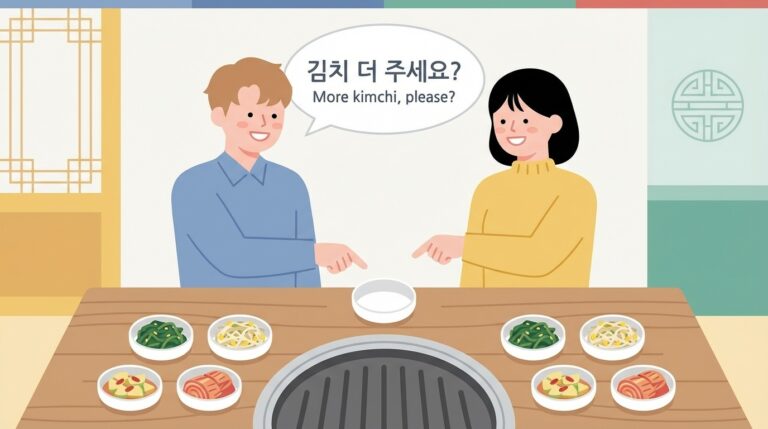
Hello! I’m your Daily Hangul editor. Imagine this: You’re sitting in a bustling Korean BBQ restaurant in the heart of Hongdae. Sizzling pork belly, the clinking of soju glasses, and a table completely covered in tiny, colorful plates of food. You take a bite of that sweet and savory fish cake (eomuk), and it’s so good that your plate is empty in seconds.
You look around. In your home country, asking for more might mean paying an extra $3. But in a K-Drama, you’ve seen the main characters effortlessly wave a hand and magically get their bowls refilled. You want to ask… but your mind goes blank. You freeze, staring sadly at your empty dish.
Sound familiar? Not knowing how to ask for a banchan (side dish) refill is a tragic missed opportunity! Korean side dishes are famously free and infinite (most of the time). This guide, born from the frantic text messages of my real students sitting in Korean restaurants, will teach you exactly how to ask for more without feeling awkward. Let’s get you that extra kimchi!
Phase 2: Deep Dive (Key Expressions)
1. 사장님, 이거 좀 더 주세요. (Boss, please give me a little more of this.)
- Pronunciation: [Sajangnim, igeo jom deo juseyo.] / Sah-jahng-neem, ee-guh johm duh joo-seh-yoh.
- Meaning: Literal: Boss, please give more of this. / Real nuance: Excuse me, could I get a refill of this, please?
- K-Culture Moment: You’ll hear this echoing across every gukbap (soup and rice) restaurant during the busy lunch rush. Calling the server “사장님” (Boss) is the ultimate respect hack, even if they aren’t the actual owner.
- Editor’s Insight: The magic word here is 좀 (a little). It softens your request. “더 주세요” sounds like a command, but “좀 더 주세요” sounds like a polite favor.
- Situation Spectrum:
[🚫 절대 금지] ———— [⚠️ 주의] ———— [✅ 자유롭게]
- Close friends (Casual): 🚫 (Too formal for friends, you’d say “이거 더 줘”)
- Restaurant Staff (Polite): ✅
- Fancy Michelin Dining: ⚠️ (Better to use “여기요” instead of “사장님” in highly formal spots)
- 🤔 Think About It: Why do Koreans call restaurant workers “Boss” (사장님) or “Auntie” (이모님)? What does this reveal about how Koreans view service workers compared to your home country?
2. 반찬 리필 되나요? (Can side dishes be refilled?)
- Pronunciation: [Banchan ripil doenayo?] / Bahn-chahn ree-peel dweh-nah-yoh?
- Meaning: Literal: Is banchan refill possible? / Real nuance: Can I get more of these side dishes?
- K-Culture Moment: You’re at a trendy, modern Korean bistro. The vibe is a bit upscale, and you aren’t 100% sure if the traditional “free refill” rule applies here. You ask this softly to check.
- Editor’s Insight: Notice the Konglish word 리필 (Refill). It’s widely understood! Using “~되나요?” (Is it possible / Can it be done?) is a fantastic B1 grammar structure that shows you are considerate and not demanding.
- Situation Spectrum:
[🚫 절대 금지] ———— [⚠️ 주의] ———— [✅ 자유롭게]
- Casual Mom-and-Pop shop: ✅
- Modern Cafe/Restaurant: ✅
- 🤔 Think About It: Konglish (Korean-English) is everywhere in Korea. Is it “ruining” the language, or just a natural evolution of global communication?
3. 저기요, 혹시 셀프바 있어요? (Excuse me, by any chance, is there a self-serve bar?)
- Pronunciation: [Jeogiyo, hoksi selpeuba isseoyo?] / Juh-gee-yo, hohk-shee sel-peu-bah ee-ssuh-yoh?
- Meaning: Literal: Excuse me, by chance, is there a self-bar? / Real nuance: Do I need to get my own refills?
- K-Culture Moment: You yelled “Sajangnim!” but the staff just pointed to a corner. Nowadays, to save on labor costs, many Korean restaurants use a 셀프바 (Self-bar) where you scoop your own kimchi.
- Editor’s Insight: 혹시 (by any chance) is your best friend when you are unsure. It instantly makes any question sound 10x more polite and cautious.
- Situation Spectrum:
[🚫 절대 금지] ———— [⚠️ 주의] ———— [✅ 자유롭게]
- All restaurants: ✅
- 🤔 Think About It: The “self-bar” culture is replacing the traditional service of servers bringing you endless plates. Do you prefer the convenience of serving yourself, or the warmth of being served?
Phase 3: Textbook vs Real Life
| Situation | 📖 Textbook Korean | 🗣️ Real Korean | 💡 Why is it different? |
|---|---|---|---|
| Calling the server | 종업원님! (Mr./Ms. Employee!) | 사장님! / 저기요! (Boss! / Excuse me!) | “Employee” sounds too distant and clinical. Koreans prefer relational titles. |
| Asking for more | 김치를 더 주시겠습니까? (Would you please give more kimchi?) | 김치 좀 더 주세요~ (Please give a little more kimchi~) | Textbooks teach highly formal business Korean. Restaurants run on friendly, efficient politeness. |
| Pointing at a dish | 이 반찬을 더 주세요. (Give more of this side dish.) | 이거 리필해 주세요. (Please refill this.) | People prefer pointing and saying “this” (이거) plus the Konglish word “refill” for speed. |
Bottom Note: At a B1 level, you want to shed that rigid textbook skin. Throw away “종업원” (employee) completely. Stick to “사장님” (Sajangnim) or “저기요” (Jeogiyo), and use a friendly, slightly raised tone at the end of your sentences!
Phase 4: Cultural Deep Dive
4-1. Non-verbal Communication: The Magic Button & Nunchi
Don’t just shout into the void! Look at your table. Do you see a little call button? Press it.
Ding-dong!
This is the ultimate hack. You don’t even need to yell “Jeogiyo!” Just press the button, and when they arrive, politely point to your empty dish and say, “이거 좀 더 주세요.”
Also, use your 눈치 (Nunchi). If the restaurant is a chaotic warzone and the server is carrying a massive, boiling pot of stew, wait a moment. Eye contact in Korea doesn’t mean a hard stare—just a soft gaze, a raised hand, and a warm nod.
4-2. K-Food Connection: The Culture of ‘Jeong’ (정)
Why are banchan free in the first place? It stems from the Korean concept of 정 (Jeong)—a deep feeling of affection, connection, and communal sharing. Historically, Koreans believed that a meal isn’t just about calories; it’s about sharing warmth. Offering endless side dishes is a restaurant owner’s way of saying, “Eat well, grow strong, and feel at home.” Even though modern inflation has made things tougher, the banchan culture proudly survives as the ultimate symbol of Korean hospitality.
Phase 5: Immersive Roleplay
Scenario A: The Samgyeopsal Showdown
Setting: Friday night, 7 PM. A smoky, bustling BBQ place near Gangnam Station. The smell of roasted garlic is in the air. You are out with your Korean coworker, Minsu.
Characters:
– YOU: A foreign professional, 3 months into your Seoul assignment, eager to impress.
– Minsu (32): Your friendly, slightly loud Korean coworker who is aggressively grilling the meat.
Minsu: 아, 역시 삼겹살은 금요일에 먹어야 제맛이지! 🥩
(Ah, yeoksi samgyeopsareun geumyoire meogeoya jemasi-ji!)
[Ah, pork belly always tastes best on a Friday!]
(🎭 Stage Direction: Minsu flips the meat with professional precision.)
YOU: 진짜 맛있어요! 근데 저기요… 쌈무가 다 떨어졌네요.
(Jinjja masisseoyo! Geunde jeogiyo… ssammuga da tteoreojyeonneyo.)
[It’s really delicious! But hey… we’re all out of pickled radish.]
Minsu: 어? 그래? 내가 시킬게.
(Eo? Geurae? Naega sikilge.)
[Oh? Really? I’ll order it.]
🔀 Your Turn! How do you respond to show off your B1 Korean skills?
– A) “아니요, 제가 할게요. 종업원님! 쌈무 추가해 주십시오!”
– B) “제가 해볼게요! (Presses bell) 사장님~ 여기 쌈무 좀 더 주세요!”
– C) “아싸! 쌈무 리필 대박!”✅ Best Choice: B — You take the initiative using the bell, a natural title (Sajangnim), and the softening word (jom).
⚠️ Choice A Analysis: Sounds like a robot from a 1990s textbook.
⚠️ Choice C Analysis: “Daebak” is fun, but totally ignores the server and the etiquette of asking politely.
(Assuming you chose B)
Server: 네~ 바로 갖다 드릴게요!
(Ne~ baro gatda deurilgeyo!)
[Yes~ I’ll bring it right over!]
Minsu: 오~ 한국어 진짜 많이 늘었는데요? 완전 한국인 다 됐어!
(O~ hangugeo jinjja mani neureonneundeyo? Wanjeon hangugin da dwaesseo!)
[Oh~ your Korean has improved so much! You’re basically Korean now!]
Scenario B: The K-Drama “Imo-nim” Moment
Setting: A tiny, older neighborhood diner. You are eating a spicy bowl of Kimchi Jjigae alone.
Server (Imo-nim – Auntie): (Slides a plate of fried eggs onto your table) 학생, 많이 먹어~
(Haksaeng, mani meogeo~)
[Student, eat up~]
YOU: 어? 저 이거 안 시켰는데요?
(Eo? Jeo igeo an sikyeonneundeyo?)
[Huh? I didn’t order this?]
Server: 서비스야. 타향살이 힘들지? 밥 든든하게 먹어야지!
(Seobiseuya. Tahyangsari himdeulji? Bap deundeunhage meogeoyaji!)
[It’s ‘service’ (on the house). Living away from home is hard, right? You need to eat heartily!]
(This is the ultimate ‘Jeong’ moment you’ll see in dramas and real life!)
Phase 6: 10-Second Shadowing Drill
Let’s practice the flow. Pay attention to the pauses (/) and the mood!
😊 Polite & Bright:
사장님~ / 이거 / 조금만 더 / 주실 수 있어요?
(Sajangnim~ / igeo / jogeumman deo / jusil su isseoyo?)
🥺 Slightly shy (if you’ve asked 3 times already):
저기요… / 죄송한데 / 김치 / 리필 되나요?
(Jeogiyo… / joesonghande / gimchi / ripil doenayo?)
Phase 7: K-Culture Glossary
| Korean | Romanization | English | Context |
|---|---|---|---|
| 반찬 | banchan | Side dishes | Small plates served with rice. The backbone of a Korean meal. |
| 리필 | ripil | Refill | Konglish word. Works for side dishes, coffee (rarely), and water. |
| 이모님 | imonim | Auntie | Affectionate term for older female restaurant workers. Used in casual spots. |
| 눈치 | nunchi | Social awareness | Reading the room. e.g., Not asking for a refill when the staff is swamped. |
| 서비스 | seobiseu | “Service” (Freebie) | Free food given by the owner as a gesture of goodwill. |
| 셀프바 | selpeuba | Self-bar | A designated area where you scoop your own extra side dishes. |
Phase 8: Traveler’s Survival Kit
🆘 Survival Expression #1: Finding the Self-Bar
– 🇰🇷 “반찬은 셀프인가요?” (Banchaneun selpeuingayo?)
– 🗣️ Pronunciation: Bahn-chahn-eun sel-peu-in-gah-yoh?
– 📍 Where to use: Any casual restaurant, fast-casual spots, malatang shops.
– 💡 Pro Tip: Look around for a sign that says “물과 반찬은 셀프입니다” (Water and banchan are self-serve) before you ask!📌 Editor’s Travel Note
– Call Buttons: Look under your napkin box or on the table edge. The bell is your best friend!
– Tipping: 🚨 NO TIPPING IN KOREA! 🚨 Do not leave cash on the table for good service or a fast refill. It will cause confusion, and they might chase you down the street to return your money.
– Paying: You usually take your bill (빌지) to the front counter to pay when you leave, rather than paying at the table.
Phase 9: Think Deeper
🧠 Think Deeper: Food & Identity (음식과 정체성)
In many Western cultures, a meal is deeply individualized—you order your plate, and you eat your plate. But in Korea, the table is a shared ecosystem. Soups are placed in the center, and banchan are meant to be reached for by everyone’s chopsticks. This communal dining reflects Korea’s “We” (우리) culture, where sharing food breaks down social barriers and builds intimacy. When you ask for a refill, you aren’t just getting more food; you are actively participating in the Korean rhythm of communal abundance.💬 Your Turn: Does your culture have a tradition of sharing food from the center of the table, or is dining strictly individual? How did it feel the first time you shared a Korean meal? Share in the comments!
Phase 10: FAQ & Troubleshooting
Q: Can I get unlimited refills on meat or main dishes?
No! Unless it specifically says “무한리필” (Muhan-ripil / All-you-can-eat), main dishes (like pork belly, stews, or premium seafood) cost extra. Only the small side dishes (kimchi, bean sprouts, etc.) are free.
Q: Should I use “이모님” (Auntie) everywhere?
No. “이모님” is great for casual, older gukbap or BBQ joints. But if you are in a modern cafe, an Italian restaurant in Seoul, or a high-end dining spot, use “저기요” (Excuse me) instead. It’s safer.
❌ Common Mistake #1: Yelling “야!” (Hey!) or waving frantically to get the server’s attention.
✅ Do this instead: Press the call button, or raise your hand slightly and make eye contact while saying “저기요~” (Jeogiyo~).
Phase 11: Wrap-up & Action Items
One-Liner Summary: Soften your request with “좀” (a little), respect the server with “사장님” (Boss), and enjoy the infinite glory of Korean banchan!
Your Action Missions for Today:
– 🥉 Bronze (Solo): Say “이거 좀 더 주세요” out loud to your mirror 3 times, focusing on a friendly tone.
– 🥈 Silver (Online): Find a K-BBQ Mukbang on YouTube and leave a comment: “한국 식당에서 반찬 리필은 최고예요!” (Banchan refills at Korean restaurants are the best!)
– 🥇 Gold (Real Life): Next time you visit a Korean restaurant, don’t suffer in silence! Confidently ask for more kimchi using today’s phrases.
📺 Special K-Culture Mission: Watch an episode of a K-Drama featuring a restaurant scene (like Let’s Eat or Hospital Playlist). Keep your eyes peeled—can you spot the characters asking for “Service” (서비스) or a refill?
Did you ever have an embarrassing moment ordering food in Korea? Let me know in the comments below!
Phase 12: Interactive Quiz
1. Situational Judgment: You are at a trendy, modern Korean fusion restaurant. You want more pickled radishes. What is the BEST way to ask?
– A) 종업원님! 무 추가!
– B) 이모!! 여기 무 좀 더 줘!
– C) 저기요, 이거 조금만 더 주실 수 있나요?
(Answer: C. Since it’s a modern/trendy spot, “Jeogiyo” is safer than “Imo”, and “jusil su innayo” is wonderfully polite.)
2. True or False – K-Culture Edition:
“If the restaurant gives you a free bottle of Coke and says it’s ‘Service’, you should leave a $2 tip on the table when you leave.”
(Answer: FALSE. There is absolutely no tipping in Korea. Just smile and say “감사합니다! 잘 마실게요!” (Thank you! I’ll drink it well!))
3. Fill in the Blank:
You want to ask if you have to get the side dishes yourself.
“저기요, 혹시 반찬은 ____ 인가요?”
(Answer: 셀프 / selpeu – self-serve)
Great job today! See you in the next lesson of Daily Hangul! 😊
Frequently Asked Questions (FAQ)
Q: What does "사장님, 이거 좀 더 주세요. (Boss, please give me a little more of this.)" mean in Korean and how do you pronounce it?
A: In Korean, "사장님, 이거 좀 더 주세요. (Boss, please give me a little more of this.)" is pronounced [Sajangnim, igeo jom deo juseyo.] and means: Literal: Boss, please give more of this. / Real nuance: Excuse me, could I get a refill of this, please?
Q: What does "반찬 리필 되나요? (Can side dishes be refilled?)" mean in Korean and how do you pronounce it?
A: In Korean, "반찬 리필 되나요? (Can side dishes be refilled?)" is pronounced [Banchan ripil doenayo?] and means: Literal: Is banchan refill possible? / Real nuance: Can I get more of these side dishes?
Q: What does "저기요, 혹시 셀프바 있어요? (Excuse me, by any chance, is there a self-serve bar?)" mean in Korean and how do you pronounce it?
A: In Korean, "저기요, 혹시 셀프바 있어요? (Excuse me, by any chance, is there a self-serve bar?)" is pronounced [Jeogiyo, hoksi selpeuba isseoyo?] and means: Literal: Excuse me, by chance, is there a self-bar? / Real nuance: Do I need to get my own refills?







