

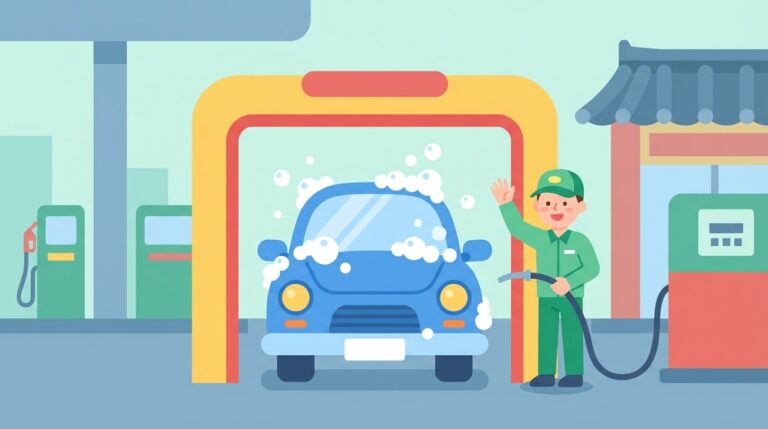
Hello! I am the Lead Editor of Daily Hangul.
Have you ever watched a K-Drama where the main characters go on a romantic road trip to Jeju Island? The wind is blowing, the ocean is sparkling… but wait, their rental car is covered in dust from the coastal roads! They pull into a gas station. What exactly do they say to get their car sparkling clean again?
If you’re planning to rent a car and drive around Korea—whether it’s exploring Jeju or taking a day trip outside Seoul—getting a car wash (세차, secha) is a must. But asking for it in a foreign language can feel intimidating!
Today, we will learn the easiest, most natural way to ask for a car wash at a Korean gas station. This guide is built from the real experiences of my students who survived their first Korean road trips. Let’s dive in!
Phase 2: Core Expression Deep Dive
1. 세차 돼요?
- Pronunciation: secha dwaeyo? [Sounds like: se-cha dway-yo?]
- Meaning: Can I get a car wash? (Literal: Does car wash become/work?)
- K-Culture Moment: You pull up to the gas station. You roll down the window, make eye contact with the friendly attendant, and simply drop this short question. It sounds incredibly local and instantly builds rapport!
- Editor’s Insight: Instead of translating “Can I…?” word-for-word, Koreans use “돼요?” (Does it work? / Is it available?). It feels much more natural, polite, and less demanding than saying “I want to…”
- Situation Spectrum:
[🚫 절대 금지] ———— [⚠️ 주의] ———— [✅ 자유롭게]
- Casual (Friends): ✅ (Drop the ‘요’ -> 세차 돼?)
- Semi-formal (Staff/Strangers): ✅ (Perfect!)
- Formal (Elders/Bosses): ⚠️ (Better to use complete formal sentences)
- 🤔 Think About It: Why do Koreans focus on “Is the service available?” rather than “Can I do it?” How does this reflect the Korean focus on the situation rather than the individual?
2. 세차장 어디에 있어요?
- Pronunciation: sechajang eodie isseoyo? [Sounds like: se-cha-jang eo-di-e ee-seo-yo?]
- Meaning: Where is the car wash?
- K-Culture Moment: Perfect for massive highway rest stops (휴게소) where the car wash might be hidden behind rows of gas pumps and food stalls!
- Editor’s Insight: The magic formula! Just attach “어디에 있어요?” (Where is it?) to any place you are looking for.
- Situation Spectrum:
[🚫 절대 금지] ———— [⚠️ 주의] ———— [✅ 자유롭게]
- Casual: ✅
- Semi-formal: ✅
- Formal: ⚠️
Phase 3: Textbook vs Real Life
| Situation | 📖 Textbook Korean | 🗣️ Real Korean | 💡 Why is it different? |
|---|---|---|---|
| Asking for a wash | 세차를 할 수 있습니까? (Can I wash my car?) | 세차 돼요? (Is wash available?) | Koreans love efficiency in daily transactions. 4 syllables beat 8! |
| Asking the price | 요금이 얼마입니까? (What is the fare?) | 얼마예요? (How much?) | Keeping it short and casual but polite with ‘요’ is standard. |
| Handing over a receipt | 영수증을 드리겠습니다. (I will give you the receipt.) | 여기 있어요. (Here it is.) | Direct, simple, and polite. Action speaks louder than words! |
Bottom Note: At the A2 level, you don’t need long, robotic sentences. Short phrases with a polite “요” at the end are your best friends in Korea!
Phase 4: K-Culture Deep Dive
4-1. Non-verbal Communication (Nunchi at the Pump)
When speaking from your car window, you don’t need to bow deeply. A slight “head nod” (목례) while staying seated is perfectly polite. Also, when handing over your credit card or receipt to the attendant, try to use both hands—or at least use one hand while your other hand lightly supports your elbow. It’s a small gesture that screams, “I respect Korean culture!”
4-2. The “Gas + Wash” K-Travel Culture
In Korea, gas stations (주유소) and automatic car washes go hand in hand. Usually, if you pump gas over a certain amount (e.g., 50,000 KRW), the machine spits out a discount receipt (할인 영수증). You hand this receipt to the car wash attendant to get a massive discount—sometimes the wash is just 2,000 to 3,000 KRW!
Also, did you know? “Self Car Wash” (셀프 세차장) has become a huge hobby for young Koreans! They gather late at night, drink iced Americanos, and spend hours meticulously cleaning their cars with foam guns. It’s totally different from the quick automatic washes!
Phase 5: Immersive Roleplay Scenario
Scenario A: The Jeju Island Road Trip
- Setting: A sunny afternoon at a gas station in Jeju Island. The ocean breeze is nice, but your rental car is salty and dusty. You just pumped gas and want to wash it before returning it.
- Characters:
- YOU: An adventurous tourist, a bit nervous but excited to use Korean.
- Attendant (직원): A friendly local ajusshi (middle-aged man) wearing a cap.
YOU: 안녕하세요! 👋
(annyeonghaseyo!)
[Hello!]
직원: 어서 오세요. 주유 다 하셨어요?
(eoseo oseyo. juyu da hasyeosseoyo?)
[Welcome. Are you done pumping gas?]
YOU: 네. 저기… 세차 돼요? 🚗✨
(ne. jeogi… secha dwaeyo?)
[Yes. Um… can I get a car wash?]
직원: 네, 됩니다. 영수증 있으세요?
(ne, doemnida. yeongsujeung isseuseyo?)
[Yes, it’s available. Do you have a receipt?]
(🎭 Stage Direction: He points toward the receipt in your hand)
YOU: 아, 네! 여기 있어요.
(a, ne! yeogi isseoyo.)
[Ah, yes! Here it is.]
직원: 네~ 주유하셨으니까 세차비는 3,000원입니다.
(ne~ juyuhasyeosseunikka sechabineun samcheonwonimnida.)
[Okay~ Since you got gas, the car wash fee is 3,000 won.]
🔀 Your Turn! How should you respond?
– A) “카드 돼요?” (Can I pay by card?)
– B) “비싸요. 안 할래요.” (It’s expensive. I won’t do it.)
– C) “깎아주세요!” (Give me a discount!)✅ Best Choice: A! In Korea, it is completely normal to pay for small amounts like 3,000 won with a credit card. “카드 돼요?” (kadeu dwaeyo?) is a lifesaver phrase!
⚠️ Choice C Analysis: Asking for a discount at a fixed-price automatic car wash will definitely confuse the attendant!
Scenario B: Bonus – The Self Car Wash Date
- YOU: 주말에 뭐 해요? (jumare mwo haeyo? – What are you doing this weekend?)
- Korean Friend: 저녁에 셀프 세차장 갈 거예요. 같이 갈래요? (jeonyeoge selpeu sechajang gal geoeyo. gachi gallaeyo? – I’m going to the self car wash in the evening. Want to come?)
- YOU: 오, 좋아요! 재밌겠어요. (o, joayo! jaemitgesseoyo. – Oh, sounds good! That sounds fun.)
Phase 6: 10-Second Shadowing Drill
Let’s practice! Follow the intonation (강세) and pausing (끊어 읽기) marks.
😊 저기요, / 세차 / 돼요?
(jeogiyo, / secha / dwaeyo?)
Feel confident and polite!
💳 저기… / 카드 / 돼요?
(jeogi… / kadeu / dwaeyo?)
Slightly tilt your head, as if asking a small favor.
Phase 7: K-Culture Glossary
| Korean | Romanization | English | Context |
|---|---|---|---|
| 세차 | secha | Car wash | Can be automatic (자동) or self-service (셀프). |
| 주유소 | juyuso | Gas station | Unlike many countries, Korean gas stations often have staff who will pump the gas for you, though ‘Self’ stations are growing. |
| 영수증 | yeongsujeung | Receipt | Keep this for your car wash discount! |
| 가득 | gadeuk | Full / Fill it up | The magic word when you want a full tank of gas. |
| 휴게소 | hyugeso | Highway rest area | Famous for amazing street food (like tornado potatoes) and exceptionally clean restrooms! |
Phase 8: Traveler’s Survival Kit
🆘 Survival Expression #1: Fill ‘er up!
– 🇰🇷 “가득 넣어주세요.” (gadeuk neoeojuseyo)
– 🗣️ Pronunciation Guide: ga-deuk neo-eo-ju-se-yo
– 📍 Where to use: At full-service gas stations.
– 💡 Pro Tip: If you don’t want a full tank, just say the amount! “오만 원 넣어주세요” (50,000 won, please).🆘 Survival Expression #2: Trash Disposal
– 🇰🇷 “영수증 버려주세요.” (yeongsujeung beoryeojuseyo)
– 🗣️ Pronunciation Guide: yeong-su-jeung beo-ryeo-ju-se-yo
– 📍 Where to use: Gas stations, cafes, convenience stores.
– 💡 Pro Tip: Koreans love a clean wallet. Cashiers will often ask if you need the receipt. Say this to save paper!📌 Editor’s Travel Note
– Useful Apps: Google Maps doesn’t work well in Korea. Download Naver Map or KakaoMap. They have dedicated buttons to find the nearest gas station (주유소) and even show real-time gas prices!
– Payment: Korea is a cashless society. Your foreign Visa/Mastercard will work in almost 99% of gas stations and car washes.
Phase 9: Think Deeper — Language & Context
🧠 Think Deeper: The Disappearance of “I”
In English, we say “Can I get a car wash?” The focus is entirely on the speaker (I). But in Korean, we say “세차 돼요?” (Does the car wash work/become?). Notice how the subject “I” completely disappears? Korean is a deeply context-dependent language. It reflects a cultural mindset that focuses on the shared situation and the environment, rather than the individual ego. It’s not about what I can do, but what the situation allows us to do together.
💬 Your Turn: Does your native language focus more on the “I” (like English) or the “situation” (like Korean)? Share in the comments!
Phase 10: FAQ & Troubleshooting
- Q: Can I just drive straight into the automatic car wash machine?
- A: No! Always stop and pay the attendant first. Also, remember to put your car in Neutral (N) and take your foot off the brake once you enter the machine track!
- Q: Can I use “돼요?” (dwaeyo) to older people?
- A: Yes! Because it ends with the polite suffix “~요”, it is perfectly fine to use with gas station attendants, cashiers, and restaurant staff.
❌ Common Mistake: Translating “I want a car wash” directly into “나는 세차를 원해요” (naneun sechareul wonhaeyo).
✅ Do this instead: This sounds like a robot from a sci-fi movie! Always stick to the natural situation-based phrase: “세차 돼요?”
Phase 11: Wrap-up & Action Items
One-Liner Summary: Next time your rental car gets dirty, just roll down your window with a smile and ask, “세차 돼요?”
🔥 Action Mission:
– 🥉 Bronze (Solo): Stand in front of a mirror, pretend you are rolling down a car window, and say “세차 돼요?” out loud 3 times.
– 🥈 Silver (Online): Comment below with one K-Drama or Variety show where you saw the characters driving a car!
– 🥇 Gold (Real Life): On your next trip to Jeju or rural Korea, confidently use this phrase to get a sparkling clean rental car!
🎥 K-Culture Mission: Open Naver Map or KakaoMap right now, zoom into Jeju Island, search for “주유소” (Gas station), and look at the Street View. Can you spot the automatic car wash tunnels next to the pumps?
Phase 12: Interactive Quiz
1. Situational Judgment: You are at a gas station. You paid for gas and got a receipt. You want to ask if they can wash your car. What is the most natural thing to say?
– A) 나는 세차를 원해요. (I want a car wash.)
– B) 세차 돼요? (Is car wash available?)
– C) 세차장 어디에 있어요? (Where is the car wash?)
2. True or False – K-Culture Edition:
– “In Korea, you must always pay for an automatic car wash in cash because it’s cheap.”
– (T / F)
3. Fill in the Blank:
You want to ask if credit cards are accepted.
“___ 돼요?”
(Check your answers in the comments!)
Frequently Asked Questions (FAQ)
Q: What does "세차 돼요?" mean in Korean and how do you pronounce it?
A: In Korean, "세차 돼요?" is pronounced [secha dwaeyo? [Sounds like: se-cha dway-yo?] and means: Can I get a car wash? (Literal: Does car wash become/work?)
Q: What does "세차장 어디에 있어요?" mean in Korean and how do you pronounce it?
A: In Korean, "세차장 어디에 있어요?" is pronounced [sechajang eodie isseoyo? [Sounds like: se-cha-jang eo-di-e ee-seo-yo?] and means: Where is the car wash?







