

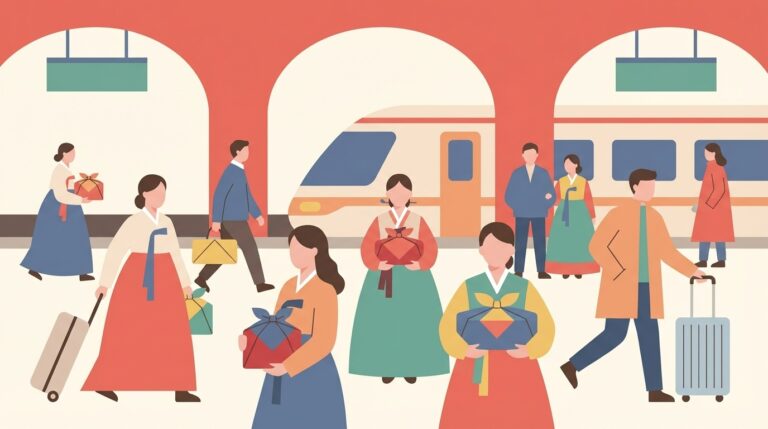
Phase 1: 공감 — 몰입형 오프닝 (Immersive Hook)
Hello! I’m your Daily Hangul Editor.
Picture this: You are watching a K-Drama. It’s the week before the Lunar New Year (설날 – Seollal). The protagonist is furiously clicking their mouse at an internet cafe, sweating as if they are trying to hack the Pentagon. But they aren’t saving the world—they are just trying to book a KTX train ticket to their hometown!
Or maybe you are actually in Korea right now. You walk into a supermarket, and suddenly there are massive, shiny gift boxes stacked to the ceiling… filled with SPAM and cooking oil? Your Korean coworkers start packing up early on a Friday, holding these giant SPAM boxes, asking you a question with the word “Gohyang” in it.
If you don’t know what’s going on, you might think everyone is preparing for a zombie apocalypse. But actually, it’s just the great Korean holiday migration! During Seollal, millions of Koreans travel back to their hometowns. Knowing just a few simple phrases about this “Hometown Migration” will instantly turn you from a confused tourist into a cultural insider.
Let’s dive into the essential survival phrases for Korea’s biggest holiday!
Phase 2: 핵심 표현 심층 분석 (Deep Dive)
1. 고향에 가요? (Are you going to your hometown?)
- Pronunciation: [Go-hyang-e ga-yo?] (Think of ‘Go’ + ‘hyang’ like ‘hang’ with a ‘y’, and ‘gayo’ like ‘guy-yo’)
- Meaning: Literal: Do you go to hometown? / Real nuance: Do you have family plans for the holiday?
- K-Culture Moment: This is the ultimate “small talk” starter in offices, cafes, and schools the week before Seollal. It’s the Korean equivalent of asking, “Are you going home for Christmas?”
- Editor’s Insight: You don’t need to answer with a long, complicated sentence. A simple “네 (Yes)” or “아니요, 집에 있어요 (No, I’m staying home)” is perfect.
- Situation Spectrum:
[🚫 절대 금지] ———— [⚠️ 주의] ———— [✅ 자유롭게]
- Casual with friends: ✅ (Say: 고향 가? – Gohyang ga?)
- Semi-formal (Coworkers): ✅
- Formal (Boss): ⚠️ (Use ‘고향에 내려가세요?’ instead to be extra polite)
- 🤔 Think About It: Why is “hometown” (고향 – Gohyang) such a big deal in Korea? In a country that urbanized rapidly, almost everyone’s parents or grandparents came from the countryside. “Going to hometown” is about reconnecting with roots.
2. 차가 많이 막혀요 (Traffic is heavily congested)
- Pronunciation: [Cha-ga ma-ni ma-kyeo-yo] (For ‘ma-kyeo’, make a tiny choking sound like a cat coughing up a hairball—it’s that harsh ‘k’ sound!)
- Meaning: Literal: Cars are blocked a lot. / Real nuance: The traffic is absolutely terrible!
- K-Culture Moment: Turn on any Korean news channel the day before Seollal, and you will see helicopters filming endless lines of red brake lights on the highway. A 4-hour drive to Busan suddenly becomes an 8-hour nightmare.
- Editor’s Insight: Use this phrase to show sympathy. If a friend says they are driving to their hometown, say this with a sad face. They will feel completely understood!
- Situation Spectrum:
[🚫 절대 금지] ———— [⚠️ 주의] ———— [✅ 자유롭게]
- Casual with friends: ✅ (차 엄청 막혀!)
- Semi-formal (Coworkers): ✅
- Formal (Boss): ✅ (It’s universally relatable!)
- 🤔 Think About It: Koreans love speed (빨리빨리 – ppalli-ppalli culture). How do you think they survive sitting in traffic for 8 hours? (Hint: Rest areas, or Hyugeso, have the best street food!)
3. 새해 복 많이 받으세요 (Happy New Year)
- Pronunciation: [Sae-hae bok ma-ni ba-deu-se-yo] (Bok sounds like ‘book’ with an ‘oh’ sound instead of ‘oo’)
- Meaning: Literal: Please receive a lot of New Year’s luck. / Real nuance: Happy Lunar New Year!
- K-Culture Moment: In K-Dramas, you’ll see children kneeling and bowing deeply to the floor to their grandparents while saying this. It’s called Sebae, and if you do it right, you get cash in an envelope!
- Editor’s Insight: This is the magic phrase. You can say it to the convenience store worker, your taxi driver, or your boss. It instantly brings a smile to their face.
- Situation Spectrum:
[🚫 절대 금지] ———— [⚠️ 주의] ———— [✅ 자유롭게]
- Casual with friends: ✅ (새해 복 많이 받아!)
- Semi-formal (Coworkers): ✅
- Formal (Boss/Elders): ✅
- 🤔 Think About It: Western greetings say “Happy” New Year (a state of being). Korean greetings say “Receive luck” (an action of receiving blessings). How does your language express New Year wishes?
Phase 3: 교과서 vs 진짜 한국어 (Textbook vs Real Life)
| Situation | 📖 Textbook Korean | 🗣️ Real Korean (A1 Friendly) | 💡 Why the difference? |
|---|---|---|---|
| Asking about travel | 저는 설날에 고향에 갑니다. (I go to my hometown on Seollal.) | 고향에 가요. (Going home.) | Koreans drop subjects (“I”) constantly when the context is obvious! |
| Complaining about traffic | 교통이 매우 혼잡합니다. (Traffic is highly congested.) | 차(가) 엄청 막혀요! (Cars are super blocked!) | Real life favors dramatic, emotional words like ‘엄청’ (super/very) over dry textbook vocabulary. |
| Exchanging holiday greetings | 즐거운 명절 보내시길 바랍니다. (I hope you spend a joyful holiday.) | 잘 다녀오세요! (Have a safe trip!) | Since everyone is traveling, “Have a safe trip there and back” is the most practical and caring greeting. |
Phase 4: 문화적 맥락 — K-Culture 딥다이브 (Cultural Deep Dive)
4-1. 비언어적 요소 (Non-verbal Communication: The Art of Giving)
During Seollal, gifting is a huge deal. Whether you are giving a fancy box of SPAM to a coworker or handing cash to a younger cousin, always use two hands. Handing something with one hand (especially to someone older) looks arrogant. Support your right elbow with your left hand—it’s a classic K-Drama move that shows ultimate respect and Nunchi!
4-2. K-Culture Connection: The KTX Ticketing War (티켓팅)
If you’re a K-Pop fan, you know the blood, sweat, and tears of getting front-row concert tickets. In Korea, Seollal train tickets are basically a BTS reunion concert. It’s called 피켓팅 (Pi-keting: Blood + Ticketing). Millions of people log onto the Korail app at exactly 6:00 AM. If you see your Korean friends looking extremely stressed out about a month before Seollal, don’t talk to them—they are probably in the online waiting room at position #45,201!
Phase 5: 실전 롤플레이 시나리오 (Immersive Roleplay)
시나리오 A: The Pre-Holiday Office Chat
- Setting: Friday afternoon, the day before the Seollal holiday begins. You are packing your bag at the office.
- Characters:
- YOU: An expat working in Seoul, planning to just chill with Netflix.
- Minsu (32): Your friendly Korean coworker, holding a giant box of Korean pears.
Minsu: 00씨, 내일부터 설날이에요! 😊
(00-ssi, naeil-buteo seollal-ieyo!)
(00, starting tomorrow it’s Seollal!)
YOU: 네, 맞아요! 민수 씨는 고향에 가요? 🚄
(Ne, majayo! Minsu-ssineun gohyange gayo?)
(Yes, that’s right! Are you going to your hometown, Minsu?)
Minsu: 네, 부산에 가요. 근데 차가 많이 막혀요… 🚗🚙🚗
(Ne, Busane gayo. Geunde chaga mani makyeoyo…)
(Yes, I’m going to Busan. But the traffic is really bad…)
YOU: 헉, 8시간?
(Heok, yeodeol-sigan?)
(Gasp, 8 hours?)
Minsu: 아마도요. 00씨는 설날에 뭐 해요?
(Amadoyo. 00-ssineun seollare mwo haeyo?)
(Probably. What are you doing for Seollal?)
🔀 당신의 차례! 어떻게 대답할까요? (Your Turn! How will you answer?)
– A) “저도 부산에 가요!” (I’m going to Busan too!) – Only say this if it’s true!
– B) “그냥 집에 있어요. 넷플릭스 봐요!” (I’m just staying home. Watching Netflix!)
– C) “새해 복 많이 받으세요!” (Happy New Year!)✅ Best Choice: B — It’s completely normal for foreigners (and many young Koreans!) to just stay in Seoul and rest. Minsu will probably be jealous of your Netflix plans!
⚠️ Choice C Analysis: It’s a great greeting, but it doesn’t answer his question. Save this phrase for when you say goodbye to him at the elevator!
YOU: 그냥 집에 있어요. 넷플릭스 봐요! 📺
(Geunyang jibe isseoyo. Netpeullikseu bwayo!)
(I’m just staying home. Watching Netflix!)
Minsu: 와, 부러워요! 푹 쉬세요!
(Wa, bureowoyo! Puk swiseyo!)
(Wow, I’m jealous! Rest well!)
YOU: 네! 민수 씨도 잘 다녀오세요. 새해 복 많이 받으세요! 🙇♂️
(Ne! Minsu-ssido jal danyeo-oseyo. Saehae bok mani badeuseyo!)
(Yes! Have a safe trip. Happy New Year!)
Phase 6: 10초 섀도잉 드릴 (Shadowing Drill)
Practice these lines out loud. Pay attention to the pauses (/) and emotions!
- 🥺 Sympathetic:
아이고 / 차가 / 엄청 막혀요?
(Aigo / cha-ga / eomcheong makyeo-yo? = Oh my, is the traffic super bad?) -
😊 Cheerful:
고향에 / 잘 다녀오세요!
(Go-hyang-e / jal danyeo-oseyo! = Have a safe trip to your hometown!) -
🙇♂️ Respectful:
새해 복 / 많이 / 받으세요!
(Sae-hae bok / ma-ni / ba-deu-se-yo! = Happy New Year!)
Phase 7: K-Culture 미니 사전 (K-Culture Glossary)
| Korean | Romanization | English | Contextual Meaning |
|---|---|---|---|
| 설날 | Seollal | Lunar New Year | One of Korea’s two biggest traditional holidays. |
| 고향 | Gohyang | Hometown | Where your parents/grandparents live. The ultimate holiday destination. |
| 세배 | Sebae | Traditional Bow | The deep bow children give to elders to show respect (and get money!). |
| 떡국 | Tteokguk | Rice Cake Soup | The traditional Seollal food. Eating it means you grow one year older! |
| 예매 | Yemae | Advance Booking | The fierce battle of booking train/bus tickets ahead of time. |
Phase 8: 여행자 서바이벌 키트 (Traveler’s Survival Kit)
Are you brave enough to travel within Korea during Seollal? Here are your essential survival phrases for the train station or bus terminal.
🆘 서바이벌 표현 #1: Buying a ticket
– 🇰🇷 “부산 가는 표 있어요?” (Busan ganeun pyo isseoyo?)
– 🗣️ Pronunciation: [Bu-san ga-neun pyo iss-eo-yo?]
– 📍 Where to use: Train station or bus terminal ticket counter.
– 💡 Meaning: Do you have tickets going to Busan?🆘 서바이벌 표현 #2: Finding your seat
– 🇰🇷 “여기가 몇 호차예요?” (Yeogiga myeot hocha-yeyo?)
– 🗣️ Pronunciation: [Yeo-gi-ga myeot ho-cha-ye-yo?]
– 📍 Where to use: Standing on the KTX platform.
– 💡 Meaning: Which train car number is this?📌 Editor’s Travel Note
– Empty Seoul: If you stay in Seoul during Seollal, the streets might feel eerily quiet! Many mom-and-pop restaurants close for 3 days.
– Survival App: Download the KorailTalk app for trains or T-money GO for buses. Don’t rely on getting a walk-in ticket during the holiday weekend!
– Palace Bonus: During Seollal, traditional palaces like Gyeongbokgung are usually free to enter! It’s the best time for photos.
Phase 9: 비판적 사고 코너 — “한 발 더 깊이” (Think Deeper)
🧠 Think Deeper: Media vs Reality (미디어 vs 현실)
In K-Dramas, “going to the hometown” is often portrayed as a peaceful, romantic escape to the countryside with beautiful scenic drives and grandmothers waiting with warm food. But for actual Koreans, the reality of “hometown migration” involves intense ticket booking wars, 8-hour traffic jams, and stressful questions from relatives (“When are you getting married?”, “Did you get a promotion?”). The holiday is beautiful, but the stress is very real!💬 Your Turn: Does your country have a holiday where everyone travels back home? Is it peaceful like a movie, or chaotic like in Korea? Share in the comments!
Phase 10: FAQ & 오해 방지 (Troubleshooting)
- Q: Can I say “고향에 가요?” to my boss?
- A: Maybe, but be careful! At the A1 level, it’s safer to just smile and say “새해 복 많이 받으세요” (Happy New Year). If you want to ask, use the formal version: “고향에 내려가세요?” (Are you heading down to your hometown?).
- Q: Can I use these phrases for the Chuseok holiday too?
- A: YES! “고향에 가요?” and “차가 많이 막혀요” are perfectly reusable for Chuseok (Korean Thanksgiving) in the autumn. Just swap out the New Year’s greeting!
❌ Common Mistake #1: Saying “해피 뉴 이어!” (Happy New Year) on Seollal.
✅ Do this instead: Koreans do say “Happy New Year” in English on January 1st (Solar New Year). But for Seollal (Lunar New Year), they strongly prefer the traditional phrase: “새해 복 많이 받으세요!”
Phase 11: 요약 및 액션 아이템 (Wrap-up)
One-Liner Summary: Surviving Korea’s holiday migration is all about asking if they are going home (고향에 가요?), sympathizing with traffic (차 막혀요), and wishing them luck (새해 복 많이 받으세요)!
🔥 Action Mission 3단계:
– 🥉 Bronze (Solo): Practice bowing slightly while saying “새해 복 많이 받으세요” 3 times in front of your mirror.
– 🥈 Silver (Online): Go to your favorite K-Pop idol’s social media and comment: “새해 복 많이 받아! 🙇♂️💖”
– 🥇 Gold (Real Life): The next time you are at a Korean restaurant or convenience store around January/February, tell the cashier “새해 복 많이 받으세요!” and watch their face light up!
🎫 K-Culture Mission:
Search “Korean highway traffic Seollal” on YouTube. Experience the 8-hour nightmare from the comfort of your couch!
Phase 12: 퀴즈 — 인터랙티브 챌린지 (Interactive Quiz)
1. Situational Judgment: Your Korean friend looks exhausted. They just drove back to Seoul after spending Seollal at their hometown. What is the most empathetic thing to say?
– A) 고향에 가요? (Are you going home?)
– B) 떡국 맛있어요? (Is the rice cake soup delicious?)
– C) 차가 많이 막혀요? (Was the traffic really bad?)
2. Fill in the Blank:
You want to get some New Year’s luck. You should say: “새해 (____) 많이 받으세요!”
– A) 돈 (Money)
– B) 복 (Luck/Blessings)
– C) 밥 (Rice)
3. True or False — K-Culture Edition:
“If you want to buy a train ticket on the day of Seollal, you can just easily walk into Seoul Station and buy one in 5 minutes.” (T/F)
👀 Click here for answers!
- C is correct! Acknowledging the terrible traffic makes you a true empathetic friend.
- B is correct! Though getting money (A) is nice, the phrase is about receiving luck (복 – Bok)!
- FALSE! It’s the “Ticketing War” (피켓팅). Tickets sell out a month in advance!
Frequently Asked Questions (FAQ)
Q: What does "고향에 가요? (Are you going to your hometown?)" mean in Korean and how do you pronounce it?
A: In Korean, "고향에 가요? (Are you going to your hometown?)" is pronounced [Go-hyang-e ga-yo?] and means: Literal: Do you go to hometown? / Real nuance: Do you have family plans for the holiday?
Q: What does "차가 많이 막혀요 (Traffic is heavily congested)" mean in Korean and how do you pronounce it?
A: In Korean, "차가 많이 막혀요 (Traffic is heavily congested)" is pronounced [Cha-ga ma-ni ma-kyeo-yo] and means: Literal: Cars are blocked a lot. / Real nuance: The traffic is absolutely terrible!
Q: What does "새해 복 많이 받으세요 (Happy New Year)" mean in Korean and how do you pronounce it?
A: In Korean, "새해 복 많이 받으세요 (Happy New Year)" is pronounced [Sae-hae bok ma-ni ba-deu-se-yo] and means: Literal: Please receive a lot of New Year's luck. / Real nuance: Happy Lunar New Year!







