

🚴 Han River Vibes: Biking, Ramen, and the Art of “Chimaek”
Phase 1: The Hook — Welcome to the “Hangang” Life
안녕하세요! This is your Daily Hangul Editor.
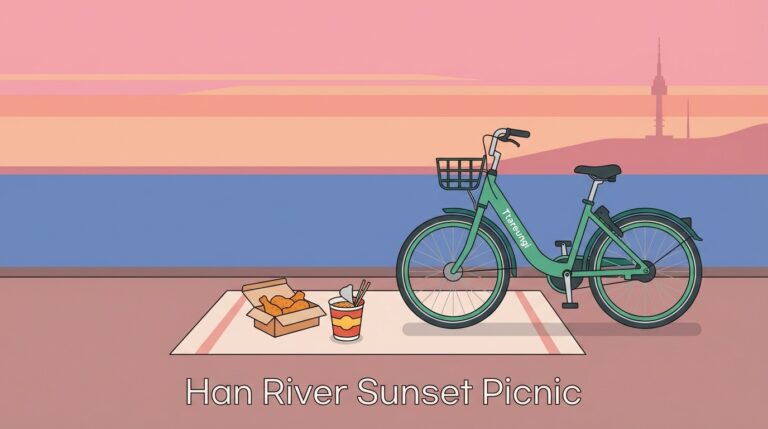
Imagine this: It’s a Friday evening in Seoul. The sun is setting over the Han River, turning the sky pink and orange. You can smell fried chicken in the air. You’re riding a bike with the wind in your hair, feeling like the main character in a K-Drama. Or maybe you’re channeling your inner RM from BTS, enjoying some peaceful “Namjooning.”
But wait—a pedestrian suddenly steps into your bike lane! Or worse, you ordered chicken 30 minutes ago, the delivery driver is calling you in rapid-fire Korean, and you have no idea where “Delivery Zone 2” is.
Don’t panic. To truly enjoy the Han River (we call it Hangang), you need more than just strong legs; you need the right words. Today, we’re going from “Tourist” to “Seoulite” with the ultimate guide to biking and chilling at the Han River.
Phase 2: Deep Dive — 3 Key Expressions
Here are the three expressions that will save your life (and your dinner) at the Han River.
1. 좀 지나갈게요 (Jom jinagalgeyo)
- Pronunciation: [Jom ji-na-gal-ge-yo]
Sound analogy: “Jom” sounds like the start of “Jump” / “Ji-na” sounds like “Gina” / “Gal-ge-yo” sounds like “Gal” + “Get” + “Yo”.- Meaning: “Excuse me, coming through!” (Literal: “I will pass by a little.”)
- K-Culture Moment: In variety shows like Running Man, when members are rushing through a crowd, they don’t just say “Excuse me.” They chant this phrase to part the sea of people.
- Editor’s Insight: The word ‘좀 (jom)’ here is magic. It softens the command. Without it, you sound aggressive. With it, you sound polite but firm. Use this when the bike path is crowded and people are walking in your lane.
- Situation Spectrum:
[🚫 Formal Meeting] ———— [⚠️ Strangers] ———— [✅ Crowded Public Spaces]- 🤔 Think About It: Why do Koreans announce their action (“I will pass”) rather than just asking for permission (“Can I pass?”)? It reflects a high-context culture where efficiency and predicting the next move are valued in shared spaces.
2. 배달존에서 받을게요 (Baedal-jon-eseo bad-eul-ge-yo)
- Pronunciation: [Bae-dal-zone-eh-seo bad-eul-ge-yo]
- Meaning: “I will receive it at the Delivery Zone.”
- K-Culture Moment: Every K-Drama scene where the couple eats fried chicken by the river? They didn’t cook it there. They picked it up at a designated Delivery Zone. This is a uniquely Korean system.
- Editor’s Insight: The Han River parks are huge. If you just say “I’m at the park,” the driver will never find you. You must specify the Zone Number (e.g., Yeouido Zone 2).
- Situation Spectrum:
[🚫 Restaurant] ———— [⚠️ Home Delivery] ———— [✅ Han River Parks]- 🤔 Think About It: The existence of “Delivery Zones” proves how massive food delivery culture is in Korea. Can you imagine a designated Uber Eats pickup spot in a park in your country?
3. 물멍 때리기 딱이다 (Mul-meong ttaerigi ttak-ida)
- Pronunciation: [Mul-meong ttae-ri-gi ttak-ee-da]
- Meaning: “It’s perfect for spacing out looking at the water.”
- K-Culture Moment: You’ll see K-Pop idols on V-Live staring blankly at a campfire (Bul-meong) or water (Mul-meong). It’s a legitimate hobby in Korea now.
- Editor’s Insight: ‘멍 때리다’ (Meong ttaerida) means to space out. Add ‘물’ (water), and it’s “water-spacing-out.” It’s the ultimate compliment for a relaxing spot.
- Situation Spectrum:
[🚫 Job Interview] ———— [⚠️ Boss] ———— [✅ Friends/Social Media]- 🤔 Think About It: In a hyper-competitive society like Korea, doing “nothing” has become a branded activity. Why do you think we needed a specific word for “doing nothing comfortably”?
Phase 3: Textbook vs. Real Life
| Situation | 📖 Textbook Korean | 🗣️ Real Korean (Insa Style) | 💡 Why the difference? |
|---|---|---|---|
| Suggesting biking | 자전거 타러 갈래? (Shall we go ride a bicycle?) | 따릉이 타러 갈래? (Wanna ride Ttareungi?) | ‘Ttareungi’ is the name of Seoul’s public bikes. Everyone uses this brand name. |
| Feeling good | 기분이 참 좋아요. (I feel very good.) | 완전 힐링된다! (This is total healing!) | ‘Healing’ is the go-to Konglish word for relaxing and destressing. |
| Eating Ramen | 라면을 먹자. (Let’s eat ramen.) | 한강 라면 콜? (Han River Ramen, call/deal?) | Eating specifically the foil-container instant ramen at the river is a cultural ritual. |
💡 Note: “Col?” (Call?) implies “Deal?” or “I’m in!” derived from poker terminology, widely used in casual slang.
Phase 4: Cultural Deep Dive
4-1. The Unspoken Rules of the Bike Path (Nunchi)
In Korea, the bike path is serious business.
– The Bell Etiquette: Don’t ring your bell aggressively. A short, polite ding combined with “Jom jinagalgeyo” is the way. Ringing it continuously is considered very rude (acting like you own the road).
– Right of Way: Pedestrians always have priority, even if they are in the wrong lane. Korean law and culture protect the walker heavily.
4-2. K-Culture Connection: The “Instant Ramen Machine” Ritual
If K-Dramas have taught us anything, it’s that ramen tastes better outdoors.
– The Machine: At Han River convenience stores, you don’t just pour hot water. You use a specialized machine that boils the ramen in a foil tray for exactly 3-4 minutes.
– The Egg: You must buy a raw egg to crack into it.
– The Vibe: Standing next to a stranger, both silently watching your noodles boil, is a shared moment of anticipation. It’s the modern campfire.
Phase 5: Immersive Roleplay
Setting: 7:00 PM, Yeouido Han River Park. The sun has set, and the city lights are reflecting on the water. You are with your Korean friend, Jisoo.
Characters:
– YOU: An intermediate Korean learner who loves biking.
– Jisoo: Your energetic Korean friend who is hungry.
(Scene Start)
Jisoo: 와, 오늘 날씨 미쳤다! 사람 진짜 많네. 우리 자전거 반납하고 뭐 좀 먹을까?
(Wa, oneul nalssi michyeotda! Saram jinjja manne. Uri jajeongeo bannaphago mwo jom meogeulkka?)
(Wow, the weather is crazy today! So many people. Should we return the bikes and eat something?)
🔀 Decision Point: What do you want to eat?
A) “I want to eat that famous Han River Ramen!”
B) “Let’s order Fried Chicken (Chimaek)!”
(If you choose B – The Classic Choice)
YOU: 좋아요! 치맥 어때요? 배달 시키자!
(Joayo! Chimaek eottaeyo? Baedal sikija!)
(Great! How about Chimaek? Let’s order delivery!)
Jisoo: 오, 좋은데? 야, 여기 전단지 받았다. 내가 주문할게. 너 돗자리 있어?
(Oh, nice. Hey, I got a flyer here. I’ll order. Do you have a picnic mat?)
YOU:
Option 1: “아니, 없어. 편의점에서 사자.” (Ani, eopseo. Pyeonuijeomeseo saja.) – Natural & Casual
Option 2: “돗자리가 뭐예요?” (Dotjariga mwoyeyo?) – Learning opportunity
Jisoo: (Laughs) 돗자리! That silver mat we sit on. 편의점 가자!
(Wait! The Delivery Driver Calls Jisoo’s Phone)
Driver (Over phone): 여보세요? 도착했습니다. 어디세요?
(Yeoboseyo? Dochakhaetseumnida. Eodiseyo?)
Jisoo: (Looks at you panicked) 어… 우리 어디지?
🔀 YOUR TURN! Help Jisoo describe the location.
Choice A: “Here! We are here!” (Too vague)
Choice B: “배달존 2번으로 와주세요!” (Baedal-jon i-beon-euro wajuseyo!)✅ Best Choice: B. This is the only way the driver will find you among 1,000 people.
Phase 6: 10-Second Shadowing Drill
Let’s practice the magic phrase to get through crowds. Focus on the intonation!
😤 Politely Firm:
죄송한데, / 좀 / 지나갈게요!
(Juesonghande, / jom / jinagalgeyo!)
Translation: I’m sorry, but / I’m passing through!😍 Excited:
오늘 날씨 / 자전거 타기 / 딱이네!
(Oneul nalssi / jajeongeo tagi / ttagine!)
Translation: Today’s weather / is perfect for / riding a bike!
Phase 7: K-Culture Mini Glossary
| Korean | Romanization | Meaning | Context |
|---|---|---|---|
| 따릉이 | Ttareungi | Seoul Public Bike | The green and white bikes you see everywhere. Named after the sound of a bike bell. |
| 치맥 | Chimaek | Chicken + Maekju (Beer) | The holy grail of Han River food combinations. |
| 돗자리 | Dotjari | Picnic Mat | usually silver/foil on one side. You are not a true local without sitting on one. |
| 물멍 | Mul-meong | Water-spacing-out | Staring at the water blankly to relax. |
Phase 8: Traveler’s Survival Kit (Han River Edition)
Visiting the Han River? Don’t leave your hotel without reading this.
🆘 Survival Expression #1: Finding the Bathroom
– 🇰🇷 “가까운 화장실이 어디예요?” (Gakkaun hwajangsil-i eodiyeyo?)
– 💡 Pro Tip: Han River parks are long. Restrooms can be far apart. Ask before it’s an emergency!🆘 Survival Expression #2: Renting a Bike
– 🇰🇷 “따릉이 앱 외국인도 돼요?” (Ttareungi app oegukindo dwaeyo?)
– 💡 Fact: Yes! The “Seoul Bike” app has an English version, and you can buy passes with a foreign credit card.📌 Editor’s Travel Note
– Delivery Apps: If you don’t have a Korean number, using apps like Baedal Minjok is hard. Solution: Look for the “Delivery Zones” where people hand out flyers. Point to a picture on the flyer and ask them to call for you, or buy from the convenience store (chimaek is sold there too!).
Phase 9: Think Deeper — “The Art of Doing Nothing”
Language & Society:
Have you noticed how many slang terms Korea has for “resting” recently? Mul-meong (water staring), Bul-meong (fire staring), Sup-meong (forest staring).
Historically, Korea has a “Palli-Palli” (Hurry Hurry) culture. Idleness was seen as laziness. But these new terms frame “doing nothing” as an active, productive hobby. By naming it “Meong”, it validates the act of resting. It’s a linguistic rebellion against burnout.
💬 Your Turn: Does your language have a specific word for “staring at nature to relax”? Or is it just called “resting”? Tell us in the comments!
Phase 10: FAQ & Troubleshooting
Q: Can I drink beer anywhere in the park?
A: YES and NO. Generally, drinking is allowed (unlike in many Western countries). However, you cannot drink while riding a bike (DUI laws apply to bikes too!), and excessive noise is frowned upon. Keep it chill.
Q: Is it rude to ride fast?
A: Yes. The Han River paths are for leisure. If you are decked out in Spandex racing gear and speeding, people might yell at you. There is a speed limit (usually 20km/h).
❌ Common Mistake: Trying to order delivery to “The bench under the big tree.”
✅ Fix: Find the Delivery Zone (배달존) marker. It is a large pole with a number on it. Give that number to the driver.
Phase 11: Wrap-up & Mission
One-Liner: To conquer the Han River, remember: Ride Ttareungi, order to the Delivery Zone, and master the art of Mul-meong.
🚀 Action Missions:
– 🥉 Bronze: Say “좀 지나갈게요” out loud 3 times while imagining walking through a crowd.
– 🥈 Silver: Search “Hangang Ramen” on YouTube or Instagram and leave a comment in Korean: “저도 한강 라면 먹고 싶어요!” (I want to eat Han River ramen too!).
– 🥇 Gold: If you are in Seoul, go to a convenience store, buy a foil ramen, and eat it by the river!
K-Culture Mission: Watch an episode of a variety show like Running Man or I Live Alone (Na Honja Sanda). Spot the moment someone uses “Jom jinagalgeyo” or eats outdoors!
Phase 12: Quiz — Are you a Han River Expert?
1. Your friend says: “Let’s go do Mul-meong.” What do they want to do?
a) Drink a lot of water.
b) Stare at the water and relax.
c) Go swimming.
Answer: b)
2. Which is the most polite/natural way to pass someone on a bike?
a) Scream “BIKE!!!”
b) Ring the bell for 10 seconds straight.
c) Say “Jamsimanyo, jom jinagalgeyo~” and ring the bell once gently.
Answer: c)
3. True or False: You can order delivery food to the exact bench you are sitting on.
Answer: False! You must go to the Delivery Zone.
See you at the river! Happy riding! 🚲🍜
Frequently Asked Questions (FAQ)
Q: What does "좀 지나갈게요 (Jom jinagalgeyo)" mean in Korean and how do you pronounce it?
A: In Korean, "좀 지나갈게요 (Jom jinagalgeyo)" is pronounced [Jom ji-na-gal-ge-yo] and means: "Excuse me, coming through!" (Literal: "I will pass by a little.")
Q: What does "배달존에서 받을게요 (Baedal-jon-eseo bad-eul-ge-yo)" mean in Korean and how do you pronounce it?
A: In Korean, "배달존에서 받을게요 (Baedal-jon-eseo bad-eul-ge-yo)" is pronounced [Bae-dal-zone-eh-seo bad-eul-ge-yo] and means: "I will receive it at the Delivery Zone."
Q: What does "물멍 때리기 딱이다 (Mul-meong ttaerigi ttak-ida)" mean in Korean and how do you pronounce it?
A: In Korean, "물멍 때리기 딱이다 (Mul-meong ttaerigi ttak-ida)" is pronounced [Mul-meong ttae-ri-gi ttak-ee-da] and means: "It's perfect for spacing out looking at the water."







