

Phase 1: The Immersive Hook
Greeting: 안녕하세요! Welcome back to Daily Hangul. I’m your editor and cultural navigator.
The Scene:
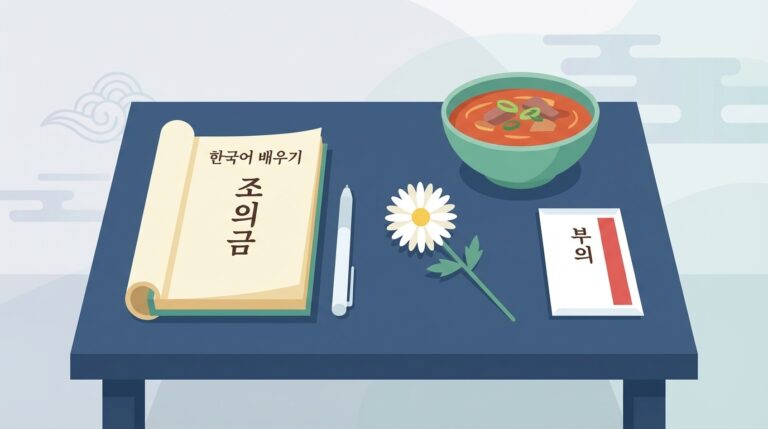
Picture this K-Drama moment: The main character rushes into a hospital building. They change into a black suit in the restroom. They enter a room filled with the scent of incense and white chrysanthemums. People are sitting on the floor, eating spicy red soup and drinking soju. The atmosphere is heavy, yet oddly noisy.
Suddenly, the protagonist faces the grieving family. They bow. They stand up to say something… and silence.
The ‘Why’:
If you live in Korea long enough, or work with Koreans, you will eventually be invited to a funeral (장례식, Jang-rye-sik). It’s one of the most important social events in Korean culture. Knowing how to order beer is great, but knowing how to offer condolences? That earns you deep, lifelong respect. It transforms you from a “foreigner” to a “friend.”
Transparency:
Today’s lesson is based on real questions from my intermediate students who felt panicked when receiving that sudden text message: “Please come to pay respects.” Let’s make sure you walk into that room with confidence and heart.
Phase 2: Deep Dive into Key Expressions
Here are the top 3 expressions you need for a Korean funeral.
1. 삼가 고인의 명복을 빕니다 (Samga goin-ui myeongbok-eul bimnida)
- Pronunciation: [Sam-ga go-in-eui myung-bok-eul bim-ni-da]
Sound analogy: “Sam” like Samsung + “Ga” like Garden. “Bimnida” sounds like a very polite “Beam me up.”- Meaning:
- Literal: “I respectfully pray for the happiness of the deceased in the next world.”
- Real Nuance: “Rest in peace.” (This is the standard, formal phrase written on envelopes and wreaths.)
- K-Culture Moment: You see this written on the ribbons of the huge flower wreaths standing outside the funeral hall in dramas like My Mister or Move to Heaven.
- Editor’s Insight: This phrase is very formal and written-focused. While you can say it, it often feels a bit like reading a textbook. It’s perfectly okay to say it, but don’t feel pressured to memorize this long sentence for spoken interaction.
- Situation Spectrum:
[🚫 Casual] ———— [⚠️ Semi-formal] ———— [✅ Formal]- 🤔 Think About It: Why does Korean emphasize “happiness in the next world” (Myeongbok) rather than just “peace”? It reflects a Buddhist/Confucian desire for the ancestor’s journey to be blessed.
2. 얼마나 상심이 크세요? (Eolmana sangsim-i keuseyo?)
- Pronunciation: [Ol-ma-na sang-shim-i keu-se-yo?]
Tip: “Sangsim” means “hurt heart” or grief.- Meaning:
- Literal: “How big is your grief?”
- Real Nuance: “I can’t imagine how heartbroken you must be.” / “My deepest condolences.”
- K-Culture Moment: In a melodrama, a friend holds the grieving person’s hands, looks into their eyes, and whispers this. It’s about empathy, not ritual.
- Editor’s Insight: This is my #1 recommendation for B1 learners. It sounds sophisticated, warm, and genuine. It acknowledges the survivor’s pain rather than focusing on the death itself.
- Situation Spectrum:
[🚫 Kids] ———— [✅ Colleagues/Elders] ———— [✅ Friends]- 🤔 Think About It: Notice the question format? It invites the listener to feel understood, rather than just receiving a statement.
3. 좋은 곳으로 가셨을 거예요 (Joeun goseuro gasyeosseul geoyeyo)
- Pronunciation: [Jo-eun go-seu-ro ga-shuss-eul geo-ye-yo]
- Meaning:
- Literal: “They must have gone to a good place.”
- Real Nuance: “He/She is in a better place now.”
- Editor’s Insight: Use this when the atmosphere has calmed down a bit, perhaps while sitting and eating with the family. It’s comforting and gentle.
- Situation Spectrum:
[✅ Casual] ———— [✅ Semi-formal] ———— [⚠️ Very Formal]
Phase 3: Textbook vs. Real Life
| Situation | 📖 Textbook Korean | 🗣️ Real Korean | 💡 Why the difference? |
|---|---|---|---|
| Meeting the family | 삼가 고인의 명복을 빕니다. (Formal script) | (Silence) + Eye contact + slight bow | Sometimes, words feel insufficient. In Korea, sharing the silence is a form of respect. |
| Cheering up | 기운 내세요. (Cheer up.) | 밥은 먹었어? (Did you eat?) | Asking about meals is the ultimate Korean way of checking on someone’s survival and well-being. |
| Leaving | 안녕히 계세요. (Goodbye.) | 먼저 일어날게요. (I’ll get up first.) | “Goodbye” (Stay in peace) sounds odd at a funeral. We apologize for leaving them behind in their grief. |
Bottom Note: At a funeral, less is more. If you panic, just say “힘내세요” (Please be strong/Hang in there) quietly. It’s universally accepted.
Phase 4: Cultural Deep Dive
4-1. Non-verbal: The Art of the Bow (Jeol)
This is where most foreigners freeze. The “Funeral Bow” is different from the “New Year’s Bow.”
1. Enter: Sign the guest book and prepare your envelope.
2. Burn Incense/Flower: Put one chrysanthemum on the altar (stem facing the photo) OR burn incense (don’t blow it out with your mouth; shake it!).
3. The Bow: Bow twice (2 times) to the photo of the deceased. Then, bow once (1 time) to the family members (Sangju).
* Why? The dead belong to the spirit world (Yin), so even numbers. The living belong to the human world (Yang), so odd numbers.
4-2. K-Food Connection: Why Spicy Soup?
In almost every K-Drama funeral scene, you see people eating Yukgaejang (육개장 – Spicy Beef Soup).
– The Meaning: The red color is believed to chase away bad spirits (ghosts dislike red).
– The Atmosphere: Funerals in Korea can be noisy. People drink, play cards, and stay up all night. This is called keeping the “waking watch” so the mourner isn’t lonely. The spicy soup keeps everyone awake and sweating out the sadness.
Phase 5: Immersive Roleplay
Setting: A hospital funeral hall in Seoul. It’s 8 PM. You are wearing a dark suit. You’ve just arrived to comfort your Korean colleague, Min-soo, whose father passed away.
Characters:
– YOU: A supportive foreign colleague.
– Min-soo: Your co-worker (Chief Mourner), looking tired and wearing a hemp armband.
The Dialogue:
(You enter the room, place a flower, and bow twice to the photo. You turn to Min-soo.)
YOU: (Bowing once to Min-soo)
(Min-soo bows back deeply.)
Min-soo: 와 줘서 고마워요. 바쁠 텐데…
(Wa jwoseo gomawoyo. Bappeul tende…)
(Translation: Thank you for coming. You must be busy…)
YOU: (Handing the envelope with two hands) …
🔀 Your Turn! What do you say?
- A) “삼가 고인의 명복을 빕니다.” (Standard, safe, formal)
- B) “얼마나 상심이 크세요?” (Empathetic, connection-focused)
- C) “많이 슬퍼요?” (Are you very sad?)
✅ Best Choice: B
Reasoning: Since Min-soo is a colleague you know, B shows warmth and B1-level emotional intelligence. A is fine but a bit robotic.
⚠️ Analysis of C: Too direct and childish for a funeral setting. Avoid asking obvious questions.
Min-soo: (Takes the envelope) 감사합니다. 저쪽에서 식사라도 하고 가세요.
(Gamsahamnida. Jeojjog-eseo siksara-do hago gaseyo.)
(Translation: Thank you. Please have a meal over there before you go.)
(🎭 Stage Direction: Min-soo points to the tables where people are eating Yukgaejang.)
Phase 6: 10-Second Shadowing Drill
Let’s practice the most empathetic phrase. Say it with a low, calm voice.
Emotion: 😢 Sad & Sincere
얼마나 / 상심이 / 크세요?
(Eolmana / sangsim-i / keuseyo?)
“How big is your grief?” (My deepest condolences.)
Phase 7: K-Culture Mini Glossary
| Korean | Romanization | Meaning | Context |
|---|---|---|---|
| 조문 | Jomun | Paying respects | The act of visiting a funeral home. |
| 상주 | Sangju | Chief Mourner | Usually the eldest son or spouse, wearing an armband. |
| 부조금 | Bujogeum | Condolence Money | Cash given in an envelope to help with funeral costs. |
| 장례식장 | Jang-rye-sik-jang | Funeral Hall | Usually located in the basement of hospitals in Korea. |
Phase 8: Traveler’s Survival Kit (Funeral Edition)
Even if you are just traveling, you might be invited if you make local friends.
🆘 Survival Phrase #1
– 🇰🇷 “뭐라고 위로해야 할지 모르겠어요.” (Mworago wiro-haeya halji moreugesseoyo.)
– 🗣️ Meaning: “I don’t know what words to say to comfort you.”
– 📍 Why: This is the perfect honest answer for a foreigner. It shows humility and sadness.
– 💡 Pro Tip: Wear BLACK SOCKS. You have to take your shoes off to enter the altar room. Holes in socks or bright neon socks are a major embarrassment!📌 Editor’s Note on Money (Bujogeum)
– Rule: Odd numbers only (30,000, 50,000 won).
– Exception: 100,000 won is okay (seen as a complete number).
– Standard: 50,000 KRW (approx $37) is the standard for acquaintances/colleagues.
Phase 9: Think Deeper — “The Noise of Grief”
Collectivism in Mourning:
If you visit a Korean funeral, you might be shocked by the noise. People drinking, laughing, and playing Go-Stop (a card game) right next to the mourning room.
In Western culture, grief is often private and quiet. In Korea, leaving a mourner alone in silence is considered cruel. The noise creates a wall of life around the death, ensuring the family knows: “We are still here. Life continues. You are not alone.”
💬 Your Turn: In your culture, is a funeral quiet or noisy? Do you leave the family alone or crowd around them?
Phase 10: FAQ & Troubleshooting
- Q: Can I wear Navy or Dark Grey?
- A: Yes! While Black is best, dark Navy or Charcoal Grey is perfectly acceptable. Just avoid bright colors or casual wear (shorts/slippers).
- Q: Can I clink glasses (Cheers) while drinking soju there?
- A: NO! 🚫 This is a huge mistake. Pour for others, but never clink glasses (Geonbae). Drink quietly.
- Q: Is it okay to cry?
- A: Yes, but wailing is usually reserved for the family. As a guest, silent tears or a somber face is appropriate.
❌ Common Mistake: Using the word “안녕” (Annyeong) for Goodbye.
✅ Fix: Just bow silently or say “먼저 일어나겠습니다” (I will rise first) when leaving.
Phase 11: Wrap-up & Action
One-Liner: Korean funerals are about presence and shared sorrow—bring your black socks, an odd amount of cash, and a sincere heart.
Action Missions:
– 🥉 Bronze: Practice the “2 Bows + 1 Bow” sequence in your living room.
– 🥈 Silver: Search “Korean Funeral Dining” on YouTube and see what Yukgaejang looks like.
– 🥇 Gold: Next time you see a sad scene in a K-Drama, try saying “얼마나 상심이 크세요?” to the screen.
K-Culture Mission: watch the drama “Reply 1988” (Episode 1). It depicts a traditional Korean funeral perfectly—the sadness, the food, and the community.
Phase 12: Interactive Quiz
1. You are preparing the money envelope (Bujogeum). Which amount is WRONG?
– A) 30,000 Won
– B) 40,000 Won
– C) 50,000 Won
– D) 100,000 Won
Answer: B) 40,000 Won. Even numbers (like 4) are associated with death/bad luck, but specifically in money gifts, we stick to odd numbers (3, 5, 7) or the round number 10 (100,000). 4 is a big No-No.
2. True or False?
– “You should blow out the incense candles with your mouth to show respect.”
Answer: False! Never blow with your mouth (the breath is unclean). Wave your hand or shake the incense stick to extinguish the flame.
Frequently Asked Questions (FAQ)
Q: What does "삼가 고인의 명복을 빕니다 (Samga goin-ui myeongbok-eul bimnida)" mean in Korean and how do you pronounce it?
A: In Korean, "삼가 고인의 명복을 빕니다 (Samga goin-ui myeongbok-eul bimnida)" is pronounced [Sam-ga go-in-eui myung-bok-eul bim-ni-da] and means: Literal: "I respectfully pray for the happiness of the deceased in the next world."
Q: What does "얼마나 상심이 크세요? (Eolmana sangsim-i keuseyo?)" mean in Korean and how do you pronounce it?
A: In Korean, "얼마나 상심이 크세요? (Eolmana sangsim-i keuseyo?)" is pronounced [Ol-ma-na sang-shim-i keu-se-yo?] and means: Literal: "How big is your grief?"
Q: What does "좋은 곳으로 가셨을 거예요 (Joeun goseuro gasyeosseul geoyeyo)" mean in Korean and how do you pronounce it?
A: In Korean, "좋은 곳으로 가셨을 거예요 (Joeun goseuro gasyeosseul geoyeyo)" is pronounced [Jo-eun go-seu-ro ga-shuss-eul geo-ye-yo] and means: Literal: "They must have gone to a good place."







