

Phase 1: The Immersive Hook
Greeting: Hello! This is your Senior Editor at Daily Hangul.
Imagine this: You are driving a rental car through the bustling streets of Seoul, feeling like the protagonist in a K-Drama. But there’s a problem. Your car is dusty from that road trip to the countryside, and it doesn’t look like the shiny, pristine cars you see in Crash Landing on You.
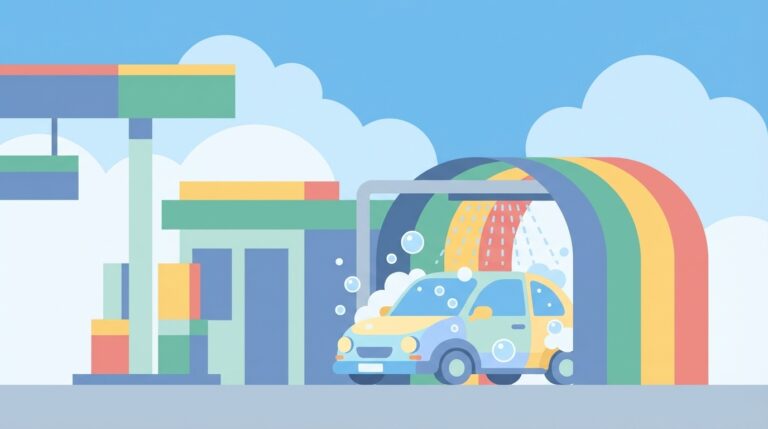
You pull into a gas station (Jooyuso), and you see a long line of cars waiting for a machine. You want to join in, but the attendant is waving a baton at you.
In a K-Drama, this is the moment the leads get stuck inside the automatic car wash for a romantic confession. In reality? If you don’t know what to say, you might just block traffic and get honked at!
Don’t panic. Getting a car wash in Korea is fast, cheap, and surprisingly high-tech. Today, we’ll learn the magic phrase to get your car sparkling clean.
Phase 2: Deep Dive into Core Expressions
Here are the 3 essential phrases you need to survive the Korean gas station car wash line.
1. 세차 돼요? (Secha dwaeyo?)
- Pronunciation: [Se-cha dwae-yo?]
Tip: ‘Se’ sounds like ‘Set’ without the t. ‘Cha’ is like ‘Cha-cha-cha’. ‘Dwae’ sounds like ‘Day’ but with your lips rounded.- Meaning: Can I get a car wash? (Literal: Is car wash okay?)
- K-Culture Moment: This is the most efficient way to ask. Koreans love efficiency. You don’t need a long sentence. Just roll down your window and ask this.
- Editor’s Insight: Most gas stations have an automatic machine. If the lights are off, asking this confirms if it’s operating.
- Situation Spectrum:
[🚫 Formal Meeting] ———— [✅ Gas Station Staff] ———— [✅ Friends]2. 주유했어요. (Juyuhæsseoyo.)
- Pronunciation: [Ju-yu-hæ-sseo-yo]
- Meaning: I filled up the gas / I got gas.
- Why use this? Essential Logic! In Korea, if you fill up gas (usually over 50,000 KRW), the car wash is heavily discounted or sometimes free. You say this to claim your discount coupon price.
- Editor’s Insight: It’s like unlocking a hidden item in a game. Use this phrase to save money!
- Situation Spectrum:
[🚫 Casual] ———— [✅ Service Staff] ———— [🚫 Boss]3. 기어 중립 (Gieo Jung-nip)
- Pronunciation: [Gi-eo Jung-nip]
- Meaning: Gear Neutral (N).
- K-Culture Moment: Inside the machine, the attendant might shout this or point to a sign. It’s the “Pali-pali” (Hurry, hurry) culture in action—the machine pulls you; you don’t drive.
- 🤔 Think About It: Why do you think automated services are so popular in Korea compared to other countries? Is it just about speed?
Phase 3: Textbook vs. Real Life
| Situation | 📖 Textbook Korean | 🗣️ Real Street Korean | 💡 Why the difference? |
|---|---|---|---|
| Asking for a wash | 세차를 할 수 있습니까? (Sechareul hal su isseumnikka?) | 세차 돼요? (Secha dwaeyo?) | The textbook version sounds like a military report. “Dwaeyo?” is quick and practical. |
| Asking price | 요금이 얼마입니까? (Yogeumi eolmaimnikka?) | 얼마예요? (Eolmayeyo?) | “Yogeum” is formal. “Eolmayeyo” covers everything from apples to car washes. |
| Confirming gas | 저는 주유를 했습니다. (Jeoneun juyureul haesseumnida.) | 주유했어요. (Juyuhæsseoyo.) | Dropping the subject “I” (Jeoneun) is standard in spoken Korean. Context is king! |
Phase 4: Cultural Deep Dive
4-1. The Art of “Service” (Seobiseu)
In Korea, “Service” (서비스) doesn’t just mean customer service. It means “freebie” or “on the house.” At a gas station, a discounted car wash is a form of “Service” for buying gas. If you pay full price for a car wash without getting gas, people might look at you like you’re throwing money away!
4-2. The “Automatic” Drama Trope
Have you noticed in K-Dramas, when a couple enters an automatic car wash, the scene suddenly becomes intimate? The noise of the brushes, the darkness, the water spraying… it isolates them from the world. Next time you enter one, imagine you are in that drama scene (even if you are just alone with a bag of chips!).
Phase 5: Immersive Roleplay Scenario
Setting: A sunny Saturday afternoon at a busy gas station in Gangnam. You just finished filling up your tank. You drive up to the entrance of the automatic car wash.
Characters:
* YOU: Driving a rental car.
* Attendant: A busy middle-aged man (Ajusshi) wearing a red vest and holding a guide baton.
Dialogue:
Attendant: (Waving baton) 앞으로 오세요!
(Apeuro oseyo!)
(Come forward!)
YOU: (Rolling down window) 안녕하세요! 세차 돼요?
(Annyeonghaseyo! Secha dwaeyo?)
(Hello! Can I get a car wash?)
Attendant: 네, 돼요. 주유하셨어요?
(Ne, dwaeyo. Juyuhasyeosseoyo?)
(Yes, you can. Did you get gas?)
🔀 Decision Point! How do you answer?
- A) “아니요.” (Aniyo – No.)
- B) “네, 주유했어요.” (Ne, Juyuhæsseoyo – Yes, I got gas.)
If you chose A:
Attendant: 그럼 5,000원입니다.
(Then it’s 5,000 won.)
Result: You pay full price, but your car gets clean.If you chose B (✅ Best Choice):
Attendant: 영수증 보여주세요. 3,000원입니다.
(Show me the receipt. It’s 3,000 won.)
Result: You get the discount! Always save your gas receipt!
YOU: (Handing over card) 여기요.
(Yeogiyo.)
(Here you go.)
Attendant: 기어 중립(N) 놓으세요!
(Gieo jung-nip noseyo!)
(Put the gear in Neutral!)
Phase 6: 10-Second Shadowing Drill
Repeat after me. Focus on the intonation!
- 😊 Asking politely:
세차 / 돼요? (Secha / dwaeyo?) -
😤 Confirming for discount:
주유 / 했어요! (Juyu / hæsseoyo!) -
🚗 In the machine:
기어는 / 중립! (Gieoneun / jung-nip!)
Phase 7: K-Culture Mini Glossary
| Korean | Romanization | English | Context |
|---|---|---|---|
| 세차 | Secha | Car wash | Essential word. ‘Se’ (Wash) + ‘Cha’ (Car). |
| 주유소 | Juyuso | Gas station | Where cars drink oil (Ju-yu). |
| 기계식 | Gigyesik | Machine-operated | Refers to the automatic car wash tunnel. |
| 손세차 | Son-secha | Hand wash | More expensive, higher quality. ‘Son’ means Hand. |
| 영수증 | Yeongsujeung | Receipt | You often need this to prove you bought gas for the discount. |
Phase 8: Traveler’s Survival Kit (Gas Station Edition)
Driving in Korea? Keep these in your pocket.
🆘 Survival Phrases
1. “가득 넣어주세요.” (Gadeuk neoeojuseyo)
* Meaning: “Fill it up, please.” (Full tank)
* Tip: ‘Gadeuk’ means full.
2. “휘발유예요 / 경유예요?” (Hwibalyu-yeyo / Gyeongyu-yeyo?)
* Meaning: Is it Gasoline / Diesel?
* Crucial: Green nozzle is usually Diesel (Gyeongyu) and Yellow is Gasoline (Hwibalyu). Don’t mix them!
3. “쓰레기 버려도 돼요?” (Sseuregi beoryeodo dwaeyo?)
* Meaning: Can I throw away trash?
* Context: There are usually trash cans near the pumps.📌 Editor’s Travel Note
* Self-Service: Most stations are “Self” (셀프). You will use a touchscreen. Look for the button “English” (often available!).
* Gloves: You will often see plastic gloves at the pump. Use them to keep your hands clean from the nozzle handle. That’s Korean consideration!
Phase 9: Think Deeper — “Pali-Pali” Culture
Efficiency vs. Experience:
Korean automatic car washes are incredibly fast. The whole process takes about 3 minutes. This reflects the Korean “Pali-pali” (Hurry, hurry) culture. Speed is a virtue in modern Korean society.
🧠 Think Deeper:
In your country, is a car wash seen as a chore to be done quickly, or a Sunday afternoon ritual done by hand? How does the speed of services in a country reflect its people’s mindset about time?
Phase 10: FAQ & Troubleshooting
- Q: Do I need to tip the attendant who pre-washes my car before the machine?
- A: No! Korea has a no-tipping culture. Just say “Gamsahamnida” (Thank you).
- Q: Can I stay in the car during the wash?
- A: Yes! For machine washes (기계식), you must stay inside. Just make sure your windows are closed tightly!
- Q: What if I don’t know if my car is Diesel or Gas?
- A: Check the fuel cap cover! Usually, Korean rental cars have a sticker inside the cap.
- ❌ Common Mistake: Opening the door or window while inside the machine.
- ✅ Do this: Sit back, relax, and enjoy the 3-minute water show.
Phase 11: Wrap-up & Mission
Summary: Today we learned how to ask for a car wash (Secha dwaeyo?) and how to claim our discount by saying we got gas (Juyuhæsseoyo).
🚀 Action Mission:
* 🥉 Bronze: Say “Secha dwaeyo?” out loud 3 times while imagining you are rolling down a car window.
* 🥈 Silver: Search for “Korean Gas Station Car Wash” on YouTube and watch a POV video.
* 🥇 Gold: If you are in Korea, go to a gas station and get a wash! Or, wash your own car and narrate your actions in Korean!
🎬 K-Culture Mission: Watch a scene from the drama Descendants of the Sun or any road-trip variety show. Look for scenes inside a car. Notice the dialogue intimacy!
💬 Your Turn: Do you prefer washing your car by hand or using a machine? Tell us in the comments!
Phase 12: Interactive Quiz
- Situation: You just bought gas and want a discount on the car wash. What do you say?
- A) 안녕하세요. (Hello.)
- B) 주유했어요. (I filled up gas.)
- C) 미안해요. (I’m sorry.)
- True or False: In a Korean automatic car wash, you should keep your foot on the brake the whole time.
- (True / False)
- Vocab Check: What is “Neutral Gear” in Korean?
- ______________ (Hint: Gieo J___-___)
Answers:
1. B) This confirms you are a paying customer eligible for the discount.
2. False! You must put the car in Neutral (N) and take your foot off the brake so the conveyor belt can pull you.
3. 기어 중립 (Gieo Jung-nip)
Frequently Asked Questions (FAQ)
Q: What does "세차 돼요? (Secha dwaeyo?)" mean in Korean and how do you pronounce it?
A: In Korean, "세차 돼요? (Secha dwaeyo?)" is pronounced [Se-cha dwae-yo?] and means: Can I get a car wash? (Literal: Is car wash okay?)
Q: What does "주유했어요. (Juyuhæsseoyo.)" mean in Korean and how do you pronounce it?
A: In Korean, "주유했어요. (Juyuhæsseoyo.)" is pronounced [Ju-yu-hæ-sseo-yo] and means: I filled up the gas / I got gas.
Q: What does "기어 중립 (Gieo Jung-nip)" mean in Korean and how do you pronounce it?
A: In Korean, "기어 중립 (Gieo Jung-nip)" is pronounced [Gi-eo Jung-nip] and means: Gear Neutral (N).







