

Phase 1: The “K-Drama Moment” Hook ☔
Annyeonghaseyo! It’s your Daily Hangul Editor. 👋
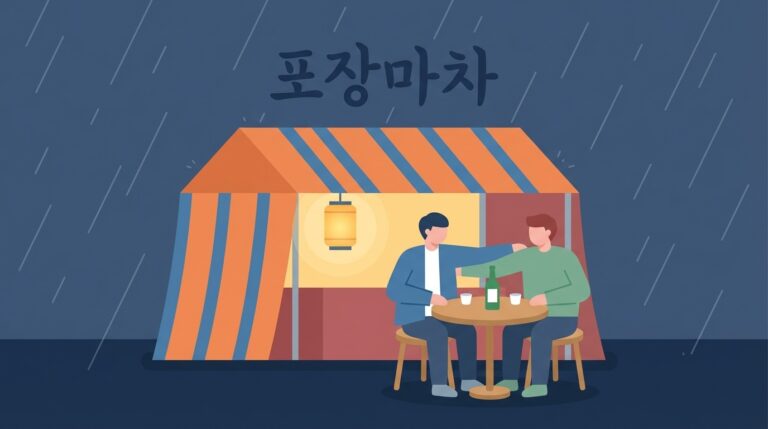
Picture this: It’s pouring rain in Seoul. You’re sitting in a Pojangmacha (those iconic orange street food tents seen in every K-Drama). Your best friend just failed an important audition or missed out on concert tickets. They down a shot of Soju and sigh deeply. 🍶
In English, you might say, “I’m so sorry.” But in Korea, if you translate that directly, it sounds like you are the one who caused their failure! 😱
To be the supportive main character in your own K-Drama life, you need the right words to heal a heart. Today, we’re learning how to say “It’s going to be okay” without making things awkward. Let’s get that “Best Friend of the Year” award! 🏆
Phase 2: Deep Dive into Core Expressions 🧠
Here are the top 3 phrases you need to comfort someone. We are focusing on the Polite (~Yo) form first, because being polite is safer!
1. 괜찮아요 (Gwaenchana-yo)
- Pronunciation: [Gwaen-cha-na-yo]
- Sound-alike: “Gwen” (like Gwen Stefani) + “Cha” (Cha-cha-cha) + “Na” (Banana) + “Yo” (Yoyo).
- Meaning: It’s okay / You’re okay / Everything is fine.
- K-Culture Moment: Think of the K-Pop idol on a live stream reading a fan’s worried comment. They smile softly and whisper, “Gwaenchana-yo.” Instant relief, right?
- Editor’s Insight: This is the Swiss Army Knife of Korean. You use it to comfort someone, but also to refuse a receipt, or say you aren’t hurt after tripping.
- Situation Spectrum:
[🚫 Boss (use caution)] ———— [✅ Coworker] ———— [✅ Friend]- 🤔 Think About It: In English, “I’m okay” is about me. In Korean, Gwaenchana can mean the situation, the person, or the future is okay. Why is the subject often missing in Korean?
2. 걱정 마세요 (Geokjeong maseyo)
- Pronunciation: [Geok-jeong ma-se-yo]
- Sound-alike: “Gawk” (at something) + “Jung” (Jungle) + “Ma” (Mama) + “Se-yo” (Say yo!).
- Meaning: Don’t worry.
- K-Drama Moment: The male lead holds the female lead’s hand just before a big crisis. “Trust me. Geokjeong maseyo.”
- Editor’s Insight: Geokjeong means “worry.” Ma comes from “Maji” (Stop/Don’t). It’s a strong, reassuring command.
- Situation Spectrum:
[⚠️ Boss] ———— [✅ Junior/Friend] ———— [✅ Kids]3. 힘내세요 (Himnaeseyo)
- Pronunciation: [Him-nae-se-yo]
- Sound-alike: “Him” (Him/Her) + “Neh” (Neigh like a horse) + “Se-yo“.
- Meaning: Cheer up / Be strong.
- Literal Meaning: “Exert your strength!” 💪
- K-Pop Moment: What fans scream at the end of a concert when the idols look tired. “Oppa, himnaeseyo!”
- 🤔 Think About It: English speakers say “Cheer up” (emotion). Koreans say “Generate strength” (physical energy). Do Koreans view sadness as a lack of energy?
Phase 3: Textbook vs. Real Life 🥊
| Situation | 📖 Textbook Korean | 🗣️ Real Street Korean | 💡 Why the difference? |
|---|---|---|---|
| Friend failed a test | 힘내세요 (Himnaeseyo) | 아자 아자! (Aja Aja!) or 화이팅! (Hwaiting!) | “Himnaeseyo” can sound a bit formal. Friends use “Hwaiting” (Konglish) for energy! |
| Friend is crying | 울지 마세요 (Ulji maseyo – Don’t cry) | 맛있는 거 먹으러 가자 (Masinneun geo meogeureo gaja) | Real Tip: In Korea, food is the ultimate cure. “Let’s go eat something yummy” is better than “Don’t cry.” |
| A small mistake | 괜찮습니다 (Gwaenchanseumnida) | 괜춘! (Gwaen-chun!) | Slang alert! Young people shorten Gwaenchana to Gwaenchun for speed and cuteness. |
Bottom Note: For A1 beginners, stick to “Hwaiting!” (Fighting). It works in 99% of casual cheering situations and everyone loves it!
Phase 4: Cultural Deep Dive — The “Jeong” of Feeding 🥘
4-1. Don’t Just Talk, Feed Them!
In Western culture, you might give a hug. In Korea, we give food. If someone is sad, saying “Everything will be okay” is good, but saying “I’ll buy you Chicken and Beer (Chimaek)” is legendary.
4-2. The “Nunchi” (Eye-measure) Factor
If you see someone crying on the Seoul subway:
– Don’t: Stare or ask “Are you okay?” loudly.
– Do: Pretend you don’t see them (give them privacy). If you have a tissue, you can silently hand it to them and walk away. That is peak Nunchi (sensing the vibe).
Phase 5: Immersive Roleplay 🎬
Scenario: It’s 8:00 PM. You are at a PC Bang (Internet Cafe) with your Korean friend, Min-su. He just failed to buy tickets for the Blackpink concert because the server crashed. He looks devastated.
Characters:
– YOU: A supportive friend.
– Min-su: A heartbroken Blink (Blackpink fan).
(Scene: Min-su slams his mouse down gently. 🖱️)
Min-su: 아… 망했다… 표가 없어.
(Ah… mang-haet-da… pyo-ga eop-seo.)
[Ah… I’m doomed… there are no tickets.]
🔀 Decision Point! How do you comfort him?
A) “미안해요.” (Mianhaeyo – I’m sorry.)
B) “괜찮아, 걱정 마!” (Gwaenchana, geokjeong ma!)
C) “축하해요!” (Chukahaeyo – Congratulations!)
✅ Best Choice: B
– Why: Choice A sounds like you deleted the tickets. Choice B is the perfect “It’s okay, don’t worry.”
YOU: 괜찮아, 걱정 마! 다음에 갈 수 있어.
(Gwaenchana, geokjeong ma! Da-eum-e gal su isseo.)
[It’s okay, don’t worry! You can go next time.]
Min-su: 진짜? 휴… 고마워.
(Jinjja? Hyu… Gomawo.)
[Really? Phew… Thanks.]
(🎭 Action: You pat him on the back gently.)
Phase 6: 10-Second Shadowing Drill 🗣️
Repeat after me! Focus on the emotion.
- 🥺 Soft & Comforting:
괜찮아요 / 걱정 마세요.
(Gwaen-cha-na-yo / Geok-jeong / ma-se-yo.)
[It’s okay / Don’t worry.] -
😤 Energetic Cheering:
힘내세요! / 할 수 있어요!
(Him-nae-se-yo! / Hal su / i-sseo-yo!)
[Cheer up! / You can do it!]
Phase 7: K-Culture Glossary 📚
| Korean | Romanization | Meaning | Context |
|---|---|---|---|
| 화이팅 | Hwaiting | Fighting! | The universal word for “Cheer up” or “Good luck.” Used everywhere from sports to exams. |
| 치맥 | Chimaek | Chicken + Beer | The soul food used to celebrate OR comfort someone. |
| 멘붕 | Menbung | Mental Breakdown | Slang for when you are shocked or panicked (like Min-su at the PC Bang). |
Phase 8: Traveler’s Survival Kit 🎒
Situation: You are traveling in Korea and things go wrong (missed the bus, lost map).
🆘 Survival Phrase #1
– 🇰🇷 “다 잘 될 거예요.” (Da jal doel geo-ye-yo.)
– 🗣️ Meaning: “Everything will be fine.”
– 📍 Use when: Your travel buddy is panicking. Be the calm leader!📌 Editor’s Travel Note
If a Korean stranger sees you struggling with a map and says “Cheer up!” (or “Hwaiting”), don’t be confused. They aren’t asking you to fight anyone. They are supporting your journey!
Phase 9: Think Deeper — “Han” and “Jeong” 🧠
Why is “Eating” acts as comfort?
Korean culture is built on Jeong (정)—a deep connection and affection between people. Sharing food is the most basic way to share Jeong. When you tell someone “Cheer up” in English, you give them words. In Korea, when you say “Let’s eat,” you give them energy and community.
💬 Your Turn: In your culture, do you give food to sad friends, or do you give them space? Let me know in the comments!
Phase 10: Troubleshooting & FAQ 🛠️
Q: Can I say “Hwaiting” to my boss?
A: Maybe. It’s a bit casual. It’s better to say “좋은 결과 있으실 거예요” (You will have good results). But if the boss is young and cool, “Hwaiting” might make them smile!
❌ Common Mistake:
Don’t say “Gwaenchana?” (Casual) to an elderly person who fell down.
✅ Correct: Use “Gwaenchana-se-yo?” (Honorific polite) or “Dachin de eopseuseyo?” (Are you hurt anywhere?).
Phase 11: Wrap-up & Mission 🚀
Summary: Today we learned that comforting in Korean is about reassurance (Gwaenchana) and energy (Himnae), often served with a side of fried chicken. 🍗
🏆 Your Mission:
– 🥉 Bronze: Look in the mirror and say “Gwaenchana-yo” with a warm smile 3 times.
– 🥈 Silver: Leave a comment on a K-Pop idol’s post saying “Oppa/Unnie, Himnaeseyo!”
– 🥇 Gold: Next time your friend is stressed, say “Geokjeong ma! Hwaiting!”
K-Culture Mission: Watch a K-Drama episode today. Count how many times they say “Gwaenchana.” (Spoiler: It will be at least 5 times!)
Phase 12: Interactive Quiz 📝
1. Your friend just broke up with their boyfriend. What is the BEST thing to say?
– A) 축하해요! (Congratulations!)
– B) 괜찮아, 맛있는 거 먹자. (It’s okay, let’s eat something yummy.)
– C) 안녕히 가세요. (Goodbye.)
2. True or False?
– “Hwaiting” means you want to fight someone physically.
– (Answer: False! It means Good Luck/Cheer up!)
(Scroll down for answer to #1)
.
.
.
Answer #1: B. Food heals all wounds in Korea! 🍜
Frequently Asked Questions (FAQ)
Q: What does "괜찮아요 (Gwaenchana-yo)" mean in Korean and how do you pronounce it?
A: In Korean, "괜찮아요 (Gwaenchana-yo)" is pronounced [Gwaen-cha-na-yo] and means: a key conversational Korean expression covered in this lesson.
Q: What does "걱정 마세요 (Geokjeong maseyo)" mean in Korean and how do you pronounce it?
A: In Korean, "걱정 마세요 (Geokjeong maseyo)" is pronounced [Geok-jeong ma-se-yo] and means: a key conversational Korean expression covered in this lesson.
Q: What does "힘내세요 (Himnaeseyo)" mean in Korean and how do you pronounce it?
A: In Korean, "힘내세요 (Himnaeseyo)" is pronounced [Him-nae-se-yo] and means: a key conversational Korean expression covered in this lesson.







