

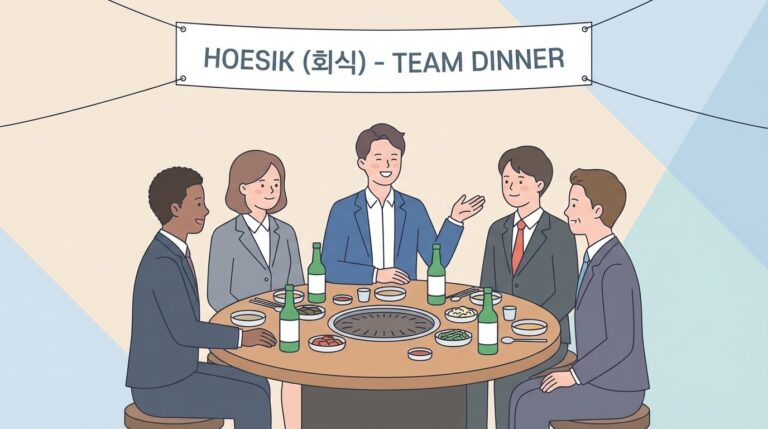
Phase 1: The Immersive Hook
Greeting: 안녕하세요! Welcome back to Daily Hangul. I’m your editor and cultural navigator, here to guide you through the jungle of Korean social dynamics.
The Scene: Picture this. You are in a sleek conference room in Gangnam, or perhaps at a high-end BBQ restaurant for a Hoesik (company dinner). The air is stiff. You’re sitting across from Manager Kim, the one who looks exactly like the stern boss from every K-Drama you’ve ever watched. The silence is deafening. You want to say something—anything—to break the ice, but your brain freezes.
In K-Dramas, this is the moment where the charismatic lead says one witty line, and suddenly everyone is laughing and clinking soju glasses. In reality? A wrong word here can make things even more awkward.
The ‘Why’: Business in Korea runs on Jeong (deep connection) and Nunchi (emotional intelligence). Mastering small talk isn’t just about filling silence; it’s about signaling, “I respect you, and I am safe to do business with.” Today, we move beyond the textbook “Hello” and learn the B2-level art of the “Business Ice-Breaker.”
Phase 2: Deep Dive into Key Expressions
Here are three expressions to turn you from a rigid foreigner into a charming business partner.
1. 말씀 많이 들었습니다.
(I have heard a lot about you.)
- Pronunciation:
Mal-sseum ma-ni deu-reot-sseum-ni-da- Sound-alike: Imagine saying “Mal-practice” + “Sum” + “Manny” (the name) + “Duh-rot” + “Sum” + “Need-a”.
- Meaning:
- Literal: I listened to a lot of words (about you).
- Real Nuance: “Your reputation precedes you / You are famous in our industry.” This is the ultimate ego-booster for Korean professionals.
- K-Culture Moment: In almost every business meeting scene in a drama like Misaeng (Incomplete Life), when a new partner enters, everyone stands up, bows, and says this. It instantly establishes respect.
- Editor’s Insight: This implies that the person is important enough to be talked about. Even if you’ve only heard their name once, say this. It’s white lie etiquette!
- Situation Spectrum:
[🚫 Casual Friends] ———— [⚠️ Colleagues] ———— [✅ First Meeting/Bosses] - 🤔 Think About It: Why does Korean business culture value “reputation” (listening to others about you) over direct self-introduction? How does this reflect the collective nature of Korean society?
2. 분위기가 정말 좋네요.
(The atmosphere is really good here.)
- Pronunciation:
Bun-wi-gi-ga jeong-mal jon-ne-yo- Sound-alike: “Bun” (bread) + “We” + “Gi” (gear) + “ga”… “Jone” (like John) + “Ne” (neighbor) + “yo”.
- Meaning:
- Literal: The atmosphere is truly good.
- Real Nuance: “You have excellent taste in choosing this venue.” You aren’t just complimenting the room; you are complimenting the host.
- K-Culture Moment: You enter a restaurant with traditional Hanok architecture. If you stay silent, it seems you are unimpressed. A quick comment on the vibe relieves the host’s anxiety about their choice.
- Editor’s Insight: Use the ending -ne-yo (-네요) instead of -im-ni-da. Neyo expresses immediate, spontaneous admiration, which feels more authentic.
- Situation Spectrum:
[✅ Casual Friends] ———— [✅ Colleagues] ———— [✅ Bosses]
3. 혹시 주말에 특별한 계획 있으세요?
(Do you happen to have any special plans for the weekend?)
- Pronunciation:
Hok-si ju-ma-re teuk-byeo-ran gye-hoek i-sseu-se-yo?- Sound-alike: “Hawk-see” (crucial word!) … “Ju” + “Ma” + “re”…
- Meaning:
- Literal: By chance, on the weekend, special plans do you have?
- Real Nuance: A polite, non-intrusive way to show interest in their personal life without crossing the line.
- Editor’s Insight: The magic word is Hoksi (혹시). It softens the question. Without Hoksi, it sounds like an interrogation. With Hoksi, it sounds like, “I’m cautious to ask, but…”
- Situation Spectrum:
[✅ Casual Friends] ———— [✅ Colleagues] ———— [⚠️ Very Senior Bosses (Use caution)]
Phase 3: Textbook vs. Real Life
| Situation | 📖 Textbook Korean | 🗣️ Real Korean (B2 Level) | 💡 Why the difference? |
|---|---|---|---|
| Meeting for the first time | 처음 뵙겠습니다. (Nice to meet you.) | 반갑습니다. 말씀 많이 들었습니다. (Glad to meet you. I’ve heard so much about you.) | Just “Nice to meet you” can feel cold. Adding the reputation comment builds instant rapport. |
| Asking about hobbies | 취미가 무엇입니까? (What is your hobby?) | 평소에 시간 나실 때 주로 뭐 하세요? (What do you usually do when you have free time?) | “Hobby” sounds like a resume question. Asking about free time is softer and more conversational. |
| Reacting to a story | 그렇습니까? (Is that so?) | 아, 정말요? 대박이네요! (Oh, really? That’s amazing!) | Formal grammar kills the vibe. Appropriate reactions (Aizuchi) show you are emotionally engaged. |
Bottom Note: In a business setting, avoid slang like “대박” (Daebak) with the CEO, but it is perfect for breaking the ice with a manager or team leader during a dinner.
Phase 4: Cultural Deep Dive — The Art of Nunchi
4-1. Non-verbal: The “Eye Contact” Balance
In the West, strong eye contact shows confidence. In Korea, staring too intensely at a superior can be seen as challenging them. When using these small talk phrases, smile gently and occasionally nod or look slightly downward to show deference. It’s part of Nunchi (눈치)—reading the room.
4-2. K-Culture Connection: The “Hoesik” (Company Dinner)
In K-Dramas like What’s Wrong with Secretary Kim, you see the team going for pork belly and soju. This isn’t just eating; it’s an extension of work. The small talk you do here determines your office life for the next month.
* Critical Perspective: Why do Koreans mix alcohol and business? Alcohol is seen as a “truth serum” that lowers social hierarchies slightly, allowing people to bond beyond their rigid job titles. However, the “forced drinking” culture is slowly changing with the younger generation (MZ Generation).
Phase 5: Immersive Roleplay
Setting: Friday, 7 PM. A high-end Izakaya in Yeouido (financial district). You are with Director Park (50s, conservative but trying to be friendly) and Assistant Lee (20s, helpful).
YOU: (Foreign manager, looking to build trust)
NPC Director Park: (Smiling) 자, 편하게 앉으세요. 여기 안주가 아주 맛있습니다.
(Ja, pyeonhage anjeuseyo. Yeogi anjuga aju masitseumnida.)
“Please, sit comfortably. The appetizers here are delicious.”
🔀 Decision Point: How do you respond?
- Option A: “네, 감사합니다. 배고파요.” (Yes, thank you. I’m hungry.)
- Option B: “와, 분위기가 정말 좋네요! 이런 곳은 어떻게 아셨어요?” (Wow, the atmosphere is great! How did you know this place?)
- Option C: “사장님, 여기 소주 주세요!” (Boss, give us Soju!)
✅ Best Choice: Option B.
* Reason: You are validating Director Park’s choice. It opens a story for him to tell (“Oh, I’ve been coming here for 10 years…”).
* Critique A: Too functional. It ends the conversation.
* Critique C: Too aggressive for the first minute. Wait for the senior to order first.
(Continuing with Option B)
Director Park: 허허, 내가 여기 단골이에요. 우리 김 과장이 예약을 잘 했지.
(Heoheo, I’m a regular here. Manager Kim booked it well.)
YOU: 아, 역시! 말씀 많이 들었습니다, 이사님 미식가라고요.
(Ah, yeoksi! Malsseum mani deureot-sseumnida, isanim misigga-ragoyo.)
“Ah, as expected! I’ve heard a lot about you, that you are a gourmet.”
Director Park: (Visibly happy) 그래요? 누가 그런 말을 해? 하하.
(Really? Who says that? Haha.)
Phase 6: 10-Second Shadowing Drill
Practice these lines to sound natural. Pay attention to the emotion tags!
- Showing Respect (Polite & Warm):
😊 말씀 / 많~이 / 들었습니다.
(Mal-sseum / ma~ni / deu-reot-sseum-ni-da.) -
Admiring the Vibe (Bright & Enthusiastic):
😲 와, / 분위기가 / 정말 / 좋네요!
(Wa, / bun-wi-gi-ga / jeong-mal / jon-ne-yo!) -
Soft Question (Cautious but Friendly):
🤔 혹시 / 주말에 / 특별한 계획 / 있으세요?
(Hok-si / ju-ma-re / teuk-byeo-ran gye-hoek / i-sseu-se-yo?)
Phase 7: K-Culture Mini Glossary
| Korean | Romanization | Meaning | Context |
|---|---|---|---|
| 눈치 | Nunchi | Eye-measure / EQ | The art of sensing the mood. Essential for knowing when to speak and when to pour a drink. |
| 단골 | Dangol | Regular customer | Being a ‘dangol’ implies loyalty and status at a restaurant. |
| 회식 | Hoesik | Company Dinner | The battlefield of Korean business social life. |
| 건배 | Geonbae | Cheers | Lit. “Dry glass.” Always wait for the senior to lift their glass first. |
| 미식가 | Misigga | Gourmet/Foodie | A great compliment for a boss who chooses the restaurant. |
Phase 8: Traveler’s Survival Kit (Business Trip Edition)
You are in a taxi going to the meeting, or at the hotel concierge.
🆘 Survival Expression #1: Taxi
* 🇰🇷 “기사님, 여기로 가주세요.” (Gisa-nim, yeogi-ro ga-juseyo.)
* 🗣️ Pronunciation: [Gi-sa-nim, yuh-gi-ro ga-ju-say-yo]
* 📍 Usage: Show the address on your phone (Naver Map) and say this.
* 💡 Pro Tip: In Korea, addressing the driver as “Gisa-nim” (Driver-nim) is much more respectful than “Ajusshi.”📌 Editor’s Travel Note
* Business Cards: Always exchange cards (Myeongham) with two hands at the start of the meeting. Study the card for 5-10 seconds before putting it on the table. Never put it in your back pocket!
Phase 9: Think Deeper — Language & Power
The Public Self vs. The Private Self
In English, you are usually just “You.” In Korean, who you are changes depending on who you are with. Notice how we used -yo and -nida endings? Korean society distinguishes sharply between Gong (Public/Official) and Sa (Private) spheres. Using proper honorifics isn’t just about grammar; it’s about acknowledging your role in the group hierarchy. When you ask, “Do you have weekend plans?” using honorifics, you are bridging that gap—trying to bring a bit of the ‘Private’ warmth into the ‘Public’ stiffness.
💬 Your Turn: Does your language change when speaking to a boss versus a friend? How strict is that line? Tell us in the comments!
Phase 10: FAQ & Troubleshooting
Q: Can I ask “How old are you?” to break the ice?
A: Maybe. In a casual setting, Koreans ask age early to establish hierarchy (who is Hyung or Unnie). However, in a business meeting, it can be rude. Stick to safe topics like travel, food, or weather until you are at the Hoesik (dinner) with a few drinks involved.
Q: What if I don’t drink alcohol?
A: No problem. But don’t flip your glass over. Receive the drink with two hands, leave it on the table, and toast with water or a soft drink. It’s the act of toasting that matters, not the liquid inside.
❌ Common Mistake: Complimenting physical appearance too aggressively.
* Don’t say: “You are very handsome/beautiful.”
* Do say: “You look very professional” or “You seem very energetic (ener-gy-ga neom-chi-se-yo).”
Phase 11: Wrap-up & Action Items
One-Liner: Breaking the ice in Korea is about lowering your ego and elevating the other person’s mood through compliments and safe curiosity.
🎬 Action Missions:
* 🥉 Bronze: Stand in front of a mirror and practice the “Ah, really?” reaction with an enthusiastic face. (Facial expression is 50% of the language!)
* 🥈 Silver: Watch a clip of a Korean talk show (like You Quiz on the Block) and count how many times they use “Hoksi” when asking questions.
* 🥇 Gold: Next time you are at a Korean restaurant (even in your home country), tell the server: “Bunwigi-ga jeongmal jonneyo!”
Phase 12: Interactive Quiz
1. Situation Judgment:
Your business partner arrives late. What is the best ice-breaker?
* A) “Why are you late?”
* B) “It’s okay. Traffic is terrible in Seoul, right?”
* C) “We started without you.”
2. True or False (K-Culture):
When clinking glasses for a toast with a boss, your glass should be higher than theirs.
* (True / False)
3. Fill in the Blank:
“I heard a lot about you” in Korean is: “________ mani deureot-sseumnida.”
Answers:
1. B (Empathy builds Jeong).
2. False (Your glass should be lower to show respect).
3. Malsseum (Honorific word for ‘speech/words’).







