

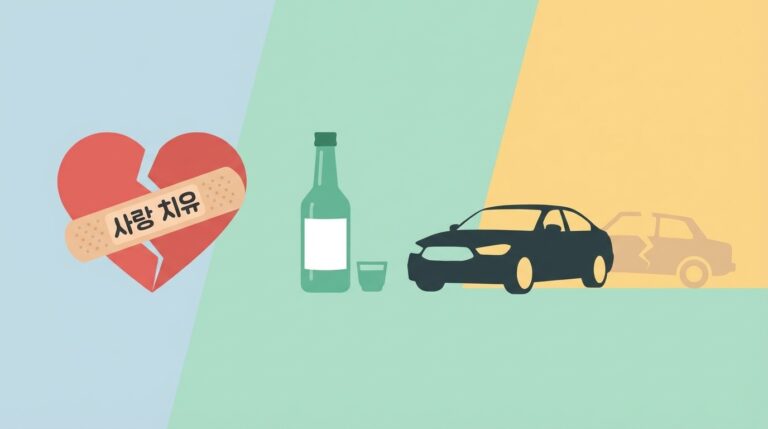
💔 Heartbroken in Seoul? How to Heal Like a K-Drama Protagonist
Phase 1: The Immersive Hook
안녕하세요! This is your Daily Hangul Editor.
Picture this: It’s raining in Seoul. You’re sitting in a Pocha (tent bar) with plastic walls flapping in the wind. A sad ballad by IU or Park Hyo-shin is playing in the background. You’re staring at a shot of soju, thinking about that person.
In every K-Drama, this is the moment your best friend slams their hand on the table and shouts a specific phrase to snap you out of it. They don’t just say “Cheer up.” They give you the uniquely Korean philosophy of love: “Old love is cured by new love.”
Today, we are going to learn how to handle breakups (이별 – ibyeol) in Korean. Not the stiff textbook way, but the way real friends talk over grilled pork belly. Ready to mend that heart? Let’s go.
Phase 2: Deep Dive into Key Expressions
1. 사랑은 다른 사랑으로 잊혀진다
(Love is forgotten by another love)
- Pronunciation: [Sarang-eun dareun sarang-euro ichyeojinda]
(Think: ‘Sarang’ sounds like ‘Sa-rang’, ‘ichyeojinda’ is soft like a whisper fading away.)- Meaning: Literal translation. It means the only cure for a broken heart is a rebound or a new relationship.
- K-Culture Moment: This is the classic K-Drama trope. The second lead usually tells this to the protagonist right before they confess their own feelings!
- Editor’s Insight: This isn’t just advice; it’s a belief. Koreans often believe that dwelling on the past (미련 – miryeon) is unhealthy. You need to “replace” the memory.
- Situation Spectrum:
[🚫 Boss] ———— [⚠️ Colleague] ———— [✅ Best Friend]- 🤔 Think About It: Why does this phrase focus on external healing (a new person) rather than internal healing (loving yourself)? Does this reflect a culture that values ‘We’ (relationships) over ‘I’?
2. 똥차 가고 벤츠 온다
(The poop car leaves, and a Mercedes comes)
- Pronunciation: [Ttong-cha gago bencheu onda]
(Start ‘Ttong’ with a strong, tense T sound. It literally means ‘poop’ or ‘junk’.)- Meaning:
- Literal: The junk car goes away, the Mercedes comes.
- Real Nuance: “Your ex was trash, and your next partner will be high-quality (like a luxury car).”
- K-Culture Moment: You will hear this constantly in friend groups when someone gets dumped. It’s the ultimate hype-up phrase to validate that the ex wasn’t worth it.
- Editor’s Insight: It sounds harsh, but it’s meant to be funny and empowering. It frames the breakup as a “lucky escape” rather than a loss.
- Situation Spectrum:
[🚫 Elders/Formal] ———— [⚠️ Close Colleague] ———— [✅ Friends]- 🤔 Think About It: Comparing people to cars is materialistic, but effective. What is the equivalent metaphor in your language? “Plenty of fish in the sea”?
3. 시간이 약이다
(Time is the medicine)
- Pronunciation: [Sigani yagida]
- Meaning: Time heals all wounds.
- Editor’s Insight: This is the safest, most gentle consolation. If you don’t know what to say, say this.
- Situation Spectrum:
[✅ Elders] ———— [✅ Colleagues] ———— [✅ Friends]
Phase 3: Textbook vs. Real Life
| Situation | 📖 Textbook Korean | 🗣️ Real Street Korean | 💡 Why the difference? |
|---|---|---|---|
| Consoling a friend | 힘내세요. (Cheer up.) | 술 한잔하자. (Let’s have a drink.) | In Korea, sharing food/alcohol is the primary way to share emotional burdens (Jeong). |
| criticizing the ex | 잊어버리세요. (Please forget them.) | 그 사람 진짜 별로였어. (That person was really ‘meh’.) | Real friends validate your anger, they don’t just tell you to be neutral. |
| Suggesting a set-up | 새로운 사람을 만나보세요. (Meet someone new.) | 소개팅 할래? (Want a blind date?) | ‘Sogaeting’ (Blind date) is the standard way to meet new people in Korea. |
Bottom Note: If you are B1 level, avoid using slang like “똥차” (Poop car) with people older than you. Stick to “더 좋은 사람 만날 거예요” (You will meet a better person).
Phase 4: Cultural Deep Dive — The “Breakup Rituals”
4-1. The Art of “Noraebang” (Karaoke)
In Korea, you don’t cry alone in your room; you go to a Coin Noraebang (코노). You sing sad ballads (balladeu) at the top of your lungs.
* Non-verbal Tip: If your Korean friend is singing a sad song, do not clap excitedly. Just sway along and look sympathetic. Reading the room (Nunchi) is key.
4-2. Food Therapy (Stress Relief)
Why is spicy food (Maeun-mat) popular after a breakup? Koreans believe spicy food makes you sweat and releases stress.
* Menu: Dakbal (Chicken feet) or Tteokbokki (Spicy rice cakes).
* K-Food Connection: If a friend asks, “Do you want to eat something spicy?” (매운 거 먹으러 갈래?), they might be sensing you are stressed or sad.
Phase 5: Immersive Roleplay
Setting: It’s Friday night at a bustling BBQ place in Hongdae. The air smells of grilled pork. Your friend, Jisoo (28, female, very energetic), is pouring you a glass of Soju.
Jisoo: 야, 그 사람 생각하지 마. 마셔, 마셔! 🍻
(Ya, geu saram saeng-gakhaji ma. Masyeo, masyeo!)
(English: Hey, don’t think about him/her. Drink, drink!)
(🎭 Jisoo hands you a full glass)
YOU: (Sighing) _______
🔀 Your Turn! How do you respond?
– A) “그래, 똥차 가고 벤츠 오겠지!” (Yeah, junk car goes, Mercedes comes!)
– B) “아니야… 아직 너무 슬퍼.” (No… I’m still too sad.)
– C) “건배!” (Cheers!)✅ Best Choice: A
Why: This shows you are trying to move on. Jisoo will love this attitude and probably shout “Nice!” (나이스!).
⚠️ Choice B Analysis: This is okay, but Jisoo might feel the need to comfort you more aggressively. The mood will stay heavy.
Phase 6: 10-Second Shadowing Drill
Let’s practice the “Mercedes” philosophy. Say it with confidence!
😤 Confident & Loud:
걱정 마! / 똥차 가고 / 벤츠 온다!
(Geok-jeong ma! / Ttong-cha gago / Bencheu onda!)
Don’t worry! The junk car leaves, and a Mercedes comes!
Phase 7: K-Culture Mini Glossary
| Korean | Romanization | Meaning | Context |
|---|---|---|---|
| 미련 | Miryeon | Lingering feelings | “Do you still have miryeon for him?” |
| 소개팅 | Sogaeting | Blind Date | Usually 1:1, arranged by friends. The cure for breakups. |
| 흑역사 | Heuk-yeok-sa | Dark History | Embarrassing past moments (like drunk texting your ex). |
| 잠수 타다 | Jamsu tada | To ghost | Lit. “To go underwater/submerge.” Disappearing from contact. |
Phase 8: Traveler’s Survival Kit (Heartbreak Edition)
Even if you aren’t heartbroken, you might want to enjoy some solitude in Seoul.
🆘 Survival Expression: Eating Alone
– 🇰🇷 “여기 1인분 되나요?” (Yeogi irinbun doenayo?)
– 🗣️ Sounds like: Yog-ee il-in-boon dwe-na-yo?
– Meaning: “Can I order for one person here?”
– Context: Many Korean BBQ/Stew places require 2+ orders.
– 💡 Pro Tip: Search for “혼밥” (Honbap – eating alone) on Naver Maps to find solo-friendly restaurants.📌 Editor’s Travel Note: Where to Cry/Think?
– Avoid: Namsan Tower (Too many couples with locks).
– Go to: Cheonggyecheon Stream at night or Han River Parks (Hangang). Sitting by the water with a beer is culturally acceptable and very healing.
Phase 9: Think Deeper — “Fate vs. Effort”
Inyeon (인연): The Red String of Fate
In Western culture, relationships often feel like a result of personal choice and effort. In Korea, the concept of Inyeon (providence or fate) is strong. If you break up, people might comfort you by saying “인연이 아니었나 봐” (I guess it wasn’t fate).
🧠 Think Deeper:
Does believing in “fate” make a breakup easier (it wasn’t meant to be) or harder (I lost my destiny)? How does your culture view the end of a relationship—as a failure of effort or a twist of fate?💬 Your Turn: How do you say “It wasn’t meant to be” in your language?
Phase 10: FAQ & Troubleshooting
Q: Can I use “sarang” (love) for a distinct crush or short dating?
A: Koreans use “Sarang” a bit more heavily than the casual English “Love.” For short dating, we might say “Jeong” (attachment) or just “dating.” But in the context of the phrase “Sarang is forgotten by another love,” it applies to any romantic interest.
Q: Is it rude to block an ex immediately?
A: In the age of KakaoTalk, blocking is common, but often considered “harsh” unless the breakup was bad. Many people just hide their profiles.
❌ Common Mistake: Drunk dialing/texting exes.
✅ Correction: This is called “kicking the blanket” (이불킥) the next morning. Friends will stop you if they have good Nunchi.
Phase 11: Wrap-up & Action Mission
Summary: Today we learned that in Korea, breakups are healed with spicy food, friends, karaoke, and the belief that a “Mercedes” is coming to replace the “Junk Car.”
🚀 Action Missions:
– 🥉 Bronze: Say “똥차 가고 벤츠 온다” to yourself in the mirror if you feel down.
– 🥈 Silver: Watch a K-Drama breakup scene and listen for the word “Miryeon” (lingering feelings).
– 🥇 Gold: Go to a Korean restaurant, order spicy food, and relieve your stress!
K-Culture Mission: Listen to the song “SoJu One Glass” (소주 한 잔) by Im Chang-jung. It’s the anthem of Korean heartbreak. Can you catch the emotion without knowing all the words?
See you next time! Keep your heart strong! (마음 단단히 먹으세요!)







