

Phase 1: Immersive Hook
Greeting: 안녕하세요! This is your Daily Hangul Chief Editor. 👋
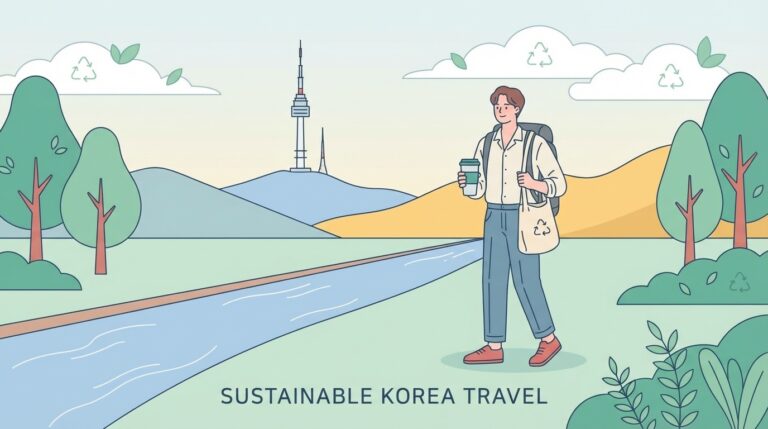
The Scene: You’re walking along the Han River park, the sun setting pink and orange behind the Namsan Tower. It’s the perfect K-Drama ending scene. But then, you see it—overflowing trash cans filled with plastic cups and delivery food containers. It breaks the immersion, doesn’t it?
In recent years, a massive wave has hit Korea: “Zero Waste” and “Eco-Life.” It’s no longer just about following rules; it’s become a trend.
Remember that variety show where the cast goes Plogging (jogging + picking up litter)? Or seeing your favorite K-Pop idol carrying a specific brand of tumbler at the airport? That’s not just product placement; it’s a statement.
Today, we aren’t just learning how to say “no plastic bag.” We are diving into the high-level, nuanced language of Sustainable Travel in Korea. If you master these phrases, you won’t just be a tourist; you’ll be a “conscious concept-dol” (a playfully intellectual idol) in the eyes of locals. Let’s get hip and green.
Phase 2: Deep Dive into Core Expressions
1. [용기 내다] (Yonggi naeda)
- Pronunciation: [Yonggi naeda] + (Sounds like “Yong-ghee” as in ghee butter + “neh-da”)
- Meaning:
- Literal: To show courage.
- Real Nuance (The Pun): In the eco-context, ‘용기(yonggi)’ means both ‘courage’ and ‘container.’ So, the campaign “용기 내!” means “Bring your own container (to pick up food)!” It’s a clever linguistic play used in the zero-waste movement.
- K-Culture Moment: You might see a sticker on a trendy tteokbokki shop window saying #용기내챌린지 (#Yonggi-nae Challenge). This implies you can bring your own Tupperware instead of using their plastic.
- Editor’s Insight: This is C1 level wit. Using this shows you understand the social movement, not just the language. It implies, “I care enough to be inconvenient.”
- Situation Spectrum:
[🚫 Formal Report] ———— [⚠️ Semi-Formal] ———— [✅ Casual/Shop Interaction]- (Used playfully or in campaigns)
- 🤔 Think About It: Why does Korea resort to puns to drive social campaigns? Does humor make strict recycling rules easier to swallow?
2. [일회용품은 빼 주세요] (Ilhoeyongpumeun ppae juseyo)
- Pronunciation: [Il-hoe-yong-pum-eun bbae ju-se-yo]
- Meaning: “Please leave out the disposable items.”
- K-Culture Moment: You are ordering delivery chicken on an app like Baemin (Baedal Minjok) to your hotel. There is a checkbox for this, but if you call or write a request, this is the phrase. It saves you from the guilt of receiving 10 pairs of wooden chopsticks you don’t need.
- Editor’s Insight: ‘빼다(Ppaeda)’ means to subtract or remove. It’s cleaner and more decisive than saying “I don’t need X.”
- Situation Spectrum:
[🚫 Respectful Bow] ———— [⚠️ Polite Request] ———— [✅ Very Common]- (Standard polite phrase for service interactions)
3. [텀블러 할인 되나요?] (Teombeulleo hal-in doenayo?)
- Pronunciation: [Teom-beul-leo ha-rin doe-na-yo?]
- Meaning: “Is there a tumbler discount?”
- K-Culture Moment: In almost every major franchise cafe (Starbucks, Twosome, Mega Coffee), bringing your own cup gets you a 300~500 KRW discount. It’s part of the “Smart Consumer” culture.
- Editor’s Insight: Don’t be shy. In Korea, being frugal and eco-friendly is considered ‘smart,’ not ‘cheap.’
Phase 3: Textbook vs. Real Life
| Situation | 📖 Textbook Korean | 🗣️ Real Korean (Eco-Insider) | 💡 Why the difference? |
|---|---|---|---|
| Recycling | 재활용을 해야 합니다. (We must recycle.) |
분리배출 철저히 해야 돼요. (We must do ‘separate discharge’ thoroughly.) |
‘Bunli-baechul’ is the specific administrative term used in apartment complexes. |
| Refusing Straw | 빨대는 필요 없습니다. (I do not need a straw.) |
아, 빨대는 괜찮아요. (Ah, straw is okay/fine [without].) |
‘Gwaenchanhayo’ is the magic word for polite refusal in 90% of situations. |
| Leftover Food | 남은 음식 좀 싸 주세요. (Please wrap leftover food.) |
남은 건 제 통에 담아주실 수 있나요? (Can you put the leftovers in my container?) |
Shows active participation in the zero-waste movement (Yonggi-nae). |
Phase 4: Cultural Context — The “Hip” Eco-Warrior
4-1. Non-verbal: The “Validating Nod”
When you hand over your personal tumbler at a busy cafe, the barista might pause. This isn’t annoyance; they are assessing the size (Tall/Grande). At this moment, give a slight, confident nod and hold the tumbler with two hands (politeness). This signals, “I know the drill, I’m helping the planet, and I respect you.”
4-2. K-Culture Connection: K-Pop & “Good Influence”
Have you heard the term 선한 영향력 (Seonhan yeonghyang-ryeok – Good Influence)? K-Pop fandoms often donate trees or organize plogging events for an idol’s birthday. If you tell a Korean friend, “I’m interested in Eco-tours or Zero-waste shops (제로웨이스트 샵),” they won’t think you are boring. They will think you are joining the “Good Influence” wave, similar to how BTS or Blackpink members promote sustainability.
Phase 5: Immersive Roleplay Scenario
Setting: A hip, upcycled industrial-style cafe in Seongsu-dong (the Brooklyn of Seoul). It’s Saturday afternoon. You have your reusable cup.
Characters:
* YOU: An eco-conscious traveler exploring Seoul’s cafe scene.
* Barista: A trendy part-timer (Alba) in his 20s, wearing an apron made of recycled denim.
Dialogue:
Barista: 주문 도와드릴까요? (May I help you order?)
YOU: 네, 아이스 아메리카노 한 잔 주세요. 혹시 여기에 담아주실 수 있나요?
(Ne, ice americano han jan juseyo. Hoksi yeogie damajusil su innayo?)
(Yes, one iced Americano please. By chance, can you put it in here [my tumbler]?)
Barista: 아, 텀블러시네요! 그럼 300원 할인해 드릴게요. 세척은 되어 있나요?
(Ah, teombeulleo-sineyo! Geureom 300won harin-hae deurilgeyo. Secheog-eun doeeo innayo?)
(Ah, a tumbler! I’ll give you a 300 won discount. Is it washed/clean?)
YOU:
🔀 Your Turn! Choose your response:
* A) 네, 깨끗해요. (Yes, it’s clean.)
* B) 아니요, 한번 헹궈 주실 수 있나요? (No, can you rinse it once?)
* C) 설거지 해주세요. (Do the dishes for me.)✅ Best Choice (A): The safest bet. Most cafes expect you to bring a clean cup.
⚠️ Choice (B): Acceptable in some friendly places, but during rush hour, asking them to rinse (헹구다) your dirty cup can be a burden (Minpye).
🚫 Choice (C): “Seolgeoji” implies a full wash with soap. This is rude to ask a barista.
Barista: 네, 알겠습니다. 영수증 필요하세요?
(Ne, algesseumnida. Yeongsujeung piryohaseyo?)
(Okay. Do you need a receipt?)
YOU: 아니요, 모바일 영수증으로 받을게요. (종이 아깝잖아요!)
(Aniyo, mobile yeongsujeung-euro badeulgeyo.)
(No, I’ll take a mobile receipt.)
Phase 6: 10-Second Shadowing Drill
Let’s practice the polite refusal of disposables. Use a soft but firm tone.
- Emotion: 😊 Helpful & Eco-conscious
- Drill:
빨대는 / 괜찮아요. / 그냥 / 입으로 마실게요!
(Bbaldaeneun / gwaenchanhayo. / Geunyang / ibeuro masilgeyo!)
(Straw is / fine [without]. / Just / I’ll drink with my mouth!)
Phase 7: K-Culture Mini Glossary
| Korean | Romanization | Meaning | Context |
|---|---|---|---|
| 줍깅 | Jup-ging | Plogging | Combination of ‘Jupda’ (pick up) + ‘Jogging’. Very popular activity among volunteer groups. |
| 비건 | Bi-geon | Vegan | Korea has a growing vegan scene. Look for the ‘Vegan’ mark in convenience stores. |
| 라벨 제거 | Label jegeo | Removing labels | Essential etiquette when recycling PET bottles in Korea. |
| 다회용기 | Dahoeyong-gi | Reusable container | The opposite of ‘Ilhoeyong-pum’ (disposable). |
Phase 8: Traveler’s Survival Kit (Eco-Edition)
🆘 Survival Expression #1
* 🇰🇷 “혹시 물통에 물 좀 채워주실 수 있나요?”
* (Hoksi multong-e mul jom chaewojusil su innayo?)
* 🗣️ Meaning: “Can you fill my water bottle?”
* 📍 Where: Cafes, Restaurants (Korea has free water everywhere!)
* 💡 Pro Tip: In Korea, water is almost always free (service). You don’t need to buy plastic bottled water. Just ask to refill!
📌 Editor’s Travel Note: The Trash Crisis
* Finding Trash Cans: You will notice it is very hard to find public trash cans on the streets of Seoul. This is to discourage household waste dumping.
* Strategy: Carry a small “trash pouch” in your bag. Dispose of your trash at your hotel or inside subway stations/train stations where bins are available.
Phase 9: Think Deeper — “Fast Trends vs. Slow Earth”
🧠 Topic: The Paradox of K-Trends
Korea is known for “Palli-Palli” (Hurry-Hurry) culture and rapidly changing trends (Fast Fashion, new cafe themes every month). Yet, the “Eco-friendly” movement emphasizes “Slow” and “Sustainable.”
Isn’t it ironic that sustainability itself has become a “fast trend” in Korea? People buy new eco-bags and new tumblers to look eco-friendly, sometimes creating more waste.
💬 Your Turn: In your country, is being eco-friendly considered “hip” and trendy, or is it seen as a strict civic duty? How does language reflect this?
Phase 10: FAQ & Troubleshooting
- Q: Can I use the ‘Yonggi-nae’ (Container) method at street food stalls (Pojangmacha)?
- Editor: Absolutely! In fact, the “Ajumma” (auntie) running the stall will likely love it. She might say, “Aigo, you are so kind to the earth!” and give you extra Tteokbokki (Service). It shows deep respect for local life.
- Q: I threw my trash in the wrong bin at the Airbnb. Will I get in trouble?
- Editor: If the host finds out, yes. Korea has a Real-Name Waste System in some areas and strict CCTV monitoring. Fines are heavy. If you are confused, take a photo and ask your host: “분리배출 어떻게 해요?” (How do I separate this trash?)
Phase 11: Wrap-up & Action Mission
One-Liner: sustainable travel in Korea isn’t just about saving the planet; it’s about connecting with the “Good Influence” culture.
Action Missions:
* 🥉 Bronze: Say “빨대는 괜찮아요” (No straw, please) to yourself in the mirror 3 times.
* 🥈 Silver: Search for “Zero waste shop Seoul” on Naver Maps or Instagram and save one location.
* 🥇 Gold: Go to a cafe, present your tumbler, and ask, “텀블러 할인 되나요?” (Is there a tumbler discount?)
K-Culture Mission:
Watch a variety show clip of idols doing a “Plogging” event. Notice how they use tongs and specific biodegradable bags. Try to spot the word “분리배출” in the subtitles!
Phase 12: Interactive Quiz
Scenario: You finished a bottle of banana milk (plastic). You are at a recycling station. You see three bins.
- 일반 쓰레기 (General Waste)
- 플라스틱 (Plastic)
- 비닐 (Vinyl/Wrapper)
The bottle has a foil lid and a plastic body. What is the CORRECT C1-level behavior?
- A) Throw the whole thing in ‘Plastic’.
- B) Throw the whole thing in ‘General Waste’.
- C) Peel off the foil lid, put the lid in ‘General Waste’ (or Vinyl if applicable), and the body in ‘Plastic’.
Correct Answer: C
Explanation: This is the “Label Jegeo” (Removing Label/Lid) etiquette. Mixing materials is a big no-no in Korea’s strict recycling culture. Doing C shows you are a true pro!
Frequently Asked Questions (FAQ)
Q: What does "[용기 내다] (Yonggi naeda)" mean in Korean and how do you pronounce it?
A: In Korean, "[용기 내다] (Yonggi naeda)" is pronounced [Yonggi naeda] and means: Literal: To show courage.
Q: What does "[일회용품은 빼 주세요] (Ilhoeyongpumeun ppae juseyo)" mean in Korean and how do you pronounce it?
A: In Korean, "[일회용품은 빼 주세요] (Ilhoeyongpumeun ppae juseyo)" is pronounced [Il-hoe-yong-pum-eun bbae ju-se-yo] and means: "Please leave out the disposable items."
Q: What does "[텀블러 할인 되나요?] (Teombeulleo hal-in doenayo?)" mean in Korean and how do you pronounce it?
A: In Korean, "[텀블러 할인 되나요?] (Teombeulleo hal-in doenayo?)" is pronounced [Teom-beul-leo ha-rin doe-na-yo?] and means: "Is there a tumbler discount?"






