

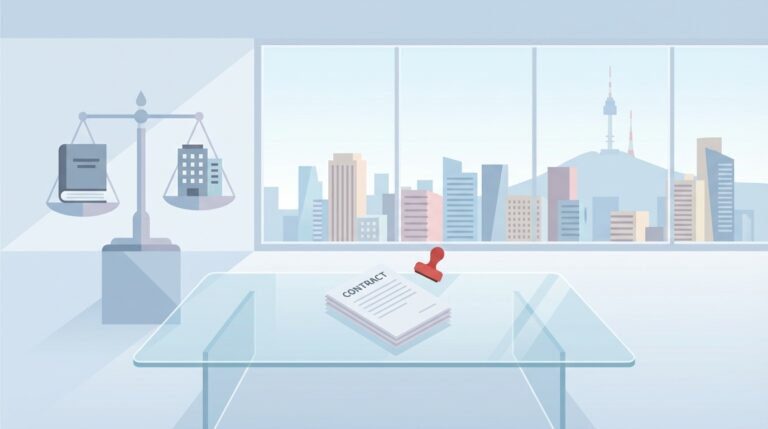
Phase 1: The Immersive Hook
Greeting: Hello, Daily Hangul readers! This is your Senior Editor, back with the heavy hitters.
K-Culture Cold Open: We’ve all seen that intense scene in a corporate K-Drama (think Misaeng or Queen of Tears). The legal team storms into the boardroom, dropping a stack of documents on the mahogany table. The atmosphere is icy. Someone whispers, “Will this hold up in court?” In Korea, the law isn’t just a set of rules; it’s a dynamic battleground between rapid modernization and traditional hierarchy. When the Labor Standards Act changes—which happens quite frequently in Korea’s fast-paced legislative environment—internal company regulations (사규) must adapt immediately. If you are working in Korea at a managerial level or handling contracts, missing a single nuance can turn a “family-like company” into a legal nightmare.
The ‘Why’: At a C2 level, you aren’t just learning to survive; you are learning to negotiate and govern. Understanding the terminology of labor law amendments protects you from unfair contracts and positions you as a highly competent professional who understands the system, not just the language.
Transparency: Today’s lesson draws from real consultations with foreign executives and HR managers operating in Seoul. Let’s decode the legalese.
Phase 2: Deep Dive into Legal Nuances
1. 저촉되다 (jeochokdoeda)
- Pronunciation: [jeo-chok-doe-da] (Think of the ‘chok’ sound like a sharp choke point—where things get stuck.)
- Meaning: To be in conflict with; to contravene (a law or regulation).
- K-Culture Moment: In the drama Extraordinary Attorney Woo, you often hear lawyers arguing that a specific company policy “relates to” or “conflicts with” existing statutes. This is the verb they use when the fit isn’t right.
- Editor’s Insight: This is a high-frequency word in legal reviews. Unlike ‘위반하다’ (to violate), which suggests an active breakage, 저촉되다 implies a state of being in conflict. It sounds more objective and professional.
- Situation Spectrum:
[🚫 Casual Friends] ———— [⚠️ Colleagues] ———— [✅ Legal/Formal] - 🤔 Think About It: Why does Korean distinguish between “breaking” a law (wi-ban) and “touching/conflicting” with a law (jeo-chok)? It reflects a legal philosophy that values harmony and structural consistency.
2. 불이익 변경 (bul-iik byeongyeong)
- Pronunciation: [bul-i-ik byeon-gyeong]
- Meaning: Adverse modification; changing rules to the detriment of employees.
- K-Culture Moment: Imagine a scene where the company suddenly cuts welfare benefits. The Union leader stands up and shouts this term. It is the “nuclear button” of Korean labor relations.
- Editor’s Insight: This is a critical legal concept. Under Korean law, if a rule change is “disadvantageous” to employees, the company must obtain the collective consent of the majority of workers. You cannot just announce it.
- Situation Spectrum:
[🚫 Casual Friends] ———— [⚠️ Colleagues] ———— [✅ HR/Union Meetings] - 🤔 Think About It: Korea has very strong worker protections on paper compared to its hierarchical culture. How does this term protect the ‘Eul’ (subordinate) from the ‘Gap’ (dominant party)?
3. 소급 적용 (sogeup jeogyong)
- Pronunciation: [so-geup jeo-gyong]
- Meaning: Retroactive application.
- K-Culture Moment: You might hear this in political news or corporate restructuring announcements. “Does this new penalty apply to mistakes made last year?”
- Editor’s Insight: Generally, retroactive application is prohibited to ensure legal stability. If you use this word correctly in a meeting, everyone will look at you with newfound respect. It signals you understand the timeline of liability.
- Situation Spectrum:
[🚫 Casual Friends] ———— [⚠️ Business Strategy] ———— [✅ Legal Review]
Phase 3: Textbook vs. Real Life
| Context | 📖 Textbook Korean | 🗣️ Real Korean (Business/Legal) | 💡 Why the difference? |
|---|---|---|---|
| Pointing out a legal issue | 법을 위반할 수 있습니다. (You might violate the law.) | 컴플라이언스 리스크가 우려됩니다. (Compliance risk is a concern.) | ‘Compliance’ (Konglish) is preferred in corporate settings to sound softer yet professional. |
| Asking to check the rules | 규칙을 확인해 주세요. (Please check the rules.) | 취업규칙과 대조 검토 바랍니다. (Please cross-reference with the Rules of Employment.) | Specificity reduces ambiguity in contracts. |
| Refusing a policy change | 그건 안 돼요. (That’s not allowed.) | 현행법상 무리가 따를 것 같습니다. (It seems it would be strained under current law.) | Direct refusal is rude; blaming the “current law” creates a neutral scapegoat. |
Bottom Note: In C2 contexts, indirectness is power. Blame the “system” or the “risk,” never the person.
Phase 4: Cultural Deep Dive — The “Nunchi” of Contracts
4-1. Non-verbal: The “Seal” of Approval
In Western cultures, a signature is final. In Korea, the Dojang (Seal/Stamp) carries weight. When presenting revised regulations, the physical act of stamping the document (especially the Ganyin or cross-stamping across folded pages) represents the binding of trust. Handing a contract with two hands, ensuring the text faces the superior, is not just manners—it’s part of the transaction.
4-2. K-Drama Trope: The “Strategy Team” (기획조정실)
In dramas like Reborn Rich, the “Strategy Team” often manipulates laws. Real life isn’t that dramatic, but the tension is real. The Labor Standards Act (근로기준법) is often called the “Worker’s Bible.” Mentioning specific article numbers (e.g., “Article 52 regarding the 52-hour work week”) during a negotiation signals that you are not a clueless foreigner, but a player in the game.
Phase 5: Immersive Roleplay — The HR Crisis
Setting: Monday, 10 AM. A glass-walled meeting room in Yeouido (Korea’s Wall Street). The air is stiff. The CEO wants to cut overtime pay by changing the calculation method.
Characters:
– YOU: Legal Compliance Officer (Foreigner, expert in Korean law).
– Director Kim: Aggressive Sales Director who thinks laws are “suggestions.”
Dialogue:
Director Kim: 이번에 개정된 노동법, 그냥 적당히 우리 사규에 맞춰서 해석하면 되는 거 아닙니까? 😤
(Ibeon-e gaejeongdoen nodongbeop, geunyang jeokdanghi uri sagyu-e matchwoseo haeseokhamyeon doeneun geo animnikka?)
(Can’t we just loosely interpret the amended labor law to fit our company regulations?)
YOU: 🎭 (Adjusting your glasses calmly)
이사님, 그렇게 단순하지 않습니다. 개정안과 현행 사규가 정면으로 저촉될 가능성이 높습니다.
(Isanim, geureoke dansunhaji anseumnida. Gaejeongan-gwa hyeonhaeng sagyu-ga jeongmyeon-euro jeochokdoel ganeungseong-i nopseumnida.)
(Director, it’s not that simple. There is a high probability that the amendment and current regulations will be in direct conflict.)
Director Kim: 에이, 직원들도 회사 사정 다 아는데, 동의서 대충 받으면 되잖아요?
(Ei, jigwondeul-do hoesa sajeong da aneunde, donguiseo daechung badeumyeon doejannayo?)
(Oh come on, the staff knows the company’s situation. Can’t we just roughly get their consent forms?)
🔀 Decision Point: How do you warn him?
- A) “안 됩니다. 불법입니다.” (Too blunt. He loses face.)
- B) “취업규칙의 불이익 변경에 해당하기 때문에, 과반수의 동의가 없으면 무효가 됩니다.” (Professional, citing the exact legal concept.)
- C) “마음대로 하세요. 전 모릅니다.” (Irresponsible.)
✅ Best Choice: B. You used the C2 term 불이익 변경 (Adverse modification). This phrase scares executives because it implies legal invalidity (무효).
YOU: (Continuing with Choice B) …나중에 소급 적용 문제라도 생기면, 회사가 감당해야 할 리스크가 너무 큽니다.
(…Najung-e sogeup jeogyong munje-rado saenggimyeon, hoesa-ga gamdanghaeya hal riseukeu-ga neomu keumnida.)
(…If an issue with retroactive application arises later, the risk the company has to bear is too great.)
Phase 6: 10-Second Shadowing Drill
Emotion: Professional, firm, yet polite warning. (😐 Serious)
Sentence:
“개정된 법안에 / 저촉되지 않도록 / 사규를 면밀히 / 검토해야 합니다.”
Pronunciation:
[Gaejeongdoen beoban-e / jeochokdoeji antorok / sagyu-reul myeonmilhi / geomtohaeya hamnida.]
Meaning:
We must meticulously review the company regulations so that they do not conflict with the amended bill.
Phase 7: K-Culture Glossary (Corporate Law Edition)
| Korean | Romanization | Meaning | Context |
|---|---|---|---|
| 근로기준법 | Geunlo-gijun-beop | Labor Standards Act | The absolute standard for all labor contracts. Supercedes company rules. |
| 포괄임금제 | Pogwal-imgeum-je | Comprehensive Wage System | A controversial fixed-overtime pay system often debated in IT/Gaming companies. |
| 갑질 | Gapjil | Abuse of power | Often legally defined now as “Workplace Harassment.” |
| 내용증명 | Naeyong-jeungmyeon | Certification of Contents | A registered letter used as legal evidence before a lawsuit. Sending this means war. |
Phase 8: Expat Professional’s Survival Kit
While this unit focuses on corporate law, even travelers or expats sign contracts (housing, gym, phones). Here is your C2 contract survival kit.
🆘 Survival Expression: The “Check the Fine Print”
– 🇰🇷 “특약 사항에 불리한 조항은 없나요?”
– (Teuk-yak sahang-e bullihan johang-eun eomnayo?)
– Meaning: “Are there any unfavorable clauses in the special terms?”
– 📍 Use here: Real estate agents, signing employment contracts.
– 💡 Pro Tip: Koreans often focus on the main text, but the 특약 (Special Covenants) at the bottom is where the traps are (e.g., “No pets,” “No refund”).📌 Editor’s Note on Digital Signatures:
Korea is moving toward digital contracts (SignOK, ModuSign), but for high-stakes contracts (housing), the In-gam (Registered Seal) is still king. If you stay long-term, register your seal at the local office (Jumin Center).
Phase 9: Think Deeper — Law & Hierarchy
Topic: The Tension between ‘Law’ and ‘Jeong’ (Affection/Bond)
In Western societies, the contract is the final word. In Korea, the contract is often viewed as the starting point of a relationship, subject to change based on circumstances and Jeong. However, the modern Korean legal landscape is shifting. The MZ generation prefers strict adherence to the written text over ambiguous “flexibility” demanded by older bosses.
🧠 Think Deeper: Why is the term “MZ Generation” so frequently discussed in Korean Labor Law amendments? It’s not just about age; it’s a clash between collectivist sacrifice and individual rights. When you use words like 불이익 변경, you are speaking the language of this new era.
Phase 10: FAQ & Troubleshooting
Q: My boss asked me to sign a contract written only in Korean. Is this legal?
A: Yes, it is legal. However, the Labor Standards Act requires key conditions to be clearly stated. If you don’t understand it, do not sign. Ask for an English version or use a translation service. In a dispute, the Korean version usually prevails.
❌ Common Mistake: Confusing 해고 (Dismissal) with 권고사직 (Resignation Recommendation).
✅ Correction: Haego is firing (very hard to do legally in Korea). Gwongosajik is the company asking you to quit voluntarily (often with a severance package). If you agree to Gwongosajik, you cannot claim unfair dismissal later. Know the difference!
Phase 11: Wrap-up & Action Items
One-Liner: To master Korean business, you must speak the language of risk management (저촉, 불이익, 소급).
Action Missions:
– 🥉 Bronze: Shadow the Phase 6 sentence until you sound like a lawyer.
– 🥈 Silver: Find a news article about “근로기준법 개정” (Labor Act Amendment) and find the word 적용 (application).
– 🥇 Gold: Next time you see a contract (even a gym membership), ask: “위약금 규정은 어떻게 되나요?” (What are the penalty regulations?)
K-Culture Mission: Watch an episode of Extraordinary Attorney Woo (Ep 12 deals with labor law). Spot the difference between the ‘Legal Team’ and the ‘HR Team’.
Phase 12: Interactive Quiz
1. Situational Judgment:
The company wants to change the remote work policy. It makes it harder for employees to work from home. What is this legally called?
– A) 단순 변경 (Simple Change)
– B) 불이익 변경 (Adverse Modification)
– C) 소급 적용 (Retroactive Application)
2. True or False:
In Korea, if a company regulation conflicts (저촉되다) with the Labor Standards Act, the company regulation is still valid if the CEO signed it.
– ( ) True
– ( ) False
Answers:
1. B) It is a disadvantageous change, requiring majority consent.
2. False. The Labor Standards Act is mandatory law. Conflicting regulations are automatically Null and Void (무효).
Frequently Asked Questions (FAQ)
Q: What does "저촉되다 (jeochokdoeda)" mean in Korean and how do you pronounce it?
A: In Korean, "저촉되다 (jeochokdoeda)" is pronounced [jeo-chok-doe-da] and means: To be in conflict with; to contravene (a law or regulation).
Q: What does "불이익 변경 (bul-iik byeongyeong)" mean in Korean and how do you pronounce it?
A: In Korean, "불이익 변경 (bul-iik byeongyeong)" is pronounced [bul-i-ik byeon-gyeong] and means: Adverse modification; changing rules to the detriment of employees.
Q: What does "소급 적용 (sogeup jeogyong)" mean in Korean and how do you pronounce it?
A: In Korean, "소급 적용 (sogeup jeogyong)" is pronounced [so-geup jeo-gyong] and means: Retroactive application.







