

Phase 1: The “Wait, What?” Moment
Greeting: Hello! I’m your editor from Daily Hangul.
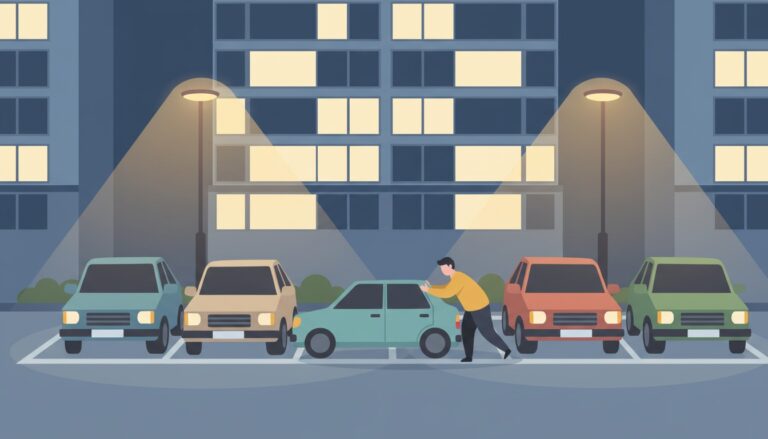
Picture this: You are watching a K-Drama. The main character is late for a crucial meeting. They rush to the parking lot, but their car is blocked by another vehicle. Disaster? Not quite.
Instead of screaming or calling a tow truck, they calmly walk up to the blocking car, put their hands on the trunk, and push it. The car rolls away effortlessly.
I’ve seen foreign friends gasp at this scene. “Are they stealing it?” “Is that legal?” “Is everyone in Korea super strong?”
Welcome to the world of 이중 주차 (Ijung Jucha – Double Parking).
Korea is 70% mountains and heavily urbanized. In Seoul, space is the ultimate luxury. Because of this, parking lots in apartment complexes are often overflowing by 8 PM. The solution? We park in front of other cars, leave the car in neutral (N), and release the handbrake so others can push it out of the way.
It sounds chaotic, but it’s actually a high-trust system based on mutual understanding. Today, we’re going to learn how to survive this “Parking War” without fighting anyone.
Phase 2: Deep Dive — The Survival Vocabulary
1. 이중 주차 (Ijung Jucha)
- Pronunciation: E-joong joo-cha [Sounds like “E” as in “email” + “Joong” like “Jung”le + “Cha” like “Cha-cha” dance]
- Meaning: Double Parking.
- K-Culture Moment: You’ll often see signs in parking lots saying “이중 주차 금지” (No double parking). But in older apartments, it’s the unwritten rule of survival.
- Editor’s Insight: This isn’t just about parking. It’s about sharing space. When you double park, you are essentially saying, “I’m sorry for the inconvenience, but I trust you to handle my car gently.”
- Situation Spectrum:
[🚫 Formal Hotel Valet] ———— [⚠️ Department Store] ———— [✅ Old Apartment Complex] - 🤔 Think About It: In your country, if you touched a stranger’s car, what would happen? Why do you think Koreans are okay with strangers touching their property in this specific context?
2. 차 좀 빼주세요 (Cha jom ppae-juseyo)
- Pronunciation: Cha jom ppae-ju-se-yo [“Cha” (car) + “Jom” (please/just) + “Ppae” (pull out/remove) + “Juseyo” (give me/do for me)]
- Meaning: Please move your car (for me).
- Real Nuance: Literally, “Please pull the car out a little.” This is the magic phrase when the car is too heavy to push, or the owner forgot to put it in neutral.
- K-Drama Scene: The protagonist calls the number on the dashboard. “Hello? Is this the owner of 1234? Cha jom ppae-juseyo.”
- Editor’s Insight: The word “좀 (jom)” is crucial here. Without it, you sound demanding. With it, you sound polite and soft.
3. 사이드(를) 풀다 (Saideu-reul pulda)
- Pronunciation: Sa-ee-deu-reul pool-da
- Meaning: To release the handbrake (emergency brake).
- Context: “Saideu” comes from “Side brake.” If you park behind someone, you must do this.
- Situation Spectrum:
[🚫 On a hill/slope] ———— [⚠️ Rainy day] ———— [✅ Flat underground parking]
Phase 3: Textbook vs. Real Life
Let’s look at how actual Koreans talk during a parking crisis.
| Situation | 📖 Textbook Korean | 🗣️ Real Korean | 💡 Why the difference? |
|---|---|---|---|
| Asking to move a car | 차를 이동해 주시겠습니까? (Could you please move the car?) | 죄송한데, 차 좀 빼주실 수 있나요? (Sorry, but can you pull the car out?) | “이동하다” is too robotic. “빼다” (pull out) is the standard verb for cars. |
| Checking if you can push | 이 차를 밀어도 됩니까? (May I push this car?) | 이거 밀어도 돼요? (Can I push this?) | In urgent mornings, shorter is better. |
| Calling the owner | 주차 문제로 전화드렸습니다. (I called regarding a parking issue.) | 차 때문에 전화드렸는데요. (I called because of the car.) | “Because of the car” implies the parking issue without being overly formal. |
Bottom Note: Never be aggressive from the start. The person blocking you is likely your neighbor.
Phase 4: Cultural Deep Dive — The “Dashboard Phone Number”
Here is a detail you might have missed in K-Dramas.
In Korea, almost every car has a small card or digital display on the front dashboard visible through the windshield. What is it?
The driver’s personal cell phone number.
In many Western countries, leaving your phone number on your car feels like a privacy nightmare. In Korea, it is considered rude NOT to have it. If you park (especially double park) and don’t leave your number, you are breaking the social contract.
K-Travel Tip: If you rent a car in Korea, the rental company often provides a temporary number or a “Business Card” slot. If you block someone and they can’t call you, you might come back to a car covered in angry sticker notes.
Phase 5: Roleplay — The Morning Rush
Setting: It’s 8:30 AM on a Tuesday. You are in the underground parking lot of your apartment. You are late for work. A white SUV is blocking your car. You check the window—the gear is in ‘P’ (Park). You can’t push it. You see the phone number on the dashboard and call.
Characters:
– YOU: Foreign resident, late for work.
– MINSU: The neighbor who owns the white SUV (looks sleepy).
Dialogue:
(Phone rings)
MINSU: (Sleepy voice) 여보세요?
(Yeoboseyo?)
Hello?
YOU: 안녕하세요, 차 때문에 전화드렸는데요.
(Annyeonghaseyo, cha ttaemune jeonhwa-deuryeonneundeyo.)
Hello, I’m calling because of the car.
MINSU: 아, 네. 무슨 일이시죠?
(Ah, ne. Museun irisijo?)
Ah, yes. What’s going on?
YOU: 제 차 앞에 주차하셨는데, 차가 안 밀려서요.
(Je cha ape jucha-hasyeonneunde, chaga an milryeoseoyo.)
You parked in front of my car, and it won’t push (move).
MINSU: 아! 제가 사이드 안 풀었나요? 죄송합니다! 금방 나갈게요!
(Ah! Jega saideu an pureonnayo? Joesonghamnida! Geumbang nagalkkeyo!)
Ah! Did I not release the brake? I’m sorry! I’ll be right out!
🔀 Decision Point: How do you respond to his apology?
- A) “빨리 좀 나와주세요.” (Please come out quickly.)
- B) “네, 천천히 오세요.” (Yes, take your time.)
- C) “아, 진짜…” (Ah, seriously…)
✅ Best Choice: B — Even if you are in a hurry, saying “Take your time” (Cheoncheonhi oseyo) puts pressure on them to hurry while making you look classy and understanding. It’s the Korean art of passive politeness.
⚠️ Choice A: Grammatically correct, but sounds annoyed. Only use if he takes more than 5 minutes.
Phase 6: 10-Second Shadowing Drill
Let’s practice the magic sentence to get your car out.
Emotion: Urgent but polite (🥺 + 🙏)
죄송한데 / 차 좀 / 빼주실 수 / 있나요?
(Joesonghande / cha jom / ppae-jusil su / innayo?)
I’m sorry, but / the car / could you move / for me?
Key Point: Don’t say “ppae” too hard. Make it a soft “ppae.”
Phase 7: K-Culture Mini Glossary
| Korean | Romanization | Meaning | Context |
|---|---|---|---|
| 만차 | Mancha | Full (Car Lot) | You see this light at the entrance. Your heart sinks. |
| 문콕 | Munkok | Door Ding | “Mun” (Door) + “Kok” (sound of hitting). The tragedy of parking too close. |
| 김여사 | Kim Yeosa | Stereotype | A derogatory slang for bad female drivers (Avoid using this! Just know it to understand bad jokes). |
| 발렛 | Ballet | Valet Parking | In Korea, even cheap coffee shops sometimes have mandatory valet parking in busy areas like Gangnam. |
Phase 8: Traveler’s Survival Kit
Even if you don’t drive, you will take taxis or walk through parking lots.
🆘 Survival Phrase #1
– 🇰🇷 “여기 세워 주세요.” (Yeogi sewo juseyo.)
– 🗣️ Pronunciation: Yeo-gi seh-wo joo-seh-yo.
– 📍 Use: When you are in a taxi and want to get off exactly here.
– 💡 Pro Tip: Don’t wait until the car stops. Say it about 50 meters before your spot.📌 Editor’s Travel Note: The “Kakao T” Revolution
If you are afraid of speaking, just use the Kakao T app. It works like Uber. You set the destination, and you don’t need to say a word about parking or directions. It’s a lifesaver for tourists.
Phase 9: Think Deeper — Space and Trust
Language & Culture:
Why does this “pushing cars” culture exist? It’s easy to say “Korea is crowded,” but it’s more than that. It requires a baseline of social trust. You trust that your neighbor won’t scratch your car while pushing it. You trust that if you leave your phone number, people won’t use it for prank calls, but only for parking issues.
Koreans often prioritize the group’s efficiency over individual convenience. “My car might be touched, but that’s better than blocking 50 people from getting to work.”
💬 Your Turn: Would you be comfortable leaving your car in neutral for a stranger to push? Why or why not? Tell me in the comments!
Phase 10: FAQ & Troubleshooting
Q: Can I push ANY car that is blocking me?
A: NO! First, check the wheels. If they are straight, look inside. If the gear shift is not in ‘N’ (Neutral), do not push. You might break the transmission or it simply won’t move. Also, never push on a slope!
Q: I saw a luxury car (Porsche/Ferrari) double parked. Should I push it?
A: I wouldn’t. The repair cost for a scratch is too high. In this case, always call the number. The owner knows the risk and will usually run out quickly.
❌ Common Mistake: Pushing the car by the spoiler or the side mirror.
✅ Fix: Always push the metal part of the trunk or the frame. Plastic parts can snap.
Phase 11: Wrap-up
Summary: Korean parking is a team sport. Double parking is normal, pushing cars is a skill, and leaving your phone number is mandatory etiquette.
Action Mission:
– 🥉 Bronze: Practice saying “차 좀 빼주세요” three times.
– 🥈 Silver: Watch a K-Drama scene involving a car and look for the phone number on the dashboard.
– 🥇 Gold: If you are in Korea, walk through an apartment parking lot at night (safely!) and count how many cars are double parked.
Phase 12: Quiz — Parking Master
1. You are double parking your car. What must you do?
a) Lock the doors and engage the handbrake tight.
b) Put the gear in Neutral (N) and release the handbrake.
c) Leave a note saying “Do not touch.”
2. You call a neighbor to move their car. They apologize. What is the polite response?
a) “Why did you park there?”
b) “Come out in 30 seconds!”
c) “Ne, cheoncheonhi oseyo.” (Take your time.)
3. True or False:
In Korea, it is illegal to display your phone number on your car dashboard.
(Scroll down for answers)
.
.
.
.
Answers:
1. b) Neutral + No Handbrake is the golden rule.
2. c) Manners matter, even in a rush.
3. False. It is socially required to display it for contact!
See you in the next lesson! Drive safe! 🚗💨
Frequently Asked Questions (FAQ)
Q: What does "이중 주차 (Ijung Jucha)" mean in Korean and how do you pronounce it?
A: In Korean, "이중 주차 (Ijung Jucha)" is pronounced [E-joong joo-cha [Sounds like "E" as in "email" + "Joong" like "Jung"le + "Cha" like "Cha-cha" dance] and means: Double Parking.
Q: What does "차 좀 빼주세요 (Cha jom ppae-juseyo)" mean in Korean and how do you pronounce it?
A: In Korean, "차 좀 빼주세요 (Cha jom ppae-juseyo)" is pronounced [Cha jom ppae-ju-se-yo ["Cha" (car] and means: Please move your car (for me).
Q: What does "사이드(를) 풀다 (Saideu-reul pulda)" mean in Korean and how do you pronounce it?
A: In Korean, "사이드(를) 풀다 (Saideu-reul pulda)" is pronounced [Sa-ee-deu-reul pool-da] and means: To release the handbrake (emergency brake).







