

Signing a Lease in Korea: K-Drama Rooftops vs. Legal Reality
Phase 1: The Immersive Hook
Hello! This is your Daily Hangul Editor.
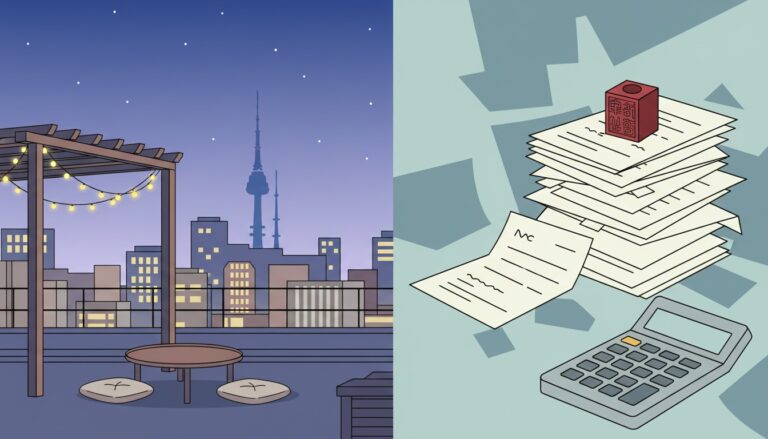
We’ve all seen it in K-Dramas. The protagonist, usually a hardworking underdog, lives on a Rooftop Room (Oktapbang). They drink soju under the stars, looking out over the Seoul nightscape, dreaming of success. It looks romantic, right?
But here is the scene they don’t show you: That protagonist sitting in a neon-lit real estate office (Budongsan), sweating bullets while an impatient agent flips through a stack of papers thick enough to stop a bullet. The agent points at a line and says, “Just stamp here.”
Stop. Do not stamp yet.
Signing a lease (Imdaecha Gyeyak) in Korea is one of the most stressful rites of passage for foreigners. One wrong move, and your deposit—often tens of thousands of dollars—could be at risk. I’ve seen students lose money because they didn’t know what Hwakjeong-ilja meant. I’ve seen others stuck with moldy walls because they didn’t write it in the Teugyak.
Today, we aren’t just learning vocabulary; we are learning how to protect your home and your wallet in Seoul.
Phase 2: Deep Dive into Key Expressions
1. 특약 사항 (Teugyak sahang)
- Pronunciation: [Teug-yak Sa-hang] (Sounds like Teug as in ‘tug’ boat + yak + Sa-hang)
- Meaning: Special Covenants / Special Terms
- K-Culture Moment: In the drama Because This Is My First Life, the housemate contract was funny, but in real life, this section is a battlefield. It’s the blank space at the bottom of the contract where you add your conditions.
- Editor’s Insight: This is your only weapon. The standard printed text protects the landlord; the Teugyak protects you. If the wallpaper is torn and the landlord says, “I’ll fix it later,” you must say, “Please write it in the Teugyak.”
- Situation Spectrum:
[🚫 Casual Chat] ———— [⚠️ Semi-Formal] ———— [✅ Legal Contracts]
(Only use this in business or legal contexts.) - 🤔 Think About It: Why is this section often left blank? In high-context cultures like Korea, verbal promises (“Of course I’ll fix it!”) used to carry weight (Jeong). But in modern real estate, relying on Jeong instead of Teugyak is a recipe for disaster.
2. 확정일자 (Hwakjeong-ilja)
- Pronunciation: [Hwak-jeong Il-ja] (Hwak like ‘walk’ but harder + jeong + il-ja)
- Meaning: Fixed Date (Legal confirmation of your lease date)
- Editor’s Insight: Think of this as a magical shield. After you sign, you go to the community center (Jumin center), show them your contract, and they stamp a date on it. This proves legally that you lived there from that day. If the landlord goes bankrupt and the house is auctioned off, this stamp puts you in line to get your deposit back. Without it? You are invisible to the court.
- Situation Spectrum:
[🚫 Friends] ———— [✅ Gov. Offices/Banks] ———— [✅ Landlords] - 🤔 Think About It: The Korean deposit system (Jeonse/Wolse) involves huge sums of money held by the landlord. This “date stamp” system was created specifically to protect tenants in a system where the landlord holds all the financial power.
3. 관리비 (Gwallibi)
- Pronunciation: [Gwal-li-bi] (Sounds like Gwal + lee + bee)
- Meaning: Maintenance Fee
- K-Culture Moment: You find a cheap studio in Gangnam for 600,000 KRW. A steal! Then the bill comes. Gwallibi is 200,000 KRW. This is the classic “bait and switch” moment often mentioned on Korean forums like Blind or Everytime.
- Editor’s Insight: Always ask, “Gwallibi poham-ingayo?” (Is the maintenance fee included?). Sometimes it includes internet and water; sometimes it’s just for the elevator cleaning. It’s the hidden tax of Korean housing.
Phase 3: Textbook vs. Real Life
| Situation | 📖 Textbook Korean | 🗣️ Real Korean (Survival) | 💡 Why different? |
|---|---|---|---|
| Negotiating Price | 월세를 좀 깎아 주실 수 있나요? (Can you discount the monthly rent?) | 사장님, 이거 좀 비싼데… 조정 안 될까요? (Boss, this is a bit expensive… can’t we adjust it?) | “Discount” sounds like buying clothes. “Adjust” (Jojeong) sounds like a business negotiation. |
| Asking about options | 가구가 포함되어 있나요? (Is furniture included?) | 여기 풀옵이에요? (Is this “Full-Op”?) | Koreans love shortening words for efficiency. Full Option = Pul-op. |
| Fixing things | 도배를 새로 해 주세요. (Please do the wallpaper anew.) | 도배/장판은 해 주시는 거죠? (You’re doing the wallpaper/flooring, right?) | Assuming they will do it is a negotiation tactic. Asking “please” makes you look weak. |
Bottom Note: Real estate agents (Gonginjunggaesa) are tough negotiators. Being too polite (textbook style) can signal that you don’t know the market prices. Use “Real Korean” to show you aren’t a tourist.
Phase 4: Cultural Deep Dive — The Art of “Nunchi” in Real Estate
4-1. The Poker Face (Non-verbal)
When you enter a room you love, do not smile. Do not scream “Daebak!” If the agent sees you love it, your bargaining power for the rent or the Teugyak vanishes. Keep a neutral face. Point out a flaw (e.g., “The window is a bit small…”) even if you don’t mind it. This is strategic Nunchi.
4-2. The “Ppalli-Ppalli” (Hurry Hurry) Trap
Korean real estate moves at light speed. A house available at 10 AM might be gone by 2 PM. Agents use this anxiety against you: “Someone else is coming to sign in an hour!” (Maybe true, maybe a lie).
* K-Drama Trope: The protagonist rushes to the bank to get the deposit money before someone else takes the rooftop apartment.
* Critical View: This speed is efficient but dangerous. Scammers rely on you feeling rushed so you skip checking the Deunggi-budeungbon (Certified Copy of Register). Breathe. Take 5 minutes to read the paper.
Phase 5: Immersive Roleplay
Setting: It’s 2 PM on a Tuesday. A small Real Estate office in Mapo-gu. The walls are covered in maps. A fan is whirring. The agent (Sajangnim) is tapping a calculator loudly.
Characters:
* YOU: Found a nice one-room (studio), but the wallpaper is stained.
* Sajangnim (Agent): Friendly but pushy. Wants to close the deal before lunch.
The Dialogue:
Sajangnim: (Slaps paper on desk) 자, 여기 도장 찍으면 돼요. 집 상태 좋잖아.
(Ja, yeogi dojang jjigeumyeon dwaeyo. Jip sangtae jochanha.)
Here, just stamp here. The house condition is good, isn’t it?
YOU: 잠깐만요. 벽지에 곰팡이 자국이 있던데요.
(Jamkkanmanyo. Byeokji-e gompangi jagugi itdeondeyo.)
Wait a moment. There were mold marks on the wallpaper.
Sajangnim: 에이, 그건 살면서 닦으면 돼. 별거 아냐.
(Ei, geugeon salmyeonseo dakkeumyeon dwae. Byeolgeo anya.)
Ay, just wipe it off while living there. It’s nothing.
🔀 Decision Point: What do you say?
- A) “아, 네… 알겠습니다.” (Ah, yes… okay.)
- B) “특약 사항에 ‘도배 새로 해줌’ 적어주세요. 안 그러면 계약 못 해요.” (Write ‘New wallpaper provided’ in the Special Terms. If not, I can’t sign.)
- C) “싫어요! 사기꾼!” (No! Scammer!)
✅ Best Choice: B
Reason: In Korea, if it’s not written, it never happened. Being firm (“I can’t sign”) usually makes them crumble immediately because they want the commission fee.
Sajangnim: (Sighs, picks up pen) 알았어, 알았어. 깐깐하시네. 자, 적었어.
(Arasseo, arasseo. Kkankkanhasine. Ja, jeogeosseo.)
Okay, okay. You’re picky. Here, I wrote it.
Phase 6: 10-Second Shadowing Drill
Let’s practice the sentence that saves you money. Say this firmly but politely.
- Context: Asking about hidden costs.
- Sentence: 관리비에 / 인터넷이랑 수도세 / 포함된 거죠?
- Romanization: Gwallibi-e / inteonet-irang sudose / pohamdoen geojyo?
- English: Internet and water / are included in the maintenance fee / right?
- Emotion: 🧐 Skeptical/Sharp (Squint your eyes slightly!)
Phase 7: K-Culture Mini Glossary
| Korean | Romanization | Meaning | Context |
|---|---|---|---|
| 전세 | Jeonse | Lump-sum deposit lease | Unique Korean system. You pay a huge deposit (50-80% of house value), pay no monthly rent, and get the deposit back when you leave. |
| 월세 | Wolse | Monthly rent | Small deposit + monthly rent. Common for foreigners and young people. |
| 복비 | Bokbi | Brokerage fee | The commission you pay the agent. Legally capped, so don’t overpay! |
| 오피스텔 | Officetel | Studio Apartment | A blend of Office + Hotel. Usually modern, higher rent, higher Gwallibi. |
Phase 8: Traveler’s Survival Kit (Accommodation Edition)
Even if you aren’t signing a 2-year lease, you might use Airbnb or a Guesthouse. Here is how to survive check-in.
🆘 Survival Phrases
* “난방 어떻게 켜요?” (Nanbang eotteoke kyeoyo?) — How do I turn on the floor heating (Ondol)? (Crucial in winter!)
* “수건 좀 더 주세요.” (Sugeon jom deo juseyo.) — Please give me more towels.
* “여기 와이파이 비번 뭐예요?” (Yeogi waipai bibeon mwoyeyo?) — What is the wifi password here?📌 Editor’s Travel Note
Korean floor heating (Ondol) takes time to warm up. Don’t crank it to 30°C immediately, or you will wake up being cooked alive like a roasted sweet potato. Set it to 23-24°C and wait.
Phase 9: Think Deeper — “Jeonse” and Trust
Topic: The Economics of Trust
Korea is one of the few countries in the world with the Jeonse (Key money) system. You give a landlord $200,000, and they give it back 2 years later with 0% interest. Why?
Historically, banks didn’t lend money easily. Landlords used Jeonse deposits as interest-free loans to invest or buy more houses, while tenants saved money by not paying monthly rent. It was a system built entirely on high-growth economics and mutual trust. Today, with low interest rates and stagnant growth, this system is cracking, leading to the “Jeonse Fraud” issues you see in the news. It’s a fascinating, risky relic of Korea’s rapid modernization.
💬 Your Turn: Does your country have a unique renting system? Or is it all monthly rent? Tell me in the comments!
Phase 10: FAQ & Troubleshooting
- Q: Can I negotiate the agent’s fee (Bokbi)?
- A: YES! Legally, there is a “maximum” rate, not a fixed rate. You can absolutely say, “Sajangnim, bokbi jom kkakka-juseyo” (Please cut the fee). Many agents will lower it slightly to close the deal.
- Q: The landlord is an old grandma. Should I use formal language?
- A: 100% Yes. Even if you are the customer, age hierarchy prevails. Use polite endings (~yo, ~supnida).
- Q: Do I need to pay for lightbulb replacement?
- A: Usually, consumables (lightbulbs, batteries) are the tenant’s responsibility. Structural issues (boiler breaking, leaking pipe) are the landlord’s responsibility.
❌ Common Mistake: Signing the contract without checking the Water Pressure (Su-ap).
✅ Fix: Always go to the bathroom, flush the toilet, and turn on the shower at the same time. If the water turns into a trickle, don’t sign.
Phase 11: Wrap-up & Action Items
One-Liner: In Korean real estate, what isn’t written in the Teugyak (Special Terms) does not exist.
Action Missions:
* 🥉 Bronze: Look around your current room. Point to items and say “Pul-op” (Full option) or “Gwallibi” (Maintenance fee).
* 🥈 Silver: Watch a scene from Parasite or Because This Is My First Life and spot the housing struggle.
* 🥇 Gold: Go to a Korean property app (like Zigbang or Dabang), look at a listing, and try to find the word 관리비 (Maintenance fee).
Phase 12: Quiz — The Savvy Tenant Challenge
- Situation: You are about to sign, but the window lock is broken. The landlord says, “I’ll fix it next week.” What do you do?
- A) Trust him and sign.
- B) Write it in the Teugyak section before signing.
- C) Fix it yourself later.
- True or False: The Jeonse system means you pay monthly rent every month.
- (True / False)
- Vocabulary: What is the short word for “Full Option” (furnished)?
- [ ]
(Scroll down for answers)
.
.
.
Answers:
1. B (Always write it down!)
2. False (Jeonse is a large deposit, usually zero monthly rent.)
3. Pul-op (풀옵)
Frequently Asked Questions (FAQ)
Q: What does "특약 사항 (Teugyak sahang)" mean in Korean and how do you pronounce it?
A: In Korean, "특약 사항 (Teugyak sahang)" is pronounced [Teug-yak Sa-hang] and means: Special Covenants / Special Terms
Q: What does "확정일자 (Hwakjeong-ilja)" mean in Korean and how do you pronounce it?
A: In Korean, "확정일자 (Hwakjeong-ilja)" is pronounced [Hwak-jeong Il-ja] and means: Fixed Date (Legal confirmation of your lease date)
Q: What does "관리비 (Gwallibi)" mean in Korean and how do you pronounce it?
A: In Korean, "관리비 (Gwallibi)" is pronounced [Gwal-li-bi] and means: Maintenance Fee







