

Phase 1: Immersive Hook
Hello! This is your Daily Hangul Editor.
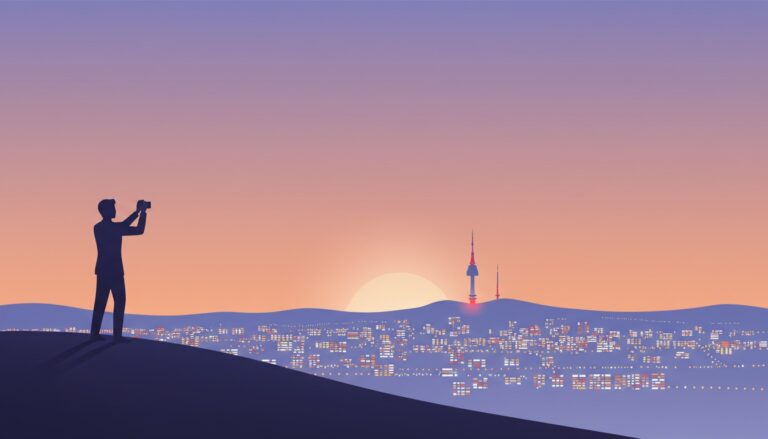
Picture this: You are standing at the top of Namsan Tower in Seoul. The sun is setting, painting the sky in purple and orange. Below you, the city lights of Seoul are starting to twinkle like a sea of stars. It looks exactly like that romantic scene in your favorite K-Drama where the main couple finally holds hands.
Your Korean friend turns to you, eyes wide, waiting for your reaction. You want to say, “This view is breathtaking!” but your brain freezes. You awkwardly smile and give a thumbs up. 👍
Don’t let this moment pass with just a gesture! Today, we’re going to learn how to express your awe like a local. Whether you are at the Han River or a trendy rooftop cafe, these phrases will make your Korean friends say, “Wow, you sound just like a Korean!”
Phase 2: Deep Dive into Key Expressions
Let’s look at the three most common ways to react to beautiful scenery.
1. 경치가 좋아요 (Gyeongchiga joayo)
- Pronunciation: [Gyeong-chi-ga jo-a-yo]
- Sound-alike: “G-young” (like young) + “Chi” (like cheese) + “ga” + “Jo-ah-yo”
- Meaning: The scenery is nice / The view is good.
- K-Culture Moment: This is the safe, standard phrase. Imagine a variety show like 2 Days & 1 Night where the cast arrives at a mountain top and politely comments on the view.
- Editor’s Insight: It is perfectly polite and correct, but it can sound a tiny bit like a textbook. It’s safe for everyone, from taxi drivers to friends.
- Situation Spectrum:
[🚫 Formal Only] ———— [✅ Standard] ———— [✅ Casual]- 🤔 Think About It: In English, we distinguish between “view” (what you see) and “scenery” (nature). In Korean, 경치 (Gyeongchi) covers both, but mostly implies a wide, open view.
2. 진짜 예뻐요 (Jinjja yeppeoyo)
- Pronunciation: [Jin-jja ye-ppeo-yo]
- Sound-alike: “Jean-jjah” (strong J) + “Yeh-puh-yo”
- Meaning: It’s really pretty.
- K-Culture Moment: You will hear this constantly in K-Dramas when the female lead looks at the night view (or when the male lead looks at her looking at the view!).
- Editor’s Insight: 예뻐요 (Yeppeoyo) means “pretty.” Interestingly, Koreans use “pretty” to describe scenery, food, and even mood, not just people. It feels more emotional and personal than “Good.”
- Situation Spectrum:
[🚫 Boss] ———— [⚠️ Colleagues] ———— [✅ Friends/General]- 🤔 Think About It: Why do Koreans describe a mountain or a building as “pretty” rather than “magnificent”? It shows a culture that values aesthetic beauty and charm in everything surrounding them.
3. 와… 대박! (Wa… Daebak!)
- Pronunciation: [Wa… Dae-bak!]
- Sound-alike: “Wah” + “Day-bak” (like ‘back’ but softer)
- Meaning: Wow… That’s a jackpot / Amazing / Crazy!
- K-Culture Moment: Every K-Pop idol reality show ever. When they enter their hotel room or see a beach, 99% of them will scream “Daebak!”
- Editor’s Insight: This is slang, but it’s so common it’s almost standard. Use this when words fail you. It conveys pure shock and amazement.
- Situation Spectrum:
[🚫 Elders/Formal] ———— [⚠️ Semi-Formal] ———— [✅ Friends/Casual]
Phase 3: Textbook vs. Real Life
| Situation | 📖 Textbook Korean | 🗣️ Real Korean | 💡 Why is it different? |
|---|---|---|---|
| Seeing the ocean | 바다가 아름답습니다. (The ocean is beautiful.) |
와, 바다다! (Wow, it’s the ocean!) |
Koreans react to the existence of the thing first with excitement. |
| Looking at city lights | 야경이 훌륭해요. (The night view is excellent.) |
야경 미쳤다… (The night view is crazy…) |
“Crazy” (Michyeotda) is the modern way to say “unbelievably good.” |
💡 Bottom Note: As an A1 learner, stick to “Jinjja yeppeoyo”. Using slang like “Michyeotda” might be too strong if your pronunciation isn’t perfect yet!
Phase 4: Cultural Deep Dive
4-1. Non-verbal: The “Photo First” Rule
In Korea, if the scenery is good, you must take a photo. If you just stand there looking with your eyes, your Korean friend might ask, “Why aren’t you taking a picture?” Taking a photo is how Koreans “consume” and “share” the moment.
4-2. K-Travel Connection: The “Photo Zone”
Visit any popular sightseeing spot in Korea (Gamcheon Culture Village, Namsan Tower, Petite France), and you will find designated “Photo Zones” (sometimes even marked on a map!).
– Survival Tip: If you see a line of people waiting in front of a painted wall or a bench, join the line. That’s the “Best Spot.”
– Critical View: Why is the photo sometimes more important than the experience? In a digitally connected society like Korea, proving you were there (validation) is a huge part of the travel experience.
Phase 5: Immersive Roleplay
Scenario A: Sunset at the Han River
Setting: It is 6:00 PM at Banpo Hangang Park. The rainbow fountain is about to start. You are with Minji (your energetic Korean language exchange partner).
Minji: (Pointing at the sunset) 헐, 저기 봐! 해 지는 거 완전 예술이다.
(Heol, jeogi bwa! Hae jineun geo wanjeon yesul-ida.)
(Gasp, look over there! The sunset is totally art.)
🔀 Your Turn! How do you react?
- A) “네, 경치가 참 좋네요.” (Ne, gyeongchiga cham jonneyo.)
- B) “와… 진짜 예쁘다!” (Wa… jinjja yeppeuda!)
- C) “감사합니다.” (Gamsahamnida.)
✅ Best Choice: B
– Reason: Minji is speaking casually to you (“Look over there!”). Option B matches her energy and casual tone. It shows you are emotionally connecting with the view.
– Analysis of A: This is correct but sounds like a robot or a grandfather.
– Analysis of C: “Thank you”? Minji didn’t make the sunset! This would be a funny mistake.
Phase 6: 10-Second Shadowing Drill
Let’s practice the most versatile phrase. Feel the emotion!
😊 (Emotion: Amazed & Happy)
와, / 여기 / 경치 / 진짜 / 예뻐요!
(Wa, / yeo-gi / gyeong-chi / jin-jja / ye-ppeo-yo!)
(Wow, / here / scenery / really / is pretty!)
Phase 7: K-Culture Mini Glossary
| Korean | Romanization | Meaning | Context |
|---|---|---|---|
| 인생샷 | Insaeng-shot | Life Shot | The best photo of your life. The goal of every scenery trip. |
| 야경 | Yagyeong | Night View | Koreans love night views (N Seoul Tower, The Bay 101 in Busan). |
| 핫플 | Hot-ple | Hot Place | A trendy place everyone is visiting right now. |
| 힐링 | Hilling | Healing | Relaxing while looking at nice scenery. |
Phase 8: Traveler’s Survival Kit
You are at the nice view, but you want to be in the picture. You need to ask a stranger.
🆘 Survival Expression: The Magic Request
– 🇰🇷 “사진 좀 찍어주세요.” (Sajin jjom jjigeo-juseyo.)
– 🗣️ Sound guide: “Sa-jin” (Photo) + “Jom” (Please/Just a little) + “Jji-geo Ju-seh-yo” (Take for me)
– 📍 Where: Anywhere nice!
– 💡 Pro Tip: Koreans are arguably the world’s best photographers. If you ask a young Korean, they will likely take 10 photos, horizontally and vertically, and maybe even crouch down to make your legs look longer!
Phase 9: Think Deeper — “Food & Identity”
Wait, why are we talking about food?
In Korea, “scenery” and “food” often go together. You don’t just go to the mountains to see the trees; you go to eat Pajeon (green onion pancake) and drink Makgeolli (rice wine) with a view.
🧠 Think Deeper:
Western hiking culture is often about the physical challenge or the solitude of nature. Korean hiking/sightseeing culture is often communal and consumptive (in a good way!). We climb to eat and share. Have you noticed how many restaurants are at the entrance of Korean national parks?💬 Your Turn: In your country, do you usually eat while sightseeing, or is the view the only focus?
Phase 10: FAQ & Troubleshooting
Q: Can I say “Saranghae” (I love you) to the scenery?
A: Not really. In English, we say “I love this view!” but in Korean, “Saranghae” is strictly for people (or pets). If you say “I love this mountain,” it sounds like you want to marry the mountain. Use “Joayo” (Like) or “Yeppeoyo” (Pretty) instead.
❌ Common Mistake: Saying “Delicious!” (Masisseoyo) because you are confused with “Cool/Stylish” (Meosisseoyo).
– Masisseoyo = Yummy 🍗
– Meosisseoyo = Cool/Stylish 😎 (Can be used for scenery too!)
– Be careful with your pronunciation!
Phase 11: Wrap-up & Mission
One-Liner Summary: When the view is great, forget the textbook and say “Jinjja yeppeoyo!” (It’s really pretty!).
🏃 Action Mission:
– 🥉 Bronze: Say “Wa, jinjja yeppeoyo” 3 times while looking at a nice picture on your phone.
– 🥈 Silver: Find a photo of Korea on Instagram and comment “여기 진짜 예뻐요!” (It is really pretty here!).
– 🥇 Gold: Open Google Street View, find “N Seoul Tower,” and pretend you are there. Say the phrase out loud!
Phase 12: Interactive Quiz
1. Which phrase implies you are very shocked and amazed?
A) Gyeongchiga joayo.
B) Daebak!
C) Annyeonghaseyo.
2. True or False?
Koreans usually only take one photo of the scenery and move on immediately.
3. Situation: You are at a beautiful beach with your boss. Which phrase is safest?
A) Wa… Michyeotda! (Wow… Crazy!)
B) Gyeongchiga cham jonneyo. (The scenery is very good.)
C) Sajin jjom jjigeo. (Take a photo.)
Answers:
1. B (Daebak is for shock/amazement.)
2. False (Koreans take MANY photos to get the “Insaeng-shot”.)
3. B (Option A is slang, Option C is rude command form. B is polite.)
Frequently Asked Questions (FAQ)
Q: What does "경치가 좋아요 (Gyeongchiga joayo)" mean in Korean and how do you pronounce it?
A: In Korean, "경치가 좋아요 (Gyeongchiga joayo)" is pronounced [Gyeong-chi-ga jo-a-yo] and means: a key conversational Korean expression covered in this lesson.
Q: What does "진짜 예뻐요 (Jinjja yeppeoyo)" mean in Korean and how do you pronounce it?
A: In Korean, "진짜 예뻐요 (Jinjja yeppeoyo)" is pronounced [Jin-jja ye-ppeo-yo] and means: a key conversational Korean expression covered in this lesson.
Q: What does "와... 대박! (Wa... Daebak!)" mean in Korean and how do you pronounce it?
A: In Korean, "와... 대박! (Wa... Daebak!)" is pronounced [Wa... Dae-bak!] and means: a key conversational Korean expression covered in this lesson.






