

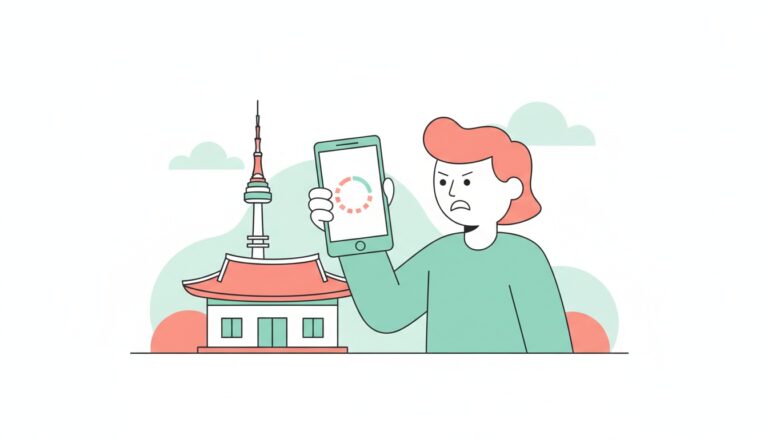
Phase 1: The “8282” Crisis — Why Internet Issues in Korea are Serious
Hello! Your Daily Hangul Editor here. 👋
Let’s set the scene. You are in Seoul, the capital of the world’s fastest internet. You’re at a hip cafe in Hongdae, trying to buy tickets for your favorite K-Pop idol’s concert (we call this “Ticketing War” or Piketing). Or maybe you’re in your Airbnb trying to stream the final episode of a K-Drama where the couple finally kisses.
Suddenly… the spinning circle of death appears. 😱
In Korea, where the culture of “Palli Palli” (Hurry, Hurry) is in the DNA, a slow internet connection isn’t just an inconvenience; it’s an emergency. Knowing how to complain about this effectively is key to survival. Today, we go beyond “Internet bad” and learn how to express your frustration like a local.
Phase 2: Deep Dive into Key Expressions
Here are the three most natural ways to say “My internet is weird” in Korea.
1. 인터넷이 자꾸 끊겨요 (Inteonet-i jakku kkeun-gyeo-yo)
- Pronunciation: [In-teo-net-i jak-ku kkeun-gyeo-yo]
Tip: ‘Kkeun’ sounds like the first part of ‘Kun’g Fu, but with a tighter throat.- Meaning: The internet keeps cutting off / dropping.
- K-Culture Moment: Think of a video call with your parents back home. The screen freezes right when you’re showing them your Bibimbap. That is kkeun-gi-da.
- Editor’s Insight: The word 자꾸 (jakku) is the magic spice here. It means “repeatedly” or “keep doing.” It emphasizes your frustration that this isn’t a one-time thing.
- Situation Spectrum:
[🚫 Boss] ———— [⚠️ Cafe Staff] ———— [✅ Friends]
(Safe to use with staff, just keep a polite tone!)- 🤔 Think About It: The verb is 끊기다 (to be cut), which is passive. Why do Koreans say “the internet is cut” rather than “I lost connection”? It shifts the blame to the internet, not you!
2. 와이파이가 잘 안 잡혀요 (Wa-i-pa-i-ga jal an jap-hyeo-yo)
- Pronunciation: [Wa-i-pa-i-ga jal an ja-pyeo-yo]
- Meaning: The Wi-Fi isn’t being caught well (The signal is weak).
- K-Culture Moment: You are in a corner of a deep underground PC Bang (Gaming Cafe). You’re trying to connect your phone, but the bars are low. You’re trying to “catch” the signal.
- Editor’s Insight: 잡히다 (jap-hi-da) means “to be caught.” In Korean, we visualize radio waves or Wi-Fi signals as invisible things floating in the air that your device needs to “catch.”
- Situation Spectrum:
[🚫 Formal Presentation] ———— [⚠️ Hotel Reception] ———— [✅ Everywhere]- 🤔 Think About It: Many Korean verbs regarding technology are physical metaphors (caught, burst, eat). Does your language visualize invisible signals this way?
3. 데이터가 안 터져요 (De-i-teo-ga an teo-jyeo-yo)
- Pronunciation: [De-i-teo-ga an teo-jyeo-yo]
- Meaning: The data isn’t bursting (The data isn’t working/connecting).
- K-Culture Moment: You’re on the KTX train going through a tunnel. Your KakaoTalk messages aren’t sending. You look at your phone and sigh.
- Editor’s Insight: 터지다 (teo-ji-da) means “to burst” or “to explode.” We use this for phone signals and data. When the signal is strong, it “bursts” through!
- Situation Spectrum:
[🚫 Formal Meeting] ———— [⚠️ Service Center] ———— [✅ Daily Life]
(Slightly more colloquial than #1 and #2, but very common.)
Phase 3: Textbook vs. Real Life
| Situation | 📖 Textbook Korean | 🗣️ Real Korean | 💡 Why the difference? |
|---|---|---|---|
| Gaming (Lag) | 인터넷 속도가 느립니다. (Internet speed is slow.) | 아, 렉 걸려! (Ah, lek-geol-ryeo!) | “Lag” (Konglish) is the universal gamer language. Short & angry. |
| Video Buffering | 동영상 재생이 안 돼요. (Video playback is not working.) | 계속 버퍼링 걸려요. (It keeps buffering.) | Koreans use the word “Buffering” directly. It’s faster. |
| Asking for PW | 비밀번호가 무엇입니까? (What is the password?) | 여기 비번 뭐예요? (Yeogi bibeon mwo-yeyo?) | “Bibeon” is the slang/short form for Bimil-beonho. |
💡 Bottom Note: In B1 level, knowing abbreviations like 비번 (Bibeon) makes you sound significantly more fluent than saying the full Bimilbeonho every time.
Phase 4: Cultural Deep Dive — The “Palli Palli” Tech Culture
4-1. Nunchi (눈치) at the Cafe
In a Korean cafe, if the Wi-Fi is slow, don’t just sit there angry. Look around (Nunchi). Is everyone else streaming videos? Is the cafe crowded?
– Non-verbal tip: If you approach the staff, show them your phone screen displaying the “loading” circle. This visual proof acts as a universal language of suffering. Do not look angry at the person; look angry at the phone together.
4-2. K-Culture Connection: The “Ticketing” (티켓팅) War
In K-Pop culture, internet speed is literally power. Fans often go to high-spec PC Bangs just to buy concert tickets because home internet isn’t trusted.
– Situation: If you tell a Korean friend, “I failed to get tickets because my data dropped,” they will offer you genuine, deep condolences. It is considered a tragedy.
Phase 5: Immersive Roleplay
Setting: It’s 2 PM at a trendy cafe in Seongsu-dong. You are trying to upload a heavy video file for work/school, but the progress bar is stuck at 99%. You walk up to the counter.
Characters:
– YOU: A desperate digital nomad.
– Staff (Ji-min): Busy part-timer, wiping a cup.
Dialogue:
You: (Hesitantly approaching) 저기요, 사장님…
(Jeogiyo, sajangnim…)
(Excuse me, boss…)
Ji-min: 네, 주문하시겠어요? ☕
(Ne, jumun-hasigesseoyo?)
(Yes, would you like to order?)
You: 아뇨, 그게 아니고요. 와이파이가 자꾸 끊겨서요.
(Anyo, geuge anigoyo. Wa-i-pa-i-ga jakku kkeun-gyeo-seoyo.)
(No, it’s not that. The Wi-Fi keeps dropping.)
Ji-min: 어? 정말요? 지금 다른 손님들은 괜찮으신데…
(Eo? Jeongmalyo? Jigeum dareun sonnim-deureun gwaenchaneushinde…)
(Oh? Really? The other customers seem fine right now…)
You: 제 핸드폰에서는 신호가 잘 안 잡혀요. 혹시 다시 켜주실 수 있나요?
(Je haendeupon-eseoneun sinhoga jal an jap-hyeo-yo. Hoksi dasi kyeo-jusil su innayo?)
(The signal isn’t being caught well on my phone. Could you possibly restart it?)
Ji-min: 음… 공유기가 안쪽에 있어서요.
(Umm… the router is deep inside.)
🔀 Decision Point! How do you respond?
- A) “아, 네… 알겠습니다.” (Give up and use your data.)
- B) “중요한 일을 해야 해서요. 한 번만 확인 부탁드려요!” (Polite persistence.)
- C) “인터넷이 너무 느려서 짜증나요.” (Emotional complaint.)
✅ Best Choice: B — Koreans value diligence (working hard). If you frame it as “important work,” they are more likely to empathize and help.
⚠️ Choice C Analysis: Expressing annoyance directly at the staff (짜증나요) is rude. Always blame the machine, not the situation.
(Continuing with Choice B…)
Ji-min: 아, 중요한 일이시구나. 잠시만요, 제가 껐다 켜볼게요! 🔌
(Ah, important work. One moment, I’ll try turning it off and on!)
Phase 6: 10-Second Shadowing Drill
Let’s practice the “whining but polite” tone.
Guide: / = Pause | 🥺 = Worried/Desperate face
🥺 저기요 / 와이파이가 / 너무 느린 것 같아요…
(Jeogiyo / wa-i-pa-i-ga / neomu neurin geot gatayo…)
“Excuse me… / the Wi-Fi / seems too slow…”😤 데이터가 / 자꾸 / 안 터져요!
(De-i-teo-ga / jakku / an teo-jyeo-yo!)
“The data / repeatedly / isn’t working!”
Phase 7: K-Culture Mini Glossary
| Korean | Romanization | English | Context |
|---|---|---|---|
| 핫스팟 | Hat-seu-pat | Hotspot | Used exactly like English. “핫스팟 좀 켜줘.” (Turn on your hotspot.) |
| 비번 | Bi-beon | Password (Slang) | Short for 비밀번호. Essential for cafes/restrooms. |
| 무제한 | Mu-je-han | Unlimited | Usually refers to “Unlimited Data” plans. |
| 공유기 | Gong-yu-gi | Router | Literally “Sharing Machine.” |
Phase 8: Traveler’s Survival Kit
If your internet dies while traveling in Korea, don’t panic. Use these.
🆘 Survival Expression #1: Asking for Password
– 🇰🇷 “여기 와이파이 비번 뭐예요?” (Yeogi wa-i-pa-i bibeon mwo-yeyo?)
– 🗣️ Meaning: “What is the Wi-Fi password here?”
– 📍 Where: Cafes, Restaurants, Hotels.
– 💡 Pro Tip: Look at the receipt! In Korea, the Wi-Fi password is almost always printed at the bottom of the receipt.🆘 Survival Expression #2: Asking for Reset
– 🇰🇷 “공유기 좀 재부팅 해주세요.” (Gong-yu-gi jom jae-bu-ting hae-juseyo.)
– 🗣️ Meaning: “Please reboot the router.”
– 📍 Where: Guesthouses, Airbnb.📌 Editor’s Travel Note
– Free Wi-Fi: Seoul has amazing public Wi-Fi on subways and buses. Look for networks named “Public WiFi Free” or “SEOUL_Secure”.
– Emergency: If you have zero connection, find a Starbucks or a McDonald’s. They are the sanctuaries of free internet without questions.
Phase 9: Think Deeper — “Palli Palli” & Modernity
Global Era Perspective:
Why is “slow internet” such a trigger for Koreans? It connects to the rapid modernization of the country. In less than 50 years, Korea went from poverty to a tech giant. Speed became synonymous with survival and success. When the internet lags, it feels like a step backward in a society that is always running forward.
💬 Your Turn: In your country, is slow internet just an annoyance, or does it feel like a crisis? Does your language have specific “angry words” for buffering? Let me know in the comments!
Phase 10: FAQ & Troubleshooting
Q: Can I ask a stranger to use their Hotspot?
A: Generally, No. Data is considered personal property. However, in a genuine emergency (lost, hurt), you can ask: “죄송한데, 핫스팟 잠깐만 쓸 수 있을까요? 급해서요.” (Sorry, can I use your hotspot for a second? It’s urgent.)
Q: Why is the Wi-Fi usually ‘iptime’?
A: You’ll see ‘iptime’ everywhere in Korea. It’s the most common router brand. It’s not a single giant network!
❌ Common Mistake:
– Saying “Internet is broken” (인터넷이 고장 났어요).
– Correction: “Go-jang” (broken) is for physical machines (like a toaster). For signals/connection, use “안 돼요” (doesn’t work) or “끊겨요” (cuts off).
Phase 11: Wrap-up
One-Liner: Complaining about the internet effectively is the first step to becoming a true modern Seoulite.
Action Missions:
– 🥉 Bronze: Say “와이파이가 자꾸 끊겨요” 3 times while looking at your phone with a sad face.
– 🥈 Silver: Go to a cafe, find the Wi-Fi password on the receipt without asking the staff.
– 🥇 Gold: If the internet is actually slow at a cafe, politely ask the staff “인터넷이 조금 느린데, 혹시 확인해 주실 수 있나요?”
K-Culture Mission:
– Watch a K-Drama scene where characters are video calling. Notice if the screen freezes for dramatic effect. Do they say “여보세요?” (Hello?) repeatedly?
Phase 12: Interactive Quiz
- Situation: You are playing a game at a PC Bang and the screen freezes. What do you scream? (Internally or to friends)
- A) 버퍼링! (Buffering!)
- B) 렉 걸려! (Lagging!)
- C) 멈춤! (Stop!)
- Fill in the Blank:
- “사장님, 와이파이가 잘 안 ______.”
- (Boss, the Wi-Fi isn’t _______ well.)
- Hint: To be caught/picked up.
- True or False:
- It is rude to ask for the Wi-Fi password in a cafe in Korea. (T/F)
Answers:
1. B (렉 걸려!) – Common gamer slang.
2. 잡혀요 (Jap-hyeo-yo)
3. False – It is expected! But check the receipt or the wall first.
Frequently Asked Questions (FAQ)
Q: What does "인터넷이 자꾸 끊겨요 (Inteonet-i jakku kkeun-gyeo-yo)" mean in Korean and how do you pronounce it?
A: In Korean, "인터넷이 자꾸 끊겨요 (Inteonet-i jakku kkeun-gyeo-yo)" is pronounced [In-teo-net-i jak-ku kkeun-gyeo-yo] and means: The internet keeps cutting off / dropping.
Q: What does "와이파이가 잘 안 잡혀요 (Wa-i-pa-i-ga jal an jap-hyeo-yo)" mean in Korean and how do you pronounce it?
A: In Korean, "와이파이가 잘 안 잡혀요 (Wa-i-pa-i-ga jal an jap-hyeo-yo)" is pronounced [Wa-i-pa-i-ga jal an ja-pyeo-yo] and means: The Wi-Fi isn't being caught well (The signal is weak).
Q: What does "데이터가 안 터져요 (De-i-teo-ga an teo-jyeo-yo)" mean in Korean and how do you pronounce it?
A: In Korean, "데이터가 안 터져요 (De-i-teo-ga an teo-jyeo-yo)" is pronounced [De-i-teo-ga an teo-jyeo-yo] and means: The data isn't bursting (The data isn't working/connecting).







