

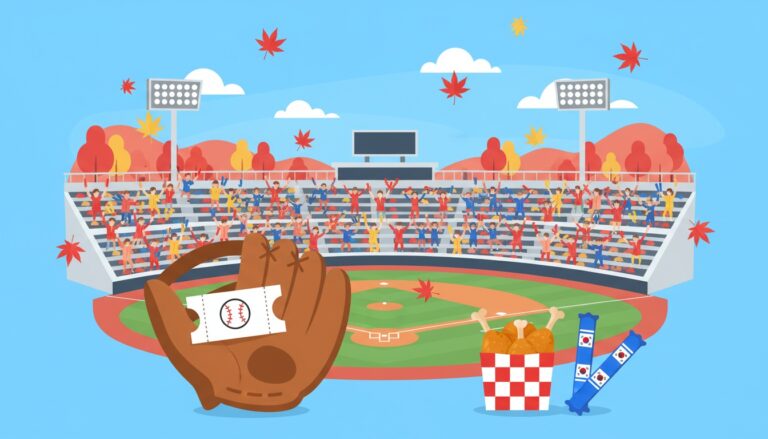
⚾ Fall Baseball Fever: Surviving the Korean Postseason
Phase 1: The Hook — Welcome to “Gaeul Yagu”
안녕하세요! This is your Daily Hangul Editor.
Imagine this: The air in Seoul has turned crisp. You’re sitting in a packed stadium, surrounded by 25,000 people screaming in perfect unison. On your left, someone is frantically refreshing a ticketing app on their phone. On your right, a stranger hands you a piece of fried chicken. Why? Because it’s October, and in Korea, October means one thing:
“Gaeul Yagu” (Fall Baseball).
In K-Dramas like Reply 1994 or Stove League, you’ve seen the passion. But until you experience the Korean Postseason, you haven’t seen the real Korea. It’s not just sports; it’s a national festival of stress, joy, and fried chicken. Today, we’re going to learn how to talk about this obsession so you don’t just watch from the sidelines—you become part of the crowd.
Let’s step up to the plate! 🏟️
Phase 2: Deep Dive — Key Expressions
Here are the three phrases that will make you sound like a veteran fan.
1. 가을 야구 (Gaeul Yagu)
- Pronunciation: [Gae-ul Ya-gu] + (Sounds like “Gae-ul” as in gull but with an ‘eh’ sound, and “Ya-gu” is snappy.)
- Meaning: Literal: Fall Baseball / Real Nuance: The Postseason / The Playoffs
- K-Culture Moment: Even people who don’t watch the regular season will ask, “우리 팀 가을 야구 갔어?” (Did our team make it to Fall Baseball?) It represents hope and glory.
- Editor’s Insight: Why “Fall”? Because the regular season ends in September. If you are still playing baseball when the leaves turn red, your team is elite. Saying “Postseason” (포스트시즌) is fine, but “Gaeul Yagu” is poetic and deeply emotional.
- Situation Spectrum:
[🚫 Formal Report] ———— [✅ Casual/Polite] ———— [✅ Slang]
(Used widely in news, casual talk, and even marketing.)- 🤔 Think About It: Why does Korean link the season (Autumn) to success? In your language, do you say “Playoffs” or is there a metaphorical name for the championship season?
2. 예매 전쟁 (Yemae Jeonjaeng)
- Pronunciation: [Ye-mae Jeon-jaeng] + (Think: Yes + May + John + Jang)
- Meaning: Literal: Reservation War / Real Nuance: The brutal battle to buy tickets
- K-Culture Moment: K-Pop fans know this pain well. Just like trying to get BTS tickets, getting baseball postseason tickets in Korea requires the fastest fingers in the world. Servers crash, and friendships are tested.
- Editor’s Insight: This isn’t an exaggeration. We literally call it a “war.” If you succeed, you are a hero (승리자).
- Situation Spectrum:
[⚠️ Business] ———— [✅ Daily Life] ———— [✅ Internet]
(Perfect for complaining to friends: “Ah, ticket war failed again.”)- 🤔 Think About It: Korea has the world’s fastest internet, yet servers still crash during these “wars.” What does this say about the intensity of Korean fan culture (fandom)?
3. 직관 (Jikgwan)
- Pronunciation: [Jik-gwan] + (Short, sharp k-sound)
- Meaning: Literal: Direct Viewing / Real Nuance: Watching the game in person at the stadium
- K-Culture Moment: You’ll see this hashtag #직관 on Instagram thousands of times. It’s the opposite of “Jib-gwan” (집관 – Watching from home).
- Editor’s Insight: In the postseason, “Jikgwan” is a status symbol. It means you survived the “Ticketing War.”
- Situation Spectrum:
[🚫 Formal Writing] ———— [✅ Casual Conversation] ———— [✅ Social Media]
Phase 3: Textbook vs. Real Life
| Situation | 📖 Textbook Korean | 🗣️ Real Korean (Insa Style) | 💡 Why the difference? |
|---|---|---|---|
| Cheering for a team | 우리 팀이 이기면 좋겠어요. (I hope our team wins.) | 가을 야구 가즈아! (Let’s go to Fall Baseball!) | “가즈아” (Gazua) is a meme/slang derived from “Let’s go,” emphasizing hype and desperation. |
| Getting tickets | 표를 예매하기가 정말 어려워요. (It is very hard to reserve tickets.) | 완전 피켓팅이었어. (It was a total blood-ticketing.) | Piketing = Blood (Pi) + Ticketing. Shows the intensity better than “difficult.” |
| Reaction to a hit | 안타입니다! (It is a hit!) | 나이스 샷! / 헐 대박! (Nice shot! / Hull, Daebak!) | Koreans mix Konglish and exclamations for instant emotional release. |
💡 Editor’s Note: For B2 learners, using “피켓팅” (Blood-ticketing) will make your Korean friends laugh and respect your vocabulary knowledge instantly!
Phase 4: Cultural Deep Dive — The Art of “Heung” (흥)
4-1. The “Cheer Song” (응원가) Phenomenon
Unlike MLB where it’s mostly organ music and clapping, K-Baseball is a rock concert. Every player has their own song and dance.
* The Rule: You don’t just sit and watch. You stand up, you sing, and you dance. This collective energy is called “Heung” (흥 – joy/excitement).
* B2 Tip: Even if you don’t know the lyrics, just hum along and shout the player’s name at the end. That’s 90% of the song!
4-2. K-Food Connection: Chimaek (치맥)
Fall Baseball is impossible without Chicken and Beer.
* Scenario: You are at the stadium. Delivery bikes will literally meet you at the stadium entrance.
* Culture: Eating while cheering is a multitasking skill. If the team scores while you are holding a chicken leg, you cheer with the chicken leg. DO NOT put it down.
Phase 5: Immersive Roleplay
Setting: A loud pub in Gangnam, huge TV screens showing the final game of the regular season. You are with your Korean friend, Min-ho.
Min-ho: (Clapping his hands) 와, 드디어 우리 팀 가을 야구 확정이다! 진짜 눈물 날 것 같아.
(Wa, deudieo uri tim gaeul yagu hwakjeong-ida! Jinjja nunmul nal geot gata.)
(Wow, our team is finally confirmed for Fall Baseball! I think I’m gonna cry.)
YOU (Select your response):
🔀 Your Turn! How do you respond?
– A) “축하해요. 정말 잘됐네요.” (Polite, but a bit distant)
– B) “대박! 야, 예매 전쟁 준비해야지?” (Perfect local reaction)
– C) “야구 별로 안 좋아해요.” (The vibe killer)
Let’s choose B!
YOU: 대박! 야, 예매 전쟁 준비해야지?
(Daebak! Ya, yemae jeonjaeng junbihaeyaji?)
(Awesome! Hey, we gotta prepare for the ticketing war, right?)
Min-ho: (Laughing) 당연하지! 나 PC방 갈 거야. 너도 같이 갈래? 이번엔 무조건 직관 가야 돼.
(Dangyeonhaji! Na PC-bang gal geoya. Neodo gachi gallae? Ibeonen mujogeon jikgwan gaya dwae.)
(Of course! I’m going to a PC Bang (Internet Cafe). Wanna come? We have to watch in person this time.)
YOU: 좋아! 내가 광클(crazy clicking)해서 꼭 성공할게.
(Joa! Naega gwang-keul haeseo kkok seong-gong halge.)
(Good! I’ll ‘crazy click’ and definitely succeed.)
✅ Decision Point Analysis: Using words like “예매 전쟁” and “광클” (Gwang-keul: slang for clicking incredibly fast) shows you understand the urgency of the situation.
Phase 6: 10-Second Shadowing Drill
Repeat this sentence to practice your intonation and rhythm. Imagine you just secured a ticket!
“드디어 / 예매 성공했다! / 가을 야구 / 보러 가자!”
(Deudieo / yemae seong-gong-haetda! / Gaeul yagu / boreo gaja!)
😊 Emotion: Pure Relief & Excitement
🗣️ Guide:
– 드디어 (Deu-di-eo): Drag the ‘eo’ slightly to show how long you waited.
– 보러 가자 (Boreo gaja): Raise the pitch at the end like a cheer!
Phase 7: K-Culture Mini Glossary
| Korean | Romanization | English | Context |
|---|---|---|---|
| 응원가 | Eung-won-ga | Cheering Song | The specific song for each player. Memorizing this = True Fan. |
| 시구 | Si-gu | First Pitch | Often done by K-Pop idols or celebrities. A huge media event. |
| 매진 | Mae-jin | Sold Out | The word you hate to see during the ticketing war. |
| 역전승 | Yeok-jeon-seung | Comeback Win | Winning a game after losing it. The most thrilling victory. |
Phase 8: Traveler’s Survival Kit (Baseball Edition)
Even if you aren’t a superfan, attending a Postseason game is a top-tier travel experience.
🆘 Survival Expression #1: Finding your seat
– 🇰🇷 “여기 3루 응원석 맞나요?” (Yeogi sam-nu eung-won-seok mannayo?)
– 🗣️ Pronunciation: [Yeo-gi Sam-nu Eung-won-seok Man-na-yo?]
– Meaning: Is this the 3rd base cheering section?
– 💡 Pro Tip: Home team usually sits on 1st base (1루), Away team on 3rd base (3루). Make sure you are in the right zone, or it gets awkward!📌 Editor’s Travel Note
– App to use: Ticketlink or Interpark Ticket. You often need a Korean phone number, so asking a Korean friend or hotel concierge for help is faster.
– Food: You can bring food IN, but no glass bottles or cans (over 1L). Convenience stores inside are packed, so buy outside!
Phase 9: Think Deeper — “One Body, One Voice”
Collective Collectivism (우리끼리):
When you watch Korean baseball, you’ll notice the “Cheerleader” (응원단장) on the stage. He commands, and 20,000 people obey instantly. Stand up. Sit down. Shout. Clap.
Why do Koreans love this synchronized cheering? It stems from the cultural value of “Uri” (Us/We). In Western sports, you often cheer individually. In Korea, the act of becoming one (일체감) gives stress relief. You aren’t just an individual watching a game; you are part of a giant organism fighting for victory.
💬 Your Turn: Does your country’s sports culture focus on individual shouting or organized chanting? Which do you prefer?
Phase 10: FAQ & Troubleshooting
- Q: Can I wear a different team’s jersey to the Postseason?
- A: Maybe. If you sit in the neutral zone (table seats), it’s fine. But if you sit in the Cheering Zone (응원석) of Team A while wearing Team B’s jersey… you will get very distinct “nunchi” (stares). It’s not dangerous, just awkward.
- Q: Is it okay to eat loudly?
- A: YES! Everyone is eating. Slurping cup ramen, crunching chicken—it’s part of the ambiance.
- ❌ Common Mistake: Trying to buy tickets at the stadium on game day.
- ✅ Fix: Postseason games are 100% reserved online. There are NO on-site tickets. Don’t go without a mobile ticket!
Phase 11: Wrap-up
One-Liner: “Gaeul Yagu” is more than a sport; it’s a battle for tickets, a feast of chicken, and a chorus of 20,000 voices.
🏃 Action Missions:
– 🥉 Bronze: Search “KBO Cheering Song” on YouTube and listen to the energy.
– 🥈 Silver: Go to a Korean fried chicken place and say, “치맥 주세요!” (Chimaek, please!).
– 🥇 Gold: Try to explain “Gaeul Yagu” to a friend using the phrase “예매 전쟁” (Ticketing War).
K-Culture Mission: Watch a clip of the “Busan Seagull” (부산 갈매기) song being sung at Lotte Giants stadium. It is the soul of Korean baseball.
Phase 12: Quiz — Are You Ready for the Postseason?
- Situational Judgment: Your friend says they failed the “Ticketing War.” What is the best comfort?
- A) “Next time, just go to the stadium and buy one.”
- B) “It’s okay, let’s do ‘Jib-gwan’ (Home viewing) with chicken!”
- C) “Why is your internet so slow?”
- True or False: You should wear the away team’s jersey in the home team’s cheering section to show dominance.
- (True / False)
Answers:
1. B (A is impossible in postseason, C is rude. B is the perfect cultural alternative.)
2. False (This is a violation of unwritten rules. Respect the zones!)
Frequently Asked Questions (FAQ)
Q: What does "가을 야구 (Gaeul Yagu)" mean in Korean and how do you pronounce it?
A: In Korean, "가을 야구 (Gaeul Yagu)" is pronounced [Gae-ul Ya-gu] and means: Literal: Fall Baseball / Real Nuance: The Postseason / The Playoffs
Q: What does "예매 전쟁 (Yemae Jeonjaeng)" mean in Korean and how do you pronounce it?
A: In Korean, "예매 전쟁 (Yemae Jeonjaeng)" is pronounced [Ye-mae Jeon-jaeng] and means: Literal: Reservation War / Real Nuance: The brutal battle to buy tickets
Q: What does "직관 (Jikgwan)" mean in Korean and how do you pronounce it?
A: In Korean, "직관 (Jikgwan)" is pronounced [Jik-gwan] and means: Literal: Direct Viewing / Real Nuance: Watching the game in person at the stadium







