

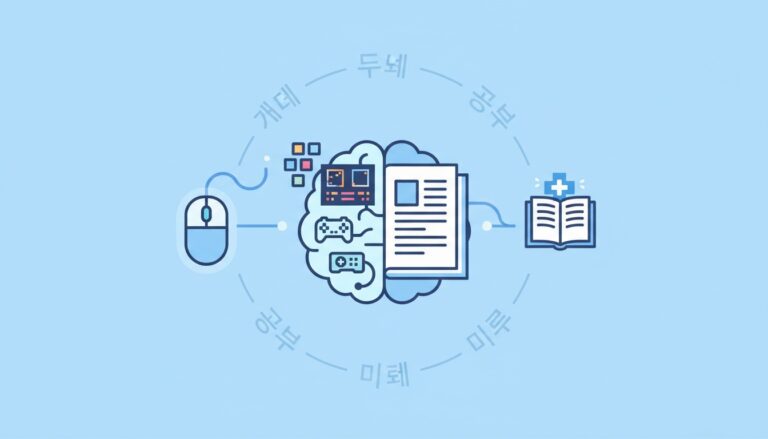
Phase 1: The Immersion — From “Time Waster” to “Brain Trainer”
Annyeonghaseyo! This is your Daily Hangul Senior Editor.
Picture this scene: In a popular K-Drama, a stressed high school student sneaks out to a PC Bang (Internet Cafe). The lighting is dim, the mechanical keyboards are clicking like rain, and they are shouting commands into a headset. Ten years ago, the next scene would inevitably be a furious mother dragging them out by the ear, screaming, “Study!”
But cut to 2024. Now, we see headlines about “Digital Therapy” and grandparents playing motion-sensing games to prevent dementia. We see Faker being treated like a national treasure, equal to BTS or Son Heung-min. The narrative has shifted. Games in Korea are no longer just a hobby; they are a sophisticated tool for education and therapy.
Today, we are going to learn how to discuss the “Positive Functions of Games” (게임의 순기능). Since you are at a C1 level, we’re moving beyond simple sentences like “Games are fun.” We are going to equip you with the vocabulary to debate, persuade, and discuss the cognitive benefits of gaming with your Korean friends—perhaps over a bowl of Jjapaguri at a PC Bang.
Phase 2: Deep Dive into Core Expressions
To sound like an intellectual insider in Korea, you need words that carry weight. Here are the top three expressions for this topic.
1. 순기능 [Sun-gi-neung]
- Pronunciation: [sun-gi-neung] Sounds like ‘Soon’ + ‘Key’ + ‘Neung’ (rhymes with lung)
- Meaning: Positive function / Beneficial role (Literal: Pure Function)
- K-Culture Moment: You’ll hear this on news debates discussing whether Esports should be part of the Olympics. “게임의 순기능을 무시할 수 없습니다.” (We cannot ignore the positive functions of games.)
- Editor’s Insight: This is a high-level vocabulary word. It’s the perfect shield when someone attacks your hobby. It implies a balanced view, acknowledging that Yeok-gi-neung (negative functions/side effects) exist, but highlighting the good.
- Situation Spectrum:
[🚫 Casual Slang] ———— [⚠️ Semi-formal] ———— [✅ Formal/Intellectual]
- Friends: ⚠️ (A bit too serious, unless having a deep talk)
- Debate/Meeting: ✅
- Writing: ✅
- 🤔 Think About It: Why does Korean distinguish so clearly between Sun-gi-neung (positive function) and Jang-jeom (merit)? Sun-gi-neung implies a systemic or societal role, not just a personal benefit. How does your language handle this nuance?
2. 몰입감 [Mor-ip-gam]
- Pronunciation: [mo-rip-gam] The ‘l’ in ‘Mol’ slides over to make an ‘R’ sound.
- Meaning: Sense of immersion / Immersiveness
- K-Culture Moment: Think of Memories of the Alhambra. The blurred line between reality and the game. When a game is so good you forget to eat, that’s high Mor-ip-gam.
- Editor’s Insight: In the context of education (Gamification), this is the “Why.” Why use games for learning? Because of the Mor-ip-gam. It’s a compliment to the developer and a description of the user experience.
- Situation Spectrum:
[✅ Casual] ———— [✅ Semi-formal] ———— [✅ Formal]
- Usable everywhere. “이 게임 몰입감 대박이다.” (This game’s immersion is daebak/awesome.)
- 🤔 Think About It: Korean culture values “flow” and focus. Being “immersed” is usually seen as a sign of passion. Is getting lost in a game seen as “focus” or “distraction” in your culture?
3. 두뇌 회전 [Du-noe hoe-jeon]
- Pronunciation: [du-noe hwe-jeon]
- Meaning: Mental rotation / Brain activity / Thinking fast (Literal: Brain Rotation)
- K-Culture Moment: Often heard in variety shows like The Genius or when idols play strategy games. “와, 두뇌 회전이 빠르시네요!” (Wow, your brain rotates fast / You think quick!)
- Editor’s Insight: This is the bridge between gaming and health. Strategy games aren’t just clicking; they require Du-noe hoe-jeon. Use this to justify why playing StarCraft is actually good for your aging brain.
- Situation Spectrum:
[✅ Casual] ———— [⚠️ Semi-formal] ———— [✅ Formal]- 🤔 Think About It: The metaphor of the brain “rotating” suggests a mechanical, active process. Does this reflect the Korean emphasis on efficiency and speed (Palli-Palli culture)?
Phase 3: Textbook vs. Real Life
At the C1 level, you shouldn’t sound like a translated script. You should sound like a local analyst.
| Situation | 📖 Textbook Korean | 🗣️ Real Korean (C1 Level) | 💡 Why the difference? |
|---|---|---|---|
| Explaining benefits | 게임은 교육에 도움이 됩니다. (Games are helpful for education.) | 게임 요소를 접목하면 학습 효율이 확 올라가요. (If you graft game elements, learning efficiency shoots up.) | Specificity. C1 speakers use specific terms like ‘graft’ (접목) and ‘efficiency’ (효율). |
| Defending gaming | 치매 예방에 좋습니다. (It is good for dementia prevention.) | 두뇌 회전을 도와서 치매 예방에 효과적이라는 연구가 많아요. (Many studies say it’s effective for dementia by helping brain rotation.) | Citing “studies” or “research” adds authority to your argument. |
| Praising a game | 이 게임 재미있어요. (This game is fun.) | 몰입감이 장난 아니에요. 시간 가는 줄 몰랐어요. (The immersion is no joke. I didn’t notice time passing.) | “Fun” is too simple. Describing the state of mind (time passing) is more native. |
Phase 4: Cultural Deep Dive
4-1. The “Game” of Eyes (Non-verbal)
When discussing serious topics like the “positive function of games,” your body language should match your intellectual tone. If you are debating this with a Korean elder or conservative boss:
* Posture: Lean forward slightly to show engagement, but don’t cross your arms (defensive).
* Eye Contact: Maintain it, but nod frequently to show you are listening to their concerns about “game addiction” before presenting your counter-argument about “therapy.”
4-2. K-Culture Connection: The “PC Bang” Evolution
In early K-Dramas, the PC Bang was a dark hideout for delinquents. Today, go to a high-end PC Bang in Gangnam (like LoL Park). It’s bright, serves restaurant-quality food (Gam-tto-kki: Game + Hotdog + Tteokbokki), and is a social hub.
* The Connection: Just as the physical space of the PC Bang has evolved from “dark” to “bright,” the societal perception of games has evolved from “addiction” to “culture/sport.”
* Critical Perspective: However, the generational gap remains. While Gen Z considers pro-gamers as idols, the older generation may still view gaming as a barrier to academic success. Your ability to explain Sun-gi-neung bridges this gap.
Phase 5: Immersive Roleplay
Setting: You are at a trendy cafe in Hongdae with Minji (30, your Korean friend who is skeptical about games) and Jun-ho (28, an avid gamer). You are discussing a news report about using VR games to treat PTSD.
Minji: 솔직히 저는 아직 잘 모르겠어요. 게임은 결국 현실 도피 아닌가요? 중독되면 무섭잖아요.
(Honestly, I don’t really get it yet. Aren’t games just escaping reality? Addiction is scary.)
Jun-ho: 에이, 누나. 요새는 ‘디지털 치료제’라고 해서 병원에서도 쓴다니까요.
(Ay, Noona. These days they call it ‘digital medicine’ and even hospitals use it.)
🔀 YOUR TURN! How do you mediate and support Jun-ho’s point with C1 vocabulary?
Option A: “맞아요. 게임은 좋은 점도 많아요. 재미있으니까 스트레스가 풀리잖아요.”
(Correct. Games have many good points. Since it’s fun, stress is relieved.)Option B: “물론 중독은 조심해야죠. 하지만 적절히 활용하면 스트레스 해소는 물론이고, 치료적 순기능도 분명히 있다고 생각해요.”
(Of course, we must be careful of addiction. But if utilized properly, I think there is clearly a therapeutic positive function, not to mention stress relief.)Option C: “민지 씨, 너무 꼰대 같아요. 게임은 예술이에요!”
(Minji, you are like an old boomer. Games are art!)
✅ Best Choice: Option B
* Why? It validates Minji’s concern (“Of course… addiction”) which is crucial in Korean rhetoric (Agreement before Disagreement), then introduces the high-level concept “Therapeutic Positive Function” (치료적 순기능).
* Option A is too simple (B1 level). Option C is rude and will end the friendship.
(Dialogue Continues with Option B)
You: 물론 중독은 조심해야죠. 하지만 적절히 활용하면 스트레스 해소는 물론이고, 치료적 순기능도 분명히 있다고 생각해요.
Minji: 치료적 순기능이요? 예를 들면 어떤 거요?
(Therapeutic positive function? For example?)
You: 음, 예를 들어 노인분들 치매 예방을 위한 게임 같은 거요. 단순한 놀이가 아니라 두뇌 회전을 돕는 훈련 도구인 셈이죠.
(Hmm, for example, games for preventing dementia in the elderly. It’s not just play, but a training tool that helps brain rotation.)
Minji: 하긴, 우리 할머니도 복지관에서 그런 거 하신다고 들은 것 같네요. 다시 봐야겠는데?
(Come to think of it, I heard my grandma does something like that at the welfare center. I guess I should rethink it?)
Phase 6: 10-Second Shadowing Drill
Practice speaking with the rhythm of a logical persuader.
Context: Explaining why you play games to a curious colleague.
Sentence: “게임은 / 더 이상 시간 낭비가 아니에요. / 새로운 지식을 배우는 / 또 하나의 창구죠.”
Romanization: Geim-eun / deo isang sigan nangbiga anieyo. / Saeroun jisigeul bae-uneun / tto hana-ui chang-gu-jyo.
Translation: Games are / no longer a waste of time. / (They are) another window / for learning new knowledge.
Emotion: 🧐 Intellectual & Confident (Not defensive, but informative)
Intonation: slightly raise pitch on ‘아니에요’ (anieyo) to emphasize the negation, and lower pitch on ‘창구죠’ (chang-gu-jyo) for a definitive conclusion.
Phase 7: K-Culture Mini Dictionary (The Gaming Edition)
| Korean | Romanization | English | Context |
|---|---|---|---|
| e스포츠 | e-seupocheu | Esports | Korea is the Mecca of Esports. Treat it as a proper noun like ‘Premier League’. |
| 셧다운제 | syeot-da-un-je | Shutdown Law | A law (abolished in 2021) that banned kids from gaming after midnight. Mentioning this shows deep knowledge of Korean gaming history. |
| 갓겜 | gat-gem | God Game | Slang for a masterpiece game. (God + Game). Use this to praise a game with high artistic or educational value. |
| 게이미피케이션 | geimipikeisyeon | Gamification | Used frequently in business and education contexts in Korea. |
| 공략 | gong-nyak | Walkthrough/Strategy | Originally for games, now used for “how to study” or “how to succeed in dating.” |
Phase 8: Traveler’s Survival Kit (The PC Bang Edition)
Even if you are studying the educational side of games, you must experience the “PC Bang” culture. It is the hub of Korean youth culture.
🆘 Survival Phrases for PC Bang
1. “비회원으로 할게요.” (Bi-hoe-won-euro hal-ge-yo)
* Meaning: I’ll play as a non-member.
* Tip: You don’t need a Korean phone number/ID to play if you choose “Guest/Non-member” at the kiosk.
2. “여기 라면 하나랑 아아 주세요.” (Yeogi ramyeon hanarang ah-ah juseyo)
* Meaning: Please give me one ramyeon and an Iced Americano here.
* Tip: You usually order from the computer screen, but knowing how to say this is useful if the system fails.
3. “팀챗해야 해서 헤드셋 좀 바꿀 수 있을까요?” (Tim-chaet haeya haeseo hedeuset jjom bakkul su isseulkkayo?)
* Meaning: I need to do team chat, can I change the headset?
* Context: Essential for multiplayer strategy games.📌 Editor’s Travel Note:
Korean PC Bangs are extremely safe. You can leave your phone on the desk while you go to the restroom. Also, the internet speed is… shocking. Prepare to be spoiled.
Phase 9: Think Deeper — “Passion or Addiction?”
Topic: Media vs. Reality
In Korean media, the line between a “passionate genius” and a “game addict” is often thin. When a character in a drama plays games to solve a crime or hack a system, it’s shown as 두뇌 회전 (Brain Rotation). But when a student plays to relieve exam stress, it’s often framed as a distraction.
Think About It:
Korea has the highest education fever in the world. Could the popularity of gaming be a direct result of this pressure? Is gaming the only “permitted” escape that fits into the digital lifestyle of Korean students? When does Sun-gi-neung (positive function) become a rationalization for escapism?
💬 Your Turn: In your country, if you say you are a “Gamer,” do people think you are smart, or do they think you are lazy? How does this perception change if the game is “educational”?
Phase 10: FAQ & Troubleshooting
Q: Can I use game slang like ‘GG’ or ‘Carry’ in daily life?
A: Yes, but be careful of the generation gap. “하드캐리했다” (Hard carried = did all the work) is commonly used in casual office settings among younger colleagues to praise someone. But don’t say it to your CEO.
Q: Is it rude to wear headphones in a PC Bang when with friends?
A: Not at all. Everyone does their own thing. But taking off one ear cup to listen to your friend is a sign of Jeong (affection/consideration).
❌ Common Mistake #1: Calling all games “Orak” (오락).
✅ Fix: “Orak” sounds very old-fashioned (like ‘electronic amusements’ from the 80s). Use “Geim” (게임). “Orak-sil” is an arcade, but “PC Bang” is where the real action is.
Phase 11: Wrap-up & Action Mission
Summary: Today we moved beyond “games are fun” to discussing the Sun-gi-neung (positive functions), Mor-ip-gam (immersion), and Du-noe hoe-jeon (brain rotation) of gaming culture.
🚀 Action Missions:
* 🥉 Bronze: Look in the mirror and practice the phrase: “게임의 순기능을 무시할 수 없어요.” (We cannot ignore the positive functions of games.)
* 🥈 Silver: Search for “Gamification in Korea” on Google or Naver and find one example of how it’s used in schools or companies.
* 🥇 Gold: Go to a Korean PC Bang (or a local internet cafe) and try ordering food/drink while playing. If you are not in Korea, try playing a Korean game (like PUBG or LoL) on a Korean server and type “수고하셨습니다” (Good job/Good game) at the end of the match.
K-Culture Mission: Watch the movie Alive (#살아있다) or the drama Memories of the Alhambra. Look for scenes where gaming skills are used to survive in the real world.
Phase 12: Interactive Quiz
- Situation Judgment: Your boss asks, “Why do young people waste time on games?” What is the most intellectual C1 response?
- A) “재미있잖아요! 꼰대처럼 굴지 마세요.” (It’s fun! Don’t be a boomer.)
- B) “스트레스 해소뿐만 아니라, 전략적 사고와 두뇌 회전에 도움이 됩니다.” (It helps with strategic thinking and brain rotation, not just stress relief.)
- C) “사장님도 해보세요. 롤 한 판?” (You try it too, boss. One game of LoL?)
- Fill in the Blank:
- “이 교육 프로그램은 게임 방식을 도입해서 학생들의 ( )을/를 높였습니다.”
- (This education program introduced game methods to increase students’ _______.)
- Hint: The word for ‘Immersion’
- True or False (K-Culture):
- Professional Gamers in Korea are often considered celebrities and can appear on mainstream TV talk shows. ( T / F )
Answers:
1. B (A is rude, C is too casual for a skeptical boss.)
2. 몰입감 (Mor-ip-gam)
3. True (Faker appears on major talk shows and commercials.)
Frequently Asked Questions (FAQ)
Q: What does "순기능 [Sun-gi-neung]" mean in Korean and how do you pronounce it?
A: In Korean, "순기능 [Sun-gi-neung]" is pronounced [sun-gi-neung] and means: Positive function / Beneficial role (Literal: Pure Function)
Q: What does "몰입감 [Mor-ip-gam]" mean in Korean and how do you pronounce it?
A: In Korean, "몰입감 [Mor-ip-gam]" is pronounced [mo-rip-gam] and means: Sense of immersion / Immersiveness
Q: What does "두뇌 회전 [Du-noe hoe-jeon]" mean in Korean and how do you pronounce it?
A: In Korean, "두뇌 회전 [Du-noe hoe-jeon]" is pronounced [du-noe hwe-jeon] and means: Mental rotation / Brain activity / Thinking fast (Literal: Brain Rotation)







