

Phase 1: The Immersive Hook
Greeting: 안녕하세요! This is your Daily Hangul Senior Editor. 👋
K-Culture Cold Open: Picture this: You are watching a tense scene in a K-Drama like Reborn Rich (재벌집 막내아들). The protagonist is staring at a wall of monitors, red and blue numbers flashing rapidly. The background music swells ominously. He slams his fist on the desk and shouts, “이건 명백한 기울어진 운동장이야!” (This is clearly a tilted playing field!).
Or perhaps you’re at a dinner in Yeouido (Seoul’s Wall Street) with your Korean colleagues. The mood is heavy. Someone sighs and mentions “공매도 (Gongmaedo)”. Suddenly, the polite atmosphere turns into a heated debate about fairness, foreign capital, and “ants” being crushed.
The ‘Why’: To truly understand the Korean psyche regarding money, you must understand the Short Selling ( 공매도) debate. It’s not just finance; it’s a cultural battleground about fairness. If you can discuss this topic using terms like “net function” (순기능) and “adverse effect” (역기능), you stop being a “foreigner learning Korean” and start being treated as an intellectual peer.
Transparency: Today’s lesson is C2 Level (Advanced). We are moving beyond survival phrases into the realm of logic, persuasion, and social commentary. Buckle up.
Phase 2: Deep Dive into Key Expressions
1. 공매도 (Gongmaedo)
- Pronunciation: [Gong-mae-do] + (Sounds like Gong as in a bell + Mae as in map + Do as in dough)
- Meaning: Short Selling (Literal: Empty Selling / Selling what you don’t have)
- K-Culture Moment: In news interviews during market crashes, you will often hear retail investors blaming gongmaedo for the drop. It is often personified as a villain in the narrative of the “common person’s struggle.”
- Editor’s Insight: While it’s a financial term, in casual conversation, it carries a heavy negative connotation among retail investors. It triggers feelings of being disadvantaged against big institutions.
- Situation Spectrum:
[🚫 Casual Banter] ———— [⚠️ Serious Talk] ———— [✅ Debate/News]- Casual: ⚠️ (Can kill the mood unless you are complaining together)
- Professional: ✅
- 🤔 Think About It: Why is the term “Empty Selling” (selling nothing) used instead of “Borrow Selling”? How does the name itself frame the concept negatively?
2. 순기능 vs. 역기능 (Sun-gi-neung vs. Yeok-gi-neung)
- Pronunciation: [Sun-gi-neung] vs. [Yeok-gi-neung]
- Meaning: Positive Function (Pros) vs. Adverse Effect/Dysfunction (Cons)
- K-Culture Moment: This is the standard framework for ANY serious debate in Korea, from education reform to K-Pop idol contracts. You will hear this pair used constantly on news panel shows like 100 Minute Debate (100분 토론).
- Editor’s Insight: Using “Good things/Bad things” (좋은 점/나쁜 점) is A2 level. Using Sun-gi-neung/Yeok-gi-neung instantly elevates your speech to C1/C2. It implies you are looking at the structural impact, not just the result.
- Situation Spectrum:
[🚫 Kids] ———— [⚠️ Friends] ———— [✅ Formal/Academic]- Friends: ⚠️ (You might sound like a professor)
- Meeting/Debate: ✅
- 🤔 Think About It: Korean heavily relies on Sino-Korean roots (Hanja) for academic terms. Sun (順 – obedient/smooth) vs. Yeok (逆 – reverse/rebel). How does this reflect the desire for order?
3. 기울어진 운동장 (Gi-ul-eo-jin un-dong-jang)
- Pronunciation: [Gi-ul-eo-jin un-dong-jang]
- Meaning: A tilted playing field (Unfair competition)
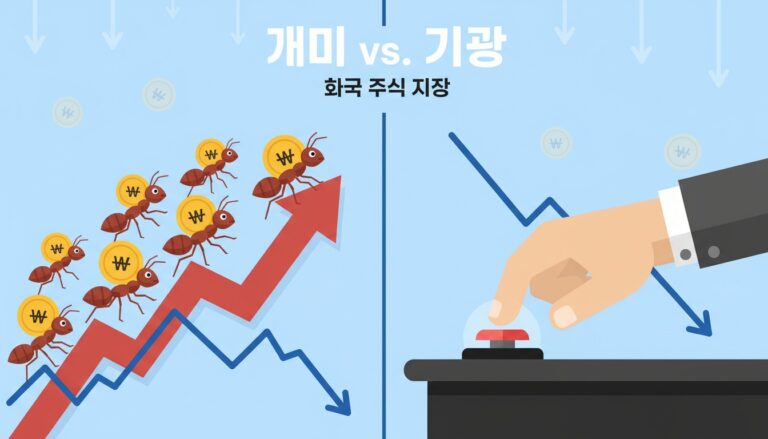
- K-Culture Moment: This idiom is ubiquitous in Korean editorials. It describes the structural inequality between “Gaemi” (Ants/Retail Investors) and “Seryeok” (Institutions/Foreigners). The ants feel they are running uphill while the institutions run downhill.
- Editor’s Insight: This is a powerful metaphor. Use this when you want to express empathy for the underdog in any situation, not just stocks.
- Situation Spectrum:
[🚫 Boss (if criticizing company)] ———— [⚠️ Colleagues] ———— [✅ Social Commentary]- Debating Social Issues: ✅
- 🤔 Think About It: Why does a sports metaphor resonate so strongly in a hyper-competitive society like Korea?
Phase 3: Textbook vs. Real Life
| Situation | 📖 Textbook Korean | 🗣️ Real Korean (Market Floor) | 💡 Why the difference? |
|---|---|---|---|
| Market Crash | 주가가 폭락했습니다. (Stock prices plummeted.) | 떡락했다. (Tteok-rak-haet-da.) | Tteok-rak combines ‘Rice cake’ (slump) + drop. Slang captures the visceral pain of loss. |
| Holding on | 주식을 계속 보유하겠습니다. (I will continue to hold the stock.) | 존버한다. (Jon-beo-han-da.) | Jon-beo (Damn hard enduring) is the crypto/stock mantra for HODL. Represents grit. |
| Retail Investors | 개인 투자자 (Individual Investors) | 개미 (Gaemi – Ants) / 동학개미 | Ants implies hard work but small power. Donghak refers to a historical peasant revolution. |
Note: As a C2 speaker, you should know Jon-beo, but use it only with close friends. In a formal debate, stick to “장기 보유” (Long-term holding).
Phase 4: Cultural Deep Dive
4-1. Non-verbal Communication: The “Red” Paradox
In the West, red means danger or loss (down). In Korea, RED means UP (profit/passion) and BLUE means DOWN (cold/death).
* The Glitch: If you see a Korean investor sighing at a screen full of blue numbers, do not say, “Oh, at least it’s cool colors!” They are losing money.
* Nunchi Tip: If the market is “blue” (falling), avoid asking your Korean colleagues “How is your portfolio?” during lunch.
4-2. The “Donghak Ant Movement” (동학개미운동)
This term emerged around 2020. It references the Donghak Peasant Revolution of 1894, where peasants rose up against foreign influence and corrupt officials.
* The Context: In the modern stock market, “Donghak Ants” are domestic retail investors fighting to protect the Korean market against foreign selling sprees (often fueled by short selling).
* Critical View: By framing investment as a “patriotic movement,” the media emotionalizes financial decisions. Is it really patriotism, or just a herd mentality seeking profit?
Phase 5: Immersive Roleplay
Setting: A quiet Izakaya in Gwanghwamun, post-work hours. You are with Min-su (35, a passionate retail investor who hates short selling) and Ji-eun (34, works at a securities firm, rational).
YOU: An expat working in finance, fluent in Korean.
(Dialogue)
Min-su: (Downing a shot of Soju)
아니, 솔직히 공매도는 폐지해야 돼. 기관이랑 외국인만 배 불리는 제도잖아. 완전 기울어진 운동장이라니까.
(Honestly, short selling should be abolished. It only fattens the institutions and foreigners. It’s a totally tilted playing field.)
Ji-eun: (Calmly grilling skewers)
민수 씨, 너무 감정적으로 보지 마세요. 공매도의 순기능도 무시할 수 없어요. 주가 거품을 빼주고 유동성을 공급하잖아요.
(Min-su, don’t look at it so emotionally. You can’t ignore the positive functions of short selling. It removes price bubbles and supplies liquidity.)
🔀 Your Turn! How do you intervene?
- Option A: “맞아요. 선진국 지수에 편입되려면 공매도는 필요악이죠.” (Agree with Ji-eun: Necessary evil for global standards.)
- Option B: “하지만 한국 시장은 불법 공매도 감시 시스템이 너무 약한 것 같아요.” (Validate Min-su: System is weak.)
- Option C: “야, 머리 아프다. 그냥 짠이나 하자!” (Avoidance: Let’s just drink.)
✅ Best Choice: Option B.
This shows high-level empathy and critical thinking. You acknowledge the theory (it exists) but critique the reality (system is weak). This is the most sophisticated C2 stance.
(Continuing with Option B)
YOU: 지은 씨 말도 맞지만… 저는 한국 시장의 불법 공매도 감시 시스템이 너무 약하다는 민수 씨 의견에도 동의해요. 신뢰가 먼저잖아요.
(Ji-eun is right, but… I also agree with Min-su that the monitoring system for illegal short selling is too weak. Trust comes first.)
Min-su: (Eyes lighting up)
거 봐! 역시 OOO 씨는 뭘 좀 아네!
(See! You really know what’s up!)
Phase 6: 10-Second Shadowing Drill
Drill: Arguing for the necessity of the system despite its flaws.
Sentence:
“공매도의 역기능이 걱정되긴 하지만, / 시장의 효율성을 위해서는 / 필요악이라고 생각합니다.”
(Although I am worried about the side effects of short selling, / for the sake of market efficiency / I think it is a necessary evil.)
Guide:
* Emotion: 😤 Rational & Professional (Serious nod)
* Pronunciation: Gong-mae-do-ui yeok-gi-neung-i / geok-jeong-dwe-gin ha-ji-man, / si-jang-ui hyo-yul-seong-eul wi-hae-seo-neun / pi-ryo-ak-i-ra-go saeng-gak-ham-ni-da.
* Key Pause: Pause after ‘hajiman’ to show you are weighing both sides.
Phase 7: K-Culture Mini Glossary
| Korean | Romanization | English | Context |
|---|---|---|---|
| 작전 세력 | Jak-jeon Se-ryeok | Market Manipulators | Literally “Operation Forces.” The villains in stock movies. |
| 물타기 | Mul-ta-gi | Averaging Down | Adding water to strong soup. Buying more as price drops to lower average cost. |
| 상투 잡다 | Sang-tu Jap-da | Buying at the top | Holding the “topknot” (hair). Buying at the absolute peak before a crash. |
| 성투 | Seong-tu | Successful Investment | Short for 성공 투자. Used as a greeting: “Have a Seong-tu!” |
Phase 8: Traveler’s & Expat’s Survival Kit
Since this is a specific finance unit, here is how to survive a Korean Bank or Brokerage Visit.
🆘 Survival Phrases
* 🇰🇷 “비거주자 외국인도 계좌 개설이 가능한가요?”
* (Bi-geo-ju-ja oe-guk-in-do gye-jwa gae-seol-i ga-neung-han-ga-yo?)
* Can a non-resident foreigner open an account?
* 🇰🇷 “수수료 우대 혜택이 있나요?”
* (Su-su-ryo u-dae hye-taek-i it-na-yo?)
* Are there any preferential benefits for fees? (Koreans always ask for discounts/benefits!)📌 Editor’s Pro Tip: The Certificate Nightmare
To trade stocks in Korea, you often need a “Public Certificate” (공동인증서). It is a notorious digital ID system. If the bank teller mentions this, take a deep breath. It requires patience and an ARC (Alien Registration Card).
Phase 9: Think Deeper — “Fairness”
Topic: The Obsession with ‘Fairness’ (공정)
In Korea, the rage against short selling isn’t just about money; it’s about Fairness (공정). Korean society is hyper-competitive, and people accept inequality if the rules are fair (meritocracy). However, short selling is perceived as a game where the elites (institutions) play by different rules than the commoners (ants).
🧠 Think Deeper:
Does your country have a financial mechanism that regular people hate? Is the stock market seen as a path to wealth or a gambling den in your culture? In Korea, for the younger generation, it is often seen as the only ladder left to climb.
Phase 10: FAQ & Troubleshooting
- Q: Can I use the word “Gongmaedo” with an older boss?
- A: Yes, it is a formal financial term. However, avoid expressing a strong political opinion about it unless you know their stance. It’s a divisive topic.
- Q: Is it okay to say I made money when the market crashed?
- A: NO. Even if you shorted the market and won, read the room (Nunchi). Many around you might have lost their savings. Humility is a virtue.
- ❌ Common Mistake: Confusing 매수 (Mae-su / Buy) and 매도 (Mae-do / Sell).
- Tip: Su (수) is receive (Hand IN). Do (도) is give away (Hand OUT).
Phase 11: Wrap-up & Action
One-Liner: “To debate the Korean market, you must balance the logic of ‘Efficiency’ with the emotion of the ‘Ants’.”
🏆 Action Missions:
* 🥉 Bronze: Practice saying “기울어진 운동장” (Tilted playing field) until it rolls off your tongue.
* 🥈 Silver: Go to Naver Finance (finance.naver.com) and find a news headline containing “공매도.” Try to read the comments (Warning: They will be angry).
* 🥇 Gold: Ask a Korean friend: “Do you think the stock market is fair?” (한국 주식 시장이 공정하다고 생각해요?) and listen to their rant.
Phase 12: Interactive Quiz
1. Situation Judgment:
Your friend looks depressed because his stocks dropped 30%. What is the WORST thing to say?
* A) “존버는 승리한다! 힘내!” (HODL wins! Cheer up!)
* B) “야, 너 물타기 해야 되는 거 아니야?” (Hey, shouldn’t you average down?)
* C) “역시 주식은 도박이야. 왜 했어?” (Stocks are gambling anyway. Why did you do it?)
Answer: C. This ignores their pain and judges them. A is supportive, B is practical (though risky), but C will end the friendship.
2. Vocabulary:
Fill in the blank: “Retail investors are often called
______ because they work hard but are small individually.”
Answer: 개미 (Ants)
Frequently Asked Questions (FAQ)
Q: What does "공매도 (Gongmaedo)" mean in Korean and how do you pronounce it?
A: In Korean, "공매도 (Gongmaedo)" is pronounced [Gong-mae-do] and means: Short Selling (Literal: Empty Selling / Selling what you don't have)
Q: What does "순기능 vs. 역기능 (Sun-gi-neung vs. Yeok-gi-neung)" mean in Korean and how do you pronounce it?
A: In Korean, "순기능 vs. 역기능 (Sun-gi-neung vs. Yeok-gi-neung)" is pronounced [Sun-gi-neung] and means: Positive Function (Pros) vs. Adverse Effect/Dysfunction (Cons)
Q: What does "기울어진 운동장 (Gi-ul-eo-jin un-dong-jang)" mean in Korean and how do you pronounce it?
A: In Korean, "기울어진 운동장 (Gi-ul-eo-jin un-dong-jang)" is pronounced [Gi-ul-eo-jin un-dong-jang] and means: A tilted playing field (Unfair competition)






