

Phase 1: The Immersive Hook
Greeting: 안녕하세요! This is your Daily Hangul Senior Editor.
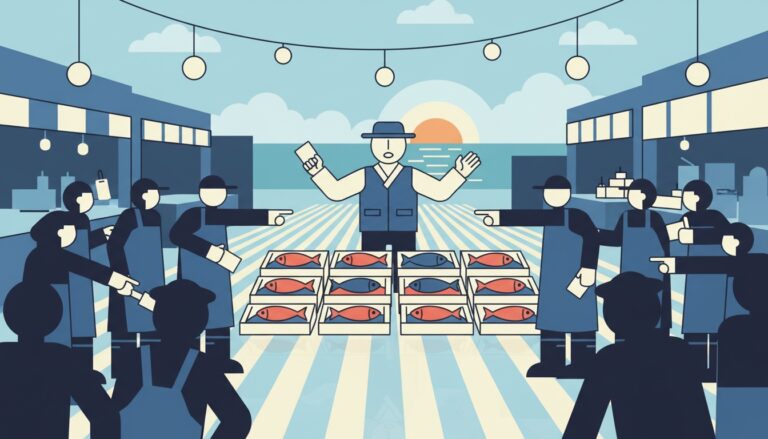
Imagine this: It’s 4:00 AM. The city of Seoul is asleep, but you are standing in the middle of a brightly lit, wet, and chaotic arena. Men in rubber boots are shouting incomprehensible syllables into microphones that sound like aggressive rap battles. Hand signals are flying faster than a K-Pop choreography.
You’ve just stepped into the Noryangjin Fisheries Wholesale Market auction.
In K-Dramas like Our Blues or Hometown Cha-Cha-Cha, the fish market is often portrayed as a place of raw vitality—where characters go to restart their lives or wash away their sorrows with a shot of Soju and sliced raw fish (Hoe). But as an advanced learner, you know the subtitles saying “Fresh fish for sale!” don’t capture the intensity of what’s actually being said.
Today, we aren’t just learning how to buy fish. We are decoding the energy of the Korean morning and learning the advanced vocabulary that defines this chaotic harmony. If you can understand the nuances here, you can handle any high-pressure business meeting in Seoul.
Phase 2: Deep Dive into Core Expressions
Since you are at a C1 level, we will skip “How much is this?” and focus on expressions that capture the essence and nuance of the market culture.
1. 시가 (Siga)
- Pronunciation: [Siga] + (Sounds like ‘See-ga’)
- Meaning: Market Price / Current Price
- K-Culture Moment: You walk into a high-end seafood restaurant. You look at the menu for ‘King Crab’. Instead of a number like ₩100,000, it ominously says ‘시가’. This is the moment your wallet starts trembling.
- Editor’s Insight: This word isn’t just about fish. It represents volatility. In Korea, the price of seafood, vegetables, and even gold fluctuates daily based on supply. Seeing ‘시가’ implies freshness, but also creates a psychological tension—you have to ask, and you might be shocked.
- Situation Spectrum:
[🚫 Casual Chat] ———— [⚠️ Shopping/Dining] ———— [✅ Business/Finance]- Note: Often used in news regarding real estate or stock prices too.
- 🤔 Think About It: Why do Koreans accept ‘Siga’ without complaint? It reflects a cultural trust in the ‘freshness’ of the current situation rather than a fixed, stale standard.
2. 물이 좋다 (Muri jota)
- Pronunciation: [Muri jota] + (Sounds like ‘Mool-ee jo-ta’)
- Meaning:
- Literal: The water is good.
- Real Nuance: The quality (of fish/goods/atmosphere) is excellent.
- K-Culture Moment:
- Market: An auctioneer points to a tank of vibrant mackerel. “오늘 물 좋은데?” (The water [quality of fish] is great today.)
- Nightlife: Your friend drags you to a club in Hongdae. “야, 여기 물 좋다!” (Hey, the crowd here is hot/attractive!)
- Editor’s Insight: This is a perfect C1 idiomatic expression. It originated from assessing the environment fish live in, but now metaphorically assesses the ‘quality’ of people or atmosphere in a venue.
- Situation Spectrum:
[🚫 Formal Presentation] ———— [⚠️ Elders] ———— [✅ Friends/Market] - 🤔 Think About It: Connecting ‘water’ to ‘quality of people’—what does this say about the importance of environment/atmosphere in Korean culture?
3. 활기 (Hwalgi)
- Pronunciation: [Hwalgi] + (Hwal-ghee)
- Meaning: Vitality, Vigor, Animation
- K-Culture Moment: Any travel show visiting a traditional market will use this word in the captions. “새벽 시장의 활기” (The vitality of the dawn market).
- Editor’s Insight: Unlike ‘Energy’ (enerji), Hwalgi has a nuance of life force and movement. It is the antidote to depression in Korean literature. It’s positive chaos.
- Situation Spectrum:
[🚫 Slang] ———— [⚠️ Casual] ———— [✅ Descriptive/Written]
Phase 3: Textbook vs. Real Life
| Situation | 📖 Textbook Korean | 🗣️ Real Korean (Market Vibe) | 💡 Why the difference? |
|---|---|---|---|
| Describing freshness | 생선이 아주 신선해요. (The fish is very fresh.) | 펄떡펄떡하네! (It’s jumping/pulsing!) | Koreans love onomatopoeia/mimetic words to emphasize vitality vividly. |
| Asking price | 가격이 얼마입니까? (What is the price?) | 오늘 시세 어때요? (How is the market rate today?) | ‘Sise’ (Rate) sounds more professional and knowledgeable than just ‘Price’. |
| Complimenting the boss | 사장님, 친절하시네요. (Boss, you are kind.) | 사장님, 인심 좋으시네! (Boss, your ‘heart/generosity’ is good!) | Insim (Human-heartedness) is the core virtue of traditional markets, not just ‘kindness’. |
Phase 4: Cultural Deep Dive
4-1. Non-verbal: The Auctioneer’s Hand
If you watch the auctioneers, their fingers move incredibly fast. These are Suji-hoga (수지호가)—hand signals for prices.
– Observation Tip: Don’t try to mimic this! It’s a secret language among wholesalers. If you wave your hand randomly during an auction, you might accidentally buy 100kg of squid. Keep your hands in your pockets!
4-2. K-Culture Connection: The ‘Hoe’ (Sashimi) Obsession
Unlike Japanese Sushi (often aged), Korean Hoe (회) focuses on texture (Jolgit-ham/Chewiness) and freshness.
– K-Drama Context: Notice how in dramas, they don’t just eat the fish; they wrap it in lettuce with garlic and spicy paste (Chojang). It’s a communal, loud experience, contrasting with the quiet artisan vibe of a sushi counter. The market auction is the prelude to this loud, communal feast.
Phase 5: Immersive Roleplay
Setting: 5:30 AM, Noryangjin Fish Market. The auction is wrapping up, and retail stalls are opening. The floor is wet, and the smell of the ocean is strong.
Characters:
– YOU: An expat living in Seoul, looking for the freshest fish for a dinner party.
– Ahjussi (NPC): A charismatic stall owner with a booming voice, wearing a rubber apron.
Dialogue:
Ahjussi: (Splashing water on the tank) 아이고, 어서 오세요! 오늘 물 좋습니다! 뭘로 드릴까?
(Aigo, eoseo oseyo! Oneul mul joseumnida! Mwollo deurilkka?)
(Welcome! The quality is amazing today! What can I get you?)
YOU: (Looking confident) 요즘 제철인 생선이 뭐예요? 방어는 끝났나요?
(Yojeum jecheorin saengseoni mwoyeyo? Bangeoneun kkeunnannayo?)
(What fish is in season right now? Is the Yellowtail season over?)
Ahjussi: 방어는 이제 끝물이지! 오늘은 도미가 시세가 아주 좋아. 펄떡펄떡한 놈으로 잡아 줄까?
(Bangeoneun ije kkeunmuriji! Oneureun domiga sisega aju joa. Peoltteok-peoltteokhan nomeuro jaba julkka?)
(Yellowtail is at the tail end! Today the Sea Bream market rate is great. Shall I catch a jumping [lively] one for you?)
🔀 Decision Point: How do you respond?
- A) “얼마예요? 깎아주세요!” (Basic: How much? Discount please!)
- B) “시가로 얼마 정도 해요? 서비스(덤) 좀 주시나요?” (Advanced: What’s the market price? Can you give some service/extras?)
- C) “비싸요. 안 살래요.” (Refusal: Too expensive. Bye.)
✅ Best Choice: B
– Reason: At a C1 level, asking for ‘Service’ (Dum) or ‘Maeuntang-geori’ (spicy soup ingredients) is more culturally attuned than just asking for a discount. It builds rapport (Jeong).
Phase 6: 10-Second Shadowing Drill
Let’s practice the rhythm. Emphasize the mimetic word to sound native.
Sentence: “Look at this! The fish is so fresh, it’s jumping around!”
😲 Emotion: Amazed & Energetic
Korean: 우와, 이거 보세요! / 생선이 아주 / 펄떡펄떡하네요!
Romanization: Uwa, igeo boseyo! / Saengseoni aju / peoltteok-peoltteok-haneyo!
Phase 7: K-Culture Mini Glossary
| Korean | Romanization | Meaning | Context |
|---|---|---|---|
| 초장 | Chojang | Vinegared Red Chili Paste | The soul of Korean sashmi. Koreans dip, Japanese dip in soy sauce. |
| 매운탕 | Maeuntang | Spicy Fish Stew | Usually made from the leftover bones/head after eating Sashimi. Essential finale. |
| 끝물 | Kkeunmul | End of Season | Metaphor for something going out of trend or losing freshness. |
| 흥정 | Heungjeong | Bargaining | The act of negotiating price vs. service. |
Phase 8: Traveler’s Survival Kit (Auction/Market Edition)
🆘 Survival Expression #1: asking for the “Going Rate”
– 🇰🇷 “오늘 (생선 이름) 시세가 어떻게 돼요?”
– (Oneul [Fish Name] sisega eotteoke dwaeyo?)
– Meaning: What is the going rate for [Fish Name] today?
– Why? Asking “How much” makes you look like a tourist. Asking “Sise” makes you look like a pro.📌 Editor’s Travel Note
– Wet Floors: Wear non-slip shoes. The floor is covered in seawater and fish blood.
– 2nd Floor Dining: In places like Noryangjin, you buy fish on the 1st floor and pay a ‘setting fee’ (sangcharim-bi) to eat it on the 2nd floor.
Phase 9: Think Deeper — “Freshness as Speed”
Topic: Why does Korean culture obsess over “Live” (Hwal-eo) fish?
In Western or Japanese culinary traditions, aging fish (relaxing the muscles) is considered a technique to enhance flavor. However, in Korea, the tank truck (driving live fish from the coast to Seoul) is a common sight.
This preference for Hwal-eo (Live Fish) mirrors the “Pali-pali” (Hurry-hurry) culture. It represents a distrust of the ‘time in between’. Historically, without refrigeration, only ‘alive’ meant ‘safe’. Today, it has evolved into a cultural preference for the chewy texture of immediate slaughter over the soft umami of aged meat.
💬 Your Turn: Does your culture prefer food that is “fresh off the farm/boat” or food that has been processed/aged for flavor?
Phase 10: FAQ & Troubleshooting
Q: Can I actually buy fish during the auction?
A: No. The auction is for wholesalers (middlemen) with licenses. As a visitor, you are a spectator. You buy from the retail stalls after the auction. Don’t try to bid!
Q: Is it rude to stare at the auctioneers?
A: Not rude, but keep a safe distance. They are working at high speed with heavy carts moving around. If you block the way, you will hear some very authentic Korean slang (swear words).
❌ Common Mistake: Asking for “Sushi” at a traditional market stall.
✅ Fix: Ask for “Hoe” (Sashimi). If you want rice, you usually order it separately or go to a specific sushi restaurant. Market stalls specialize in slicing the fish only.
Phase 11: Wrap-up & Action Items
Summary: Today we learned that the fish market is a battlefield of vitality (Hwalgi), where prices (Siga) fluctuate, and the quality (Mul) dictates the flow.
Action Missions:
– 🥉 Bronze: Say “오늘 물 좋은데?” while looking at your groceries (or even your reflection!).
– 🥈 Silver: Watch a scene from the drama Our Blues featuring the market and try to spot the ‘auction hand signals’.
– 🥇 Gold: Go to a local market (or fish section) and ask, “What is in season (Jecheol) these days?” in Korean.
Phase 12: Quiz — Interactive Challenge
1. Situational Judgment:
You are at a business dinner. Your boss asks, “How is the project team doing these days?”
You want to say the atmosphere is great and energetic. Which word from today fits best metaphorically?
- A) 시가 (Siga)
- B) 활기 (Hwalgi)
- C) 끝물 (Kkeunmul)
2. True or False:
“Asking ‘Siga’ (Market Price) means the price is cheap and fixed.”
(True / False)
🔑 Answers:
1. B) 활기 (Hwalgi). It means vitality/vigor. (A is market price, C is end of season/washed up).
2. False. Siga means the price fluctuates and is currently unset on the menu—usually expensive!
Frequently Asked Questions (FAQ)
Q: What does "시가 (Siga)" mean in Korean and how do you pronounce it?
A: In Korean, "시가 (Siga)" is pronounced [Siga] and means: Market Price / Current Price
Q: What does "물이 좋다 (Muri jota)" mean in Korean and how do you pronounce it?
A: In Korean, "물이 좋다 (Muri jota)" is pronounced [Muri jota] and means: Literal: The water is good.
Q: What does "활기 (Hwalgi)" mean in Korean and how do you pronounce it?
A: In Korean, "활기 (Hwalgi)" is pronounced [Hwalgi] and means: Vitality, Vigor, Animation







